One Western leader who has made a point of listening to the concerns of the Christians of the Muslim world is Venice's Cardinal Angelo Scola, host of the two-day encounter at the 17th century Basilica di Santa Maria della Salute. Scola is rapidly becoming Catholicism's most influential voice — beyond the Pope himself — on matters related to the Muslim world. From Venice, which for centuries has served as a bridge betweeen civilizations, the Cardinal founded Oasis, a cultural and study center and twice-annual journal that gathers perspectives from Catholics in Muslim countries. The initiative is both as a way to safeguard the rights of Christian minorities, and to promote mutual understanding between the Church and Islam.
"We gain knowledge about the different forms of Islam by starting with what the Christians living in these various realities suggest to us," Scola said. In the past, many in the Vatican hierarchy believed it was too risky to raise the issues of religious liberty and violence in Islamic countries. "Sometimes we have been too timid," Scola said. "We can't stay quiet. We want the encounter. It is vital to distinguish fundamentalism not just from the so-called 'moderate' Muslims, which can be an ambiguous term, but from the masses in the Islamic world."
Read more …
Sunday, June 24, 2007
Catholics Ponder Muslim Coexistence
In beautiful Venice, Catholics gathered to discuss this timely and vital issue.


Saturday, June 23, 2007
Nativity of St. John the Baptist - Abu Gosh
 Saint Anne with the Christ Child, the Virgin, and Saint John the Baptist
Hans Baldung Grien - 1511
On this Solemnity of the Nativity of Saint John the Baptist (the Church only celebrates three births on her liturgical calendar -- guess the other two), I want to make mention of an interesting place if you ever make your way to the Holy Land on pilgrimage. It is a place that (a) may be the historical site of Emmaus, (b) is the site of a magnificent Crusader church similar to that of St. Ann's Church in Jerusalem, and (c) bears the name, alternatively, of St. John the Baptist and the Church of the Resurrection, commemorating the birth of the former and the post-resurrection appearance of Our Lord at Emmaus of the latter. The frescoes in the nave were being restored when I visited in 2001. Also, a chamber music festival takes place there utilizing its magnificent acoustics each year.
This Crusader church at Abu Gosh, Israel also bears the dubious honor of being the setting for a climactic scene in The Dionysus Mandate. Here is a brief excerpt:
He backed Aly down the steps to the grotto holding her arm in one hand and the pistol in the other. Aly recognized the mistake Neesam was making in the darkness as he walked them closer and closer to the edge of the deep, spring-fed baptism pool. She did nothing to warn Neesam or slow their progress. They stepped off and splashed simultaneously into the baptismal’s shockingly cold waters.
Aly had a split second to gulp a deep breath before going under. She felt herself going down in the dark waters with her hands tightly bound in the small of her back. Neesam disappeared. She thought, He’s up and back to the surface already. I can’t swim and I can’t breathe. And I can’t get my hands free.
But Lucent Neesam, though a naturally gifted swimmer, at that moment found himself slowly yet inexorably moved under an ancient stone archway once stood upon by chaplains to the Crusaders. His head struck solid rock when he tried to surface making him wince. All right, son of a buggering b**ch, he told himself. Let’s get out of this infernal puddle. He twisted, sweeping a hand through the further reaches of the baptismal pool. His lungs burned, and he lurched in the direction, he thought, of the opening beyond the massive walls of the Crusader church ...
+ + +
May the good saint forgive any exploitation the author of The Dionysus Mandate may have perpetrated by using the church commemorating his birthplace. Did Neesam and/or Aly get out of the baptismal pool's dark and dangerous waters? Ah, well ...
Waterhouse - PRB
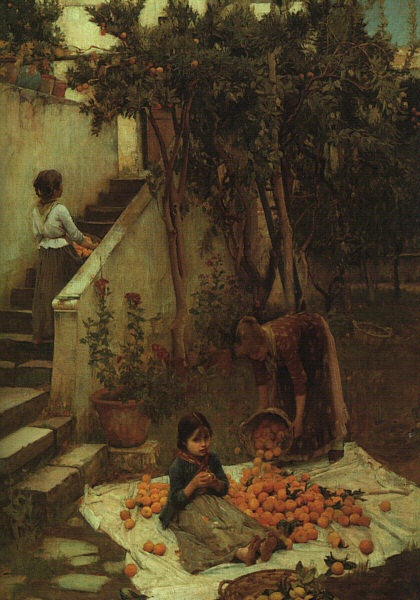 The Orange Gatherers - 1890 [Private Collection]
In 1874, at the age of twenty-five, Waterhouse submitted the classical allegory Sleep and His Half-Brother Death to the Royal Academy's Summer Exhibition. The painting was very well received and he exhibited at the RA almost every year afterwards until his death in 1917. In 1883 he married Esther Kenworthy, the daughter of an art schoolmaster from Ealing who had exhibited her own flower-paintings at the Royal Academy and elsewhere. They had two children, but both died in childhood.
In 1895 Waterhouse was elected to the status of full Academician. He taught at the St. John's Wood Art School, joined the St John's Wood Arts Club, and served on the Royal Academy Council.
One of Waterhouse's most famous paintings is The Lady of Shalott, a study of Elaine of Astolat, who dies of grief when Lancelot will not love her. He actually painted three different versions of this character, in 1888, 1896, and 1916.
Another of Waterhouse's favorite subjects was Ophelia; the most famous of his paintings of Ophelia depicts her just before her death, putting flowers in her hair as she sits on a tree branch leaning over a lake. Like The Lady of Shalott and other Waterhouse paintings, it deals with a woman dying in or near water. He also may have been inspired by paintings of Ophelia by Dante Gabriel Rossetti and Millais. He submitted his Ophelia painting of 1888 in order to receive his diploma from the Royal Academy. (He had originally wanted to submit a painting titled "A Mermaid", but it was not completed in time.) After this, the painting was lost until the 20th century, and is now displayed in the collection of Lord Lloyd-Webber. Waterhouse would paint Ophelia again in 1894 and 1909 or 1910, and planned another painting in the series, called "Ophelia in the Churchyard."
Waterhouse could not finish the series of Ophelia paintings because he was gravely ill with cancer by 1915. He died two years later, and his grave can be found at Kensal Green Cemetery in London. -- Wikipedia
Friday, June 22, 2007
Death & Politics
by Joseph Bottum
[snip] These topics of violence and death in the Bible play a major role in the writings of René Girard, and it is hardly possible to consider questions of death and the origin of culture without mentioning Girard’s fascinating work on the ancient mythology of sacrifice and scapegoats.
In a biographical interview he gave in 1995, Girard declared that all the themes he has developed over the last four decades were present in his mind even in the late 1950s as a “dense intuition,” a “block” to be penetrated little by little. His publications began to appear in the early 1960s with widely acclaimed expositions of the way triangular relations form among characters in novels, particularly Dostoevsky’s. He then moved to anthropology, holding that ancient cultures are based on sacrificial violence against a scapegoat.
The connection came with his increasing study of psychology and his argument that desire is “mimetic”—that we learn what it is we want by watching what others want. The simplest examples involve the innumerable ancient stories, from Egypt down to Rome, that speak of siblings, often twins, one of whom is destroyed in the course of founding a new city. Girard insists we read these myths as recording genuine human murders: In the mad swirl of mimetic violence, each revenge in turn revenged, the nascent city threatens to devour itself. But with the choice of a scapegoat to sacrifice, the cycle can be broken with an unconscious agreement to aim all the culture’s vengeance at a single target.
Some of Girard’s followers seem to envision a precultural state of primal violence, opening Girard’s thought to the complaint that what little we know of ancient history offers no evidence that cities were actually born in riot and mayhem. To interpret sacrificial myths, however, we need not posit an original fury. We need notice only that every ancient culture manifests in its myths a deep terror of the mimetic escalation of violence. In response to this threatened violence of all against all, the old foundational myths pose the solution of another violence: the violence of all against one, the violence in which a victim is selected as the source of the cultural breakdown and sacrificed. The sacrificial victim, Girard writes, “unwittingly conjures up a baleful, infectious force that his own death—or triumph—transforms into a guarantee of order and tranquility.”
Girard’s final turn, to explicit Christian theology, allowed him to unveil the solution: At the center of his thought lies the Cross, the Sacrifice that breaks the cycle of sacrifice, violence, and mimetic murder. For Girard, the problem of forming a culture—of preventing and containing the spiraling disaster of internecine murder and cultural collapse—is like a quadratic equation with two solutions: the negative one of sacrificial mythology and the positive one of nonviolence, made visible by biblical revelation. Christ’s sacrifice breaks open the scapegoat mechanism for all to see the murder that lies at its root.
Girard is surely right that modern political theory has systematically underestimated the social power of revenge: At the root of ancient culture, he notes, there was a burial society—although it usually had to commit murder in order to get the body to bury. Along the way, Girard grants real insight into both how the ancients used sacrifice and why Counter-Enlightenment thinkers embrace death as they strain for some new foundation. Through the old cultural mechanism of murder, violence really can drive out violence—Satan can drive out Satan, to use Girard’s expression—by aiming the escalating aggression of a culture at a single enemy and victim, a scapegoat for all that ails it.
The trouble is that Girard seems to lack much political theory—or, at least, much political theory short of Isaiah’s. “It shall come to pass in the last days” that “all nations shall flow unto” the holy city, but eschatology is a bad guide to ordinary politics. Indeed, in Girard’s reading of history, the Judeo-Christian revelation has increased or even created our modern political problems, for the scapegoat myth—the negative solution to the problem of culture—ceases to work particularly well once we understand how it works.
If the ancient mechanism has begun to fail, as Girard insists, replaced by a new mechanism that will work only in the End Time, then what help is there for us now? Girardianism pushes us to conclude that modern culture, in its essence, has become irretrievably thin and self-contradictory, while the modern state has grown fundamentally ungovernable. Surely the scapegoat mechanism proves too much: With Girard’s psychological explanation of mimetic rivalry for the success of death at forming community, we are left with murder and apocalyptic change as our only alternatives—the quadratic equation with only two solutions.
A more ordinary use of death seems necessary to get us by, enriching everyday life with temporal extension. We need, I suggest, a new theory of the cultural power of grief for the between-time in which we live. We need an intermediate—and properly political—understanding of the debt the living owe the dead.
Read the article/essay here.Thursday, June 21, 2007
They Really Were Out to Get Us...
Self-described ex-KGB operative and defector, Yuri Bezmenov, lays out in this interview the active propaganda measures which the KGB undertook to demoralize the US during the Cold War. NB: This is not a paranoid flag-waving post. Rather a warning in an age of disinformation. Don't get caught in themes; watch the anthropological structures. For more information read from: "Mimetic Theory & Rene Girard" in our sidebar.
Summer Thoughts
 Predella - (1879) - Dante Gabriel Rossetti
It's a great concept, and I don't like to throw cold water on recollections of Bill Murray writhing in all his purgatorial splendor. So, consider this reflection not a squelching of Yousefzade's post, by any means, but instead a commentary on how mimetic theory sees Nietzsche's "eternal return."
In his choosing Dionysus over Christ, Nietzsche was rightly seeing the only alternatives, but he was choosing the way that Girard called "the primitive sacred."
The eternal return is the way that violence "makes gods" and establishes (at least) three elements necessary for culture formation: myth, ritual, and prohibition. After the founding violence during which a victim is arbitrarily chosen and cast out or murdered, myth develops, making the now unified people feel good about their actions of violence. Ritual too accrues vital importance, re-enacting the founding violence so as to "bind back" (religare) the people to what made them unified. This accounts for the universal presence of a sacrificial altar at the heart of every culture. And, finally, prohibitions keep people from falling into behaviors that threaten to destroy culture (murder, adultery, incest, etc.) before ressentiment can be siphoned off in the sanctioned, ritualized, cathartic events of sacrifice.
The "eternal return" takes place in Girard's understanding when the ritual no longer carries sufficient cathartic effect to cohere the culture. It spirals into a sacrificial event (the prologue called "sacrificial preparation") during which prohibitions, distinctions, and taboos are erased, and cultural "meltdown", as it were, occurs.
Disregarding the themes that bombard us in newspapers, internet news reports, blogs, and websites, many see western civilization in the throes, structurally, of just such a stage of the "eternal return."
Personally, I don't think Groundhog Day symbolizes Nietzsche's "eternal return" at all. But go rent it and enjoy -- the cool, snowy scenes may make summer more bearable!
Wednesday, June 20, 2007
Master Catechist - Pope B16 on St. Athanasius
 All too often we seem to blog away about choosing sides; like Christianity v. Islam or conservative v. liberal or atheist v. religious or corporate life v. farming (and on and on as we can't seem to define the "I" of each of us any other way except by the 'us v. them' scenario) and the sad reality is that very few of us in the pews this Sunday will have actually taken the time to study from any of the great catechists for the sole purpose of drawing ever nearer to God. I think that Amy Welborn has a great challenge for all of us, Catholic or otherwise, and that is to develop or get into a study using the soon to be available Apostles and her study guide coming out through OSV.
This is not to say that it isn't interesting to learn about the 'other side', however if called upon to defend the Church and The Word, just how much are you up on it to do that? It is one thing to know the 'other side' but it is another thing to have experienced the encounter of Christ and having your "I" expanded so to meet the 'other' and be on firm ground. Having just come from a Jeff Cavin and Tim Gray workshop on Acts of the Apostles (I'm that one toward the back right side next to the aisle) there is more and more options (meaning less and less excuses not) to get immersed in The Word. Are you up to doing that in a manner causing the least amount of scandal? When we model after the great catechists, who have drawn all their faith, hope, knowledge and love from the Living Word, rarely is one scandalized for the Truth sets one free. Read about St. Athanasius and St. Anthony and allow them to help you draw nearer to God.
From "ATHANASIUS: PASSIONATE THEOLOGIAN OF THE INCARNATE WORD" at Vatican Information Service reporting on Pope Benedict XVI's catechises this morning.
This saint's most famous work "is his treatise 'On the Incantation of the Word'," in which he affirms that the Word of God "was made man that we might be made God; and He manifested Himself by a body that we might receive the idea of the unseen Father; and He endured the insolence of men that we might inherit immortality."Here is a link to "Life of St. Anthony" by St. Athanasius that Pope Benedict XVI refers to in his catechises this morning.
Athanasius is also the author of meditations upon the Psalms and, above all, of one of the most popular works of ancient Christian literature, "the 'Life of St. Anthony,' the biography of St. Anthony Abbot which ... made a great contribution to the spread of monasticism in East and West."
The life of Athanasius, like that of St. Anthony, the Pope concluded, "shows us that 'those who draw near to God do not withdraw from men, but rather become truly close to them'."
Tip of the hat to Michael @ Annunciation
Prager's Alley & Don't-Get-It Atheists
 Dennis Prager confronted Christopher Hitchens with an hypothetical situation. Hitch cited Prager's question in his book, God Is Not Great: How Religion Poisons Everything, and even Richard Dawkins mentioned it. However, Prager now says Hitch mis-remembers the question, the context, and just about everything that he, Prager, was driving at. Decide for yourself -- Prager:
A question I pose to atheists and others who argue that religion is irrelevant to moral behavior has been cited by Christopher Hitchens in his national best-seller, "God Is Not Great: How Religion Poisons Everything." And Hitchens's citation has been widely quoted – from the New Yorker to the website of the Oxford evolutionist and best-selling atheist author Richard Dawkins.
Tuesday, June 19, 2007
A Must Read - On the Impact of Christianity
Fjordman (on a par with Mark Steyn, in my book) takes on enemies of Christianity, although admittedly not a Christian himself:
Keep reading …
Quite a few individuals among the anti-Western crowd hate Christianity passionately. You have to be an imbecile to believe that Christianity and Islam are “almost identical,” meaning “just as bad.” There’s a world of difference between the religious founders and their followers. Yes, it’s true that the Church has at times suppressed dissenters, including scientists. This is common knowledge. But to present Christianity as exclusively anti-science is factually wrong.
Dads - In Body and Truth
An area of occasional concern for the 3Ms is what fatherhood should look like for Christian men. Gerald Augustinus over at The Cafeteria Is Closed posted featuring an article from Slate entitled, ”Stretch Marks for Fathers.” Research is now showing that as their spouse's pregnancy develops, and even after birth, they too undergo some fairly significant physical changes. This is a hopeful development in underscoring the essential rôle of fathers today.
Both areas -- the new-found physiological changes in fathers' bodies and the abandoning of families by fathers -- are areas for profound prayer, accountability, and responsibility. Dads are not perfect. But nature can be profoundly changed, and even perfected, by the grace of God. (Neither of my sons would claim that of their father, I assure you.) And the place to begin is and ever will be the sacramental locus of God's grace, the Catholic Church.
Interest in how men's bodies prepare themselves for fatherhood only seems to matter to the extent it sheds light on mothers. Meanwhile, the ways in which dads screw up their kids is a thriving area of research.Meanwhile, in today's Washington Post, Eugene Robinson's op/ed piece, ”A Father’s Absence and a Son’s Message,” addresses the "dire" situation caused by absent fathers.
Both areas -- the new-found physiological changes in fathers' bodies and the abandoning of families by fathers -- are areas for profound prayer, accountability, and responsibility. Dads are not perfect. But nature can be profoundly changed, and even perfected, by the grace of God. (Neither of my sons would claim that of their father, I assure you.) And the place to begin is and ever will be the sacramental locus of God's grace, the Catholic Church.
Monday, June 18, 2007
Denouncing the Culture of Death
'The secretary of the organization Pro-Life Youth of Valencia (Spain), Juan Rivera, denounced the State and society for their “de facto protection of abortion,” saying, “Its hypocrisy to speak about human rights and at the same time pay no attention to those who walk down the street with their hands stained with blood.” '
This sounds like remarkable wisdom from one so young.
This sounds like remarkable wisdom from one so young.
Pope Benedict XVI in Assisi - 800th Anniversary of the Conversion of St. Francis
 Benedict XVI delivers a great message to 25,ooo youth gathered in Assisi yesterday.
Pope to youth: be, like Francis, in love with Christ and history’s protagonists
Dear young people, you have reminded me of some of the pressing issues for youth today, of your difficulties in building a future for yourselves and above all of your strained efforts to discover the truth.
 In the account of Christ’s passion we find Pilates question: “What is the truth?” (Jn 18,38). It is a question which resounds widely throughout modern day culture. The Gospel indicates Christ as the truth: God’s truth and man’s truth. We risk spending our entire lives deafened by the chaos of empty voices, we risk losing his voice among the din, the only voice which counts because it is the only voice which saves. We content ourselves with fragments of the truth, we allow ourselves to be seduced by truths that are only such in appearance. Is it really a wonder, then, that we find ourselves surrounded by a world of contradictions, which, despite the many marvellous things, so often deludes us with its banal expressions, its injustices, and its violence?
  Without God, the world looses its basis and its direction. Do not be afraid my dear friends, to imitate Francis above all in the ability to turn to yourselves. He knew how to make room for silence within himself, to listen to God’s Word. Step by step he allowed himself to be taken by the hand and guided by God towards a full encounter with Christ, to the point of making it the precious treasure and light of his life. Link to the article.
To read a second of Benedict XVI's message; On Peace, a Call From Assisi link here.
 And for more photos of what Assisi looked like on June 17, 2007 link here.
Girard, Gans & Imitation in Children
Antioch Closes
The small, liberal arts college famed for establishing policy governing methodology of sexual activity ("May I unbutton your blouse?" "May I touch your br**st?") is closing. Sad, are we?
Antioch College became a rump where the most illiberal trends in education became entrenched. Since it is always easier to impose a conformist ethos on a small group than a large one, as the student body dwindled, free expression and freedom of thought were crushed under the weight of ultraliberal orthodoxy. By the 1990s the breadth of challenging ideas a student might encounter at Antioch had narrowed, and the college became a place not for education, but for indoctrination. Everyone was on the same page, a little to the left of The Nation in worldview.And so, R.I.P. Antioch College. Nah.
Sunday, June 17, 2007
Solitary Refinement
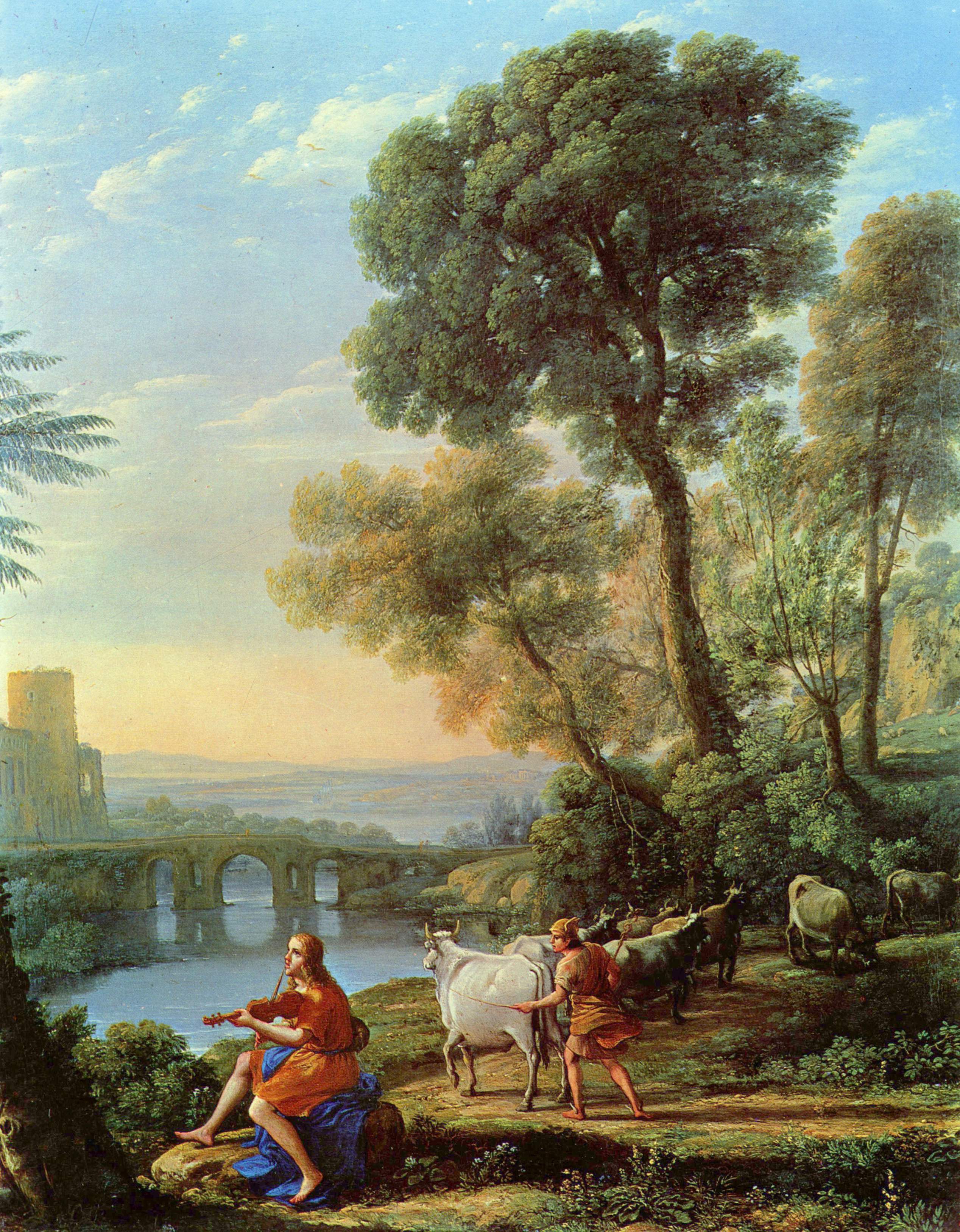 Landscape with Apollo and Mercury (1645) - Claude Lorrain
The Bane of Western Man
But, Hey - At Least I'm First! Aren't I the Winner?
Regarding Western Man's compulsion to be "first" at any and everything:The Canadian writer Naomi Klein believes that the terror attacks of September 11th 2001 were caused by Western racism. On the contrary, they were triggered by excessive anti-racism. If you believe the story of Michael Tuoheya, a former U.S. Airways ticket agent, he checked in terrorist leader Muhammad Atta for a flight that day. According to Tuoheya, “I said to myself, ‘If this guy doesn’t look like an Arab terrorist, then nothing does.’ Then I gave myself a mental slap, because in this day and age, it’s not nice to say things like this.” Atta joined three other hijackers and crashed into one of the World Trade Center’s towers in New York City.Modern Westerners are increasingly unwilling to risk our lives for anything, but we are willing to die for anti-discrimination any day. Anti-racism is the new God, an angry God requiring your unquestioned submission and if necessary death — a bit like Allah, incidentally.
The Western man was the first to create parliamentary democracy, the first to reach the North and the South Pole and the first to travel to the Moon. He always likes to go where no man has gone before him. The sad thing is that there is now so little unchartered territory, so few boundaries left to breach. What to do? Well, embracing organized national suicide is something no man has ever done before, presumably for very good reasons. The Western Man smells an opportunity to once again lead mankind into unchartered territory, and boldly seizes it. He may not be sensible, but at least he’s first, and to the Western Man, that is what matters above all else.
It is possible to view the history of the West as one of freeing oneself from the constraints of the past, and of granting equality to ever-expanding circles of people, starting with universal suffrage for men, later for women, then equality for all ethnic, religious and sexual subgroups and eventually even for non-citizens and enemies. The West has led the world in innovation for centuries. Yet perhaps this disposition, which has been the Western Man’s greatest strength, can also be his curse. Perhaps he sometimes breaks down restraints that are needed, and insists on equality where no equality naturally exists. His self-image has been to question tradition on every level, to always move forward. The Western Man has freed himself from the restraints of his traditions, his religion, his culture and the memories of his past. More recently, he has also rid himself off his sex, his skin color, his very physical being. He is, in essence, nothing, and is thus constrained by nothing. The Western Man is thus free at least.
In a letter to son Michael he said,
This is a fallen world ... The world has been 'going to the bad' all down the ages. The various social forms shift, and each new mode has its special dangers; but the 'hard spirit of concupiescence' has walked down every street, and sat leering in every house, since Adam fell ... I put before you the one great thing to love on earth: the Blessed Sacrament ..... There you will find romance, glory, honour, fidelity, and the true way of all your loves upon earth, and more than that: Death: by the divine paradox, that which ends life, and demands the surrender of all, and yet by the taste (or foretaste) of which alone can what you seek in your earthly relationships (love, faithfulness, joy) be maintained, or take on that complexion of reality, of eternal endurance, which every man's heart desires. [6-8 March 1941]
Woody Allen Interviews Billy Graham
In honor of the passing of Ruth Graham. These clips (H/T Instapundit several months ago) from a more civil era!
Part 1
Part 2
Part 1
Part 2
Saturday, June 16, 2007
GKC - Truer Today than When He Said It
G. K. Chesterton connects the dots concerning Sex, Life, and Property.
Dreadnought Redux
John Heard - aka Dreadnought - is, as Porthos repeatedly tells us, one of the most forthright crusaders for the Church's teachings on human sexuality. In a post on an article from Commonweal here (warning: some disturbing "eye candy"), he decries the succumbing of so many who want to subvert the Church's teachings to mere human predilections and whims (read: Gnostic desires and disordered passions):
(This is nothing except) a telling example of what Catholicism would look like if it were a bastard religion that worshipped a new god known (or more likely unknown) most often via personal experience. In short, it is the same Christianity-lite and near neo-Pagansim we've been fed by sixties-era liberals for decades.This from a self-avowed homosexual ("gay conservative") who deems John Paul II the Great's Theology of the Body the "summa" of the 21st century. You go, Dreadnought.
Friday, June 15, 2007
"Girl on a Rock" (+ Truth & Goodness)
 Maxfield Parrish - (1870 - 1966)
And, while you are looking at beauty, read Father Cantalamessa's homily on Conversion and the Pearl of Great Price.
Crisis of Distinctions
Over at Vox Nova, Katerina Marie posted news about the Hamas/Fatah fighting happening in Gaza. The comments contain the usual "news analysis" one comes to expect from the respective liberal / conservative arenas: it's the Bush/Cheney Regime's fault; no, it's the UN's ... Sigh.
None of this addresses the problem at the "tectonic level," if you will. For this, one must turn to the unique revelatory witness of the canonical New Testament for the deepest anthropological underpinnings of human culture, human interactions, human violence. And, in the service of the Magisterium of the Church, no one has explicated the ramifications of biblical understanding in anthropological terms better than René Girard. If you don't know a thing about Girard or are convinced that your mentor/interpreter of human life is much better than Girard, c'est la vie.
This blog is not an apologetic, but a forum for "Squaring the Circle of Our Rad Trad Catholic Girardian Conserberalism." So, in the words of Father Goose, if you don't happen to like (us), pass (us) by.
Hamas and Fatah, structurally, are rivals. To the observer, one would have a difficult time discerning many differences in them. Both lay claim to leadership via authority from the people and, more importantly, from Allah. Both see Israel an abomination to Islam. Both strive to observe Shariah, with subtle and slight differences that are hardly noticeable. And that is the issue: a crisis of distinctions. That which causes conflict is not difference but similarity. As Girard notes:
Rather, the natural and fallen human religion is bloodthirsty, violent, and sacrificial -- other, not self-. The anthropology of the Bible knows this. The deposit of the faith safeguarded and dilegently taught by Mother Church knows this. Modern westerners have forgotten or rejected this, and those not under the influence of Christ's teaching never knew this.
The "crisis of distinctions" in Girard's stunningly accurate analysis is the world we now live in. How we shall address this crisis when it draws near to us is the task given us to perform.
None of this addresses the problem at the "tectonic level," if you will. For this, one must turn to the unique revelatory witness of the canonical New Testament for the deepest anthropological underpinnings of human culture, human interactions, human violence. And, in the service of the Magisterium of the Church, no one has explicated the ramifications of biblical understanding in anthropological terms better than René Girard. If you don't know a thing about Girard or are convinced that your mentor/interpreter of human life is much better than Girard, c'est la vie.
This blog is not an apologetic, but a forum for "Squaring the Circle of Our Rad Trad Catholic Girardian Conserberalism." So, in the words of Father Goose, if you don't happen to like (us), pass (us) by.
Hamas and Fatah, structurally, are rivals. To the observer, one would have a difficult time discerning many differences in them. Both lay claim to leadership via authority from the people and, more importantly, from Allah. Both see Israel an abomination to Islam. Both strive to observe Shariah, with subtle and slight differences that are hardly noticeable. And that is the issue: a crisis of distinctions. That which causes conflict is not difference but similarity. As Girard notes:
Sometimes the cause is internal -- political disturbances, for example, or religious conflicts. Fortunately, we do not have to determine the actual cause. No matter what circumstances trigger great collective persecutions, the experience of those who live through them is the same. The strongest impression is without question an extreme loss of social order evidenced by the disappearance of the rules and "differences" that define cultural divisions. Descriptions of these events are all alike ... We should not be surprised since all the sources speak endlessly of the absence of difference, the lack of cultural differentiation, and the confusion that results. For example the Portuguese monk Fco de Santa Maria writes in 1697:What terrifies the onlooker is that one worries with a not-insignificant fear that what is happening in Gaza (or Sarajevo not so many years ago) may happen in Paris, in Madrid, in New York, or Dearborn before long. What happens when ad-hoc "priests" (aka "street youth") light very dry tinder near me? Thus, Girard lays open the anxieties of the post-modern western person who is beginning to realize with Girard that the inchoate fall-back religion of the human race is not a sweeping, Rousseau-esque "Co-Exist" naïveté of so many New Age bumper-stickers, nor is it the Golden Rule (that is a hard-fought value as every Christian parent knows).
As soon as this violent and tempestuous spark is lit in a kingdom or a republic, magistrates are bewildered, people are terrified, the government is thrown into disarray. Laws are no longer obeyed; business comes to a halt; families lose coherence ... Those who were burying others yesterday are themselves buried today ... No pity is shown to friends since every sign of pity is dangerous.
Rather, the natural and fallen human religion is bloodthirsty, violent, and sacrificial -- other, not self-. The anthropology of the Bible knows this. The deposit of the faith safeguarded and dilegently taught by Mother Church knows this. Modern westerners have forgotten or rejected this, and those not under the influence of Christ's teaching never knew this.
The "crisis of distinctions" in Girard's stunningly accurate analysis is the world we now live in. How we shall address this crisis when it draws near to us is the task given us to perform.
Wednesday, June 13, 2007
Whacked - Lives 18 Months
This reads like something I vaguely remember from the Desert Fathers. Or was it Washington Irving?
[HT: Shea]
[HT: Shea]
I once was lost, but now am found - Feast Day of St. Anthony of Padua

These words from John Newton seem to reflect a devotion similar to what many might pray to St. Anthony. We know Anthony as the saint to pray for lost items, yet he was gifted in many areas of life. It was by chance that Anthony was asked to preach for the friars at an ordination and it was then that they discovered one of his great gifts, that of preaching the Good News. Francis soon wrote to Anthony:
I Brother Francis send wishes of health to Brother Anthony, my bishop. It pleases me that you teach sacred theology to the brothers, as long as in the words of the Rule you "do not extinguish the Spirit of prayer and devotion" with study of this kind.“(N)ot to extinguish the Spirit of prayer and devotion with study”…within this admonishment comes the view that in everything we teach we present it fully in the Spirit of prayer and devotion. Boy, how we have lost that in our schools, universities and, I am afraid, in many of our families. Let us lift up our prayers to St. Anthony today asking for help to see and speak everything through the Spirit of prayer and devotion.
Guys check out the basilica of St. Anthony. Click here to see more on St. Anthony
Narnia in the Meantime
A visitor @ Mark Shea's blog lifted up an apparent Catholic Narnia Fan Website (not that one needs be Catholic to love the land of us Puddleglum types).
Village Atheists
There are several prominent authors presently promulgating books regarding what they consider to be the idiocy of believing in God. Since it is a time-honored practice to consider one's opponent as a valuable voice in the low tavern of life, the Three Massketeers choose not to dismiss their wrong-headed opinions out of hand, much the way Professor Ransom considered MacPhee an invaluable member of the group gathered at St.-Anne's-on-the-Hill in Lewis's That Hideous Strength. (Yes, yes, modeled on Lewis's tutor who taught him syllogistic thinking: "I have no opinions!")
As resources, Michael Liccione suggests the follow ways for ”Dealing with Dawkins.”
[Tip: Amy Welborn]
As resources, Michael Liccione suggests the follow ways for ”Dealing with Dawkins.”
[Tip: Amy Welborn]
Tuesday, June 12, 2007
Saint Eulalia + PRB
 St. Eulalia - John William Waterhouse [1885] - The Tate Gallery, London
This painting earned Waterhouse, member of the Pre-Raphaelite Brotherhood, his election as an Associate of the Royal Academy. Waterhouse avoids manipulation by depicting the vulnerability of the dead saint, life "going on," and the ostensible power of the state in a now-peaceful moment after her martyrdom.
Prudentius says that the body of St. Eulalia was shrouded by a miraculous fall of snow when lying exposed in the forum after her martyrdom.
"A Spanish martyr in the persecution of Diocletian (12 February, 304), patron of the cathedral and city of Barcelona, also of sailors. The Acts of her life and martyrdom were copied early in the twelfth century, and with elegant conciseness, by the learned ecclesiastic Renallus Grammaticus (Bol. acad. hist., Madrid, 1902, XLI, 253-255). Their chief historical source is a Latin hymn of the middle of the seventh century by Quiricus, Bishop of Barcelona, friend and correspondent of St. Ildephonsus of Toledo and of Tajo, Bishop of Saragossa. This hymn, identical with that of Prudentius (Peridstephanon, III) for the feast of St. Eulalia of Merida (10 December, 304), was preserved in the Visigothic Church and has reached us through the Mozarabic Liturgy.
"There is no reason to doubt the existence of two distinct saints of this name, despite the over-hasty and hypercritical doubts of some. The aforesaid Quiricus of Barcelona and Oroncius of Merida were present at the tenth council of Toledo (656). The latter had already founded (651) a convent of nuns close by the basilica of the celebrated martyr of his episcopal city, had written a rule for its guidance, and given it for abbess the noble lady Eugenia. Quiricus now did as much for the basilica and sepulchre of the martyr of Barcelona, close to whom he wished to be buried, as we read in the last lines of the hymn. The inscriptions on many Visigothic altars show that they contained relics of St. Eulalia; except in the context, however, they do not distinguish between the martyr of Barcelona and the one of Merida. On an altar in the village of Morera, Province of Badajoz, we find enumerated consecutively Sts. Fructuosus and Augurius (Tarragona), St. Eulalia (Barcelona), St. Baudillius (Nimes, and St. Paulus (Narbonne). The Visigothic archeology of Eastern Spain has been hitherto poor in hagiological remains; nevertheless, a trans-Pyrenean inscription found at Montady near Béziers mentions a basilica dedicated to the martyrs Sts. Vincentius, Iñes, and Eulalia (of Barcelona). Until 23 November, 874, the body of the Barcelona bartyr reposed outside the walls of the city in the church of Santa Maria del Mar. On that date both the body and the tomb were transferred to his cathedral by Bishop Frodoinus. In memory of this act hehe set up an inscription yet preserved in the Muséo Provincial of Barcelona (no. 864); see also volume XX of Florez, "España Sagrada", for a reproduction of the same. Not long before this the martyr, St. Eulogius, having occasion to defend the martyrs of Cordova for their spontaneous confession of the Christian Faith before the Muslim magistrates, quoted the example of St. Eulalia of Barcelona, and referred to the ancients Acts of her martyrdom. Her distinct personality is also confirmed by the existence of an ancient church and monastery in Cordova that bear the name of the Barcelona martyr; this important evidence is borne out by the Mozarabic calendars examined by the learned Dom Ferotin." -- New Advent
Her Feast Day is February 12.
Monday, June 11, 2007
Fearsome, Faithful Living + Part 2
Athos' post Fearsome, Faithful Living + stirred in me a response that turned into something more than a mere comment - so I decided to post it here.
Dear Ath, beware that you and Monk do not fall into some kind of model/rival scandal. Pondering this post left me thinking about 3 great remarks from 3 great teachers:

1) Gil Bailie's comment from The Truth of the Cross tape, "The Gospel is like the Supreme Court. Let’s say that you are going to do something that is going to cost you many millions of dollars; however you are a little anxious that it is somehow against the law, or it might be unconstitutional. You go to the Supreme Court and say that we are going to do this and it is very expensive, is that unconstitutional? The Supreme Court will tell you that they cannot tell you because we cannot give advisory opinions. So they say, go spend your millions and if someone sues you, come back in and then we will tell you. The Gospel is the same way. It answers no idle questions. It answers no questions that are asked for merely curiosity sake. But it does answer questions that arise with urgency, and new questions always arise. When we are moved due to historical situations, because of existential situations, go to the Gospel and ask it, ask the Christ Gospel, to answer our needs, it will answer us, but we will have to come to it with that kind of need." and

2A) Model-Rival. Strictly speaking, if a model is a person in our immediate life setting (parent, authority figure, peer), then he or she is always potentially a rival. Likewise, a rival in this same immediate setting is always basically a model, although this may not be apparent to the subject. The model-rival is associated with an object of desire which the subject wants to obtain, but the important thing is not as much the object as the defeat of the model-rival. Continually putting oneself in situations of rivalry may be exhilarating if one is winning, but losing may lead to extreme depression. The situation becomes a crisis if the person is entrapped in a model-obstacle relationship.
2B) Model-Obstacle. The model-obstacle is someone or something over whom the subject cannot win, or in some cases it would be accurate to say that the subject will not allow himself to defeat the model/obstacle, for to achieve that would be to lose the model. All sorts of self-defeating behavior, including addictions (so well described in Dostoyevsky's writings), stem from this predicament. From the standpoint of the mimetic theory, it can only be understood in terms of the mimetic, interdividual character of human existence. The person in this predicament could be described as stumbling over or being blocked by the skandalon. The skandalon of the Gospels is a an obstacle or stumblingblock (the older meaning of "scandal" in English and French, from the Latin and Greek). The skandalon is associated with Satan. This is seen particularly, e.g., in the Gospel of Matthew. Jesus has spoken of his suffering, death, and resurrection, and Peter rebukes him for saying he will suffer and die. Jesus in turn rebukes Peter: "Get behind me, Satan! You are a skandalon to me... " (Matt. 16:23). That is, "you are a scandal, an obstacle, a hindrance to me." Here Satan, usually named as the personification of the mimetic model-obstacle, is "deconstructed" or "demythologized" in that Jesus uses the name to express the mimetic rivalry that obsesses Peter. Peter wants to identify himself with a worldly winner and in anger he begins telling his master what he can and cannot do. Something quite similar is reported concerning James and John, who ask to be Jesus's chief lieutenants when he comes into his glory (Mark 10:35-45; Matt. 20:20-28).
The preceding is taken from "The Girard Reader," edited by James G. Williams.
and 3) being a follower of the Franciscan way; once Brother Leo asked Francis what perfect joy is? Francis related that if, they, when wet, cold, and muddy, knocked on a convent door, and the porter refused to let them in but drove them away like a couple of thieves, beating them with clubs until they nearly died, "and if we endure all this so patiently, and think of the sufferings of Christ, the All-praised One, and of how much we ought to suffer for the sake of our love of him - O Brother Leo, mark thou, that in this is perfect joy."

Question: Prior to the Protestant rebellion would such wonderings (such as what constitutes legitimate "security" that you and Monk tossed around) have even entered the minds of anyone?
Dear Ath, beware that you and Monk do not fall into some kind of model/rival scandal. Pondering this post left me thinking about 3 great remarks from 3 great teachers:

1) Gil Bailie's comment from The Truth of the Cross tape, "The Gospel is like the Supreme Court. Let’s say that you are going to do something that is going to cost you many millions of dollars; however you are a little anxious that it is somehow against the law, or it might be unconstitutional. You go to the Supreme Court and say that we are going to do this and it is very expensive, is that unconstitutional? The Supreme Court will tell you that they cannot tell you because we cannot give advisory opinions. So they say, go spend your millions and if someone sues you, come back in and then we will tell you. The Gospel is the same way. It answers no idle questions. It answers no questions that are asked for merely curiosity sake. But it does answer questions that arise with urgency, and new questions always arise. When we are moved due to historical situations, because of existential situations, go to the Gospel and ask it, ask the Christ Gospel, to answer our needs, it will answer us, but we will have to come to it with that kind of need." and

2A) Model-Rival. Strictly speaking, if a model is a person in our immediate life setting (parent, authority figure, peer), then he or she is always potentially a rival. Likewise, a rival in this same immediate setting is always basically a model, although this may not be apparent to the subject. The model-rival is associated with an object of desire which the subject wants to obtain, but the important thing is not as much the object as the defeat of the model-rival. Continually putting oneself in situations of rivalry may be exhilarating if one is winning, but losing may lead to extreme depression. The situation becomes a crisis if the person is entrapped in a model-obstacle relationship.
2B) Model-Obstacle. The model-obstacle is someone or something over whom the subject cannot win, or in some cases it would be accurate to say that the subject will not allow himself to defeat the model/obstacle, for to achieve that would be to lose the model. All sorts of self-defeating behavior, including addictions (so well described in Dostoyevsky's writings), stem from this predicament. From the standpoint of the mimetic theory, it can only be understood in terms of the mimetic, interdividual character of human existence. The person in this predicament could be described as stumbling over or being blocked by the skandalon. The skandalon of the Gospels is a an obstacle or stumblingblock (the older meaning of "scandal" in English and French, from the Latin and Greek). The skandalon is associated with Satan. This is seen particularly, e.g., in the Gospel of Matthew. Jesus has spoken of his suffering, death, and resurrection, and Peter rebukes him for saying he will suffer and die. Jesus in turn rebukes Peter: "Get behind me, Satan! You are a skandalon to me... " (Matt. 16:23). That is, "you are a scandal, an obstacle, a hindrance to me." Here Satan, usually named as the personification of the mimetic model-obstacle, is "deconstructed" or "demythologized" in that Jesus uses the name to express the mimetic rivalry that obsesses Peter. Peter wants to identify himself with a worldly winner and in anger he begins telling his master what he can and cannot do. Something quite similar is reported concerning James and John, who ask to be Jesus's chief lieutenants when he comes into his glory (Mark 10:35-45; Matt. 20:20-28).
The preceding is taken from "The Girard Reader," edited by James G. Williams.
and 3) being a follower of the Franciscan way; once Brother Leo asked Francis what perfect joy is? Francis related that if, they, when wet, cold, and muddy, knocked on a convent door, and the porter refused to let them in but drove them away like a couple of thieves, beating them with clubs until they nearly died, "and if we endure all this so patiently, and think of the sufferings of Christ, the All-praised One, and of how much we ought to suffer for the sake of our love of him - O Brother Leo, mark thou, that in this is perfect joy."

Question: Prior to the Protestant rebellion would such wonderings (such as what constitutes legitimate "security" that you and Monk tossed around) have even entered the minds of anyone?
Sunday, June 10, 2007
Fearsome, Faithful Living +
From today's New York Times, what you need to know about what the Koran teaches regarding killing another human being, entitled Permission – The Guidebook for Taking a Life.
In a post, below, Monk from The Wacky Wannabee Musical Monk and I discussed what constitutes legitimate "security". It's only normal if one is exercising any concern for oneself and one's loved ones that we try to size up potential areas of danger ahead, and avoid them (walking in Central Park or on the Washington Mall in deserted, shadowy places sans visible people, etc.). But in reality, it is nearly impossible to take into account all such contingencies.
In C. S. Lewis's second book of his Space Trilogy, Ransom is on Perelandra (Venus, in the Massketeers' Guide to the Galaxy). Lewis tells how his hero made his way through the treacherous caverns of Perelandra: at one moment taking what would appear (if watched by an observer) overmuch caution, at another extreme risks, because he himself could not see but was climbing by feel alone.
In my opinion (in the same way that Saint Paul will occasionally step aside in the Epistles and say, "Now this is my opinion -- Paul" when not proclaiming the Gospel) -- this is Athos speaking now -- we must do three things in the face of such realistic threats:
(1) Not succumb to hate. We must pray for our enemies, as Our Lord commands [Mtt 5,44], and never willingly give in to "righteous" anger. Love [caritas, agape] is a decision. Like top-spin in ping-pong, it takes all the side-spin of evil off the ball served to us. Through God's grace, we choose not to return evil for evil. I will suggest a method for such prayer in the first comment (below).
(2) Exercise legitimate defense. The Catechism of the Catholic Church is clear: "Love toward oneself remains a fundamental principle of morality ..." (Remember, "Love your neighbor as yourself?") and "The defense of the common good requires that an unjust aggressor be rendered unable to cause harm." (Nos. 2264, 2265) This is posited on justice as Saint Thomas Aquinas understood it: to give what is due to God and to our neighbor; namely, what is right for the common good. This is perfectly in keeping with honoring and loving our aggressive "enemy" -- one wants to keep the enemy from carrying out unjust evil and violence, even if the enemy is accidentally injured or even killed in so doing (No. 2264).
(3) And, perhaps the most important point, do not provoke a potential enemy into aggressive and sinful behavior. This is scandal, and constitutes grave sin. Again, the Catechism:
And keep your eyes on Jesus! As the old Gospel chorus said: Turn your eyes upon Jesus, Look full in His wonderful face. And the things of earth will grow strangely dim, In the light of His glory and grace. +
In a post, below, Monk from The Wacky Wannabee Musical Monk and I discussed what constitutes legitimate "security". It's only normal if one is exercising any concern for oneself and one's loved ones that we try to size up potential areas of danger ahead, and avoid them (walking in Central Park or on the Washington Mall in deserted, shadowy places sans visible people, etc.). But in reality, it is nearly impossible to take into account all such contingencies.
In C. S. Lewis's second book of his Space Trilogy, Ransom is on Perelandra (Venus, in the Massketeers' Guide to the Galaxy). Lewis tells how his hero made his way through the treacherous caverns of Perelandra: at one moment taking what would appear (if watched by an observer) overmuch caution, at another extreme risks, because he himself could not see but was climbing by feel alone.
In my opinion (in the same way that Saint Paul will occasionally step aside in the Epistles and say, "Now this is my opinion -- Paul" when not proclaiming the Gospel) -- this is Athos speaking now -- we must do three things in the face of such realistic threats:
(1) Not succumb to hate. We must pray for our enemies, as Our Lord commands [Mtt 5,44], and never willingly give in to "righteous" anger. Love [caritas, agape] is a decision. Like top-spin in ping-pong, it takes all the side-spin of evil off the ball served to us. Through God's grace, we choose not to return evil for evil. I will suggest a method for such prayer in the first comment (below).
(2) Exercise legitimate defense. The Catechism of the Catholic Church is clear: "Love toward oneself remains a fundamental principle of morality ..." (Remember, "Love your neighbor as yourself?") and "The defense of the common good requires that an unjust aggressor be rendered unable to cause harm." (Nos. 2264, 2265) This is posited on justice as Saint Thomas Aquinas understood it: to give what is due to God and to our neighbor; namely, what is right for the common good. This is perfectly in keeping with honoring and loving our aggressive "enemy" -- one wants to keep the enemy from carrying out unjust evil and violence, even if the enemy is accidentally injured or even killed in so doing (No. 2264).
(3) And, perhaps the most important point, do not provoke a potential enemy into aggressive and sinful behavior. This is scandal, and constitutes grave sin. Again, the Catechism:
Scandal is an attitude or behavior which leads another to do evil. The person who gives scandal becomes his neighbor's tempter. He damages virtue and integrity; he may even draw his brother into spiritual death. Scandal is a grave offense if by deed or omission another is deliberately led into a grave offense. (No. 2284) "Temptations to sin are sure to come; but woe to him by whom they come!" (Lk 17,1 in No. 2287).So, as difficult as these days are, Our Lord gives us a viable path through them to Heaven by His grace: in seven wonderful words, prudence, justice, fortitude, temperance (the Cardinal Virtues), faith, hope, and love (the Theological virtues).
And keep your eyes on Jesus! As the old Gospel chorus said: Turn your eyes upon Jesus, Look full in His wonderful face. And the things of earth will grow strangely dim, In the light of His glory and grace. +
Embed Experiment: Zappa, Inca Roads
Not for everyone, this Zappa piece is nevertheless a brilliant composition, at least in Porthos' personal canon, especially the 2 1/2 minute guitar solo that starts 2 minutes in--one of the best and most searching guitar solos ever. Nice percussion and xylophone, too.
The breathless techno video presentation/message is well-done but not of interest to me--it's just that this is the only YouTube of the studio version of Inca Roads . . . I do not endorse the philosophy here, which for the most part is alien to me. (I hope the author who was nice enough to put it together does not mind that ungrateful reflection . . .)
Collapse of Europe Conference
It is great to know that our-man-on-the-scene, Gil Bailie, of the Cornerstone Forum, will be attending a conference on the collapse of Europe at Pepperdine University, Malibu. Participants will include Ayaan Hirsi Ali, Mark Steyn, Daniel Pipes, Avi Davis, James Q. Wilson, and a boatload of other top flight folk.
It's great to know Gil will be present. See his thoughts about the event here.
See for yourself what the conference will be about. And you might want to pray that security is beefed up today and tomorrow at Pepperdine ...
It's great to know Gil will be present. See his thoughts about the event here.
See for yourself what the conference will be about. And you might want to pray that security is beefed up today and tomorrow at Pepperdine ...
Fr Cantalamessa on Memory
ROME, JUNE 8, 2007 (Zenit.org).- Here is a translation of a commentary by the Pontifical Household preacher, Capuchin Father Raniero Cantalamessa, on the readings from this Sunday's liturgy.
* * *
Do This in Memory of Me
Solemnity of the Most Holy Body and Blood of Christ
Genesis 14:18-20; 1 Corinthians 11:23-26; Luke 9:11b-17
In the second reading of this feast, St. Paul presents us with the most ancient account we have of the institution of the Eucharist, written no more than about 20 years after the fact. Let us try to find something new in the Eucharistic mystery, using the concept of memorial: "Do this in memory of me."
Memory is one of the most mysterious and greatest powers of the human spirit. Everything seen, heard and done from early childhood is conserved in this immense womb, ready to reawaken and to dance into the light either by an external stimulus or by our own will.
Without memory we will cease to be ourselves, we will lose our identity. Those who are struck by total amnesia, wander lost on the streets, without knowing their own name or where they live.
A memory, once it has come to mind, has the power to catalyze our whole interior world and route everything toward its object, especially if this is not a thing or a fact, but a living person.
When a mother remembers her child, who was born a few days ago and is left at home, everything inside her flies toward her baby, a movement of tenderness rises from her maternal depths and perhaps brings tears to her eyes.
Not just the individual has memory; human groups -- family, tribe, nation -- also have a collective memory. The wealth of a people is not so much measured by the reserves of gold it holds in its vaults, but rather by how many memories it holds in its collective consciousness. It is the sharing of many memories that cements the unity of a group. To keep such memories alive, they are linked to a place, to a holiday.
Americans have Memorial Day, the day in which they remember those who fell in all the wars; the Indians have the Gandhi Memorial, a green park in New Delhi that is supposed to remind the nation who he was and what he did. We Italians also have our memorials: The civil holidays recall the most important events in our recent history, and streets, piazzas and airports are dedicated to our most eminent people.
This very rich human background in regard to memory should help us better understand what the Eucharist is for the Christian people. It is a memorial because it recalls the event to which all of humanity now owes its existence as redeemed humanity: the death of the Lord.
But the Eucharist has something that distinguishes it from every other memorial. It is memorial and presence together, even if hidden under the signs of bread and wine. Memorial Day cannot bring those who have fallen back to life; the Gandhi Memorial cannot make Gandhi alive again. In a sense, the Eucharistic memorial, however, according to the faith of Christians, does do this in regard to Christ.
But together with all the beautiful things that we have said about memory, we must mention a danger that is inherent to it. Memory can be easily transformed into sterile and paralyzing nostalgia. This happens when a person becomes the prisoner of his own memories and ends up living in the past.
Indeed, the Eucharistic memorial does not pertain to this type of memory. On the contrary, it projects us forward; after the consecration the people say: "We proclaim your death, O Lord, and confess your resurrection, until you come."
An antiphon attributed to St. Thomas Aquinas ("O sacrum convivium") defines the Eucharist as the sacred feast in which "Christ is received, the memory of his passion is celebrated, the soul is filled with grace, and we are given the pledge of future glory."
Saturday, June 09, 2007
The Good Earth

Tomatoes from the summer of '06. This is Lady Porthos' work, not mine, but I've got to bolster up my Agrarian creds to curry favor with Ath.
An additional Distributist contribution. (It's Eva, and not Zsa Zsa as previously reported in the comment boxes.)
Solemnity of the Most Holy Body and Blood of Christ +
 Madonna with the Host - Jean-Auguste-Dominique Ingre (1780-1867)
Musee d'Orsay, Paris
Mika Nakashima Amazing Grace LOVEMIKA.NET
Great voice and wonderful piano. Sit back and close your eyes and enjoy. Afterwards, check out our new play list from the side bar.
The Hilton Diaries
"Lately I'm identifying with the Jews and all the horrible things that happened to them during Vietnam."
(Offered with mild Girardian guilt about celebrity scapegoating.)
Via Tim Blair
(Offered with mild Girardian guilt about celebrity scapegoating.)
Via Tim Blair
Sound the Retreat!

[Guesthouse - Holy Cross Abbey] Once every so often, I feel the need to make a silent retreat. Coming from a rather low church evangelical background (first the E. U. B. Church, then United Methodist), the very word "retreat" sounded like a failure of nerve, a backward movement in the face of an advancing enemy, a lack of resolve. It took a special go-between establishment called the Church of the Saviour and one of its mission fellowships, The Potter’s House, and its one-time spiritual director (1973-1976), Conrad Hoover, to show me otherwise.
A spiritual retreat is anything but a "backward movement." Yet another member of The Church of the Saviour, author Elizabeth O’Connor, wrote magnificently that as always Our Lord modeled the way we need to continue to carry out his ministry of reconciliation; namely, in a rhythm of active ministry and pulling back in prayer, contemplation, and reflection. This rhythm, the "journey inward and journey outward" keeps us from burn out, on the one hand, and navel-gazing, on the other.
At the same time that I was engaged in spiritual direction with Conrad, I was attending a monthly ecumenical book study led by two monks at Holy Cross Abbey, Berryville, Virginia, at the invitation of a fellow United Methodist pastor. In that monthly group of pastors and religious, we read the works of great Christian spiritual writers, among which were the works of Thomas Merton.
"Hmm," I thought, "this is a funny thing. Merton was a Cistercian. This Abbey is Cistercian. Ms. O'Connor and Conrad are recommending this 'retreat' notion and a 'journey inward, journey outward.' Means nothing to my background as a Protestant Christian. Maybe it's worth a try."
And so began a pattern in my life of going on retreat, nearly always at Holy Cross Abbey, for the past 27 years. And I highly recommend it to you, gentle reader.
Friday, June 08, 2007
Peter Kreeft (via Monk)
Musical Monk has pointed us to the work of Peter Kreeft. There is very good stuff to be found there.
Just thought I'd highlight the site in a main post rather than down in the comment boxes. Monk can't do that since he's not a 'Teer. Yet.
Just thought I'd highlight the site in a main post rather than down in the comment boxes. Monk can't do that since he's not a 'Teer. Yet.
Fausta on the Dorian Graying of Media
Fausta posts on media coddling of human rights immorality. Via Pajamas Media.
At first I thought it was immortality. In fact, I thought it was "immortality" until I was 1/2 - 2/3 through the post.
My declining eyesight aside, who's to say this link won't prompt a visit from Fausta herself? Such things have happened. (Granted, she's a big shot blogger now.)
At first I thought it was immortality. In fact, I thought it was "immortality" until I was 1/2 - 2/3 through the post.
My declining eyesight aside, who's to say this link won't prompt a visit from Fausta herself? Such things have happened. (Granted, she's a big shot blogger now.)


Puts into Crisis the Wisdom of Men

Thanks to Amy Welborn
Continuing with the mystery highlighted with our post St. Norbert we bring you Pope Benedict's message during the Solemnity of the Body and Blood of Christ (Corpus Christi). Jesus' Incarnation and Presence “puts into crisis the wisdom of men”.
Calling the assembly’s attention to the miracle of the Eucharist, Benedict XVI noted that “when the priest proclaims after the consecration, ‘This is the Mystery of our faith!’ he proclaims the mystery just celebrated, and manifests his stupor in front of the substantial conversion of the bread and wine into the body and blood of the Lord Jesus, a reality which surpasses all human understanding.”
CRISIS -- c.1425, from Gk. krisis "turning point in a disease" (used as such by Hippocrates and Galen), lit. "judgment," from krinein "to separate, decide, judge," from PIE base *krei- "to sieve, discriminate, distinguish" (cf. Gk. krinesthai "to explain;" O.E. hriddel "sieve;" L. cribrum "sieve," crimen "judgment, crime," cernere (pp. cretus) "to sift, separate;" O.Ir. criathar, O.Welsh cruitr "sieve;" M.Ir. crich "border, boundary"). Transferred non-medical sense is 1627. A Ger. term for "mid-life crisis" is Torschlusspanik, lit. "shut-door-panic," fear of being on the wrong side of a closing gate.
The 'wisdom of men' is at crisis.
Mad Man in the Street
Mary Eberstadt on secularization and the decline of religion in Europe and the decline of the family.
Thursday, June 07, 2007
'The Hireling Shepherd'
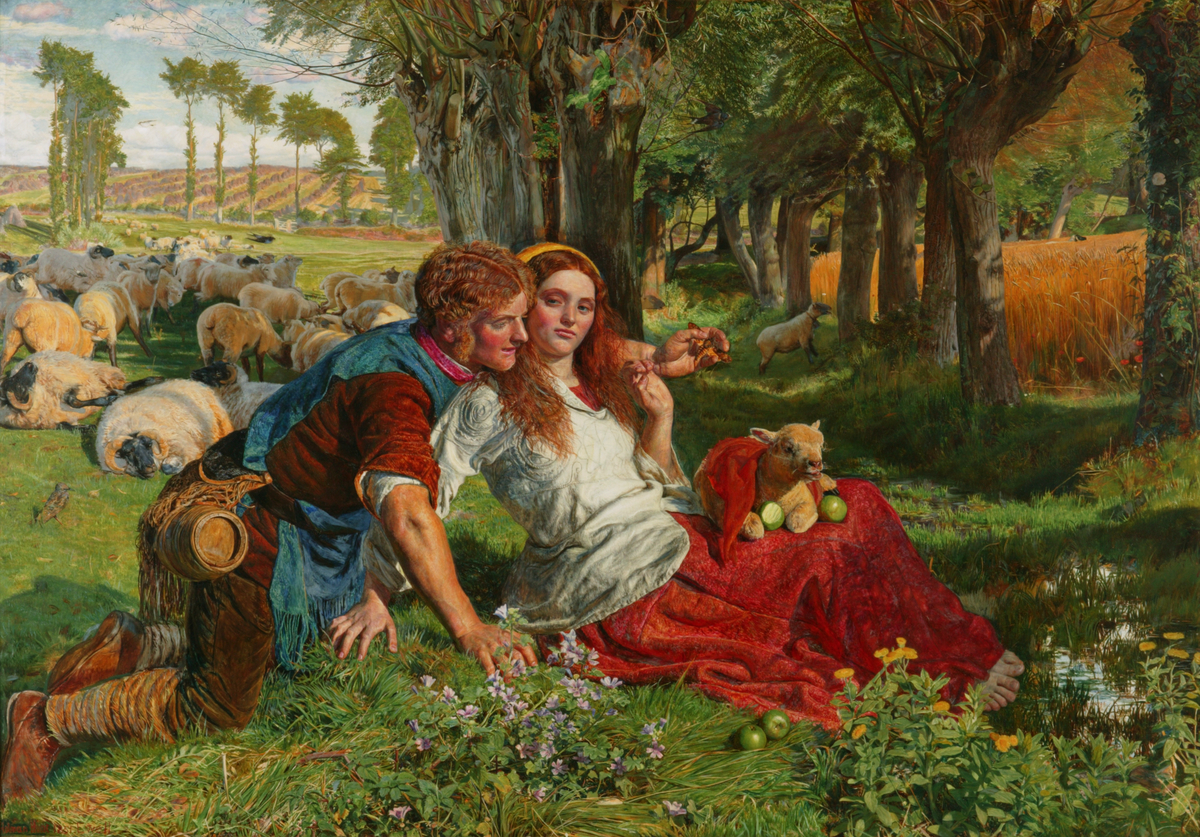 William Holman Hunt (1827-1910)
The painting, The Hireling Shepherd, by Hunt is replete with biblical imagery [Cf. John 10:1-18]. Hunt brought together Rossetti and Millais and in all likelihood was the artist most responsible for the formation of the Pre-Raphaelite Brotherhood.
But it is interesting to note several other things about the PRB. First, they named themselves for someone -- or, more accurately, for a time period prior to someone, namely, the artist Raphael. Why go to the bother of cryptically calling yourself by a time period that preceded an artist when you happen to be aspiring artists living in England?
Look at the dates of Raphael. He was born in 1483 and died in 1520. Notice anything? Not yet?
Okay, then let's look at two other dates that juxtapose interestingly. First, the birth year of a man who would change western Christendom for better or worse, Martin Luther: 1483. And now a date by which this firebrand German monk would have set fire to dry tinder with such tracts as his Epitome in which he declared "that the true Antichrist is sitting in the temple of God and is reigning in Rome -- that empurpled Babylon -- and that the Roman curia is the Synagogue of Satan" [Will Durant, The Reformation: A History of European Civilization from Wyclif to Calvin: 1300-1564, 351].
Secondly, many themes of the PRB came lovingly from plays by William Shakespeare, who as I have posted recently, is attaining a measurable reputation for being a "papist" in post Reformation England.
Thirdly, in their own lifetimes, the PRB artists were castigated for painting themes that narrowly skirted accusations of being pro-Catholic Church. I will share these in future posts.
But the most important piece of evidence that the PRB was not merely a romantic sigh for a lost Medievalism, I think, is the first point above. It was the Brotherhood's agreement to cloak their identity in a kind of counter-Protestant Reformation mentality, artistry, and loyalty. It was just sufficiently obscure and forthright that a curious investigator could easily connect the historical "dots" but most would not.
I would be interested in knowing if others -- and probably much more scholarly than I -- have traced these pieces of evidence. I will happily bow to former and better research if that so happens.
Meanwhile, I like to think I have discovered why I love the Pre-Raphaelite paintings so much.
To learn more about Raphael please link to Artsy’s Raphael page.
What IS the Wrath of God?
One of the most profoundly misunderstood concepts among Christ's followers is that known as God's wrath. Here to help us is our friend, mentor, and pal of the Three Massketeers, Gil Bailie.
The following comes from Gil's taped lecture entitled, "The Mystery of History." For more opportunities to hear Gil speak, either in person or on CD/tape, go to his website linked above.
The following comes from Gil's taped lecture entitled, "The Mystery of History." For more opportunities to hear Gil speak, either in person or on CD/tape, go to his website linked above.
What is “God’s wrath?” Does Jesus reveal a wrathful God? It’s a very central question. Clearly John [of Patmos] is talking about the wrath of God. And clearly the crucifixion and resurrection represent a judgment; a very solemn one with enormous consequences. But how are we to reckon with this notion of the wrath of God?
I will suggest to you the following, not based on my suppositions or my speculation, but based on what I think is in John’s Apocalypse. We don’t realize how profoundly John is reinterpreting the Old Testament images and symbolism that he is using to express his Christian faith. We don’t realize how in concert the Book of Revelation is with all the other New Testament texts. You see, this has to be in concert with I Corinthians 13; this has to be in concert with the Gospels that speak of the mercy of God and that show us God incarnate in the One Who was constantly forgiving and bidding his disciples to turn the other cheek and go the extra mile. John’s Apocalypse has to be in concert with that. And it is, I think, read correctly.
What then is the wrath of God? I would say that the wrath of God is forgiveness. The wrath of God is forgiveness. Sin is its own punishment. Dante knew that. Surely God knows it. All we have to do is look around. Sin is its own punishment. It doesn’t need a shove from God. In the natural course of its transformation from heady self-assertion into dreary despair and alienation. Sin is deprived of all its consolations, save one: the sinner can sulk in the spiteful knowledge that his misery is imposed by a harsh and vindictive God. And he can curse God for condemning him to the hellish conditions in which he finds himself.
But when God forgives through Christ on the cross, then the sinner either accepts forgiveness or he rejects it and is forced to inhabit a hell whose doors stand wide open. And to be tormented thereby by the realization that the torment itself can be blamed on no one but himself. That’s hell. That is the wrath of God made possible by the revelation of God’s infinite mercy and forgiveness that Jesus brings to us. The wrath of God is God eliminating the notion of a wrathful God, and thereby condemning those who refuse forgiveness and cling to their sinful rebellion to the hellish torment of realizing that with one heartfelt mea culpa it could all be otherwise.
Franciscan Monks that Rock
Monks That Rock help spread the Good News to many young who otherwise may be dancing to a different tune.
Wednesday, June 06, 2007
Saint Norbert —1080-1134.

June 6 - St. Norbert
Norbert became archbishop of Magdeburg in central Germany, a territory half pagan and half Christian. In this position he zealously and courageously continued his work for the Church until his death on June 6, 1134.
On the occasion of his ordination to the priesthood, Norbert said,
"O Priest! You are not yourself because you are God. You are not of yourself because you are the servant and minister of Christ. You are not your own because you are the spouse of the Church. You are not yourself because you are the mediator between God and man. You are not from yourself because you are nothing. What then are you? Nothing and everything. O Priest! Take care lest what was said to Christ on the cross be said to you: 'He saved others, himself he cannot save!'"
As most of Europe withers away in indifference to the Christian Word, we pray that Pope Benedict XVI is able to turn the tide in Germany. Read about a saint who, in a distant past, did so much in converting the hearts and souls of Germany.
From American Catholic:
A different world cannot be built by indifferent people. The same is true in regard to the Church. Sad to say, the so-called updating of the Church has not engendered the different Church which was so devoutly and hopefully envisioned by Vatican Council II. A principal reason for this failure was—and is—the indifference of vast numbers of nominal faithful, their indifference to ecclesiastical authority and essential doctrines of the faith. Unswerving loyalty to the Church and fervent devotion to the Eucharist, as practiced by Norbert, will continue immeasurably towards maintaining the people of God in accord with the heart of Christ.
The Great God Debate
Following up on Athos' Hitch post below, the debate between Christopher Hitchens and Mark D. Roberts on Hugh Hewitt's show can be read in transcription or listened to here at Townhall (if you scroll around a bit).
I have not had a chance to read or hear it, and so can give no impressions yet.
Correction: Transcripts are not actually up yet, but you can still listen.
I have not had a chance to read or hear it, and so can give no impressions yet.
Correction: Transcripts are not actually up yet, but you can still listen.
Tuesday, June 05, 2007
Spiritual Direction & the Pagan
Recently, Aramis and I had a discussion about spiritual direction and directors. As a recovering Jungian and former member of the C. G. Jung Society of Tidewater Virginia (in my "New Age Zen Methodist" phase of spirituality) I can vouch the number of persons who go asearching for transcendence in all the wrong places.
In the arid secularist times in which we live in the west, it is nearly inevitable that this will happen. René Girard's mimetic theory predicts with a high degree of probability that without the moral infrastructure and authentic transcendence provided by the Christian revelation, persons will slip into what he calls "the primitive sacred." Either by willful rejection of the teachings of the Church's Magisterium, that vouchsafes the deposit of faith in Sacred Scripture and Tradition, or by ignorance of the same, persons will re-enter the world of paganism. (The Old Testament prophets knew this perfectly well.) It is, as Nietzsche said a choice between Christ or Dionysus. There is no middle ground. Not for liberals. Not for conservatives.
In this knowledge, I penned a fictional form of catechesis entitled The Dionysus Mandate to show the multiple ways that people can find themselves sliding into "the primitive sacred." In the excerpt below, I depict two women religious who are well away from the safe-keeping of the Sacraments and well into the influence of the neo-pagan. A third woman riding with them is also a neo-pagan, but more seriously into an effort to re-institute the darker elements of pagan religion:
[32-33]
In the arid secularist times in which we live in the west, it is nearly inevitable that this will happen. René Girard's mimetic theory predicts with a high degree of probability that without the moral infrastructure and authentic transcendence provided by the Christian revelation, persons will slip into what he calls "the primitive sacred." Either by willful rejection of the teachings of the Church's Magisterium, that vouchsafes the deposit of faith in Sacred Scripture and Tradition, or by ignorance of the same, persons will re-enter the world of paganism. (The Old Testament prophets knew this perfectly well.) It is, as Nietzsche said a choice between Christ or Dionysus. There is no middle ground. Not for liberals. Not for conservatives.
In this knowledge, I penned a fictional form of catechesis entitled The Dionysus Mandate to show the multiple ways that people can find themselves sliding into "the primitive sacred." In the excerpt below, I depict two women religious who are well away from the safe-keeping of the Sacraments and well into the influence of the neo-pagan. A third woman riding with them is also a neo-pagan, but more seriously into an effort to re-institute the darker elements of pagan religion:
Mel noticed three women in a late model Swedish car. Two in the front seat seemed to exude attentiveness to their surroundings reminiscent of nuns from a parochial school. Mel flipped the page of his sketchbook and began a drawing of the threesome.
“Isn’t this divine? Did you just hear that man over there? He was saying he thought he saw a shark’s fin!” the younger woman in the front seat asked. She had short-cropped blond hair and a large, open, smiling face. “Ah! It’s so good to get away from the retreat center for awhile! I can’t think of anywhere I’d rather be than at the ocean.”
“Did you remind Father Edmund to use the Medicine Wheel with his parish group from Saint Gummarus?” the older woman asked.
The younger woman, Susanna Ruggieri, said, “I showed him around. They especially liked all the books we have on Jungian spirituality in the library. They’re big into the collective unconscious in that parish. You should have seen the envy on their faces when I told them we would be spending the eclipse conference with Father Luke Coyote!”
Her companion, Mary Fran Ugolino, a stylish woman of slighter build and silver hair, picked up a brochure. “’An Experience in Pre-Christian Transcendence and Gaia Consciousness,’” she read. “I spoke with Father Luke last Saturday evening. He made a point of saying he was looking forward to seeing me again.”
A copy of the former Catholic priest’s newest book, The Sacrament of Non-commitment: Open Marriages, Freedom and Love for Today, sat between them on the console. His frequent affaires de cœur with admirers of both sexes made for best seller material.
The third woman, in the backseat, seemed quiet and sullen. Her sunglasses and auburn-hair partially hid her expression from the enthusiastic women in the front seat. How did I ever get stuck with these idiots for a ride? she thought.
“Frederika!” Susanna said, turning quickly. “Be sure to register for the ‘Gaia Consciousness Workshop’ as soon as we get there! It will be tomorrow morning after Father Luke’s plenary address. I’ve heard we actually get to dance to songs taped during a voodoo ceremony!”
Frederika shifted and looked out the window, rolling her eyes. Gaia voodoo dancing, my sweet a**.
[32-33]
Dawn of a New Beginning - July 2, 2007
 Athos posted on Dawn's new venture earlier (see here), however I think it deserves more fanfare. Not only will July 2 represent a new beginning for Dawn Eden, but you can bet she will be a great model and teacher for young people on many campuses throughout the country. Read about Dawn here, as she will be starting a new vocation as director of the Cardinal Newman Society's new Love and Responsibility program. Hey Dawn, we need to link you up with Gil Bailie and his Emmaus Road Initiative as well as he has a great retreat entitled: BODY LANGUAGE: The Word Made Flesh "Male and Female He Made Them."
We know that you will inspire a whole new generation of people. If there is anything we 3 Massketeers can do to help please let us know.
Subscribe to:
Posts (Atom)