And It Isn't a Nosegay
Gerald Augustinus at The Cafeteria is Closed reports that the Holy Father is lending support to Genoa's Archbishop Angelo Bagnasco, the president of the Italian bishops' conference, in the face of death threats: most recently, a bullet in the mail. Not "soft coercion." Not a subtle message. Point blank clear: message received.
Once again we note that the Catholic Church, in supporting the sacrament of Holy Matrimony, the "domestic church," and the common good, draws the usual lynch-mob of miscreants and degenerates. They understand that their "special interests" (read: neo-pagan, anti-Christ agenda) are only confronted by Catholic truth. Who else? Please show me if I'm wrong about that. We're supposed to forgive, turn the other cheek, not return evil for evil. They certainly don't have to. Any means -- political, judicial, ecumenical, death threats -- any means to disassemble the foundations of civility, sanity, and hope for humanity.
Catholic World News reports that Cardinal Camillo Ruini, who had preceded Archbishop Bagnasco as president of the Italian bishops' conference, told the Italian daily Corriere della Sera that Italian Church leaders would not be silenced by threats. “We will speak even more clearly and forcefully," he vowed.
For the clearest, most lucid expression of why support for our Church leaders matters and such violent threats cannot be ignored, pick up a copy of David P. Lang's superb slim volume, Why Matter Matters [Our Sunday Visitor, 2002]. Hint: Genesis 1, 31.
Tuesday, May 01, 2007
Sunday, April 29, 2007
Back By Popular Demand +
 William Holman Hunt (1853–4)
All right, not by popular demand. I just needed to see it plainly and forthrightly again.
The Light of the World is an allegorical painting by William Holman Hunt representing the figure of Jesus preparing to knock on an overgrown and long-unopened door, symbolic of the human conscience. The scriptural basis for this concept can be found in Revelation 3:19-21: "Behold, I stand at the door and knock; if any man hear my voice, and open the door, I will come in to him, and will sup with him, and he with me". According to Hunt: "I painted the picture with what I thought, unworthy though I was, to be by Divine command, and not simply as a good subject." It has sometimes been remarked that the door in the painting has no handle, and can therefore only be opened from the inside.
The painting was Hunt's most famous and successful work and was toured around the world. The original is now in a side room off the large chapel at Keble College, Oxford. Hunt painted a large copy towards the end of his life, which is now in St Paul's Cathedral, London.
The painting was Hunt's most famous and successful work and was toured around the world. The original is now in a side room off the large chapel at Keble College, Oxford. Hunt painted a large copy towards the end of his life, which is now in St Paul's Cathedral, London.
-- http://en.wikipedia.org/wiki/The_Light_of_the_World
Saturday, April 28, 2007

Friday, April 27, 2007
Christian Faith a Pharmakos?
Drug and Poison?
In an article entitled, "Christian Background To Political Correctness?" in the online journal Global Politician, Fjordman makes a disturbing yet largely accurate observation:
This nearly borders on a hat-in-hand Nietzschean position, but one can understand Fjordman's observation. The Church contains and guards the deposit of faith in Sacred Scripture and Tradition via the Magisterium. Yet the plethora of expressions of Christianity in greater or lesser degrees represents and misrepresents Catholic truth in word and action.
Fjordman notes that Christian ethics sans Christian beliefs can be deadly to a culture, as we see in the West:
In an article entitled, "Christian Background To Political Correctness?" in the online journal Global Politician, Fjordman makes a disturbing yet largely accurate observation:
Christian ethics have proved more durable than Christian beliefs.Furthermore, he notes that while he is not a Christian, he has deep appreciation for the contributions made by the Christian faith. However, the question that distresses him in the present cultural crisis facing the West is, "precisely because Christianity has so profoundly shaped our culture, isn’t it plausible that it may also, at least indirectly, have contributed to some of the flaws that currently ail us as well?"
This nearly borders on a hat-in-hand Nietzschean position, but one can understand Fjordman's observation. The Church contains and guards the deposit of faith in Sacred Scripture and Tradition via the Magisterium. Yet the plethora of expressions of Christianity in greater or lesser degrees represents and misrepresents Catholic truth in word and action.
Fjordman notes that Christian ethics sans Christian beliefs can be deadly to a culture, as we see in the West:
So, for those who still maintain the theological virtue of hope, it is not time to compromise with the state, as Fjordman suggests. It is time to evangelize the truth claims of the Gospel and the deposit of faith -- the beliefs -- vouchsafed by the Magisterium. For truly, Christian ethics, which a secular West won't even give credit to -- can, as Fjordman says, be deadly with Christian belief.One major component of Western self-loathing is the idea that we should we be punished for crimes, perceived or real, committed by our ancestors before we were even born. It could be argued that this idea has its roots in Christian thinking, in the concept of original sin, committed by Adam and Eve, but where all their descendants are subject to its effects. Christian ethics have proved more durable than Christian beliefs. Even when we have supposedly left the religion behind, we still believe we have to make atonement for the sins of our forefathers, but since we no longer believe that Christ has made that sacrifice for us and washed away our sins, we end up sacrificing ourselves instead...
Perhaps Christianity, despite its many great qualities, needs to be balanced out by other more worldly elements, such as attachment to nation states.
Thursday, April 26, 2007
American Idol Gives Back Celine and Elvis
Elvis and Celine Dion from Yahoo videos.
I figure that one of us Massketeers have to hold up the common fan -- though I love the beauty of classical and jazz music, I guess there are times when I just got to have my Elvis fix.
I figure that one of us Massketeers have to hold up the common fan -- though I love the beauty of classical and jazz music, I guess there are times when I just got to have my Elvis fix.
Tuesday, April 24, 2007
Growing Pains?
With due respect to fellow Massketeer, Porthos, and in the same vein, I might add, as "Paglia on Radio," I would like to share with our multitude of readers something borrowed from Dymphna at Gates of Vienna, namely, this video piece entitled ”The Trouble with Islam.”
Commonsensical, whimsical, mildly low on the level of discourse expected and demanded of our readership, but worthy of a look and a listen, in my humble opinion.
Commonsensical, whimsical, mildly low on the level of discourse expected and demanded of our readership, but worthy of a look and a listen, in my humble opinion.
Monday, April 23, 2007
Sunday, April 22, 2007
The Farmer, Violinist, the Metro & 'Ugly as Sin'
Talk about a "slaps forehead, why didn't I think of that?" connection. The Yeoman Farmer makes a superb connection in regards to a cool article from the Washington Post Sunday Magazine, ”Pearls Before Breakfast” and Catholic Church architecture. Context matters, as if Daniel Mitsui didn't know that already. But chalk one up for Yeoman, outstanding in his field.
Beauty & the Quiet Mind
 The Art of Painting - Jan Vermeer
c. 1666-73; Oil on canvas, 130 x 110 cm; Kunsthistorisches Museum, Vienna
Sylvia Shaw Judson gave us a slim volume entitled, The Quiet Eye, the philosophy of which being one of quieting one's inner life through art; using that which one looks upon to bring about a peace that is rare, given our usual states of conscious turmoil, hectic drivenness, and other conditions of unrest. This, of course, is the point of carving out time to spend on a retreat. But I find the paintings of Jan Vermeer to provide such opportunities of centering, reflection, contemplation (I believe fellow Massketeer Porthos does too, but I'll let him speak for himself.) Music by the Tallis Scholars is conducive to such contemplation as well.
Given the works of evil perpetrated upon students and faculty of Virginia Tech University, the alternatives -- a "mind enslaved" and a mind at rest in God's arms [Psalm 131] -- one would do well to heed the words shared by friend and mentor, Gil Bailie:
Given the works of evil perpetrated upon students and faculty of Virginia Tech University, the alternatives -- a "mind enslaved" and a mind at rest in God's arms [Psalm 131] -- one would do well to heed the words shared by friend and mentor, Gil Bailie:
(The polymorphously perverse mind) is a mind enslaved. It desires not only to possess the other, but to consume or destroy. It wishes not only to imitate the other, nor merely to possess itself in the other, but to destroy the other as the place where the self is alienated to itself.
All the appeals to custom, to tradition, to authority, to the positive teaching of religion, to the gestures repeated since childhood are not meant to compel reason nor to supplement it, but to protect it against the vertigo of the imagination. And the only people to be scandalized are, in the words of St Augustine, ‘Those who do not know how rare and difficult a thing it is for the fleshly imagination to be subdued by the serenity of a devout mind."
Thursday, April 19, 2007
Ismail Ax & the Primitive Sacred
Mark Gordon at Suicide of the West lifts up a frightening yet keen intuition about the shooter at VTU. Fatuous speculation? Not if one takes seriously René Girard's mimetic theory.
In the times when the cultural enterprise of a people are loosening mores, prohibitions, taboos that confined scandalizing behavior, Girard, Jean-Michel Oughourlian and Guy Lefort laid down the blueprint for a predictable gradient that leads nearly inexorably to complete social meltdown. Such "sacrificial preparation" mimics the founding violence that gave rise to culture in the first place. To believe with supreme naïveté that we moderns have outgrown such "primitive" behavior is worthy only of such folk as still believe in the myth of the autonomous self. You know, like the commissioners of the EU.
That a loner, bereft of the benefit of the light of the Gospel should stray toward violence that is a clear expression of what Girard calls the "primitive sacred" with dehumanization of its enemies and immunity from repercussions for violence performed upon them is only "natural" in every sense of the word. For, only the revelation of the deposit of faith vouchsafed by the Catholic Church offers freedom from this gradient of sin and death.
But regardless whether the shooter was or was not a recent convert to Islam, Nietzsche would have been proud of the lad, Cho Seung-Hu or Ismail Ax, for trying to jump start the old mechanism of the "eternal return." If we willingly relinquish Catholic truth, either in its full expression guarded by the Magisterium of Mother Church or watered-down versions of other christianities, we will see with dread and awe that the vacuum of secularity will be filled by Islam or other expressions of the primitive sacred.
That will be the doom of those who refuse to remain attached to the True Vine, Jesus Christ the only Son of the Father [Jn 15]. May the West awaken to the sounding alarm. And soon.
In the times when the cultural enterprise of a people are loosening mores, prohibitions, taboos that confined scandalizing behavior, Girard, Jean-Michel Oughourlian and Guy Lefort laid down the blueprint for a predictable gradient that leads nearly inexorably to complete social meltdown. Such "sacrificial preparation" mimics the founding violence that gave rise to culture in the first place. To believe with supreme naïveté that we moderns have outgrown such "primitive" behavior is worthy only of such folk as still believe in the myth of the autonomous self. You know, like the commissioners of the EU.
That a loner, bereft of the benefit of the light of the Gospel should stray toward violence that is a clear expression of what Girard calls the "primitive sacred" with dehumanization of its enemies and immunity from repercussions for violence performed upon them is only "natural" in every sense of the word. For, only the revelation of the deposit of faith vouchsafed by the Catholic Church offers freedom from this gradient of sin and death.
But regardless whether the shooter was or was not a recent convert to Islam, Nietzsche would have been proud of the lad, Cho Seung-Hu or Ismail Ax, for trying to jump start the old mechanism of the "eternal return." If we willingly relinquish Catholic truth, either in its full expression guarded by the Magisterium of Mother Church or watered-down versions of other christianities, we will see with dread and awe that the vacuum of secularity will be filled by Islam or other expressions of the primitive sacred.
That will be the doom of those who refuse to remain attached to the True Vine, Jesus Christ the only Son of the Father [Jn 15]. May the West awaken to the sounding alarm. And soon.
A Cursillo Prison Weekend for Aramis
 Matthew 25:35-40
For I was hungry and you gave me food, I was thirsty and you gave me drink, a stranger and you welcomed me, naked and you clothed me, ill and you cared for me, in prison and you visited me.'
Then the righteous will answer him and say, 'Lord, when did we see you hungry and feed you, or thirsty and give you drink? When did we see you a stranger and welcome you, or naked and clothe you? When did we see you ill or in prison, and visit you?'
And the king will say to them in reply, 'Amen, I say to you, whatever you did for one of these least brothers of mine, you did for me.'
My wife and I will be away this weekend participating on a prison Cursillo weekend. Though we have done a number of 'street' weekends, this will be our first Cursillo team expereience behind bars. Our local Cursillo community has been going into prison some 12 or 13 years. The candidates in the correctional center, as well as everyone on the team, could use your prayers. May the Holy Spirit penetrate all our walls and defense mechanisms to fill our hearts with His Love. Please pray for the guards and all staff personal as well.
Assuming that I behave and they let me out I will try to let you know how it goes the first of next week.
DeColores
Tuesday, April 17, 2007
Brit Docs Opt Out - Bravo

A growing number of British physicians are deciding to opt out of performing abortions. Dare one hope that a crack is opening and allowing the light of truth shine into the medical community? That those who have sought to redefine when human life begins are being stripped of their myths and machinations at long last?
Monday, April 16, 2007
Our Prayers Go Out +
 The Three Massketeers' prayers rise up and our hearts go out to the families of the victims of the tragic shooting spree on the campus of Virginia Tech University, Blackburg, Virginia. May the victims rest in peace. May all of us know that suffering does have meaning, and we can and should offer it up for the good of all souls, especially the soul least prayed for in Purgatory.
In the Mercy. +
Sunday, April 15, 2007
Divine Mercy Sunday +
 The Incredulity of St Thomas [1634] -- Rembrandt
Magnificat today gives a meditation from the writings of Father Hans Urs Von Balthasar. Before Mass started, I was nearly in tears reading these words. And in the homily, the good padre told his flock (I was a guest, returning from a weekend retreat) that in a day when God's name is routinely invoked to smite and destroy enemies, it is vital that we witness to the divine mercy of God, vindicated in the crucifixion and resurrection of Our Lord.
He told us in a succinct, magnificent homily the we should be "pioneers, like the pioneers who settled the old West. Only we should pioneer the good news of God's divine mercy through our mercy, our forgiveness, our compassion." With that, Von Balthasar:
So you, too, come up, Thomas. Come forth from your cave of sorrows. Put your finger here and see my hands. Extend your hand and place it in my side. And do not think that your blind suffering is more clairvoyant than my grace …
But since you are so wounded and the open torment of your heart has opened up to the abyss of your very self, put out your hand to me and, with it, feel the pulse of another Heart: through this new experience your soul will surrender and heave up the dark gall which it has long collected. I must overpower you. I cannot spare exacting from you your melancholy – your most-loved possession. Give it to me, even if it costs you your soul and your inner self thinks it must die. Give me this idol, this cold stony clot in your breast, and in its place I will give you a new heart of flesh that will beat to the pulse of my own Heart.
Give me this self of yours, which lives on its not being able to live, which is sick because it cannot die. Let it perish, and you will finally begin to live. You are enamored of the sad puzzle of your incomprehensible ego. But you have already been seen through and comprehended, for look: if your heart accuses you, I am nevertheless greater than this your heart, and I know everything. Dare to make the leap into the Light! Do not take the world to be more profound than God! Do not think that I cannot make short work of you! Your city is besieged, your provisions are exhausted: you must capitulate. What could be simpler and sweeter than opening the door to love? What could be easier than falling to one’s knee and saying: “My Lord and my God?”
Saturday, April 14, 2007
Thursday, April 12, 2007
Real Life Imitating Art
In The Dionysus Mandate, a young Downs Syndrome boy is recruited as a sacrificial victim:
But now a report has brought this occurrence in Dionysus Mandate into high relief:
Pray for the witness of Catholic truth, the Church, and our Holy Father. Pray for all innocents who are taken advantage of by evil. And read The Dionysus Mandate. Not for its art, but for its truth.
“How is the pharmakos for my ritual at Caesarea Philippi, sir?”Aly Lambert, the heroine of the story, later hears the fate of young Áchmed on her car radio:
“You read my mind, Lucent! We are on our way to visit him right now. Then we need to return to the airport.”
They walked down an alleyway filled with the open shade of a bright Friday afternoon in the Middle East. Praetorius opened a gate leading to the small courtyard of a rundown house. He proceeded to the open front door.
“Hello!” he called. “Hello?”
A Palestinian woman appeared and hid her smile behind a white shawl. She carried an infant in the crook of one arm. Herr Praetorius made polite inquiries and the woman invited him in as a trusted acquaintance. Neesam waited in the courtyard. Soon, the old man reappeared leading a small boy by the hand. Perhaps ten years old, his face bore the signs of Downs Syndrome. The old man knelt down slowly and introduced the boy to his companion.
“Lucent, I want you to meet Áchmed. We met here in Jericho some time ago in his father’s shop.
A report on BBC World News snapped her suddenly back into the present:All well and good. For fiction in a dystopian future wherein a willful return to human sacrifice is de rigueur among the powers that be.
“Turning to the Middle East, tourists in Israel made a disturbing discovery this morning in the vicinity of Caesarea Philippi. The mutilated body of young Palestinean boy was found at the entrance to the cave known as Pan’s Grotto."
Damn.
“Authorities speculate that an obscure occultist group may be responsible.”
“It was probably Neesam’s turn this time,” Aly muttered.
But now a report has brought this occurrence in Dionysus Mandate into high relief:
BAGHDAD, 10 April 2007 (IRIN) - BAGHDAD, 10 April 2007 (IRIN) - The dreams 13-year-old Barak Muhammad (not his real name) had of leading a normal teenage life were dashed when his father sold him to al-Qaeda militants. Being mentally handicapped, he said he was considered a burden by his family and was told he would be better off sacrificing his life for his country.I would love to say that this clearly delineates between the foes of the West and our Christ enlightened culture, but you, gentle reader, would see through the farce's façade, when abortion, euthanasia, and nixing of the "invalid" run rampant through the culture of death in Old Christendom and the New World.
"I don't have a mother and never went to school. I was dreaming of a day that I would go to school like my other brothers, but I was considered different. My father was always telling me that I was a mistake in his life, a boy that was just bringing expenses and problems," Barak said.
Nine-year-old Saleh Ahmed (not his real name) said he was forced to help insurgents after they forced their way into his home and threatened to kill his mother and sisters if his father did not hand him over.
"They told me to say that I'm happy working with them but it's not true. I want to go back home and stay with my mother," Saleh told IRIN in privacy. When his trainer, Abu Ahmed, returned to the room, Saleh changed his tune and said he was happy to fight US forces and would die to save his country.
Pray for the witness of Catholic truth, the Church, and our Holy Father. Pray for all innocents who are taken advantage of by evil. And read The Dionysus Mandate. Not for its art, but for its truth.


Noli Me Tangere
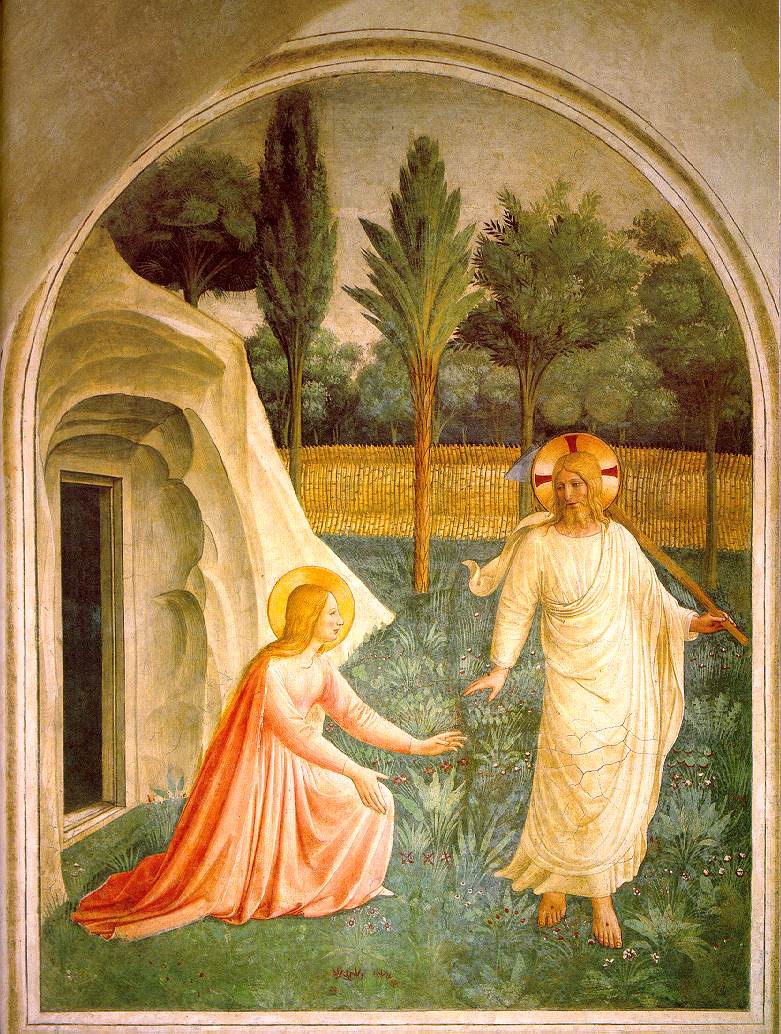 Noli Me Tangere - Fra Angelica
1440-41; Fresco, Convent of San Marco, Florence
From the ridiculous (below) to the sublime. Florentine painter, a Dominican friar, Fra Angelico lived from 1400-1455. Although in popular tradition he has been seen as `not an artist properly so-called but an inspired saint' (Ruskin), Angelico was in fact a highly professional artist, who was in touch with the most advanced developments in contemporary Florentine art and in later life travelled extensively for prestigious commissions. He probably began his career as a manuscript illuminator, and his early paintings are strongly influenced by International Gothic. But even in the most lavishly decorative of them all-- the Annunciation in the Diocesan Museum in Cortona-- Masaccio's incluence is evident in the insistent perspective of the architecture.
For most of his career Angelico was based in S. Domenico in Fiesole (he became Prior there in 1450), but his most famous works were painted at S. Marco in Florence (now an Angelico museum), a Sylvestrine monastry which was taken over by his Order in 1436.
Angelico died in Rome and was buried in the church of S. Maria sopra Minerva, where his tombstone still exists. Vasari, who referred to Fra Giovanni as `a simple and most holy man', popularized the use of the name Angelico for him, but he says it is the name by which he was always known, and it was certainly used as early as 1469. The painter has long been called `Beato Angelico' (the Blessed Angelico), but his beatification was not made official by the Vatican until 1984. [Web Museum]
Wednesday, April 11, 2007
Monday, April 09, 2007

Sunday, April 08, 2007
Saturday, April 07, 2007
Watermelon in Easter Hay
OK, well, look, transcendence does pop up in unusual places, like in some of Frank's arrangements and guitar work.
The Harrowing of Hell
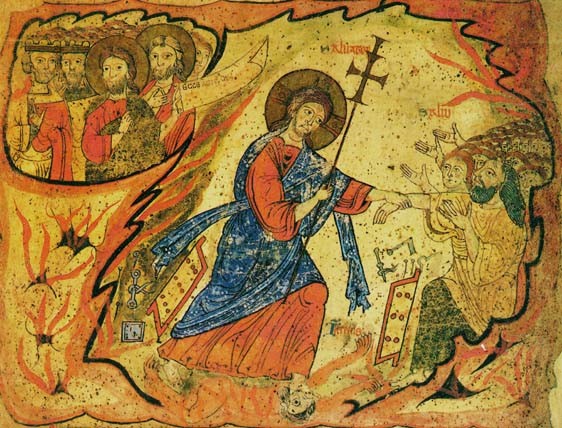 The Harrowing of Hell
"Writers of Old English prose homilies and lives of saints continually employ the subject, but it is in medieval English literature that it is most fully found, both in prose and verse, and particularly in the drama. Art and literature all through Europe had from early times embodied in many forms the Descent into Hell, and specimens plays upon this theme in various European literatures still exist, but it is in Middle English dramatic literature that we find the fullest and most dramatic development of the subject.
"The earliest specimen extant of the English religious drama is upon the Harrowing of Hell, and the four great cycles of English mystery plays each devote to it a separate scene. It is found also in the ancient Cornish plays. These medieval versions of the story, while ultimately based upon the New Testament and the Fathers, have yet, in their details, been found to proceed from the apocryphal Gospel of Nicodemus, the literary form of a part of which is said to date back to the second of third century. In its Latin form this "gospel" was known in England from a very early time; Bede and other Old English writers are said to show intimate acquaintance with it. English translations were made of it in the Middle Ages, and in the long Middle English poem known as "Cursor Mundi" a paraphrase of it is found."
-- From the online Catholic Encyclopedia, New Advent.
One may also consult or this.
And, finally, Dr. Will Willimon preached this sermon at Duke Chapel a few years ago.
One may also consult or this.
And, finally, Dr. Will Willimon preached this sermon at Duke Chapel a few years ago.
Friday, April 06, 2007
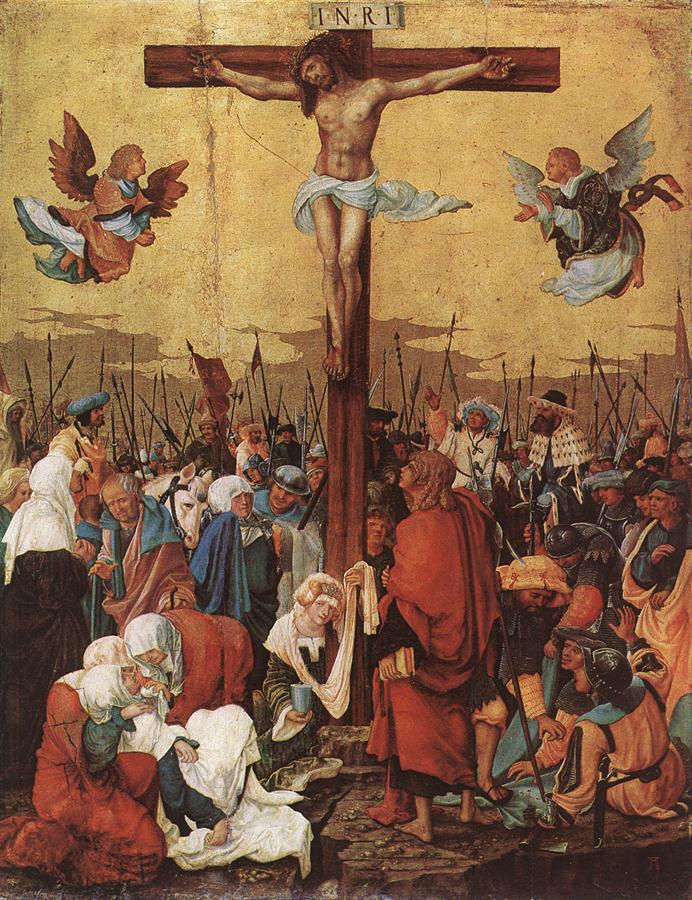
Triduum +
Death Shall Have No Dominion
In the annals of human love, there will always be those whose stories by which we will find ourselves feeling moved: Peter Abelard and Héloïse, Dante and Beatrix, perhaps even one's grandparent's -- particularly if you are wearing your grandmother's wedding band with the date of their wedding [1916] and they drove off to homestead in Montana on an Indian motorcycle with a sidecar. What makes one story more significant than that of another? What makes such a story rich not only with the love of man for woman, woman for man, but with the theologically hoped for but never proven element of eternity?
Our friend and mentor, Gil Bailie, founder and president of the Cornerstone Forum, describes in his reverie on Holy Thursday what this element is. In his usual diction that packs the punch of a poet who selects words like rocks from a riverbed, Gil builds a monument of living stones to human love of husband and wife valorized and vouchsafed by the sole source of human hope, our Eucharistic Lord. An apt meditation for the beginning of the Holy Triduum.
In the annals of human love, there will always be those whose stories by which we will find ourselves feeling moved: Peter Abelard and Héloïse, Dante and Beatrix, perhaps even one's grandparent's -- particularly if you are wearing your grandmother's wedding band with the date of their wedding [1916] and they drove off to homestead in Montana on an Indian motorcycle with a sidecar. What makes one story more significant than that of another? What makes such a story rich not only with the love of man for woman, woman for man, but with the theologically hoped for but never proven element of eternity?
Our friend and mentor, Gil Bailie, founder and president of the Cornerstone Forum, describes in his reverie on Holy Thursday what this element is. In his usual diction that packs the punch of a poet who selects words like rocks from a riverbed, Gil builds a monument of living stones to human love of husband and wife valorized and vouchsafed by the sole source of human hope, our Eucharistic Lord. An apt meditation for the beginning of the Holy Triduum.
Wednesday, April 04, 2007
René Girard for Holy Week
First it was Mark Gordon lifting up praise for Girard and now we have FIRST THINGS article René Girard for Holy Week by Edward T. Oakes, S.J.
Here is an excerpt:
What a great Holy Week meditation - reading the anthropological study of mimesis through the lens of René Girard. In fact anytime is a great time for this.

Here is an excerpt:
Again, if you want to know why contemporary art keeps preening itself on its “daring transgressions,” you’ll find the answer in Girard. Also, if you’re a puzzled secularist, wondering why religion is making such a comeback in the headlines, you need only go to Girard for the answer. As Kirwin rightly notes: “Girard has explicitly distanced himself from Marcel Gauchet’s claim that Christianity has brought about the end of religion in the world. Rather, he suggests our current humanism will be perceived as merely a short interval between two forms of religion.” (I don’t think Girard has been at all taken off-guard by the resurgence of militant Islam.)
Of course, that still leaves open the question of what that “second form” of religion will look like in the future, to which Girard has only this quintessentially Christian answer to give: “What makes our hearts turn to stone is the discovery that, in one sense or another, we are all butchers pretending to be sacrificers. . . . One thing alone can put an end to this infernal ordeal, the certainty of being forgiven.”
What a great Holy Week meditation - reading the anthropological study of mimesis through the lens of René Girard. In fact anytime is a great time for this.

British Pluck
The Brussels Journal reports that British schoolteachers are dropping mention of the Crusades and the Holocaust. Any ideas why?
Without recourse to the "truth that will set you free" -- cf. below, "The Chaplet of Divine Mercy," -- one cannot hold one's ground, and one falls under the dread of the primitive sacred. In this case, symbolized by the scimitar.
Bernard Lewis in a recent speech, mentioned the two moments in European history when Islam was turned back successfully.
Without recourse to the "truth that will set you free" -- cf. below, "The Chaplet of Divine Mercy," -- one cannot hold one's ground, and one falls under the dread of the primitive sacred. In this case, symbolized by the scimitar.
Bernard Lewis in a recent speech, mentioned the two moments in European history when Islam was turned back successfully.
He had mentioned the two Muslim assaults on Europe: the Arab one that ended in the West, near Poitiers with the victory of Charles Martel in 732. And the one that started in the East, with the Turks, which was marked by the two assaults on Vienna, the second one in 1683, the high-water mark of Ottoman power in Europe.
And so, just toward the end, was this unremarked but remarkable sentence:We will see.
"Third time lucky?"

Tuesday, April 03, 2007
Today’s grace: Rene Girard & Gil Bailie

Today Mark Gordon at his blog, Suicide of the West, has a nice reflection on Rene Girard and Gil Bailie and the Anthropology of the Cross.
 He concludes with the following comment: I believe this discovery is the key to reintroducing Christianity to postmodern Western civilization. Best of all, I have found that on a personal level the further one drills into the implications of Girardian theory, the deeper one’s appreciation grows for the truth of the orthodox Christian faith. As you begin this journey, “Be not afraid!” The work of Girard-Bailie is a profound escort into the anthropological heart of the Gospel, the bosom of the Church and the Mystery of Jesus Christ.
We 3 Massketeers
 proudly raise are pens high and heartily agree with Mark and salute Rene Girard and Gil Bailie.
Monday, April 02, 2007
April 2, 2005

Easter 2005 was celebrated on March 27.
On April 2nd of that year, my wife and I took a trip to Holy Name Cathedral, formally the Cathedral of the Holy Name in downtown Chicago.
 We had never been there and, as we had just completed the RCIA program in our local parish, we couldn't get enough of anything that was Roman Catholic, and that is still true today.
Oh what beauty we found ourselves in. Once inside we made our way to one of the front pews and noticed a group of people over to the left of the altar. A baptism service was just about to begin. It was for a young Mexican-American little boy named Sebastian. The priest was fluent in both Spanish and English, and he had a gift for making everyone feel a part of this special moment. He went around the family and asked each their name and gave a short history and meaning of each name, some of this was in Spanish and some in English. We learned that Sebastian meant venerated or majestic.

Then at one point early in the proceeding, around 1:45pm CST, the priest made THE announcement; that as we are here in The Holy Name Cathedral in downtown Chicago celebrating this very special baptism, a true blessing of the Church, on the other side of the planet, Pope John Paul II had just past away. With that he paused ever so slightly and then continued on with the ceremony.
The news was not surprising to us, we knew that Pope JPII was in failing health, and so we sat there in silence, rosary in hand and tears rolling down our cheeks. Some time after the baptism we got up to leave, only to be stunned to see a near packed cathedral, as people, in reverence and silence, had filled the pews. When we got outside there were TV trucks and camera crews looking to capture a sound-byte from anyone on their reaction to the news of the Pope’s death (not of course little Sebastian's baptism). We slipped past all that and ducked into a small sidewalk café before heading back home. While we were in the café a TV was on and we watched the news - and there in this small café in downtown Chicago we learned so much more about our faith and our Church, that before this time, we hadn’t a clue.
As I said, April 2nd that year was a week after Easter. I know this because I had just completed the RCIA program and was still unable to participate in full communion that Easter due to the delay that my dioceses had in sending my Privilege of Faith paperwork to Rome. The death of JPII was now going to delay my entry into the Church even more.
Well, my paperwork finally came through and on a glorious evening in November 2005, I was confirmed and my wife and I celebrated a renewal of our wedding vows in the Catholic Church; all this on her birthday. What a blessing.
By the way, today, April 2nd is my birthday and I wonder about little Sebastian and how he and his family are doing. I pray that they are well.
Monday of Holy Week +
Torrents of Peace
On this Monday of Holy Week, a quotation from Aldous Huxley from Gil Bailie's tape series on Dante's masterpiece, The Inferno:
On this Monday of Holy Week, a quotation from Aldous Huxley from Gil Bailie's tape series on Dante's masterpiece, The Inferno:
“Who will ever believe or imagine that there can be torrents of peace which sweep away the dikes, which breach the levies, and shatter the sea wall? And yet this is what actually happens. God’s peace is like a river whose course is in one country and has been diverted into another by the breaking of a dike. This invading peace does things which do not seem proper to the nature of peace. For it comes with a rush, it comes with impetuosity. It comes like an element of another life, with the sound of celestial harmony and such swiftness that the soul is utterly overthrown, not because she has made any resistance to the blessing, but because of its very abundance. This abundance does no violence except to the obstacles in the way of its benediction. And all the animals that are not peaceable take flight before the onset of this peace.”
Sunday, April 01, 2007
Passion Sunday +
 The Deposition - Caravaggio
1604; Pinacoteca Vaticana
Now (in the Church's wisdom) as we look upon the end note of a sad tale replayed "since the foundation of the world," a prolepsis for what will take place this Holy Week, we have the opportunity to realize our culpability, our collusion, our aptness for falling into victimizing. We can pray along with the publican in Jesus' parable [Mtt 18:10ff], "Lord, have mercy on me, a sinner."
BLATHMAC'S LAMENT
Your People seized your son, Mary, they flogged him.
There struck him the green reed and fists across ruddy cheeks.
It was a hideous deed that was done to him;
that his very mother-kin should crucify the man who had come to save them.
A crown of thorns was placed about his beautiful head;
nails were driven through his feet,
others through his hands.
When they thought thus that Jesus could be approached,
Longinus then came to slay him with the spear.
The King of the seven holy heavens,
when his heart was pierced,
wine was spilled upon the pathways,
the blood of Christ flowing through his gleaming sides.
The flowing blood from the body of the dear Lord baptized the head of Adam,
for the shaft of the cross of Christ had aimed at his mouth.
By the same blood (it was a fair occasion!) quickly did he cure the fully blind man,
who openly with his two hands, was plying the lance.
+
Blathmac, who was a Culdee (part of the Celtic reform movement in the 8th century), composed this lament, asking the Blessed Virgin to come to him and keen for the dead Son of God.
Jeff Cavins on TV
Jeff Cavins, on our blogroll, is doing a walkabout series in the Holy Land with Raymond Arroyo, titled Path of the Messiah. Check it out.
EWTN schedule.
EWTN schedule.
Saturday, March 31, 2007
To the Abbey
 Near the 'canonical' end of The Dionysus Mandate [Ch. 18], the protagonist, Aly Lambert, goes to visit her spiritual director at an abbey.
Aly drove up the hill to the entrance of the Abbey. Two pillars of native riverbed rocks stood on either side of the entrance to the long and winding stretch of road leading to the monastery. Farmland and a grazing herd of cattle lined either side of this parcel of land west of the Blue Ridge mountains and Shenandoah River.The two monks depicted in this excerpt are two actual residents at the monastery at which I try to go on retreat at least twice a year. Brother Steve is the Guestmaster and loves his feline companions, and Father 'Gabriel' is Father [/medical doctor/poet] Mark. Both are faithful to their monastic vows of chastity, poverty, and stability for these many decades. Yet, like the confidant of Aly Lambert, above, these Trappist monks are astonishingly in touch with the world for which they pray through the Psalter and liturgical hours. Father Mark is one of the most knowledgeable readers of René Girard of my acquaintance. He knows the ins and outs of mimesis, desire, sacrifice, and redemption. His smile welcomes one into a collaboration of prayer, reason, faith, and compassion in and for a fallen world.
Father Gabriel was waiting for her in the Guesthouse’s conference room. Aly waved to the Guestmaster, Brother Stephen, who stood under the eaves waiting to greet her. He was used to seeing Aly’s old car arrive here for her monthly time with Father Gabriel. He smiled down at her from his six foot three frame and took her in with his gaunt eyes.
“Haven’t seen you in these parts for quite awhile,” he said smiling. “Skipped a time or two, didn’t you?”
“A lot going on, Brother Steve.”
“Always is.” He looked down at a cat rubbing against his leg. “Father Gabriel’s inside.”
After their hour session Aly drove back on Route 50 toward her apartment in the District. She pondered Father Gabriel’s parting words to her.
“Remember, Aly. If you choose an active revolt against Dionysus, you will be hunted and ultimately found. If so, you may very well become a Dionysus victim yourself.
“Yet I have many friends,” he said. “Among Trappists, Franciscans, Dominicans, Youth Apostles ... They will be happy to give you shelter and safe haven any way they can do so. In Italy, the Balkans, Lebanon, France, Israel, here. There won’t be any place that is really safe, however. This will be a dangerous path, Aly.”
Cast far from your mind images of morose cowled monks hiding behind the cloister walls. We live and move supported by the "dynamos of prayer" that are Catholic monasteries and convents. And if I were in Aly Lambert's shoes, I, too, would rush to the abbey for sound spiritual direction on rebelling against the Generative Mimetic Scapegoating Mechanism [Hamerton-Kelly]. The contemplatives are thinking hearts and the leaven in the loaf of the Church. We are fortunate for their lives of work and prayer.
Friday, March 30, 2007
Commonplace, Enriching Work
 Godspy reviews Look Homeward, America by Bill Kauffman (ISI Books, 2006). It looks to be a direct descendant of the Distributist movement of the early 20th century (those who don't know that Dorothy Day and Peter Maurin of the Catholic Worker movement grew from this branch of Catholic social theory ... well, need to know better). The use of such knee jerk terms as "radicals" and "anarchists" in the subtitle are, in my opinion, meant for book sales more than accuracy.
Reviewer Caleb Stegall emphasizes that this isn't a nostalgic romanticism, but a reorienting the fault line from the false dichotomy of right/left, Republican/Democrat to that "between materialists who recognize only a temporal order and those who admit to a higher, transcendent order." An unfortunate equating this movement with an idyllic "Americanism" can be skimmed over if one uses it simply as a marker pointing to a more transcendent goal. To wit, Kauffman writes:
[T]he most ennobling work we do is seldomFor an example of such ora et labora in action visit Christopher Blunt's The Yeoman Farmer blog.
remunerated in greenbacks. Bearing and raising
a child, cultivating a garden, just being there for
a sibling or friend to lean on: this “work” is
compensated in a currency far more valuable
than Uncle Sam’s paper. This, in fact, is the
work that should be honored on Labor Day. The
work we do for “nothing.” (For everything,
really.) The work that enriches us as human
beings; that binds us to our families and our
neighbors; that shrouds even the most commonplace
of lives in glory. This is the work
whose coin, whose only coin, is love.

Thursday, March 29, 2007
'Praying Among Ruins'
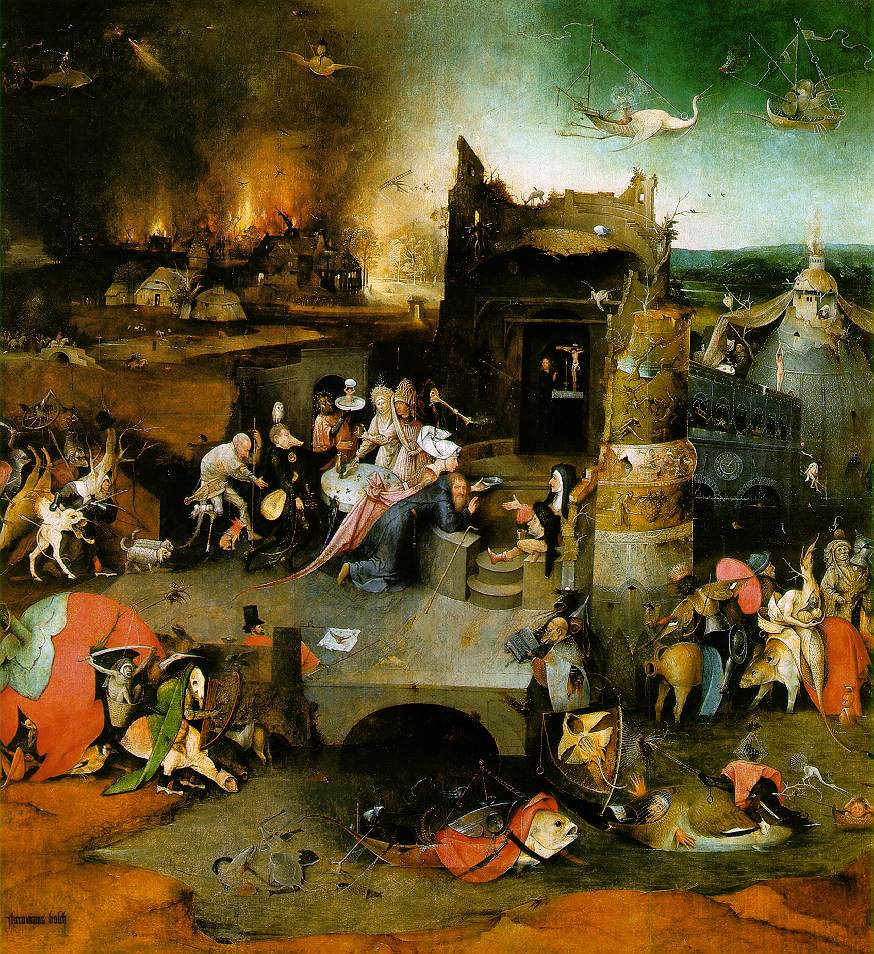
The Temptation of Saint Anthony - Hieronymus Bosch (c. 1450-1516)
Daniel Mitsui gives us a grave reminder at The Lion & the Cardinal:
There is a truth to this so simple that we often forget it: Satan is smarter than us. And he is stronger than us and he is more patient than us. Were he not, we would have no need of a Savior ... Satan hates the Church and he wants us to hate the Church. And he is smart enough and strong enough and patient enough to ruin everything that makes loving the Church easy. He was smart enough to ruin the seemingly immortal Middle Ages, so he is certainly smart enough to ruin the fragile traditionalist movement today ... A Church that is not permanently scarred is not the Body of Christ.Read all of this sober Lenten meditation here.
Wednesday, March 28, 2007
Tuesday, March 27, 2007
Vocational Discernment - Spiritual Direction
 Like magic - a post by Amy Welborn pointed to Aimee Milburn's blog, Historical Christian - Musings of a Roman Catholic Convert and her post On Vocational Discernment and Spiritual Direction, and behold it appears here. Recently the Massketeers have posted and commented on the troubled state of fatherhood and I have indirectly linked one’s calling or vocation to fatherhood with another’s calling or vocation to the priesthood. These are important ‘vocations’ that society has attempted to deconstruct and trivialize. We can help the vocations of fatherhood and priesthood by our reverent participation in the Body of Christ and bringing forth prayers and people seeking discernment and spiritual direction.
So if you are feeling sheepish a solid tool that we can hold out for people is spiritual direction – not only to help with direction for one’s life, but also as a calling or vocation to consider. Just as in my parish, we pray daily for more people to enter the religious life, we can pray for more people to help with that discernment process.
Look for my comment in the link On Vocational Discernment and Spiritual Direction.
Monday, March 26, 2007
Sunday, March 25, 2007
Feeling Sheepish
As one who appreciates a densely packed, diction intense, and aptly turned phrased book, the words of David P. Lang in his book, Why Matter Matters, should resonate with all reasonable and faithful Catholics:
When man's delicately woven biological and spiritual fabric is not respected, when its Creator is not reverenced, then might makes right and hell torments earth.So then, read the following and make your own inferences. Baaaaa, humbug. Things get foolisher and foolisher ...
European (Soviet) Union?
Derk-Jan Eppink, cabinet member of commissioners, has learned the ropes in the European Union. Or, one could say, he has learned how not to be hung by the ropes in the EU. "I have learned all the necessary survival techniques to be a mandarin: intrigue, trickery and deceit," Commissioner Eppink notes.
Of greatest interest, Eppink notes the similarities between the former Soviet Union and the EU here.
Keep the insights of this worldly politician in mind as the Holy Father issues a dire and heartfelt warning to the back of a wayward son trudging off to a far country ...
Of greatest interest, Eppink notes the similarities between the former Soviet Union and the EU here.
Keep the insights of this worldly politician in mind as the Holy Father issues a dire and heartfelt warning to the back of a wayward son trudging off to a far country ...
Saturday, March 24, 2007
Apocalypse in the Balance
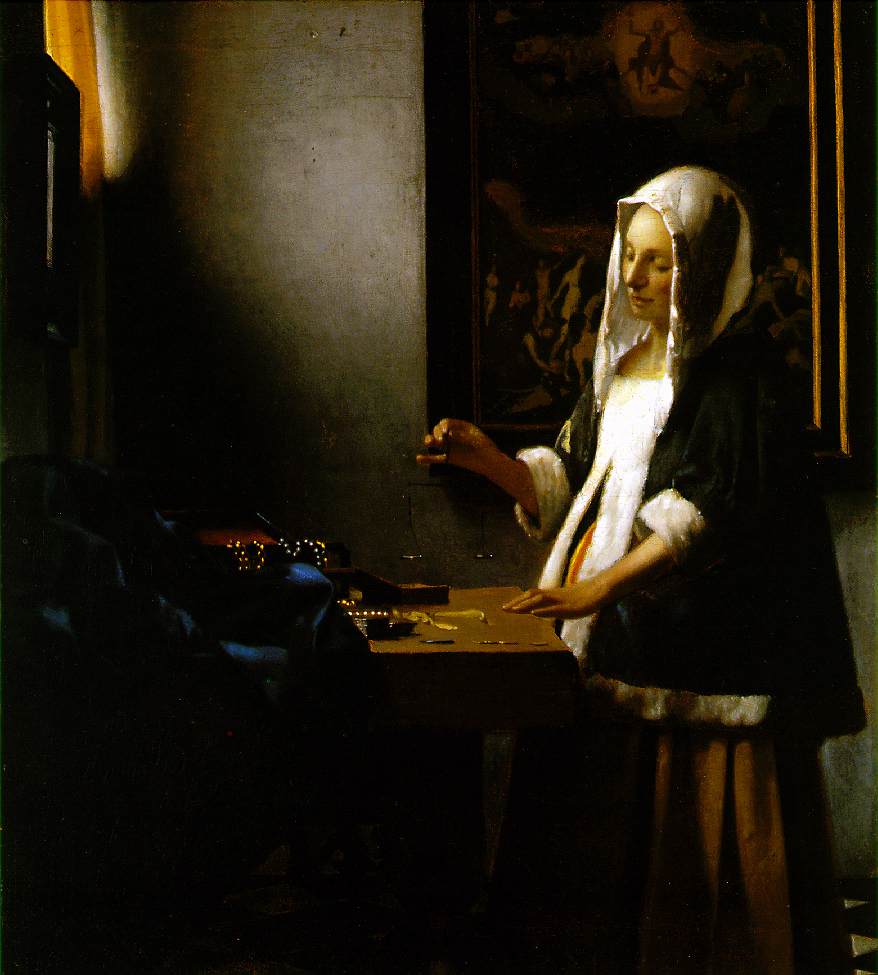 Woman Holding a Balance (1664) - Jan Vermeer
National Gallery of Art, Washington
It has been awhile since we've featured a work by Vermeer, but this one bears a repeat performance. I read an extremely thoughtful analysis by Robert Hamerton-Kelly about apocalypse, Revelation, and, of course, mimetic theory. If you have the time, gentle reader, I commend his explication to you here.
Friday, March 23, 2007
Fatherhood -- Priesthood - Do they go hand-in-hand?
I would like to go back to our inquiry into fatherhood and ask what does fatherhood look like drinking the cup, as in this excerpt from Bailie's talk, Entering the Biblical Story at the Eucharistic Table? Notice how right away he dismisses John the Baptist as a role model.

When we hold up the image of a human father does it reveal a side that fails, at least in all cultural terms? It seems to me that fatherhood is always on the verge of being sacrificed. In other words, his role will often take him on a path of being expelled either by his family or by the culture.
Pulling out another excerpt from the Bailie talk:
 I suggest that fatherhood needs to be looked at in relation - in particular, in relation to the Body of Christ, the Church and priesthood - not independently, as the head of the family, as if we could separate fatherhood and Church. It is actually by way of this separation that we have been able to deconstruct and dismantle fatherhood. I think that what I am saying is that the only real way to define, model and/or re-present fatherhood is through the strengthening of the Church and the priesthood. What do you think?
Is the whole idea of absorbing the tension of the ... (you name it) the family; or of the community; or of the world; is it really a key component of fatherhood?The word (martyr) means to witness. Simply to be the kind of person who when something begins to swirl, when the melodrama gets set in motion, when accusations are made, can we step into the breach and absorb some of that animosity and break up the little knot that is forming?
Not by going in as John the Baptist would do and fighting it back in the other direction. But simply by stepping into that world and absorbing that tension (like the old Rolaids commercial, absorbs 47 times its own weight in access stomach acids…).
Can we be the kind of people that can move into that place, and drink the cup and be part of Christ forgiveness? The world is going to choke on its own unforgivenness if we don’t. That is our role in the world.
It is not forgiveness on the cheap. So it is a subtle process, it requires character and dignity and courage and most of all it requires an enormous moral generosity. So Jesus is inducting us into service for history in a world which is going to now increasingly be deprived of its old mechanism for taking away its own sins on the cheap. He is bringing us into this mission of taking them away in such a way that not only honors our dignity and our freedom, but also rehabilitates us.It has always seemed to me that fatherhood actually is a major ingredient to tension build-up within the family. How does father help others to hear the cock crow AND absorb the tension that the crowing usually results in?

When we hold up the image of a human father does it reveal a side that fails, at least in all cultural terms? It seems to me that fatherhood is always on the verge of being sacrificed. In other words, his role will often take him on a path of being expelled either by his family or by the culture.
Pulling out another excerpt from the Bailie talk:
... Eucharistic Mandate. He says that Christ often calls us to failure, not success just as He Himself was called to the Cross.
“The marvelous religion teacher, the hard working bishop who manages his diocese well, the mother of a family strongly rooted in the faith have done no more works than the dedicated religion teacher whose classroom is like a drudgery, or the zealous and caring bishop whose administration is constantly criticized or the loving mother whose family, despite her efforts, have all abandoned the Church. In many ways the last three have received a higher calling.” (Bailie here quotes from Wm. Riley)
Isn’t that amazing? We are called to move into that place of brokenness and to take up our cross. And to do it in such a way that the world hears the cock crow, and that the world feels the forgiveness of God. And that the world recognizes that we are not doing it on our own, or that we are not doing it because we are nice, or morally superior. We are doing it because Christ has laid His Hand on us.
 I suggest that fatherhood needs to be looked at in relation - in particular, in relation to the Body of Christ, the Church and priesthood - not independently, as the head of the family, as if we could separate fatherhood and Church. It is actually by way of this separation that we have been able to deconstruct and dismantle fatherhood. I think that what I am saying is that the only real way to define, model and/or re-present fatherhood is through the strengthening of the Church and the priesthood. What do you think?
Thursday, March 22, 2007
The 'CNN Effect'
or, An Sophomoric but Accurate Student Video Version of Mark Steyn's Insights into a Spineless West ...
By way of Andrew Cusack, Esq.
By way of Andrew Cusack, Esq.
Life of Mary (Rainer Maria Rilke)

Speaking of poetry, Anchoress directs us to a cycle of poems on Mary's life, translated into English over at
The Cafeteria Is Closed.
Epiphany
Poetry by John Kenna. Permission has been granted by "Cousin John" to post his poetry here.
Epiphany
In the night my flowering apple tree has been changed, has become an angel
dressed in a pink so fine no tongue can lie about it. Maybe it's the hue of truth
or the stuff of the soul. Her blooms stop all my words. A dusky fall of magenta
petals scatter from her limbs like hundreds of cerise birds. As she spreads her
wings to fly, they land on the grass just coming up from winter's lengthy doze.
She speaks an unknown language to the moon. Around her roots the very void
crouches inside itself and begins to brighten into a beauty that comes right up
to my eyes and stops. It is too large to come inside me, too glorious for my
all too human dark, and I must turn and go back down the dusty mountain.
bjk
Epiphany
In the night my flowering apple tree has been changed, has become an angel
dressed in a pink so fine no tongue can lie about it. Maybe it's the hue of truth
or the stuff of the soul. Her blooms stop all my words. A dusky fall of magenta
petals scatter from her limbs like hundreds of cerise birds. As she spreads her
wings to fly, they land on the grass just coming up from winter's lengthy doze.
She speaks an unknown language to the moon. Around her roots the very void
crouches inside itself and begins to brighten into a beauty that comes right up
to my eyes and stops. It is too large to come inside me, too glorious for my
all too human dark, and I must turn and go back down the dusty mountain.
bjk
Wednesday, March 21, 2007
"Unforgiveness"
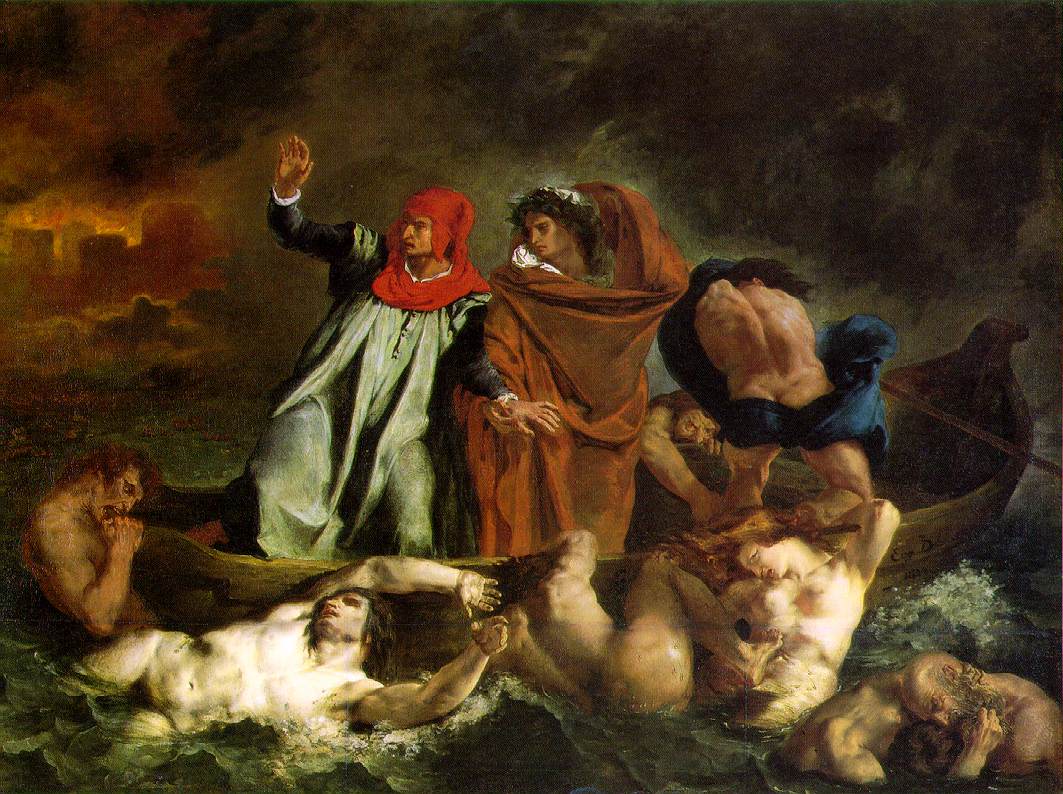 The Barque of Dante - Eugène Delacroix
 1822; Oil on canvas; Musee du Louvre, Paris
The excellent series to which Aramis alluded also speaks to the excruciating problem of the unforgiven. It is not triumphalism on the part of persons who are in a state of grace to say this, just because they know and practice the Sacrament of Penance. The Sacraments are gifts of God for real, living, breathing humans, free but for the recognition of one's sins and the need for absolution, repentance, and expiation. But, of course, this more than implies the need to demarcate sinfulness for what it is, not to attempt to normalize sin and call it "choice", "lifestyle", or "infringement of rights." René Girard says as much in a recent interview when he discusses the Ten Commandments.
The problem of unforgiveness sets up an escalating cacophony in the echo-chamber of our human cosmos. Bailie:
The problem of unforgiveness sets up an escalating cacophony in the echo-chamber of our human cosmos. Bailie:
When we look out and we read the morning paper and we see the six o’clock news, we see ignorance and sin and insensitivity and all the rest of it. And sometimes we establish some kind of moral stance about it. But if we look at it as Christians, what we see is this crying out of this massive unforgiven. All the terrible things ... that are going to happen in the future are going to be committed by unforgiven people. And Jesus, as the [Misfit] in Flannery O’Connor’s short story says, “thrown everything off” by destroying the system that used to take away the sins of the world ‘on the cheap’ at the expense of the scapegoat. And so the unforgiveness festers. And Jesus now is ... giving us another way of taking away sin. The biblical God is not going to take away sin with a wave of the wand. Why?
This has to do with the whole theodicy question, why does God allow all the terrible things in the world. God is not going to take away at the wave of the wand because that would rob us of our freedom and dignity. God wants love and love has to be freely offered. And if you’re going to create enough freedom so that love can be freely offered, you’re going to have to live in a world made perilous by what people do with that freedom. You can’t have it both ways.
God has put all his bets on love and therefore on freedom. And therefore what we do with that freedom can be a catastrophe. But God is not going to take away our sins by robbing us of that freedom, because it would rob us of our covenantal love for our Creator.
How’s he going to take it away, then? He could only take away our sins ... on the cheap by waving a wand, but will take them away instantly if we ask to have them taken away. All we have to do is first recognize our sinfulness, or complicity, that is to say, “Hear the cock crow,” and the key is to ask for forgiveness -- and we can’t ask for forgiveness until we recognize our sinfulness, and we can’t recognize our sinfulness until we go to the pit of that little “machine” which used to wash it away and we suddenly see what we’ve been doing. We hear the cock crow and we have that moment of conversion. So his blood is shed so that sins may be forgiven, not taken away on the cheap -- and be forgiven be a moment of conversion. So his blood is shed so that sins may be forgiven -- not taken away on the cheap -- but be forgiven because we have recognized them and asked for forgiveness. And then, Jesus says, “Take this and drink it. This is my blood.”
Brief Summary on Girard and Anthropology
Following up on the Girard - YouTube post...
Here is yet another excerpt from Entering the Biblical Story at the Eucharistic Table A talk given by Gil Bailie. If you get tired of these just let me know, because if left up to me I would vote that we spend all of our time digger deeper into these talks...
This is from the Q & A segment at the end of the tape.
Q: Can you talk about the mechanism of violence and anthropology?
Gil:
Here is yet another excerpt from Entering the Biblical Story at the Eucharistic Table A talk given by Gil Bailie. If you get tired of these just let me know, because if left up to me I would vote that we spend all of our time digger deeper into these talks...
This is from the Q & A segment at the end of the tape.
Q: Can you talk about the mechanism of violence and anthropology?
Gil:
When the 19th century anthropologist went out, by the way I am talking anthropology – I have a definition of anthropology that I haven’t told you yet. Anthropology is the study of cultures by people who no longer have one. And you will notice that it was invented by the west about 200 or rather 150 years ago. Somebody once said about poetry; don’t write a poem unless you have to and you could say the same thing about anthropology. Don’t invent the science of anthropology unless you have to. We had to about 150 years ago. And the first anthropologists went out and started studying these other cultures and they came back with all sorts of data and they sorted through it and they said ah-ha! All over the place, wherever you look we have these dying and rising gods. We have these stories that are very interesting. There is a crisis; and there is a death; and there is reconciliation or a resolution or some kind of resurrection. They were all Enlightenment people so that means they didn’t know squat about religion, so they had this insight – the insight was Christianity was just another myth. And that idea was so radical at first that only the academics talked about it. That was before academics became famous and had press conferences. Then it trickled out and people started studying these things and it comes into the modern times, and I don’t want to scapegoat because I have read these people and gleaned a lot from their work, but Mircea Eliade, Joseph Campbell and all those people for whom Christianity is just another dying and rising myth. Gradually that language seeps into the church. Only in the last 30 years have we Christians started talking that way; unbelievable that we would talk that way.
Okay, anthropologists said that Christianity is just another myth because it is exactly the same thing as what they discovered all over the world. And we Christians said, no, no, it is not the same thing - ours is different. Oh yea, the anthropologists asked, how is it different? Well,..., ah,…, ah,…, well, you see, nails hurt more or something like that. We tried to account for it in whatever way or we fled the scene. Girard said, NO. You have to begin there. You have to say YES, you are right. If you want to recover Christianity’s universality, you don’t flee from that revelation you a firm it. Yes of course it is structurally identical to all of that. It had to be: it has it be, because all of that is a telling of the story that is false. All of that tells you the story from the point of view of the victimizing community. You get the crisis; you get the death; and you get reconciliation, but you never get the innocence of the victim, NEVER. Christianity presents something that is structurally identical and reverses the whole valence by creating a community of people who come together because they have heard the cock crow; they have seen the innocence of the victim; the scales have fallen from their eyes; they have seen the idolatry of the world and they have begun to see the face of the living God. So it has to be the same. And this is what I was trying to say earlier, when the world says no, we don’t counter that with some kind of over-against: yes, yes, yes – no, no, no like some chant in the school yard. We go deeper into the mystery until we can bring up an affirmation that brings in that negation that can affirm that negation itself, which is exactly what happened in this example of Girard saying yes, it is the same.
Casting the First Stone
 The Woman taken in Adultery (1644)
REMBRANDT [1606 - 1669] - National Gallery
“Let the one among you who is without sin
be the first to throw a stone at her.”
Again he bent down and wrote on the ground.
And in response, they went away one by one,
beginning with the elders.
So he was left alone with the woman before him.
Then Jesus straightened up and said to her,
“Woman, where are they?
Has no one condemned you?”
She replied, “No one, sir.”
Then Jesus said, “Neither do I condemn you.
Go, and from now on do not sin any more.”
be the first to throw a stone at her.”
Again he bent down and wrote on the ground.
And in response, they went away one by one,
beginning with the elders.
So he was left alone with the woman before him.
Then Jesus straightened up and said to her,
“Woman, where are they?
Has no one condemned you?”
She replied, “No one, sir.”
Then Jesus said, “Neither do I condemn you.
Go, and from now on do not sin any more.”
This Sunday's Gospel reading from John chapter 8 is, by some biblical scholars' estimation, lucky even to be included in the canonical New Testament. But the councils of the late fourth century were more than wise to include this pericope. The entirety [Jn 8, 1-11] shows the breadth and capacity of the mercy of the Word made flesh, Jesus Christ who, as Saint Augustine points out, is always revealing to us the nature of the Triune God, Father, Son, and Holy Spirit.
We recognize the crowd bringing the woman to Jesus. We know them like the back of our hand; we may even be implicated by similar scapegoating, self-righteous behavior. The same old same old. Yada, yada, yada.
But in Jesus we see goodness, forgiveness, grace for fresh starts, and a twinkle in the eye that does not, in turn, reject and scapegoat the scapegoaters, but rather offers One who stands with the victim in the tide of the onslaught of the unforgiven.
We recognize the crowd bringing the woman to Jesus. We know them like the back of our hand; we may even be implicated by similar scapegoating, self-righteous behavior. The same old same old. Yada, yada, yada.
But in Jesus we see goodness, forgiveness, grace for fresh starts, and a twinkle in the eye that does not, in turn, reject and scapegoat the scapegoaters, but rather offers One who stands with the victim in the tide of the onslaught of the unforgiven.
“Neither do I condemn you. Go, and from now on do not sin any more.”
May each of us follow our divine Model, Master, Friend, and Savior -- Offer mercy and steadfast love [agape, hesed] this Lent. Make a friend. Be a friend. Bring a friend to Christ. Or sit with a friend at the feet of Christ and enjoy the "one thing needful" together. +Tuesday, March 20, 2007
Nabucco - Verdi

Porthos seemed to be begging for some culture, some art, or classical music. Well, here you go...and see how beautifully it connects back to the Mass.
The first reading this morning 3/20 is from Ezekiel (47:1-9,12) as he tells of a hopeful vision for a people in exile. Father Gregg, in his homily, relates the story behind the opera, Nabucco by Verdi. Link here.
Sit back and enjoy. Click here for the synopsis of the opera.
Protestant Stations of the Cross

offered here by Dr. Mark Roberts. Because no such good inclinations should go unlinked.
Hat Tip: Hugh Hewitt
Monday, March 19, 2007
Girard and Vattimo Exchange (You Tube)
The alert Athos directs us in the comment boxes to an excellent You Tube exchange between the philosopher Gianni Vattimo and René Girard. It runs just under 100 minutes, and is mostly (except for Girard's answers) in Italian. This is linked from the COV&R 2007 site.
Sunday, March 18, 2007
Fr. Phil: "You WIll Betray Christ"
Fr. Phil's homilies not only pack a punch, but also induce visits and admiring comments from cool ladies. I have no reason to believe that his homily from the 4th Sunday of Lent will be any different:
Can you smell the wood of the cross from here? It’s still too far to see…just the smell of it is closer. Just about eighteen days more in this desert and we will be there to see him nailed to the wood. Then it will be the scent of wood and blood. Maybe vinegar and sweat as well. And some stinging smoke from the trash fires. And more caking dust. Will you run with the disciplines from Gethsemane? Will you walk with him along the sorrowful way and jeer with the other invisible bodies, adding your cowardly squeak to all the other taunts and cries from those he loved and fed and healed? Will you deny him to protect your safety, to conceal your once-professed love? Will you betray him? Of course you will. And so will I. It is what we do when given the choice to die for a friend or live for a cause. These moments of truth-telling make prudence easy and courage foolish. Praise God then that He does not wait for us to come to Him but rather comes to us first. His memory is holy and ours in need of sanctification.
Paul teaches the contentious Corinthians that “…God was reconciling the world to himself in Christ, not counting their trespasses against them and entrusting to them the message of reconciliation.” So, we are forgiven and then given the ministry of forgiveness to spread in the world, the work of bringing together those split apart, broken under, distant and made alien. The first reconciliation is with God. No other bond of friendship or love makes the least bit of sense outside the bond of love that our Father has for us. That we love is His doing. We cannot love without Him. And without love we can know nothing of Him or His creation—nothing about ourselves, others, or the things of this world. Just beyond the moment of creation itself, to be reconciled to God through Christ Jesus is the primitive move of love. Nothing stands before His love and remains broken, sick, injured, lonely, or distant…nothing, that is, but the stubborn refusal to be loved.
And why would anyone refuse to be loved by Love Himself? To be loved by God is to be changed forever. Clenched fists, an obstinately set jaw, a cold-heart do not easily release control to airy promises of safety and bliss. Even divine promises of safety and bliss. This an anxiety so profound that the Legions of Hell are frightened for us—even they believe! But we are capable of choosing still whether or not we will be changed forever by our desire for God or left squalling helplessly in our mulish refusal at the door to eternal darkness. There are worse choices than betrayal. There is the decision against love. And then crippling despair.
Though reconciliation with God is first, it is not the only reconciliation required of us. To love God is something too easily left in the world of forms, the merely abstract gesture of good will toward divine being. Something more concrete, more worldly is required of our love. We must be reconciled to one another in Christ. The Prodigal Son returns to a party thrown in this name. His father welcomes him home without reservation because he is the father’s son. Despite the son’s gross irresponsibility and near criminal immorality, the father opens his arms to receive the wretch, drapes him in his finest robes, slaughters a fat calf, and celebrates the feckless life of this reprobate. Sorry. I’m with the obedient brother on this one. Why the celebration? The natural consequences of the son’s irresponsibility are absolutely just. He wasted his inheritance, scattering it like seed on sand, and reaped the bitter harvest. He deserves his fate. Yes, exactly, he deserves his fate and his father’s harsh judgment! But he receives mercy, forgiveness, and a welcome home party. He is reconciled in love b/c he was dead and now lives. B/c he was lost and now he is found. Our faith is about excess and waste, overflowing love and beautifully squandered gifts. There is nothing pretty or genteel about the cross. Nothing efficient about the empty tomb. Love reconciles like a thunderstorm soaks dry earth.
We will betray Christ before he reaches the cross. Despite our fervent fasting and pristine prayers, despite our honest intent and good will, despite everything we did, do, and will do during Lent, we will come to the decision that it is best to live for the cause than to die for our friend. And we will go on…to be reconciled to God, to one another, and to become the ambassadors for Christ that Paul urges us to be. We will remember our betrayal as a sign of weakness, anxiety, sin. We will recall again and again the exact moment we did not speak up for Christ, the exact moment we let some insult to his faith slide by, the exact moment we chose to be his enemy dressed as his friend. We will remember when we choose to blend in with the crowd, to throw a stone or two on the sorrowful way, to shout a curse at his stripped and bleeding back. We will remember our betrayal. But he won’t.
Can you smell the wood of the cross? There are many more steps between here and now and the foot of the tree. The hot sand blows stinging hard and everything and everyone you’ve left behind calls to you out of friendship to come back. What’s ahead after all? Blood, bits of flesh, spit, gall, deception, cruelty, violence…your betrayal of a friend. You can turn back now. Do it. Just for a second. Look back to Ash Wednesday. What do you see? Hot promises? Eager intentions? A hunger for holiness? I’m going to do it this time!? Sure. And will you? Not likely. You’ll make it to the cross alright. But you won’t make it there any holier than when you left on Ash Wednesday. Do you think the purpose of Lent is to make you holy? Holier? The purpose of Lent is to show you your need for God. You will make it to the cross b/c God wants you at the cross. Holy or not. Your dieting and fasting and fussing about prayer and alms are at best distractions if they don’t serve to clear up God’s will for you: smell the wood, then see the wood, then taste it. Then feel it against your skin, your hands, your back and feet, feel it—burning, wet, raw, sharp. You are Christ. Lent is not your time to flee from weakness and temptation. Run to them! Lent is your time to pray like the Prodigal Son, “Father, I have sinned against heaven and you, I no longer deserve to be called your son…” And then wait for God the Father to forget your sins and drape you in His finest robes and slaughter the fattest calf to welcome you home again.
Sniff the air. The cross is coming closer. The cup is full. Will you drink from it? Or will you pour it into the desert sand?
Huhlariuss Myoozahkull Hyjinks
are embedded by Anchoress here. Lotta fun. Athos might appreciate the Scottish riverdance halfway through the second one.
These put me in mind of the beloved PDQ Bach, who (I find) is sadly under-present at You Tube.
These put me in mind of the beloved PDQ Bach, who (I find) is sadly under-present at You Tube.
Saturday, March 17, 2007
COV&R Conference
I am rather impressed by the focus and scope of the 2007 Colloquium on Violence and Religion (COV&R) conference in Amsterdam. It seems to me that the organization is finally living up to its name post 9/11. Maybe Fr. Andre Lascaris has something to do with this one.
Fatherhood as part of the forgiving mission of Christ
Can we image fatherhood in terms of the forgiving mission of Christ rather than some retro man of the past?
Another excerpt from Entering the Biblical Story at the Eucharistic Table
A talk given by Gil Bailie
Another excerpt from Entering the Biblical Story at the Eucharistic Table
A talk given by Gil Bailie
I want to talk about the Last Supper...
So Jesus has very little time. He gets to Jerusalem and it looks like the hour is approaching. There is no more time for sermons – there is no more time for explanations – there is time for very little, what is he going to do? It is very important to Jesus that he leaves them capable of receiving the truth, which will be available to them after the cross. So what does he do? He has a pass-over meal. And the pass-over meal is about getting out of Egypt. Some of what I am going to do below will be in a campy/Monty Python way…, but I think that there is something incredible here that we have not come to grips with.
I am going to reverse the order – let us start with the cup. He takes the cup and He says, “This is the cup of my blood which will be shed so that sin may be forgiven.” He is interpreting the cross. This is the cup of my blood, which will be shed so that sins may be forgiven. Now remember, when Jesus shows up, we humans have always had a way of taking away sins. We take away sins by putting it on the back of our scapegoat, getting rid of it and feeling righteous. Jesus is about to destroy that way by showing us the face of the innocent victim. What happens if he destroys that system and walks away and does nothing else? What happens, and in some extent is what is happening, which is, we begin to choke on our own unforgivenness, which is a synonym for resentment and virtually a synonym for sin. Unforgivenness, the world is filling up with unforgivenness. When we look out and read the morning paper and we see the 6 o’clock news we see this ignorance and sin and insensitivity and all of the rest of it. Sometimes we establish some sort of moral stance about it, but if we look at it as Christians what we see is this crying out of this massive unforgivenness...all the terrible things that are going to happen in the future are going to be committed by unforgiven people.
And Jesus has thrown everything off by destroying the system that used to take away the sins of the world on the cheap at the expense of the scapegoat. And so the unforgivenness festers, and festers. Jesus is now giving us another way of taking away sin. The Biblical God is not going to take away sin with a wave of the wand. Why? This has to do with the whole theodicy question, ‘why does God allow all the terrible things to happen in the world?’ God is not going to take away sins by the wave of the wand because that would rob us of our freedom and our dignity. God wants love and love has to be freely offered. And if you are going to create enough freedom so that love can be freely offered you are going to have to live in a world made perilous by what people do with that freedom. You cannot have it both ways. God has put all his bets on love, and therefore on freedom and therefore, what we do with that freedom can be a catastrophe, but God is not going to take away our sins by robbing us of our freedom because it would rob us of our covenantal love for our Creator.
How is He going to take it away then? He will take them away instantly if we ask that they be taken away. All we have to do is, first of all recognize our sinfulness, our complicity, that is to say, hear the cock crow and ask for forgiveness. The key is to ask for forgiveness. And we can’t ask for forgiveness until we recognize our sinfulness. And we can’t recognize our sinfulness until we go to the pit of that little machine that use to wash it away and we see what we have been doing. We hear the cock crow and we have that moment of conversion.
And so His blood is shed so that sins may be forgiven, not taken away on the cheap, but forgiven because we have recognized them and asked for forgiveness. And then Jesus says, “Take this and drink it. This is my blood.” He goes back to the question which Jesus asked about His own passion when people asked him, ‘who is going to sit at your right hand?’ He asks, “Can you drink the cup that I am going to drink?” That question is asked at the end of Mark’s Gospel – at the Eucharist in Mark’s Gospel it said He gave them this cup and they all drank of it, and they all died a martyr’s death. It is that kind of implication.
In the Eucharist we are offered that cup, why? It is because we are incorporated into the forgiving mission of Christ. When Jesus says in Matthew’s Gospel, you have the keys to the kingdom whose sins you forgive, they are forgiven and whose sin you retain, they are retained - we should understand how significant this statement is. It seems silly to introduce a baseball metaphor at this point, but if a pitcher lets a couple guys on base and the manager decides to put in another pitcher, and somebody gets a hit and those guys come in, they are on the ERA of the pitcher who got pulled out. When Jesus says, whose sins you forgive, they are forgiven, whose sins are retained; they are retained. He is saying, I think, all the unforgivenness that you could have solved and didn’t is on your ERA – it’s on your record. You are in charge of all the unforgivenness that you could forgive and don’t. Can you drink this cup? Can you drink this cup? What does it mean to drink this cup in order that sins might be forgiven?
All this means, I think, is that we must be able to step into that place, not that we are going to become martyrs, most of us do not have the courage for it, but martyrs in another way. The word means to witness. Simply to be the kind of person who when something begins to swirl, when the melodrama gets set in motion, when accusations are made we can, at the risk of our own reputation, our own standing in the community, our own livelihood whatever it happens to be, can we step into the breach and absorb some of that animosity and break up the little knot that is forming? Not by going in as John the Baptist would do and fighting it back in the other direction. But simply by stepping into that world and absorbing that tension (like the old Rolaids commercial, absorbs 47 times its own weight in access stomach acids…). Can we be the kind of people that can move into that place, and drink the cup and be part of Christ forgiveness? The world is going to choke on its own unforgivenness if we don’t. That is our role in the world. This is not cheap forgiveness. The forgiven one has to hear the cock crow, and we shouldn’t go around being lily-white liberals that we are forgiving easy and never being part of the cock crowing. People have to hear the cock crow - we have to hear it. Jesus, when He forgives people, He always says, “go, and sin no more.” It is not forgiveness on the cheap. So it is a subtle process, it requires character and dignity and courage and most of all it requires an enormous moral generosity. So Jesus is inducting us into service for history in a world which is going to now increasingly be deprived of its old mechanism for taking away its own sins on the cheap. He is bringing us into this mission of taking them away in such a way that not only honors our dignity and our freedom, but also rehabilitates us.
John Fleming Interview (podcast)
Anchoress points to a neat interview with Middle Ages scholar John Fleming, conducted by Fausta.
Transcript here.
Transcript here.
Subscribe to:
Posts (Atom)