*******Squaring the Circle of Our Rad Trad Catholic Girardian Conserberalism******* all 4 1 & 1 4 all
Monday, September 24, 2007
The Death of Reason
I beg my brother Mass'keteers' pardon. I fully intended not to post again until one of them posted, but Gen at Real, Clear Religion had this essay -- The Death of Reason -- by Alisa Craddock that is so fine, I beg the indulgence of all who are tired of seeing "Athos" at the bottom of postings.
And Aramis reminded me some time back of this fine compendium of Belloc's works by Matthew Anger, ” A Reader's Guide to Hilaire Belloc.” It is well worth a visit.
Sunday, September 23, 2007
Back to Barbarity ... Or Repentance
God's Kingdom or Apocalypse?Ken Burns' new documentary, The War, premiers tonight. Is this good news, or bad? The Washington Post says today that near the end, "the camera lingers for a full 40 seconds on the image of a dead U. S. Marine on Iwo Jima. Face up, arms splayed, teeth bared, he is as grotesque as a man forever young can be."
One effect of such truth telling (the deconstructing of the mythology of war's "glory") to a generation that lacks true transcendence is to heighten the dread -- the religious awe -- the human heart feels toward death. Hit the pause button: "What is true transcendence?" one must ask. (1) First, it is a certitude that every single human being is eternal (for good or ill), and that biological cessation of life is not our terminus, our end point, our telos. (2) Secondly, it is a faith-filled hope that such knowledge is based on our peculiar nature; namely, that we are created imago dei -- in the image and likeness of God -- and that peculiar nature is not affected by death. And (3) thirdly, by virtue of that nature and relationship to God (for Christians, by God's grace through faith in Jesus Christ) our sufferings and deaths have meaning and purpose in the "economy" of God's Kingdom. "O Death, where is your sting?" we can say with Saint Paul.
But, you see, here lies the problem. Staring at the realities of life and death from the point of view of one whose "operating system" includes the above is one thing. Staring at them without the benefit of such faith produces and reduces humans to a far different level of being. It, in fact, brings the most stout-hearted atheist (literally, one without God) to the level of a modern primitive who has to function without the benefits of the revealed biblical faith that had been at the heart and soul of the Christian West until the first fissures appeared during the so-called "Enlightenment".
One might say that the endless project of Hollywood to create images of ever more violent scenarios, the "reality TV" efforts to throw people (down to "Kids Nation") into rivalries and bloody death-dealing mayhem has the effect of demoralizing a West made weak by its cowering awareness of the power of death. Death has become the 'new sex,' so fascinated have we become by it, awed by it, stunned by it, with demonstrable effects: enervation, low birth-rates, nihilism. The West's new motto: "What's the use?" So, I ask again, "Is the premier of Ken Burns' The War good news or bad?"
As the stars would have it, the West has a self-appointed rival and enemy that is decidedly not so enervated by the power of death. Indeed, it seems to thrive on such power, because its O/S leaves room for a parody of the Bible's Heaven -- however laughable its 72-virgins version may seem to us. Indeed, the West's enemy thrives on the West's a-theistic fears of death. Time was, the West knew that there were worse things one could do to a person than kill him, and ,conversely, there were worse things that could happen to one than to be killed. But now, such documentaries, no less than Hollywood's unholy fascination with death and other elements of the primitive Sacred, help create paralyzed, cowering, and rather spineless masses who believe nothing (defining "nothing" here is simply a laundry-list of priorities and values of modernist vapidity).
To such masses in the West, perhaps a scimitar-wielding overlord is what will be necessary. "Necessary for WHAT?" you may ask. Necessary, as Israel discovered during the Babylonian Exile, to repent and return to its precious, revealed faith in the steadfastly-loving, covenant-keeping God of Abraham, Isaac, and Jacob. Necessary today for us to repent and return to the God in Three Persons, the Most Blessed Trinity: Father, Son, and Holy Spirit.
What's With Kids These Days?
Teach the apostolic faith full on…no compromises on basic doctrine or dogma. This generation of college students can smell an intellectual/spiritual weasel a hundred miles away. They would rather hear the bald-faced Truth and struggle with it than listen to a priest/minister try to sugar-coat a difficult teaching in the vain search for popularity or “hipness.”
Fr Powell's full article here.
Saturday, September 22, 2007
"Fire Starters" - Picking a Fight?
Gil Bailie says in his tape series on The Gospel of John, "…For us moderns, we will become acquainted with the power and uniqueness and singularity of the Christian gospels the more so that we see them in anthropological terms. And seeing them thus will not in any way diminish their spiritual implications for each of us. As a matter of fact, quite the contrary, I feel. But to shift from a kind of theological to an anthropological entrée to the gospels, I think, is called for in our time …" [12A]
A sad truth is that when a "sacrificial preparation" reaches a certain level of social and psychological turmoil, both individuals and groups will bifurcate, like cells dividing, into mimetic rivals or "doubles". This is a distinguishing feature of the "Sacred", anthropologically speaking. With no prior knowledge of mimetic theory, one can see this on the personal level when a colleague, co-worker, family member seems not able to "come alive" except when there is agitation, rancour, or hurt feelings in the air. The Sacred has a vast power over fallen human consciousness and behavior.
Witness your own feelings when you view these pictures – not obscene, but troubling. One can easily see and feel how strong are the mimetic forces at work in our world today. And, I hope and pray, one can feel the utter need for the vastly more powerful sacramental power of love (hesed, agape, charity) made possible through the grace of God through faith in Jesus Christ.
The time is coming, I fear, when it will take every ounce of sacramental grace, acting through the theological and cardinal virtues to fight against the doubling rivalry such persons -- the true "slaves of Allah" (or the primitive Sacred) -- in respect and honor and love.
He Just Wants to Have His Say ...
The Spirit of the 4Ms
If you, gentle reader, ever have access to the Three Musketeers (1973) and/or Four Musketeers (1974), and a free evening, pop the popcorn and relish one of the truest expressions of brotherhood, folly (as in Erasmus' In Praise of …), and gallantry. Michael York, Frank Finley, Oliver Reed, and Richard Chamberlain do nearly as good a job representing D'Artagnan, Porthos, Athos, and Aramis as the Mass'keteers .... All 4 1 & 1 4 All +
BXVI - Lightning Rod
Benedict XVI comments on terrorists' use of violence in God's name. The Holy Father also seems to be speaking as The Man about repressive and abusive treatment of Christians in nations under Shariah Islamic law. The entire text of his speech to the Centrist Democratic International here.Apparently the Holy Father does not mind being the lightning rod for those who like to throw a pagan deity's lightning bolts. Speaking the truth carries a price. Thank God for him!
Friday, September 21, 2007
Derb, Islamophobophobe
Mass'keteers make list of Wealthiest Americans

Opening to Yahoo this morning, I see my buddy Bill Gates' mug above the article of the wealthiest of the wealthy, and was shocked that neither Porthos, Aramis, Athos, or myself, made the list. Everyday I get to receive the Savior of the world in the Eucharist, and I must ask, what is of more value than that?
If I were allowed my own list of the richest people I know, many don't have two penny's to rub together, and if they did, they'd be the first to give'em away to someone in greater need (and there is always someone in greater need!).
It is oddly fitting that this article comes out on Saint Matthew's feast day, as he is a great example of the rich getting richer . . .God's way!
Thursday, September 20, 2007
The Gift of the Self (tape 12 excerpt)
When we are at the foot of the cross, we are standing at the very place where the old anthropology came into being. All of our social and psychological reflexes are programmed to have us emote toward that event in such a way as to reconstitute the old anthropology. So if we simply show up at the scene and the (Holy) Spirit is not there (or we have our ears plugged so the Word cannot penetrate) to inform us on how to respond to it we will simply put our fists in the air and say, "right on" as we do away with one more heretic or one more blasphemer or one more insurrectionist. It (the cross) is so close to the scene at the source of the old anthropology that it is very easily turned into precisely that again. So the Spirit has to be there. Gil Bailie
Aramis here: The key to becoming fully human, and thus not falling into the soap opera of mimetic entanglements that lead inevitably to the sacrificial killing, is grounding ourselves in Christ. For those who choose to turn away or rebel against Christ - as they will find themselves in the midst of another killing event, they will have no model to follow to instruct how to finally turn this long page of history. This is all linked to what it means to be a person.
Personality is essential to man. This truth becomes clear, however, and can be affirmed only under the guidance of Revelation, which related man to a living, personal God, which makes him a son of God, which teaches the ordering of His Providence. When man fails to ground his personal perfection in Divine Revelation, he still retains an awareness of the individual as a rounded, dignified and creative human being. He can have no consciousness, however, of the real person who is the absolute ground of each man, an absolute ground superior to every psychological or cultural advantage or achievement. The knowledge of what it means to be a person is inextricably bound up with the Faith of Christianity. An affirmation and a cultivation of the personal can endure for a time perhaps after Faith has been extinguished, but gradually they too will be lost. Romano Guardini
Aramis here: Christians themselves, must come to understand that Christianity is not just another religion in the list of world religions. God has blessed each of us with His Son so that we may give our lives back to him in praise, worship, and obedience - not only choosing, but also being a witness to Life. (BTW: To me, in response to Athos' post on Shangri-la I have come to see it not as a place, but a state of being - being a person. In my bouts with stroke, divorce and cancer I have had the blessing to experience, if only in small glimpes - I have come to witness to Life and I think it beats out any Shangri-la imaginable.)
Wednesday, September 19, 2007
Searching for Shangri-La
Regardless, when one considers the loss of sub-creations, in Tolkien's parlance, whatever the source, at the hands of those caught in the fearful symmetry of the primitive Sacred, one wonders and dreams of such a place as Shangri-la. Is it a merely a playful fantasy, a parody of being, finally and eternally, in the presence of our greatest desire, the Beatific Vision? Or, is it a valid goal amid the terrors and destruction of conventional culture? Even Tolkien's Rivendell was not a place in Middle Earth of final security for the elves, let alone mortals in his Lord of the Rings.
What grieves my heart, teaching the young through out the school year as I do, is how, seemingly, the young have given up any vision of truth, goodness, and beauty for a compromise: the quick and funny for Truth; the fascinating for the Beautiful; the immediate satisfaction for Goodness. How can they develop a taste for anything other than these poor parodies when their "taste buds," so to speak, are burnt out by the mere spicy and sensory overload of image and "music" (?) of pop culture? And that is among the western young whose greatest influences are neo-pagan. What of those whose models more emphatically laud blood sacrifice and destruction as a "good" worthy of paradise?
Shangri-La looks more appealing to me these days, even as it recedes farther into the realm of mirages. But our hope is that every person who pledges fealty to the one Lord, Jesus Christ, will, by loving the LORD our God with all of our heart, soul, mind, and strength -- and our neighbor as ourself -- by doing so, will be a witness, and indeed an outpost of truth, goodness, and beauty. Only by remaining at-one with the True Vine [Jn 15] do we have a prayer of helping others into God's civility and sanity.
Each is Responsible for the Salvation of the Other - Mimetic Theory
The pope continues his teaching on the Fathers of the Church, from Asia News Italy:
“Well prepared married couples close the door to divorce”: this urges the necessity of a Christian formation from early childhood. It is also the “most current” lesson of “the authentic presence of Christian lay faithful in families and in society” which comes from St John Chrysostom and which Benedict XVI indicated to the 20 thousand people present at the general audience.
And from the family it follows on that each one of us “is in some way responsible for the salvation of the other, this is the principal of our social life: not being only self-interested”.Mimetic theory teaches that the more we are self-centered and only interested in ourself the less ontological density we have and the more prone we are to falling into the mimetic entanglements of rivalry and violence. So not only from the moral and social levels does Church teaching make sense, but also from a psychological level as well.
Prove It: You -- Looks Like a Great Book from Amy Welborn
Then I move on to honesty, not only because this is a fundamental component to the life of a Christian, but because my experience with teens tells me casual, pragmatic dishonesty without a shred of guilt is a huge problem.Is this, "pragmatic dishonesty without a shred of guilt" not also a huge problem with us adults as well? Where do the youth pick up this dishonesty without guilt but from their models?
600-Pound Gorilla
I drove down the main street of our northern Virginia city, stopping and starting at the untimed and planned-for-inconvenience traffic signals. While waiting for the light to change, as always, I looked in my rear view mirror to see what the driver looked like in the car behind me, in this case a nondescript minivan.I looked and tried to focus. Hmm. A shadowy outline, short – am I seeing the outline of the headrest, or that of the driver’s head? Two young ladies walked by our vehicles on the sidewalk, talking to one another pleasantly, dressed appropriately, I thought, for perhaps one of the last warm evenings before autumn lowers the evening temperatures: short jean skirt for one, sleeveless blouse for the other.
There was head motion in the driver’s seat of the minivan behind me. Ah, that driver is noticing the pedestrians too, I thought. The head turned a full 45 degrees to look at the women strolling by our cars.
Wait. Yes. Ah, now I see. The driver behind me is wearing a burqa – dark in color, no more than an inch of opening (allowing for full range of vision – necessary for northern Virginia driving). Now I understand why I couldn’t see more than I usually can make out of the person driving behind me (not that I am a rear view mirror “starer”). I continued scanning around, waiting for the light to change. It all took, perhaps at most, fifteen seconds. I went my way to – all right, I admit it – Starbucks. And she turned right and went her merry way.
How do you tell a billion people with a kind of collective chip on their shoulder that you don't care for their taste in women’s fashion? Understanding of the deity? Knack for producing cradle and convert whackos who seem to thrive on the bloody deaths of their – and their deity’s -- perceived enemies?
Some people call them names, like Theodore Dalrymple, who calls them the ”Marxists of our time.” But that metaphor just won’t wash, really. It won’t do to try to conflate atheists with raving monotheists with a penchant for literalistic bibliophilia. Some roll over, play dead, and acquiesce to their taste in women’s fashion, for example. But that won’t do either, and it won’t placate in the long run.
I used to laugh at a joke when I was very young: “Where does a 600-pound gorilla sit? Anywhere he wants.” Folks, we have a billion-pound gorilla to learn to deal with, and he is very opinionated.
By the way, I wonder what the driver behind me was thinking of that short skirt and that sleeveless blouse walking by our cars?
Humble Confidence
A lady and saint that we Three -- and, I hope, we Four -- Mass'keteers have continuously held a torch for, St. Thérèse of Lisieux.The author is Rev. Jean C. J. d'Elbeé, a French retreat master who has been profoundly affected by Saint Therese of the Child Jesus’ “little doctrine” He made it the subject of ten spiritual conferences contained in his book I Believe in Love. In the form of a personal retreat, he explains St. Therese’s teaching about confident love, leading readers to a profound personal encounter with Jesus Christ. Through his reflections on Therese’s life and teaching, Fr. d’Elbee unfolds for the reader the inner meaning of the psalmist’s cry, “Lord, You have opened my heart, and I run in the way of Your commandments.”
Tuesday, September 18, 2007
Reflecting Praise

First, I am more than a little humbled to stand next to these three men of God, especially in that they are all men of even a greater humility.
Fighting back instincts to try to overly impress on my first post, I thought I would link to our mutual friend Dawn Eden's recent article on the 10 1/2 Reasons to be Chaste, as the 1/2 is a reference to a comment of mine she quotes in the article (it was to be called 10 Reasons .. .,originally).
A friend of mine offers another sobering thought: If you have sex outside of marriage, what you're really saying to your sex partner is, "I wish you hell."
I came up with that statement after a lot of thought and prayer dealing with a young man I was counseling about his upcoming engagement. The two kids involved are both Christians, but in this "try it before you buy it" oversexed society of ours, my friend was worried that things might happen between engagement and the actual wedding.
After we talked about his job as husband being that to help his beloved get to heaven, I reminded him that taking her through hell first (a sexual act being a mortal sin) most likely wasn't the best route.
Dawn's article, as usual, is full of good advice from one (like myself) being restored to purity by the love of our Father, and the Truth of His word.
... man confronted a decision ...
Classical man only lived before that crisis which was the coming of Christ. With the advent of Christ man confronted a decision which placed him on a new level of existence... With the coming of Christ man's existence took on an earnestness which classical antiquity never knew simply because it had no way of knowing it. This earnestness did not spring from a human maturity; it sprang from the call which each person received from God through Christ. With this call the person opened his eyes, he was awakened for the first time in his life. -- Romano Guardini, The Persistence of Christian Signs in a Secularized Society
... man confronted a decision ...
Decision: to decide - from O.Fr. decider, from L. decidere "to decide," lit. "to cut off," from de- "off" + cædere "to cut" -- Meaning that we can't go back; we, that is humanity, have cut ourselves off from our pre-Christ existence; we were called out, we were awaken through Christ to a new being.
The magnetic pull ("negative" mimesis) to fall back to an instinctual self-preservation existence has been unveiled to us by the cross; it is our attraction to the cathartic. Our new being, directed by the Church where grace perfects nature, is instead a total surrender and faith in God coming to life through Christ ("positive" mimesis).
The Church provides daily access to this total surrender -- the Mass. And it is by way of our response to God calling us out to participate through our vocation as He has set before us, in our time and place. There is hardly a more significant act we, the human, participate in then the listening for and responding to our call. (Have you done your listening and responding for today?)
So we must defend, nurture and protect this call (to vocation) for ourselves, for others and for generations to come. How do we do that? SURRENDER! Surrender, putting on the armor of Christ, and become warriors for God during this time of turmoil. If we think we could get around this choice we are wrong for the only alternative is surrendering to the pagan vestiges and the cathartic, re-generating violence of conventional culture and religion, and since the Cross of Christ this works less and less effective, requiring more and more violence.
So the word for today is surrender - and getting your anthropology right is crucial for it is a choice -- we either give ourselves over to Dionysus or surrender to Christ.
Today's meditation of the day featured in the Magnificat seems appropriate.
Meditation of the Day
Why Jesus Tells the Woman Not to Weep
Over and over again we are faced with our inability, incapacity: we struggle to reach God, but in vain. But then, when we are exhausted – precisely in the midst of this exhaustion, this failure – we experience that it is he who has come to us. Exhaustion as the “rustling sound” in which God is to be found (Elijah!)
How could weakness be an obstacle? Weak armies are easily defeated, weak fortresses easily overrun, provided they are smart enough to capitulate. Otherwise they are also stormed, but not before they have been shot to pieces, much to their own detriment. In conclusion: learn how to surrender!
Father Hans Urs Von Balthasar (+ 1988) was an eminent Swiss Catholic theologian who wrote prodigiously.
Monday, September 17, 2007
Update - American Doubling Rivalry
But I'm not writing about Zorkot. That ad hoc "priests" find themselves "called" to sacrifice others (recall what Old Testament priests did to blood offerings at altars, not the announcement of "self-sacrifice" by priests on Stewardship Sunday) should not come as a surprise to anyone. Rather, I'm writing about the knee-jerk doubling mimesis that is tempting to Westerners still under the influence of the Gospel and, more especially, to those who are not. A blog I will not name has this quotation/slogan in its masthead:
to spit upon his hands, hoist the black flag,
and begin slitting throats"
-- H. L. Mencken
And here is where, for men of good faith, we must rely on the power of grace -- in prayer and sacrament -- to keep our focus not on those who would engage us in a mimetic rivalry of a global scale, but on the Lord of life. Our Holy Father will guide us, for our vocations are empowered from within the Catholic Church, and from nowhere else. And we will, as the old gospel chorus says so truly:
Look full in his wonderful face
And the things of earth will grow strangely dim
In the light of his glory and grace.
+
Fr Cantalamessa on Mother Teresa
The ‘Atheism’ of Mother Teresa
She became poor to serve the materially poor — did she similarly share the sufferings of the spiritually poor? Read the article.
Sunday, September 16, 2007
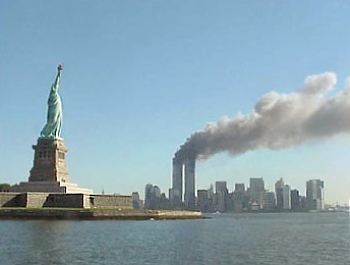
God’s mercy Stronger Than the Darkness of September 11th
You Gotta Love Him“Humanity is in need of a vigorous witness and proclamation of God’s mercy” even “in the wake of the tragic events of September 11th 2001, which overshadowed the dawning of the third millennium”: was the affirmation of Benedict XVI today before the recitation of the Angelus prayer in the presence of thousands of pilgrims gathered in the courtyard of the apostolic palace of Castel Gandolfo. Continue reading ...
Each Has a Special Vocation
We have all read things like this many times, but how many actually live into the vocation God has blessed you with? How many have gone through a discernment process?
Israeli Noodniks Nix Syrian Nukes
Those rascally Israeli bullies. They won't even let Syria join in any reign-fear games with North Korean nuclear playthings.
"Degenerate"
The Archbishop of Cologne had the unmitigated gall to use "degenerate" to describe modern art. It is a term that Germans apparently still associate with Nazis' taste in art.What the Archbishop actually said was this: "When culture is disconnected from divine reverence, the cult descends into ritualism and culture degenerates. It loses its centre." He later expressed regret for any misunderstanding. Well, if the shoe fits.
His words bear a striking similarity to an observation made by Gil Bailie regarding the symptomology of the recrudescence of the pagan in terms of sexuality, and with good reason:
Once (sexuality) is awakened the path one takes can lead either into a pagan carnival which turns later into a hellish nightmare, or it can lead on the road that Dante took to the mystery of true transcendence. So, what we have to do when we critique the modern sexual hysteria is we have to be careful. It’s not a question of “sex” at all. It’s a question of something more profound than that. It’s a question of a mimetic problem in the first instance, and at a deeper level it’s a question of an ontological problem: the lack of ontological moorings [Gabriel Marcel], and its effects on our lives and other realms.
On the other hand, we have to say that in the Judeo-Christian tradition, the expression of sexual love is a sacrament. It’s highly regarded. It is considered part and parcel of a religious life, so we have to clarify this. . .In a certain way, we have to become the defenders of sexuality in our world. We have to say, “It’s more important than that!” because we so easily trigger this cliche’ which is: “O well, there are those people who want to shut down the operation and those people who want to turn it loose. . .” Sexuality has tremendous power. . .because it has to do with bringing life into the world. It has to do with the great mystery of creation. It’s a very powerful thing . . . the human level that’s beyond just its natural, instinctual power. At the level of human psycho-genesis it is a very powerful phenomenon. And it will be religious one way or another.
If (sexuality) has no true transcendent context, it will eventually squirm and worm its way into a kind of pagan revival, which starts out in a carnivalesque atmosphere and ends in a hellish nightmare. . . That’s what is happening in some places in our world. OR, we have Dante’s example for what might happen otherwise.
Saturday, September 15, 2007
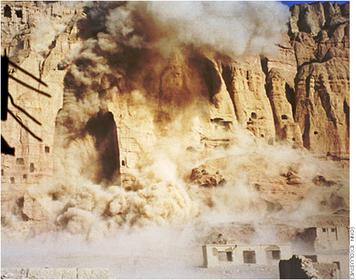
Bamiyan Buddha - Before/After

Iconoclasm is not the sole domain of non-Christians. An extraordinary amount of it took place during the Protestant Reformation. If one values art, say, like that at the Vatican Museums, one might ask if the temporal expressions of truth, goodness, and beauty have any intrinsic goodness worth passing on to future generations. If it doesn't, in your mind, you have nothing to lose. If it does have value, one might ask how can such expressions of sub-creation be preserved, again, say, in light of certain developments (cf. above photos).By the way, the second photo is slated for removal from Wikipedia after 17 September (two days from now -- get a good look, while you can).
Our superficiality and inconstancy get in way of understanding sorrows of Mary
Meditation of the Day
Our Lady of Sorrows
We understand but little of the sorrows of Mary, for little grieves us except what wounds our bodies, our self-love, our vanity, or our pride. We suffer too from men’s ingratitude, from the afflictions of our family or our native land. But sin grieves us but little…
Our superficiality and our inconstancy prevent us from seeing what an evil sin is; precisely because it strikes so deep it cannot be known by those who look only at the surface. In its manner of ravaging souls and society, sin is like one of those diseases which affect vital but hidden organs, and which the sufferer is ignorant of even while they near a crises.
To experience salutary grief, grief for sin, it is necessary truly to love God whom sin offends and sinner whom it destroys…
But to know just how far grief of sin can go, one must turn to the heart of Mary. Her grief sprang from an unequalled love for God, for Jesus crucified, and for souls – a love which surpassed that of the greatest saints, and even of all the saints united, a love which had never ceased to grow, a love which had never been restrained by the slightest fault or imperfection. Isfsuch was Mary’s love, what must her grief have been!
Unlike us who are so superficial, she saw with piercing clarity what it was that caused the losses of so many souls: the concupiscence of the flesh, the concupiscence of the eyes, the pride of life. All sins combined to add to her grief; all revolts against God, all out burst of sacrilegious rage…
Mary’s grief was deep as was her love, both natural and supernatural, of her Son. She love him with a virginal love, most pure and tender; loved him as her only Son, miraculously conceived, and as her God. To understand Mary’s dolors, one would need to have received, as did the stigmatics, the impression of the wounds of the Savior…
On the hill of Calvary, grace and charity overflowed from the heart of Jesus to the heart of his Mother. He it was who sustained her, just as it was she who sustained Saint John. Jesus offered up her martyrdom as well as his own, and she offered herself with her Son, who was more dear to her than her own life. If the least of the acts of Nazareth increased Mary’s charity, what must have been the effect of her participation in the cross of Jesus!
Father Reginald Garrigou-Lagrange, O.P. (+ 1964) was a great Dominican theologian who produced over five hundred books and articles.
The Seven Sorrows of the Virgin - Albrecht Dürer

Albrecht Dürer was born on 21 May, 1471 in Nuremberg, south Germany, son of a prosperous goldsmith Albrecht Dürer the Elder (1427-1502), and Barbara Holper. His early training was in drawing, woodcutting and printing, which were to remain his main and favorite media throughout his artistic career. 1486 through 1489 he was apprenticed in the workshop of Nuremberg artist Michael Wolgemut.
He traveled much. In 1490 he left his native city for four year, probably initially visiting Cologne and possibly the Netherlands. He traveled to Italy twice in 1494-95 and 1505-07, visited Venice and Bologna, perhaps Florence and Rome. His fame was broadcasted through his engravings, and artists in Italy were soon drawing on them for ideas... The Seven Sorrows of the Virgin is the earliest known altarpiece by Dürer. It was originally very large, about 2x3 m. The right half, representing the Seven Joys of the Virgin, is now missing and only the left part with sorrows survived. The central part depicts the grieving Virgin after the Crucifixion. Around the Virgin are seven smaller panels with detailed scenes from the life of the Christ (from top left): the Circumcision, the Flight into Egypt, the 12 year old Christ among the Doctors, the bearing of the Cross, the Nailing to the Cross, the Crucifixion and the Lamentation. The altarpiece was bought in mid-sixteenth century by the artist Lucas Cranach the Younger (1515-86), it was probably him who sawed the work into separate panels.
Fr Cantalamessa on Fatherhood
His father ran out to meet him24th Sunday in Ordinary Time
Exodus 32:7-11, 13-14; 1 Timothy 1:12-17; Luke 15:1-32
In this Sunday's liturgy the entire 15th chapter of Luke's Gospel is read. The chapter contains the three "mercy parables": the lost sheep, the lost coin, and the prodigal son.
"A man had two sons": Anyone who has even the most minimal familiarity with the Gospel on hearing these five words will immediately exclaim, "the parable of the prodigal son!"
On other occasions I have focused on the spiritual significance of the parable; this time I would like to consider an aspect that has received little attention, but which is very relevant at this moment and close to life. At the bottom of the parable is simply the story of a reconciliation between father and son, and we all know that such a reconciliation is essential to the happiness of fathers and children. Continue reading …
Friday, September 14, 2007
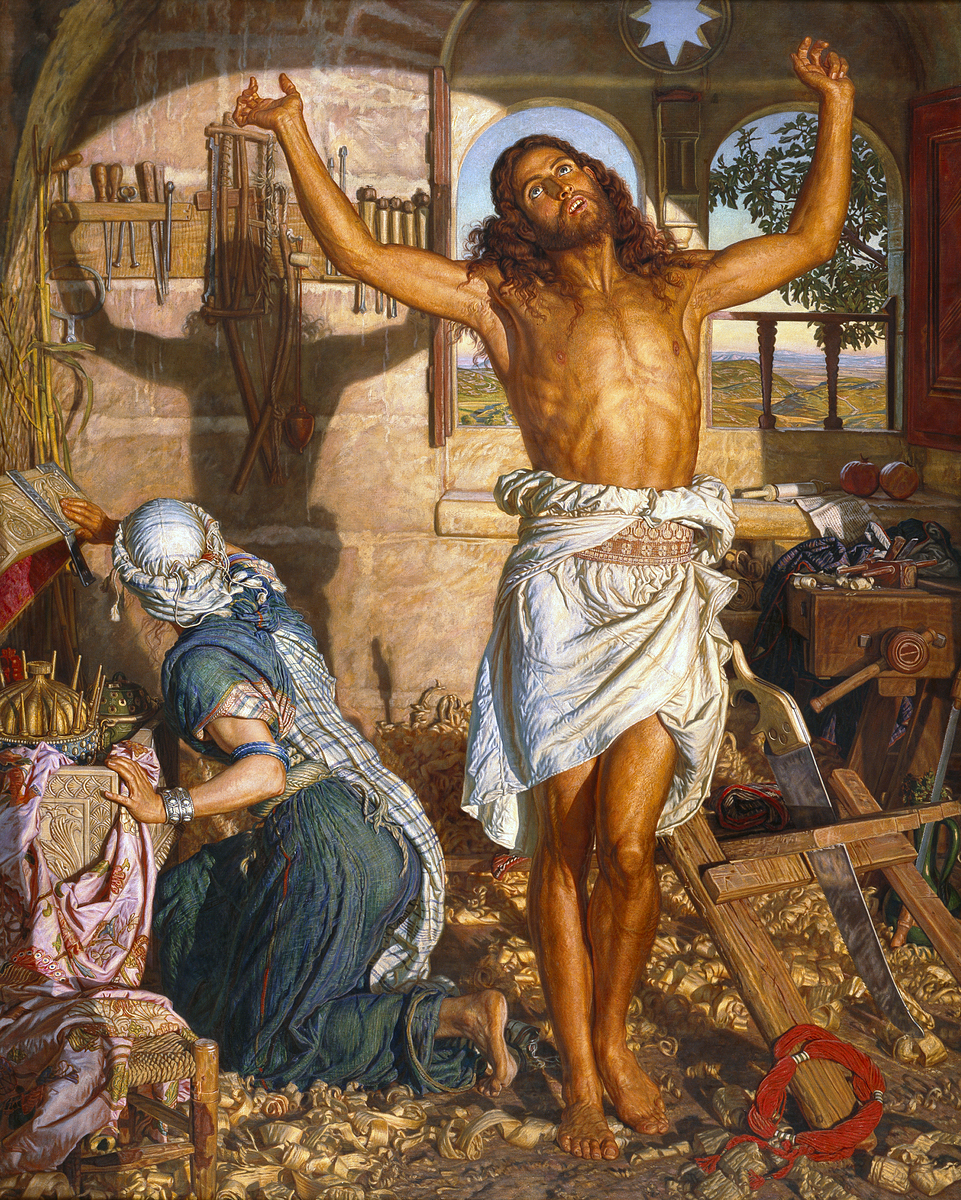
James Collison - PRB
Collinson was a devout Christian who was attracted to the devotional and high church aspects of Pre-Raphaelitism. A convert to Catholicism, Collinson reverted to high Anglicanism in order to marry Christina Rossetti, but his conscience forced his return to Catholicism and the break-up of the engagement. When Millais' painting Christ in the House of his Parents was accused of blasphemy, Collinson resigned from the Brotherhood in the belief that it was bringing the Christian religion into disrepute.
During his period as a Pre-Raphaelite, Collinson contributed a long devotional poem to The Germ and produced a number of religious works, most importantly The Renunciation of St. Elizabeth of Hungary (1850) and The Holy Family (1878). After his resignation Collinson trained for the priesthood at a Jesuit college, but did not complete his studies.
In 1858 he married Eliza Wheeler, the sister in law of the painter John Rogers Herbert, one of the early influences on the Pre-Raphaelites. Returning to his artistic career he painted a number of secular genre paintings, the best-known of which are To Let and For Sale, both of which lightheartedly depict pretty women in situations that suggest moral temptation.
He was secretary of the Society of British Artists from 1861 to 1870. -- Wikipedia
All 4 1 & 1 4 All
If you haven't recently visited Musical Monk's blog, you may not have noticed the change on his shingle: D’artagnan. The 3 Mass'keteers have admired our brother in Christ's youthful exploits hither and yon -- Italy, O'Hare Airport, Mickey D's -- all the exotic destinations of a debonair and cavalier young rake. [Note to Aramis: Please change the name of D'artagnan's blog in sidebar. There's a good chap.] What ho and anon!
No Doubt About It - A Powerful Sacrament
Every individual nature that has not experienced God in prayer remains cut off from itself. Every human love that omits prayer losses what is finest and most distinctive in the presence of the Beloved. All reconciliation that is brought about without prayer remains extrinsic to those reconciled. -- Maurice NedoncelleThough this quote is not part of That Catholic Show video, I feel that they have done a pretty good job of setting the stage for how one should prepare to enter into the Sacrament of Reconciliation. Prayer is truly instrumental.
Exaltation of the Cross -- Franciscan Spirit
Exaltation of the Cross
If you wish to have the light of finding grace, and a heart free from all care, if you wish to curb all harmful temptations, and to be made perfect in the ways of God, do not tarry in running to the cross of Christ. Truly there is no other way for the sons of Christ to manage to find God, and having found him, to hold on to him, but in the life and the way of suffering God and man which…is the Book of Life, the reading of which no one can have access to except through continual prayer. Continued prayer elevates, illumines, and transforms the soul. Illumined by the light perceived in prayer, the soul see clearly the way of Christ prepared and trodden by the feet of the Crucified; running along this way with an expanded heart, it not only distances itself from the weighty cares of the world but rises above itself to taste divine sweetness. ‘then it is set ablaze by divine fire. Thus illumined, elevated, and set ablaze, it is transformed into the God-man. All this is achieved by gazing on the cross in continual prayer.
Hence, my dearest son, fling yourself upon this cross, ask him who died on it for you to enlighten you to know yourself fully, so that plunged deep in the knowledge of your own defects, you can be uplifted to know fully the sweetness of divine goodness which seemed incomprehensible to you when, so full of defects as you were, God lifted you up to divine sonship, and promised to be your Father.
Do not, therefore, be ungrateful toward him, but strive to accomplish in everything the will of so great and so lovable a Father. For if legitimate sons cannot accomplish what pleases the Father, how will the adulterous ones be able to do so? Adulterous sons are the ones who stray from the discipline of the cross through concupiscence of the flesh. Legitimate sons, on the other hand, are the ones who strive to conform themselves in every way to their teacher and Father who suffered for them. They do so by following him in poverty, suffering, and contempt. For certainly, my dear son, these three things are the basis and the fulfillment of all perfection. For in these three, the soul is truly enlightened, perfected and purged and most fittingly prepared for divine transformation.
Blessed Angela of Foligno (+ 1309) was a wife and mother who later became a Franciscan tertiary and an esteemed mystical writer.
tip to Doctors of the Catholic Church and Magnificat
Mark Shea seconds the motion made by the Zipster: 9-11 was a tar baby strategy on the part of al Qaeda. If so, it worked.
A Life Worth Living
Tuesday, September 11, 2007
Pinkerton - Duty and Destiny
The Once & Future ChristendomFrom death of the West—to knights of the West
by James P. Pinkerton
The Call of Duty—and Destiny
In one of the great epics of Western literature, the hero, confronted by numerous and powerful enemies, temporarily gives in to weakness and self-pity. “I wish,” he sighs, “none of this had happened.” The hero’s wise adviser responds, “So do all who live to see such times, but that is not for them to decide.” The old man continues, “There are other forces at work in this world … besides the will of evil.” Some events, he adds, are “meant” to be, “And that is an encouraging thought.”
Read entire article. Mark Gordon summarizes it well here.
9/11 - Tilly's Story
Or, "How I Survived the Fall of WTC 2," via Little Green Footballs here. An amazing read.And look at Michelle Malkin's tribute, ”Remembrance and Resistance,”, but only if you promise not to fall into a doubling rivalry with terrorists. Promise?
Monday, September 10, 2007
Mother Teresa and Poverty of the Heart
You can find Calcutta is Everywhere
Poverty of the Heart
Osama bin Luther ...
No. None of the petty actors in this play could see the outcome of the Reformation. It was merely a time of vast social and psychological upheaval. This isn't to say that the "leaders" of it were not pleased by what was happening, but none could see what has happened to present-day Europe, and -- I hope -- none would be pleased by it.
Likewise, many hope today for a "reformation" of Islam led by "moderate Muslims." I fear they are not looking closely enough at the facts of our present-day turmoil. The "reformation of Islam" is taking place now. And the "Luther" of it is Osama bin Laden. We do not see this as the Islamic Reformation, because it does not meet our paradigm for what we expect from it in terms of results. Like the people of 15th-16th century Europe (and England, though that was a false dichotomy at the time), we do not understand the ramifications of what this Muslim "Luther" is doing. We see the same kind of violence taking place, and do not understand what it will do to the structures of sanity and civility we take so much for granted.
Pity. The Catholic Church salvaged what it could of Europe with the Council of Trent, the heroic work of Saint Ignatius of Loyola and his Jesuits, and the martyrs like Saint Edmund Campion. Time and time only will tell what will happen as the outcome of this "Reformation".
Sunday, September 09, 2007
Madeleine L'Engle - A Thinker's Writer
The death of Madeleine L'Engle, author of A Wrinkle in Time (hardly only a book for children, but one that will propel them into the biblical faith quite nicely), feels to me like the passing of a grand old aunt, the likes of whom I always assumed would die one day, but one I'd hoped would accompany my own adult years for as many as possible.Her multitude of books bolstered my younger adult years through pastoral ministry (an arid affair), assuring me of a wider, bolder, less parochial world of reality than ducking into the office, seeing to next Sunday's bulletin and the monthly newsletter, attending the local ministerial association meetings, and talking with a high-maintenance member about the incredible importance of their rather meaningless life.
I am the first to admit that my description of the (Protestant) pastoral ministry tells more about me than about the importance of the vocation, but L'Engle's assurance of the vitality of a sacramental faith (she was a life-long Episcopalian) as well as my enduring yearning for a deeper experience of Transcendence drove me inextricably into the arms of the Catholic Church and the fullness of the faith. If any are looking for someone to blame for my conversion, Ms. L'Engle is a co-conspirator, albeit completely unbeknownst to her.
An interview (2006) with mentions of Harry Potter. The NYT obituary.
My dear Ms. L'Engle, Requiescat in Pace +
Saturday, September 08, 2007
Mother Teresa, Theresian

Athos offered a very nice post on Mother Teresa's dark night here. I wanted to follow up with a few thoughts sparked by a selection in my Therese devotional reader:
"God is admirable, but above all he is lovable, so let us love Him . . . let us love Him enough to suffer for Him whatever He chooses, even griefs of soul, aridities, anguish, seeming frigidities. Ah! that is indeed a great love, to love Jesus without feeling the sweetness of that love, there you have martyrdom. . . .All right! Let us die martyrs!
Martydom unrealized by men, known to God alone, undiscoverable by the eye of any creature, martyrdom without honor, without triumph. . . .There you will have love pushed even to heroism. But one day a grateful God will cry out: 'My turn now.' Oh! What shall we see then? What is that life, to which there shall be no end?"
Letter to Celine, July 14, 1889
from The Little Way of Therese of Liseux: Into the Arms of Love, John Nelson, Liguori, 1997
Well, anyone who has dipped into Therese's spirituality will recognize this as essential Therese. I remember from an EWTN series that when Therese was invited to a Lourdes retreat, she refused, saying, "I prefer the monotony of suffering to ecstasy." In the Theresian universe, the dark night seems to be not, as with St. John of the Cross, a passage on the way to a higher road, but itself the highest kind of earthly spirituality there is--the kind of private "martyrdom" described above. So, I am struck by the strong Theresian element in Mother Teresa's long, dark night, which shows her to be a true disciple of The Little Way (possibly more than she knew).
I seem to remember (though I can't track down the source for that right now) that Mother Teresa chose the name Teresa after Therese of Lisieux (rather than Teresa of Avila), and it is certainly clear that much of her mission and sprituality drew on The Little Way. Some connections are noted, for instance, here. Another connection, between the dark night of Teresa and the suffering in the last years of Therese's life, is briefly noted in by Andrew Greeley here.
So, Mother Teresa, even in her long, dark night, is very Theresian. I should add that this is not the kind of spirituality I "aspire" to, because I doubt I could handle it, but maybe I can at least aspire to aspire, and certainly recognize it as wayyyyy superior to anything I could ever actually aspire to . . .
Emmaus Road Initiative - Opening Session
Mr. Bailie wove a deep personalism -- our "mutual ensemble of sadness" -- with his usual prophetic hermeneutic of the challenges and perils facing an ever-growing de-Christianized west. Mentioning the similarity between the two disciples on the road to Emmaus and present-day followers of Christ, he noted how tempting it is to stay in a slough of reminiscing. "They were reminiscing 'all that had happened' -- and this is on the Day of the Resurrection! But once the 'nickel drops,' (at the breaking of the Bread), Pentecost, say, and after, there is no reminiscing. It is all forward."
One can see that Mr. Bailie wants Christians to face the perils of a demoralizing post-modern nihilism within the Christianized west, and Islamic fascism without (at least spiritually), with a faith in the power of the living Christ to use what has been given us: the Answer -- Scripture, Tradition, the Creeds, the Magisterium. Use these, by going deeper into them and their meaning for the historical Now, in order to be the right persons at the right places to love and serve the Lord, and one another.
The upcoming nation-wide Emmaus Road Initiative meeting times and places are to be found here.
What is the Most Precious Thing We Have?
A short quiz from Gil Bailie (tape 7 from The Gift of Self):
What is the greatest discovery in the history of humanity?
Monotheism! The essence of that discovery is that the God of monotheism is Transcendent. He is not in the stone; he is not in the temple; he is not on the mountain or the storm; he is not in my culture; he is not in my ethnicity or my gender; and he is not in my psyche or my ... He is Transcendent! Monotheism and a Transcendent God are the most important discoveries in history.
A couple excerpts from Athos' post Cassandras -- Keep It Up
"...it is the lack of revelation that leads conventional human religion, anthropologically speaking, to the same destination, i.e., the place of sacrifice. The scandal of particularity is the truth claim of the biblical revelation. Without this claim, we are right back in the relativism of comparative world religions 101. Hence, the Christian faith IS categorically different, superior, and unique in that it claims we are ALL crucifiers, mobsters, etc. capable of bloodthirstiness, betrayal, and cruelty." -- Athos
In the end it was summed up by Nietzsche who said we must choose either Christ or Dionysus. The choice, structurally, is manifestly clear in our world today.
From the post Politics & Apocalypse - Robert Hamerton-Kelly:
"...since monotheism is the first and most effective blow against the pagan sacrificial order, and every great religion is great to the extent that it decodes its own mythology of sacred violence." -- Robert Hamerton-Kelly
Politics & Apocalypse - Robert Hamerton-Kelly
I, Aramis, bring this paper to our attention for a number of reasons, but one is to challenge ourselves, as the paper did, to not get trapped in our Western political philosophy in trying to grope for meaning at what is happening in the world today. Granted, mimetic theory stretches our comfort zones and pushes our intellectual processes beyond the university sheepskin, but MT has tremendous powers to help our blurred comprehension see what is going out of focus as well as what is coming into to focus. Political philosophy is generally static and potentially burdensome, as the paper will bring out, though it has produced some great feats of intellectual and structural fruits, but in the end and on its own it will prove out to be barren.
Ironically, the sacred violence of jihadist Islam, which believes it is strengthening its sacral foundation, is in fact sawing at the branch on which the religion sits. Suicidal violence no longer confirms the fundamental distinction but rather erases it, and deals crippling blows to the system of good violence that is supposed to control bad violence. The violence that no longer heeds the distinction between life and death might indeed be fatal to the sacrificial mechanism, which like an ancient automobile is shaking itself to bits on rocky roads. The beginning of the apocalyptic end might be upon us, and a gigantic sacrificial crisis breaking out.
So mimetic theory leaves us with a vision of a long lasting, universal social and cultural structure of sacred violence, based on the working of the surrogate victim ruse, now re-entering the great sacrificial crisis of the original period and thus disintegrating into cultural and social confusion and more and more uncontrolled violence. The fact that Islam is the current vanguard of this crack up can be no surprise, since monotheism is the first and most effective blow against the pagan sacrificial order, and every great religion is great to the extent that it decodes its own mythology of sacred violence. In doing this, the great religions disclose the ruse and render it progressively ineffectual, thus weakening the traditional religious control of violence. Islam has reached a new extreme of this process and by destroying itself as a religion is ultimately saving itself as a faith, if indeed it is the true faith. If not it is simply destroying itself.
Islam in the throes of an advancing sacrificial crisis, indicated by the emergence in it of suicide as a virtue where it has traditionally been a sin, makes the world wait in vain for a representative and authoritative condemnation of murder by suicide. When will the leadership, however fragmented, emphatically and repeatedly announce that those who do such things are not Muslims but pagans and are going not to paradise but to hell? We wait in vain for such transparency and cannot shake the suspicion that Islam does not speak out because it affirms the violence of the sacred and is by mimetic standards nothing but a mode of pagan sacrifice, blaming the scapegoat and purchasing internal unity with the blood of the external enemy. This last, desperate attempt to make the mechanism work is already uniquely undermined by the suicidal, self-sacrificial erasure of the first distinction between the mob and the victim, between life and death. Where the mob kills itself for the sake of itself, the logic of the ruse has entered a stage of terminal decay, and sacrificial structure will soon be utterly unable to control violence. This is the sign that the latter days of the present world are upon us.
I do not mean that soon the stars will fall from the night sky and the moon be washed in blood, the dragon arise from the lake of fire and the wicked be tortured by God; no, I mean simply that the present global order is in a process of deep transformation and the outcome is uncertain. The old order is collapsing and sacrifice can no longer stop the crisis of disorder or hold it up. The USA with all its military power, which I regard as a prime instance of good violence, cannot bring order in Iraq, which is a sign of this historical stage of advanced sacrificial failure, an apocalypse indeed.I have added the link to this article in our side panel under Mimetic Theory & Rene Girard to the list of other fine articles that we here at the Three Mass'keteers recommend that you check out.
Friday, September 07, 2007
Dennis Miller on Profiling
Thursday, September 06, 2007
Cassandras -- Keep It Up
In classical literature, Cassandra is depicted as a harbinger of impending peril to whom none listened in her doomed and beloved city of Troy. Today, the number of Cassandras cry out about a formidable array of signs pointing to the old Christian West's denial and ignorance of the demographic, legal, and religious intentions of Islam.I will not name the blogs, you probably know most of them if you are a regular reader of The Four Mass'keteers; two I am fortunate to say are posted by my personal friends. The Catholic bloggers among them -- and I count myself among them -- consider the heirs of Christendom at the height of its finest hour to be no account wastrels who have given up and gone to seed. Like Jack and the choirboys in Golding's Lord of the Flies, they have not only let the signal fire go out, they have begun tribal, pagan practices as orgies, infanticide, and delapidation of the walls that once offered protection and the temples that safeguarded truth, beauty, and goodness.
To the blogging Cassandras, it seems that if Islam wants to gain its world-wide domination and "peace" [Dar al-Islam], the children of the West seem only too willing to provide the foot-baths, change the laws, cloak their women, and relinquish any signs of strength, virtue, and chivalry ... as long as the party lasts and the dope holds out. The West's motto? "Yeah, whatever, man. Pass me another toke."
The Cassandras at moments wonder if these wastrels are worth worrying our heads about, particularly since the mammoth, bell-shaped curve of westerners slumber and do not perceive any threat.
My one piece of advice to western nations is this: demand reciprocity when it comes to the freedoms of immigrants. If a country like, say, Saudi Arabia does not allow Bibles to be distributed within it, do not allow immigration into the western country by citizens of that nation. If freedom of religion is not allowed, do not allow immigration into the western country. It is a simple -- and no doubt simplistic -- action, but it is to a degree measurable.
As a Cassandra, I'd love to finally be proved a Chicken Little. But for now, I'll keep the sword upstairs, the dog loose, and the Catechism handy.
The Key to Happiness
Want to know the key to happiness? Save yourself a lot of therapy, shopping expeditions, chasing worthless idols, and time staring at yourself in a mirror (to see what others will see and how they will judge you)?In his reflections on The Gospel of John, Gil Bailie says that Our Lord makes clear what it takes to be truly happy. "The key to happiness is to know who your Lord is. The key to unhappiness is to have about two dozen of them, and deny every one." This is a point stressed in the Farewell Discourses of John's Gospel -- knowing and doing the will of God as revealed in the kenotic, self-emptying, love of Jesus Christ.
But Bailie is making a different yet related point here. Moderns do our utmost to hide our role models, our mentors, those we copy and imitate. ("Who ME? I don't imitate anyone!") We are taught that to have models is to be cowardly, non-assertive, timid. Alternatively, we collude in the myth of "self-made" men and women. We quake at the thought of having our imitation found out, so we hide it (even from ourselves) at all costs.
But what René Girard's mimetic theory by definition teaches -- and the Bible knows about us so well -- is that humans are mimetic -- we cannot not imitate. Our sole freedom resides in choosing a model worthy of imitating.
The Christian faith in general and the Catholic Church in particular teaches that Jesus Christ is not only the Lord and Savior of the world, but the only Model worth imitating; he is the "external mediator," in Girard's parlance, the One who comes from outside the fallenness of the world dominated by Satan to rescue, redeem, and make whole.
Bailie will be at Washington Theological Union this Saturday, September 8th, at 9:30 a.m. If you are near the northern Virginia, Metro D.C. area, you may want to drop in.
Mother Teresa & Barking Dogs
By way of New Advent, a commentary on Mother Teresa's personal letters by Deal Hudson. Mr. Hudson mentions what so many have already noted; namely, that the "dark night of the soul" (St. John of the Cross) is an expected hurdle that spiritual giants of the Church's faith must cross time and again.But what Mr. Hudson does most admirably is not so much belittle such notorious detractors of Mother Teresa, like Christopher Hitchens, as hit the "reveal code" button of their motives. He quotes Jim Towey, a man who served as legal counsel for Mother Teresa for twelve years:
“People of faith understand the cry uttered by Mother Teresa -- people of no faith find it to be a stumbling cross. They cannot get their minds around the fact that Christ suffered and felt abandoned by the Father.”He thinks that Christopher Hitchens is nothing but a publicity seeker.
“He’s a provocateur. He uses Mother Teresa to get attention, to feed off her celebrity. Hitchens has to conclude she was a hypocrite, or he has to retract his book and his atheism.”
Wednesday, September 05, 2007
The 0.1% Solution - a comment on a post @ Reflections on Faith and Culture
Gil touches on the issue of suffering and the relieving of suffering from a Christian perspective. On the level of mimetic theory we may see other issues at work - both levels unveiling a satanic element for sure.
3 quotes from R Schwager's Banished from Eden pg 154 and 155 and 149:
The seduction of the human project of "self-deification tends therefore to move towards animal life and even ends by seeking the divine in what is lifeless."
"F. Tippler in his "Physics of Immortality" presents a physics in which he tries to explain God and the resurrection of the dead by physical formulas. He delineates a vision of a life that extends gradually in a digital fashion from our planet into the whole cosmos. Is this life anything more than the most complex, mechanistic information? In Girard's analysis of the logic of desire the imitator imitates his model and the model his imitator, until both appear indistinguishable from an observer's point of view. According to this logic, the living yearns for the lifeless and the lifeless for the living, until both are indistinguishable to everyday eyes."
"In a world of deception and suffering "every individual is necessarily threatened and profoundly intimidated. All therefore spontaneously seek good repute, appreciation, and honor in order to feel secure. However, a humanity requiring that each person support and make himself secure through others locks itself in its own prison, and in this situation true faith is impossible (John 5:44). By this reciprocal search for honor and recognition humans balance themselves through one another and thus shield themselves in a self-sufficient way against God. A satanic tendency arises, of which individuals may be largely unaware and in which they become entrapped."
Tuesday, September 04, 2007
Sky Captain - Major Subcreation
J. R. R. Tolkien, devout Catholic, Oxford don, husband, dad, and Pope's man, called the work of the imagination the "subcreation" of the created (humans). Rarely have I seen a vision of subcreation on the silver screen to equal (and satisfy the child in me) that of the brothers Conran, "Sky Captain and the World of Tomorrow" [2004]. If you find the opportunity, I highly recommend it. It is so choice. [HT: last two sentences, Ferris Bueller] The kicker is that Paltrow, Jolie, and Law did the entire thing in front of blue screen.Truly Human? When Are We Truly Human?
Humility recognizes God as he is... Humility and trust are what make a person truly human.
Most often in life I catch myself in the mimetic snares of the moment, often referring to it as being caught up in the crowd or caught up in the thrill or excitement or fear or even boredom: times where I pat myself on the back or tear myself or another down, but in those times I am most alien to the person who is birthed and called out by God. I am so often in the clutches of the spirit of the moment or thrill or excitement or fear or even boredom; but not in the Spirit of humility and trust which is when I am in the spirit of having said yes to Christ.
Humility for me, Aramis, seems to not only recognize God as he is, but also sees myself for as I am (in any given moment). And trust allows me to name the spirit for which I am caught up in without experiencing the emotional roller coaster of the false self. Humility and trust lead me to repentance and forgiveness - metanoia when I have turned away from God; and humility and trust sits me down at Our Lord's feet to share in His Peace.
I often find meditating on the words of Pope Benedict XVI so grounding and also so in tune with my understanding of mimetic theory. I find myself surrendering to Mary's YES - humility and trust are touchstones for my coming alive - being truly human.