The following is a reflection by Mother Teresa of Calcutta - Sunday May 2, 2010, The Magnificat.
“The less we have, the more we give. Seems absurd, but it’s the logic of love.”…
True love causes pain. Jesus, in order to give us the proof of his love, died on the cross. A mother, in order to give birth to her baby, has to suffer. If you really love one another, you will not be able to avoid making sacrifices.
The poor do not need our condescending attitude or our pity. They only need our love and our tenderness.
To me, Jesus is the Life I want to life, the Light I want to reflect, the Way to the Father, the Love I want to express, the joy I want to share, the Peace I want to sow around me. Jesus is everything to me.
Faith is scarce, it is because there is too much selfishness in the world, too much egoism. Faith, in order to be authentic, has to be generous and giving. Love and faith go hand in hand…
God has created us so we do small things with great love. I believe in that great love, that comes, or should come from our heart, should start at home: with my family, my neighbors across the street, house right next door. And this love should then reach to everyone.
(Magnificat, from Mother Teresa: In My Own Words, compiled by Jose Luis Gonzales-Balado)
To expound on the underlined portion above, Jesus didn’t give us a list of do’s and don’ts in the Gospels. Rather, he gave us a way of life. (Another good reflection here.)
I also go back to yesterday and the idea of "work" as the "Gospel of Work" or our work lived as vocation. All this provides us a glimpse into God's gift of HIS LOVE and what we are to imitate.
Showing posts with label Let This Mind Be in You. Show all posts
Showing posts with label Let This Mind Be in You. Show all posts
Sunday, May 02, 2010


Sunday, April 18, 2010
Duffy - The Medieval Mass
 THE LITURGY LAY AT the heart of medieval religion, and the Mass lay at the heart of the liturgy. In the Mass the redemption of the world, wrought on Good Friday once and for all, was renewed and made fruitful for all who believed. Christ himself, immolated on the altar of the cross, became present on the altar of the parish church, body, soul, and divinity, and his blood flowed once again, to nourish and renew Church and world. As kneeling congregations raised their eyes to see the Host held high above the priest's head at the sacring, they were transported to Calvary itself, and gathered not only into the passion and resurrection of Christ, but into the full sweep of salvation history as a whole.
- Eamon Duffy, The Stripping of the Altars
Friday, April 16, 2010
You Know that God is at Work...
 Gil Bailie tells of a visiting priest from Cape Town, South Africa who gave a homily that included the following:
“You know that God is at work when you are unlovable and you still get loved: when you have done something unforgiveable and you get forgiven: and you are untrustworthy you are trusted anyway.”
From: “Let This Mind Be in You” tape series on conversion by Gil Bailie.
Thursday, February 05, 2009
Saturday, February 24, 2007
CONVERSION or else ... what will happen to us?
 In concluding “Let This Mind Be in You” tape series on conversion, Gil Bailie admits that in his attempt to weave together all the themes of the earlier sessions he had to leave out 3 pages of connecting-the-dots. I must admit that I would have liked to have had those pages. With the help of the groundbreaking work of Rene Girard, Gil tries to bring clarity to this radical understanding of culture and the person as both are being deconstructed under the weight of the Gospels. Even the thought of this task is not an easy thing to get your arms around.
Some of the major dots used by Gil in the final tape on conversion are:
Friedrich Nietzsche
The Underground Man – Fyodor Dostoyevsky
Reveries of The Solitary Walker – Jean-Jacques Rousseau

Meister Eckhart
Johann Baptist Metz
Jean-Michel Oughourlian
Scriptures
The Church
Communion of Saints
Curing possession with possession
Manic depression
Conversion
St. Paul
Blessed Mother Mary
Jesus Christ
I love this series on conversion and each time I revisit it I glean something more. But there is so much to absorb that I could still use more help in connecting the dots. I have tried over and over to find closure on these posts regarding this tape series and frankly I am at a loss. I can only fall to the ground (with the Poor Clares or St. Thérèse) and pray with Mary; Lord, not my will be done, but Your Will be done.
 Ecce Ancilla Domini - Dante Gabriel Rossetti
For other posts that the 3 Massketeers have made on Gil Bailie's tape series, Let This Mind be in You follow the links below:
Athos posts here
Athos notes here
Athos notes on tape 9B link here
Aramis notes on tape 5 here
Aramis notes on tape 4 here
Aramis notes on tape 3 here
Aramis notes on tape 2 here
and you can see our first post regarding this tape series by clicking here
Sunday, January 28, 2007
By Your Light We See Light

Girl with a Pearl Earring
c. 1665-1666; Oil on canvas, 44.5 x 39 cm; Royal Cabinet of Paintings Mauritshuis, The Hague
In our ongoing discussion of conversion, self hood, and ontological substantiation, we throw around some pretty big words. Delve into dark corners and crevasses of the human soul. Muck about. But every once in a while we owe it to ourselves to come to a quiet place. Allow our eyes to gaze on beauty. Light. And instead of being pulled by demons in every direction (like the drawing of Saint Anthony below), we will find the mind returning to the Source of our being. Gratitude, too, will follow.
Our friend and mentor, Gil Bailie, whose blog can be found here, has written on serenity that can only be got through prayer ... and its beastly alternative. Meditate well on his words, and let not your heart be troubled; neither let it be afraid.
Our friend and mentor, Gil Bailie, whose blog can be found here, has written on serenity that can only be got through prayer ... and its beastly alternative. Meditate well on his words, and let not your heart be troubled; neither let it be afraid.
Friday, January 26, 2007
Let This Mind Be in You - Tape 5
 Where are you in this 1324 fresco by Bernardo Daddi called The Martyrdom of St Stephen?
Though continually being dismantled by the Christian revelation, the cultural and psychological mechanism of scapegoating is still in place as it tempts us with various pseudo conversions. This mechanism is the mimetic dynamic and Rene Girard has provided us the interpretative tools to make the Gospels even more relevant today in the modern world.
In tape 5 on this series on conversion, Gil Bailie talks about the influence of a model on us and how this fact is central to the social and psychological economy of Christian conversion. There is always a model.
Over the years mimetic processes have been mistaken for sexual or socio-economic ones, and so without the insights into the mimetic dynamic there is a tendency to see secondary problems as primary. That is to say, there is a tendency to see in sexuality itself, or in money or wealth itself, or in power itself, the source of all evil. Girard's insight helps us to see the mimetic dynamic at play in our fall (our sinfulness) as well as seeing the same mimetic dynamic leading us to our redemption. With this insight enabling us to get beyond the secondary problems we can begin to address our struggles at a more hopeful place.
The major themes that Gil has been using in this series on conversion are:
1) the theme of ‘gravity and grace’ provided by Simone Weil - gravity being that pull towards confusion and sinfulness leading us toward violence - and grace being the alternative to it;
2) Nietzsche's idea that the modern world has to choose between Dionysus and Christ;
3) Don't Get Sucked In - the summation of the Western Tradition;
4) Realizing that self-possession is not a viable alternative to getting sucked in, it is simply the preliminary to getting sucked in;
5) the Cross is a source of another kind of gravitational field which is the only alternative to the gravitational field that holds us in the grip of some kind of primitive sacred system and;
6) Mimesis leads us into the hellish place and it is what leads us out.
Nietzsche says that at the heart and soul of the Dionysian motif is the confusion of the transitory state or what Girard calls the crisis of distinction where all the social and psychological confusion reaches a climax resulting in destruction. One could say that St. Paul experienced his conversion while looking on the act of destruction (the scapegoating act) itself when he saw Stephen stoned. Most of us do not see these acts first hand – we see it on TV, but generally these acts seem disconnected to our world. There is a gap between those scapegoating acts of destruction and the transitory state from which we find ourselves in. Girard has helped to close the gap by showing us how this transitory state of confusion and delusion leads to that violence – it is by mimetic desire. Gil points out that if we are able to keep from slipping into the last stage of destruction it is because we are blessed with certain social and psychological structures that help that to be the case. Our experience is probably not from the pit of hell looking at the destruction of the Dionysian dynamic, but rather it is the stage of social confusion that the transitory state represents and that often leads to the destruction.
So from within this transitory state, one can observe how the mimetic process works in our relationships with models and friends. Friendship can lead one out of the mess of social and psychological disorder, as well as it can lead one into it. So friendship (a model) is another word for mimetic affects. The power of an example of a crowd can lead one into the gravitational field of the Dionysian craziness and the power of example of a model which stands outside of that can lead one out. In both cases, it is mimesis at work because it is the DNA of human social and spiritual life.
The challenge for us is to notice when this process takes a sinister turn, as you can bet that it will, at a point that is nearly always veiled to our eyes – a game, a jest, a laugh, a playfulness – by way of mimetic contagion a desire to do injury will come, moving toward its sacrificial or Dionysian end. This dynamic is what generates all conventional social solidarity.
The Feast of Stephen
Anthony Hecht
I
The coltish horseplay of the locker room,
Moist with the steam of the tiled shower stalls,
With shameless blends of civet, musk and sweat,
Loud with the cap-gun snapping of wet towels
Under the steel-ribbed cages of bare bulbs,
In some such setting of thick basement pipes
And janitorial realities
Boys for the first time frankly eye each other,
Inspect each others' bodies at close range,
And what they see is not so much another
As a strange, possible version of themselves,
--------------------------------------------------
--------------------------------------------------
From the vast echo-chamber of the gym,
Among the scumbled shouts and shrill of whistles,
The bounced basketball sound of a leather whip.
III
Think of those barren places where men gather
To act in the terrible name of rectitude,
Of acned shame, punk's pride, muscle or turf,
The bully's thin superiority.
Think of the Sturm-Abteilungs Kommandant*
Who loves Beethoven and collects Degas,
Or the blond boys in jeans whose narrowed eyes
Are focused by some hard and smothered lust,
Who lounge in a studied mimicry of ease,
Flick their live butts into the standing weeds,
And comb their hair in the mirror of cracked windows
Of an abandoned warehouse where they keep
In darkened readiness for their occasion
The rope, the chains, handcuffs and gasoline.
IV
Out in the rippled heat of a neighbor's field,
In the kilowatts of noon, they've got one cornered.
The bugs are jumping, and the burly youths
Strip to the waist for the hot work ahead.
They go to arm themselves at the dry-stone wall,
Having flung down their wet and salty garments
At the feet of a young man whose name is Saul.
----------------------------------------------------------
* commander of the German Storm Troopers
The feast of Stephen…it is still happening today. We see versions of it happening and we don’t make the connections. We almost cherish the gap as we go blind with apathy and claims of innocence. It is not a case of moralizing but rather unveiling a structure of enslavement to the human mimetic dynamic that we are all a part of just like Saul at the stoning of Stephen from which his conversion liberated him. Paul comes to see, through his conversion experience that the same human mimetic dynamic is the structure that will lead the way to freedom and out of the violence, as Christ led him to the disciples and the building up of the Church, the Mystical Body of Christ.
For other posts on Gil Bailie's tape series, Let This Mind be in You:
Athos notes here
Athos notes on tape 9B link here
Aramis notes on tape 5 here
Aramis notes on tape 4 here
Aramis notes on tape 3 here
Aramis notes on tape 2 here
and you can see our first post regarding this tape series by clicking here
Tuesday, January 23, 2007
Let This Mind Be in You - Tape 4

Don't Get Sucked In is the Western Culture's mantra which has been highly influenced by the Gospels, and though it is sound advice be aware that attempting to stand separate from the Gospels in a self-possessed posture, with even a virtuous character, is only the first stage of being possessed by something else.
We have grown up under the cloud of the Enlightenment Age and have been taught that one can take or leave religion (or simply compartmentalize your life so it has little or no meaning). My son, who worked at a printing and copy shop years ago, brought home the poster I have attached here because he thought I would like it. I have used this over and over in seminars on the problem of living without God as the center and focus of one's life. I would often conclude that the trajectory of one's life seems to always be misfiring and/or aborting when God is not at the heart of your life. So it seemed to me that the poster fits the lesson of this tape.
Summary of tape 4: Conversion is something that happens to us – it is not something we do. What we must try to do in the mean time however, is not to get sucked in to something that substitutes for it. We cannot avoid getting sucked in by remaining self-possessed or by thinking that all you need is a virtuous character. We can only fundamentally and finally avoid being sucked in by being sucked into something else. The problem with the Western Culture mantra is that if you work at not being sucked in to anything you could miss what happened to W. H. Auden as he writes from "Forewords and Afterwords:"
“One fine summer night in June 1933 I was sitting on a lawn after dinner with three colleagues, two women and one man – we liked each other well enough but we were certainly not intimate friends, nor had any one of us a sexual interest in another. Incidentally, we had not drunk any alcohol. We were talking casually about everyday matters when, quite suddenly and unexpectedly, something happened. I felt myself invaded by a power which, though I consented to it, was irresistible and certainly not mine.” (inserting comment: This experience is obviously NOT self-possession.) “For the first time in my life, I knew exactly – because, thanks to the power, I was doing it – what it means to love one's neighbor as one's self. I was also certain, though the conversation continued to be perfectly ordinary, that my three colleagues were having the same experience. (In the case of one of them, I was later able to confirm this.) My personal feelings toward them were unchanged-they were still colleagues, not intimate friends, but I felt their existence as themselves to be of infinite value and I rejoiced in it.
“I recalled with shame the many occasions on which I had been spiteful, snobbish, selfish, but the immediate joy was greater than the shame, for I knew that, so long as I was possessed by this spirit, it would be literally impossible for me to injure another human being. I also knew that the power would, of course, be withdrawn sooner or later and that, when it did, my greed and self-regard would return. The experience lasted at its full intensity for about two hours when we said good night to each other and went to bed. When I awoke the next morning it was still present, though weaker, and it did not vanish completely for two days or so. The memory of the experience has not prevented me from making use of others, grossly and often, but it has made it much more difficult for me to deceive myself about what I am up to. And among the various factors which several years later brought me back to the Christian faith in which I had been brought up, the memory of this experience and asking myself what it could mean was one of the most crucial, though, at the time it occurred, I thought I had done with Christianity for good…”
Auden continues: “Not the least puzzling thing about it is that most of the experiences which are closest to it are clear cases of diabolic possession as when thousands cheer hysterically for the man-god or cry blood thirstily for the crucifixion for the God-man. Still without it, there might be no church.”
For other posts on Gil Bailie's tape series, Let This Mind be in You:
Athos notes here
Athos notes on tape 9B link here
Aramis notes on tape 4 here
Aramis notes on tape 3 here
Aramis notes on tape 2 here
and you can see our first post regarding this tape series by clicking here
Tuesday, January 16, 2007
Let This Mind Be ... Continuing

"The Christian revelation not only deconstructs the sacrificial social structures but in doing so deconstructs the conventional self which to a considerable extent is a product of these social structures. Just as the agape community toward which Christian social life aspires has as its historical backdrop the disintegration of the sacrificial community, which is its anthropological antecedent, so the Christ-centered self toward which Christian spirituality aspires has as its psychological backdrop the disintegration of the conventional self. Which is to say, the self -- its anthropological predecessor, the self that has been a component part of the social and cultural life generated sacrificial reflexes – this self, this dying self, is what
Paul called the old anthropos, the old Adam. And he declared it to be dead or dying. And that the Christian spiritual life ought to devote itself to discovering a self that does not die,"says Bailie.
The aspirant unawares soaks in light and grace, not seeing or knowing whence it comes, clinging to the conventional selfhood afforded it by the Dionysian realm. But, by that same grace, all is changed, in the twinkling of an eye, at the last trump.
And that self is ushered into the blessed realm if only for an instant. And the conventional is ripped and torn asunder (like Eustace in the Narnia Tales). And all is changed to be explored in newness and light.
Friday, January 12, 2007
Let This Mind Be in You tape #3
The touchstone for the understanding the Bible is the moment when Saul, soon after witnessing the stoning of Stephen, had a conversion. He realized that he participated in the persecution directed at enforcing the law for cultural order trying to keep his religion from contamination by heresy. The significance is that though he participated and approved of the stoning of Stephen he still has a revelation – a revelation of the innocence of the victim of the law and order campaign of his day. It tells us that the power of the crowd is unbelievable. The next we know of Saul he's on the road to Damascus and the cock crows. He realizes that he has been a persecutor and yet becomes one who tells the story.
In this session Gil looks at 2 sayings that address the 2 forms of power/influence that bring about order.
 Friedrich Nietzsche
"The thoughtless man thinks that the will is the only thing that operates – that willing is something simple, manifestly given, and comprehensible in itself. He is convinced that when he does anything, for example, when he delivers a blow, it is he who strikes, and he has struck because he has willed to strike. Of the mechanism of the occurrence, and of the manifold subtle operation that must be preformed in order that the blow may result, and likewise the incapacity of the will in itself to effect even the smallest part of these operations, he knows nothing of these. (Arthur) Schopenhauer with his assumption that all that exists is something volitional has set a primitive mythology on the throne. He seems never to have attempted an analysis of the will, because he believes like everybody in the simplicity and immediateness of all volition. While volition is in fact such a cleverly practiced mechanical process that it almost escapes the observing eye." -- from The Gay Science
Notes from Bailie: The will is something that happens to us. We get caught up in it. The will that Nietzsche wants to revive cannot be revived by an individual – in the same way that, try as we may, we cannot revive myths, because the mental attitude which is, ‘I am going to find a myth and believe in it,’ is antithetical to mythological consciousness. Mythological consciousness is a consciousness of someone who has been caught up in it. Likewise the will, according to Nietzsche, for it to revive culture to the Apollonian order of its heroic tradition must be swept up into a power greater than what an individual can revive – so then when you deliver the blow, you may think it is your will, but it is not, something else is operating.
St. Paul realizes the need to become Christ-links whereas Nietzsche wanted to transform humankind into Ubermensch with enough will-power to revive the Apollonian order. The reason for the Ubermensch with will-power is because myth no longer has the lasting power of old. What Nietzsche saw was that to reclaim order culture would have to come from either the Dionysian impulse or Christ.
 Simone Weil
"God has provided that when his grace penetrates to the very center of a person and from there illuminates all his being, he is able to walk on water without violating any of the laws of nature. When, however, a man turns away from God he simply gives himself up to the law of gravity. Then he thinks he can decide and choose, but he is only a thing, a stone, that falls. If we examine human society and souls closely and with real attention, we see that wherever the virtue of supernatural light is absent, everything is obedient to mechanical laws as blind and as exact as the law of gravitation… Those whom we call criminals are only tiles blown off a roof by the wind and falling at random. Their only fault is the initial choice by which they became such tiles."
“The mechanism of necessity can be transposed to any level while still remaining true to itself. It is the same in the world of pure matter, in the animal world, among nations, and in souls. Seen from our present standpoint, and in human perspective, it is quite blind. If, however, we transport our hearts beyond ourselves, beyond the universe, beyond space and time to where our Father dwells, and if from there we behold this mechanism, it appears quite different. What seemed to be necessity becomes obedience. Matter is entirely passive and in consequence entirely obedient to God’s will. It is a perfect model for us. There cannot be any being other than God and that which obeys God.” Waiting for God (pg. 75-76)
The rest of tape 3 focuses on the play "The Bacchae" by Euripides. I will leave that for Athos and another post, but to end with Bailie's ending of the session: The romance of "The Bacchae" is that if one let’s oneself go, one can be swept away into this beautiful place – a golden age – where freedom is law and so one can go with the gravitational flow. We need to remember that we are under the influence of either the biblical God or it’s the influence of what Simone Weil called gravity and what Nietzsche called Dionysus.
For other posts on Gil Bailie's tape series, Let This Mind be in You:
Athos notes on tape 9B link here
Aramis notes on tape 2 here
and you can see our first post regarding this tape series by clicking here
The Cross, Remorse and Conversion
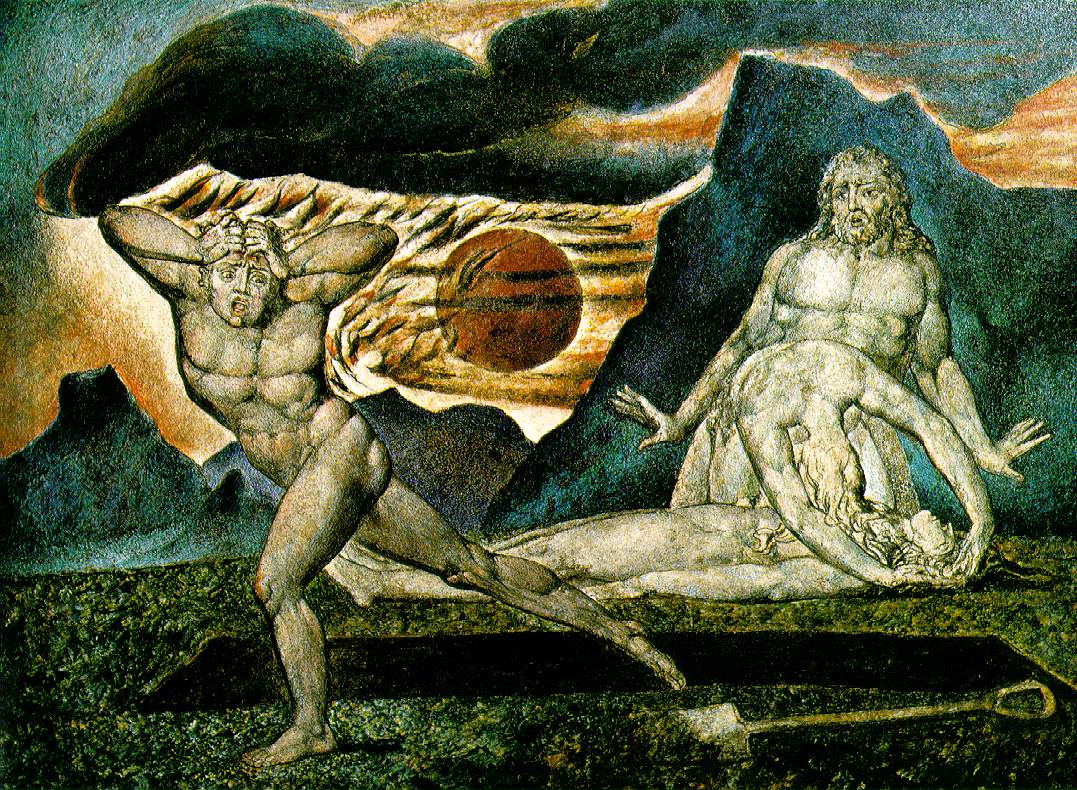
In our ongoing discussion of Gil Bailie's tape series on conversion, William Blake's painting depicting Cain's remorse at his murder of his brother, Abel, is operative. In the excerpt below, Bailie speaks of the absolute necessity for remorse in pulling away from the crowd (of which modernist "individuality" is a shammy parody) in order to experience authentic Christian conversion. As brother Aramis points out, however, this removal of oneself from the crowd is not meant to be an isolatory event. Rather, it is so one can (a) realign oneself with the true source of ontological substance, and (b) enter into true communion with others so graced in the Catholic Church, the gathering of those called into being around the eucharistic Lord at his eucharistic table. Bailie:
Christian conversion always means coming out of the crowd. When Peter heard the cock crow, it was curing him of that little crowd he gathered with around the charcoal fire at Jesus’ trial. When Paul is knocked down on the road to Damascus and he hears the word ‘persecution’, he is being pulled out of the crowd, of the mob.
It is/was in both cases for them and is, I think, the revelation of the cross that brings us out of the crowd for absolutely obvious reasons, once you think about it, because the crowd is brought together and it generates its social camaraderie precisely in those events that are structurally indistinguishable from the crucifixion. The crowd produces the crucifixion. So it is in identifying with the victim of the crowd that one comes out of the crowd. So the cross is the thing that brings us out of the crowd in the Christian economy of things.
So the birth of subjectivity, real subjectivity, is conversion. And the cross reveals because it destroys all the illusions, eventually, that allow us to believe in the god of the sacrificers. And once those illusions are taken from us, it is possible then to see the living God, the God of truth, which in human culture is always the God of the victim. Not because God or Christianity is perverse or masochistic, but because in a world that generates its culture and coherence sacrificially, the living God can only manifest via the victim. So the cross takes us out of the crowd and reveals to us something that takes the crowd’s place. You can’t come out of the crowd and just stay out of the crowd with no other grounding. You will just drift right back into another version of it, probably a sillier, shammier version of it …
Monday, December 04, 2006
Let This Mind Be in You - Gil Bailie TAPE 2
The Massketeers press on with our look at the psychology of Christian conversion through a study of a tape series by Gil Bailie called "Let This Mind Be In You." This post will lead us into a discussion of tape 2 (we discussed tape 1 last month). Please join us as we explore the psychology of Christian conversion looking at metaphysical desire which can be either vertical (Real Transcendence) or horizontal (deviated); the former brings us into true personhood and love and the ladder leads to first scandal and then violence. Now don’t be shy, we are open to responsible comments.
The following are a few excerpts from tape 2.
Matthew 22:37,40 -- And He said to him, " 'YOU SHALL LOVE THE LORD YOUR GOD WITH ALL YOUR HEART, AND WITH ALL YOUR SOUL, AND WITH ALL YOUR MIND.' "This is the great and foremost commandment. "The second is like it, 'YOU SHALL LOVE YOUR NEIGHBOR AS YOURSELF.' "On these two commandments depend the whole Law and the Prophets."
We have heard this a million times, but I don’t think we have heard it enough, particularly the first commandment. He did not say to believe in God and love humanity. He did not say be nice and love others. He said these two go together and the first is to love God with all your heart, mind and soul. And the second is to love others AS yourself. Now historical Christianity's compliance with this injunction and the compliance with individual Christians down through the ages has been a hit and miss affair. But thank God the injunction is there as a reminder for us when we need a touchstone.
Partly due to the romantic view of basic human benevolence, which was retailed by Rousseau, and others and partly due to the rationalistic, ‘where there is a will there is a way’ spirit of the Enlightenment, the modern world came to believe that it could obey the second commandment without bothering with the first. …
In practice, if not always in professed belief in doctrine, the modern world enshrined only the second of the two great commandments, the one Jesus said was the lesser of the two and the one that was dependent upon the first one. The modern world has assumed that the two commandments could be separated. The creaking and groining, indeed the shouting and the shooting that you hear outside, is coming from the collapse of that assumption. …
Girard, in Things Hidden, says: "In reality, no purely intellectual process and no experience of a purely philosophical nature can secure the individual the slightest victory over mimetic desire and its victimage delusions.
… There is so much territory covered in this statement. It is precisely that arch between mimetic desire and the victimage delusion which Girard has made it his business to delineate…
He goes on: "Intellection can achieve only displacement and substitution, though these may give individuals the sense of having achieved a victory."
What he means with displacement and substitution – when we try to explicate ourselves from the mimetic desire and the victimage delusion we do so by being morally offended by the effects of someone’s victimage delusion and so we crank our own victimage operation in order to direct it toward the victimizer that we have just been scandalized by. So we have substituted or displaced the object of the victimage delusion, but we haven’t broken the spirit of the prince of this world (to speak in Biblical terms).
Going on to the last sentence of this Girard quote from Things Hidden: "For there to be even the slightest degree of progress, the victimage delusion must be vanquished on the most intimate level of experience."
This is where Christian conversion comes in. And that is where the first commandment comes in. ...
We are desire. This desire is metaphysical - not desire in a Freudian sense - this is not some impulse-response to a natural need of urge, because those desires can be satisfied, but ours can’t. What happens with that desire is the big question anthropologically? What do we do with this enormous desire? Well, we fool ourselves completely by thinking that it is animal desire or some version of it, like some materialists desire. However, Alexandre Kojeve, in his analysis on Hegel says, “Human desire must be directed toward another desire.” ... It must be directed toward another desire. So to speak metaphysically, could I love God if God was not love and did not love me? Human desire must be directed toward another desire. But there are plenty of other desires around. The world is filled with them and of course the most potent are metaphysical ones.
Now we come to the human socio-drama and the contagiousness of the desire – desire must be directed toward another desire and what happens when it is?
Monday, November 27, 2006
A Tuning Fork for Let This Mind Be In You

This post will lead us into a discussion around the tape series entitled "Let This Mind Be in You" by Gil Bailie. Please join us as we explore the psychology of Christian conversion.
St. Paul – I live now not I, but Christ lives in me. – Galatians 2:20
Walker Percy: Doctor of Soul – This is the age of anxiety because it is the age of the lost of self.
Gil Bailie – Individualism, once considered an alternative to social conformity and a remedy for psychological alienation has turned out to be only a more ingenious form of conformity and a flamboyant form of alienation. What we thought was a cure for the epidemic for the psychological distress was only the next step of the epidemic. A real cure and a source of genuine psychological authenticity is what Christians call conversion, and it is a phenomenon, the psychological implications of which we yet to fully appreciate.
Gabriel Marcel captured the essence of Christian conversion and the psychological freedom it entails when he said that genuine selfhood involves “the subordination of the self to a superior reality – a reality at my deepest level, more truly me than I am myself.”
Gil Bailie – We have failed to grasp the scope and significance of today’s profound cultural and psychological crisis because we have yet to fully appreciate the depth and power of the revelation that is bringing it about.
Leszek Kolakowski from Modernity on Endless Trial “The strength of Christianity does not reveal itself in a theocracy or in a monopoly on the creation of rules for all areas of civilization. Its strength is manifested in its ability to build a barrier against hatred in the consciousness of individuals. The requirement of the renunciation of hatred was a challenge thrown down by Christianity to human nature. If Christians are only to be found among those who know how to meet this challenge how many are there now in the world? I do not know, however many there are, they are the salt of the earth and European civilization would be a desert without them.”
Entrance here to anthropology.
So if we are all tuned up, let us begin.
Subscribe to:
Posts (Atom)