
Showing posts with label Pre-Raphaelite Brotherhood. Show all posts
Showing posts with label Pre-Raphaelite Brotherhood. Show all posts
Friday, March 25, 2011


Tuesday, October 05, 2010

Sunday, January 03, 2010

Sunday, November 22, 2009

Saturday, September 26, 2009

Tuesday, June 09, 2009
Prayer Request - Gil Bailie
 The Woodsman's Daughter (1850-51) - Sir John Everett Millais
Please remember in your prayers today Gil Bailie who is undergoing surgery.
Saturday, May 23, 2009
Value of Work
 Work (1852-65) - Ford Madox Brown
When Matthew Crawford finished his doctorate in political philosophy at the University of Chicago, he took a job at a Washington think tank. "I was always tired," he writes, "and honestly could not see the rationale for my being paid at all." He quit after five months and started doing motorcycle repair in a decaying factory in Richmond, Va. This journey from philosopher manqué to philosopher-mechanic is the arc of his new book, Shop Class as Soulcraft: An Inquiry Into the Value of Work. It's appropriate that it arrives in May, the month when college seniors commence real life. Skip Dr. Seuss, or a tie from Vineyard Vines, and give them a copy for graduation.Read all of Heidegger and the Art of Motorcycle Maintenance.The graduates won't even skim Shop Class, of course. But maybe, five years from now, when they can't understand why their high-paying jobs at Micron Consulting seem pointless and enervating, Crawford's writing will show them a way forward. It's not an insult to say that Shop Class is the best self-help book that I've ever read. Almost all works in the genre skip the "self" part and jump straight to the "help." Crawford rightly asks whether today's cubicle dweller even has a respectable self. Many of us work in jobs with no discernible products or measurable results. We manage brands and implement initiatives, all the while basing our self-esteem on the opinions of others.
Compare that with the motorcycle mechanic. Instead of the vague threat of a performance review, the mechanic faces the tactile problem of a bike that won't start. He tests various theories and deploys actual tools. The sign of success is a roaring engine ...
Thursday, April 09, 2009
Cowper - PRB
 Saint Francis and the Heavenly Melody (1904) - Frank Cowper
For Brother Aramis and Lady Aramis - A blessed Triduum
Tuesday, March 24, 2009

Sunday, November 16, 2008

Saturday, November 15, 2008


Sunday, June 08, 2008
Collins - PRB
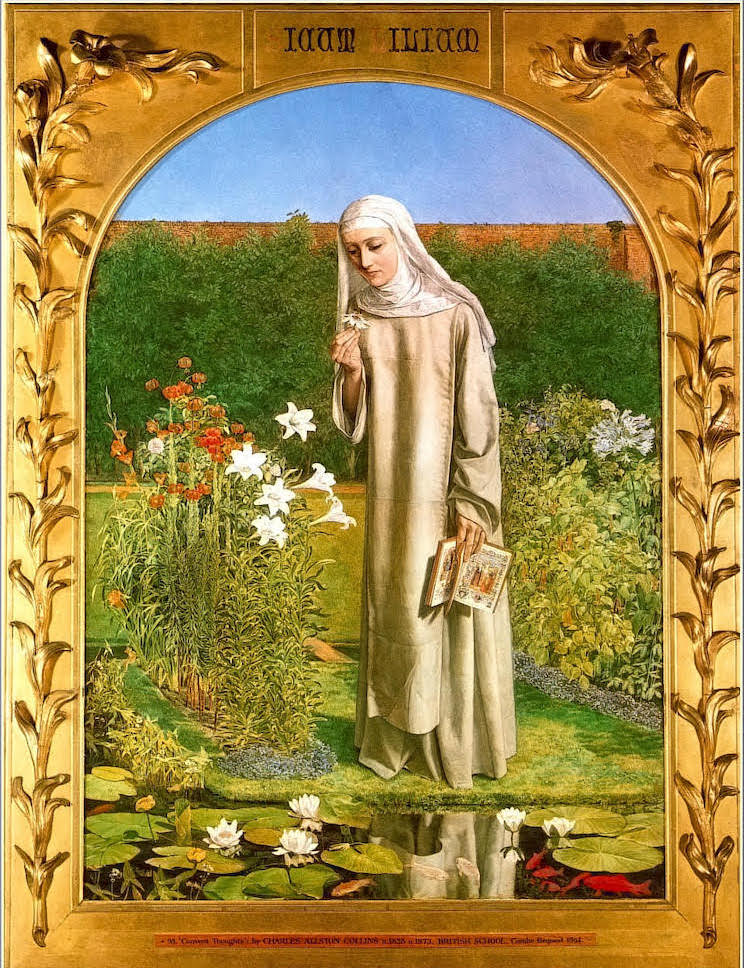 Convent Thoughts (1851) - Charles Allston Collins
According to Christopher Wood (The Pre Raphaelites), "Collins's picture is typical of the early, gothic phase of the movement, and the religious piety of these works led many critics to accuse the painters of being Roman Catholic sympathizers. The mood of this picture is generally similar to Rossetti's early works, but the flowers and garden reflect Millais's influence" (22).
But Clare Asquith relates something more telling in her tome, Shadowplay - The Hidden Beliefs and Coded Politics of William Shakespeare: "Unknown to Pericles, (Thaisa) retires to a convent - a common refuge for women exiled from England." (250, my emphasis)
Sunday, May 04, 2008

Friday, May 02, 2008
Thursday, April 10, 2008

Sunday, March 23, 2008
Happy Easter
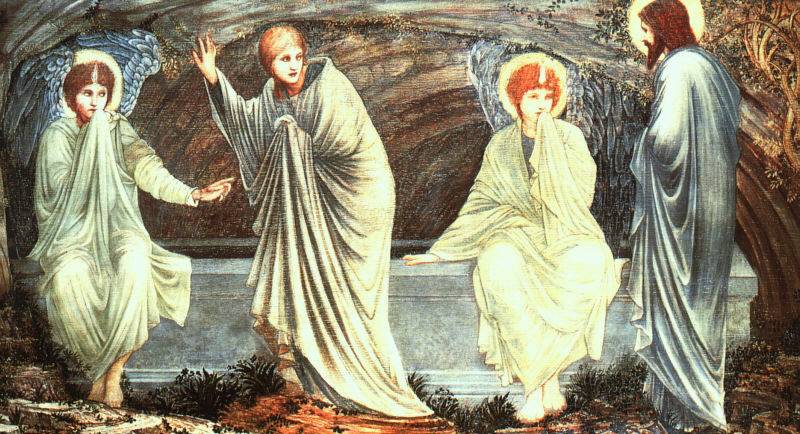 The Morning of the Resurrection [1882] - Sir Edward Coley Burne-Jones
Rejoice, heavenly powers! Sing, choirs of angels!
Exult, all creation around God's throne!
Jesus Christ, our King, is risen!
Sound the trumpet of salvation!
+
The whole bright world rejoices now, Hilariter, hilariter;
The birds do sing on every bough Alleluia, alleluia.
Then shout beneath the racing skies, Hilariter, hilariter;
To him who rose that we might rise, Alleluia, alleluia.
And all you living things make praise, Hilariter, hilariter;
He guideth you on all your ways, Alleluia, alleluia.
He, Father, son, and Holy Ghost - Hilariter, hilariter!
Our God most high, our joy and boast. Alleluia, alleluia!
Sunday, September 23, 2007
Friday, September 14, 2007
James Collison - PRB
 The Holy Family by James Collinson, 1878
Collinson was a devout Christian who was attracted to the devotional and high church aspects of Pre-Raphaelitism. A convert to Catholicism, Collinson reverted to high Anglicanism in order to marry Christina Rossetti, but his conscience forced his return to Catholicism and the break-up of the engagement. When Millais' painting Christ in the House of his Parents was accused of blasphemy, Collinson resigned from the Brotherhood in the belief that it was bringing the Christian religion into disrepute.
During his period as a Pre-Raphaelite, Collinson contributed a long devotional poem to The Germ and produced a number of religious works, most importantly The Renunciation of St. Elizabeth of Hungary (1850) and The Holy Family (1878). After his resignation Collinson trained for the priesthood at a Jesuit college, but did not complete his studies.
In 1858 he married Eliza Wheeler, the sister in law of the painter John Rogers Herbert, one of the early influences on the Pre-Raphaelites. Returning to his artistic career he painted a number of secular genre paintings, the best-known of which are To Let and For Sale, both of which lightheartedly depict pretty women in situations that suggest moral temptation.
He was secretary of the Society of British Artists from 1861 to 1870. -- Wikipedia
Sunday, September 02, 2007
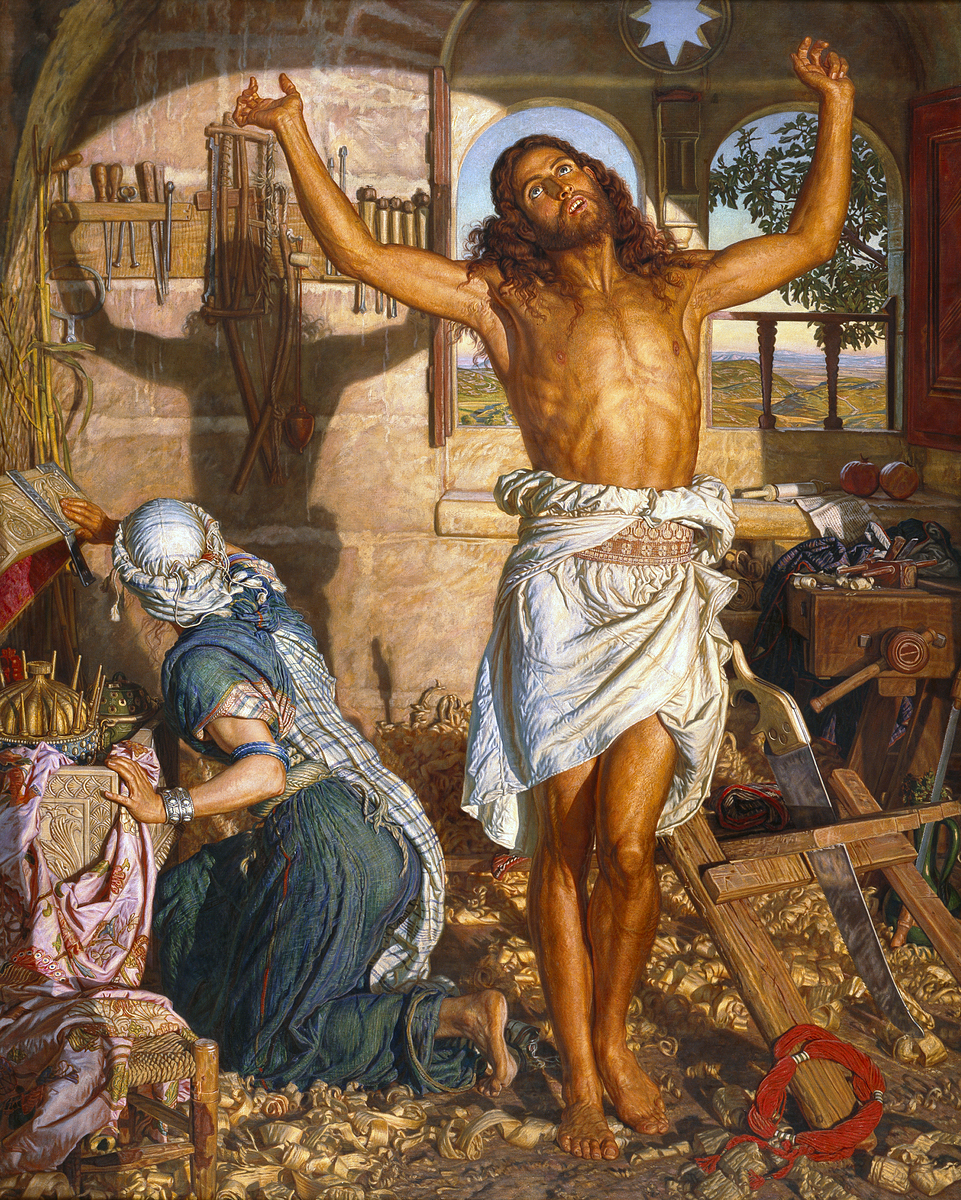
Labor Day - Ford Madox Brown PRB
 Work - 1852-65; Oil on canvas; City Art Gallery, Manchester, England
His best-known picture, The Last of England (City Art Gallery, Birmingham, 1855) was inspired by the departure of Woolner, the Pre-Raphaelite sculptor, for Australia. The other famous anthology piece that Brown painted, Work, shows his dedicated craftsmanship and brilliant coloring, but is somewhat swamped by its social idealism. In 1861 Brown was a founder member of William Morris's company, for which he designed stained glass and furniture. The major work of the later part of his career is a cycle of paintings (1878-93) in Manchester Town Hall on the history of the city. Brown was an individualist and a man of prickly temperament; he opposed the Royal Academy and was a pioneer of the one-man show. -- Web Museum, Paris
Subscribe to:
Posts (Atom)