Showing posts with label C S Lewis. Show all posts
Showing posts with label C S Lewis. Show all posts
Friday, November 12, 2010
The Chronicles of Narnia: The Voyage of The Dawn Treader
I was recollecting this story A Dragon's Tale by Marjorie Thompson today and I discovered that the movie of CS Lewis' book, The Voyage of the Dawn Treader will be coming out next month. Awesome. Before you get swept away by the movie check out this little piece called, A Dragon's Tale. And for you Radio Theatre Drama buffs link to my post above and get a taste of this very segment of the book describing Eustace stripping off the scales from the dragon that he had become.


Friday, May 07, 2010
Man or Rabbit? C.S. Lewis

Why do we not only NOT press the questions that C.S. Lewis presents here but we bury further our heads in the sand, is it so we won't have to come to terms with our humanity?
But still—for intellectual honour has sunk very low in our age—I hear someone whimpering on with his question - “Will it help me? Will it make me happy? Do you really think I’d be better if I became a Christian?” Well, if you must have it, my answer is “Yes.” But I don’t like giving an answer at all at this stage. Here is a door, behind which, according to some people, the secret of the universe is waiting for you. Either that’s true or it isn’t. And if it isn’t, then what the door really conceals is simply the greatest fraud, the most colossal “sell” on record. Isn’t it obviously the job of every man (that is a man and not a rabbit) to try to find out which, and then to devote his full energies either to serving this tremendous secret or to exposing and destroying this gigantic humbug? Faced with such an issue, can you really remain wholly absorbed in your own blessed “moral development”?
Read this very relevant chapter by C.S. Lewis from God in the Dock


Friday, December 25, 2009
The League of Bearded Catholics
With the apparent demise of The Blue Boar - it's been a dead stick since the catastrophic events surrounding the notorious Four Men's Feast - I lift a tankard to a new star in the night sky. Tim Jones of Old World Swine puts forth what looks to be a fine new effort. Ladies and gentlemen, I give you The League of Bearded Catholics.
T(olkien)he L(ewis)eague of B(elloc)earded C(hesterton)atholics stretches the imagination somewhat since only one of the four actually grew a beard for any sustained amount of time (Belloc), but all four had beards to shave, and Lewis never was a Catholic. (NB: Fr Walter Hooper, Lewis's executive secretary is quoted in Joseph Pearce's book, C. S. Lewis and the Catholic Church, to the effect that if Lewis were still alive, in his opinion, Lewis would be a Catholic today with the suspect faith and morality in the Anglican communion.)
Check it out.
Friday, December 18, 2009
Qoheleth to Christ - The Need for Today
 Monsignor Charles Pope, quoting from Qoheleth in Ecclesiastes chapter 12, gives A Biblical Meditation on Old Age. Don't look for any upbeat, "old age and death are a small thing" here. Qoheleth is the quintessential curmudgeon.
Michael Ward in his superb and important book on Lewis's Chronicles of Narnia, Planet Narnia, explicates C. S. Lewis's use of medieval cosmology to understand not merely literary goings-on, but current events. Lewis would call Qoheleth's musings "saturnocentric" - an allusion to the oldest and farthest from the sun planet (in the cosmology of the Middle Ages): "astringent, stern, tough, unmerry, uncomfortable, unconciliatory, and serious."
But, for the follower of Christ, Qoheleth like Saturn, does not carry the final say-so. One might say that following the path of "progressive revelation," "Vanity, vanity, all is vanity" is neither the last word nor does it sit, ultimately, enthroned.
According to Ward, Lewis was "impatient with clerical bromides about death being a small thing." In The Last Battle, Lewis not only gave Saturn full sway, killing off all the characters - including all of the Pevensie children (sans Susan who wasn't present), but Narnia itself draws to a close, with the last king of Narnia, Tirian, experiencing a searing abandonment and desolation. Aslan does not come. The young, final king experiences what Lewis called "The highest condition of the Human Will ...
... when, not seeing God, not seeming itself to grasp Him at all, it yet holds Him fast.
While not diminishing the pain and suffering of loss and death, Lewis objected to what he called "The Promethean Fallacy in Ethics" - a fallacy he found in every "good atheist"; namely, the criticism or defiance that such a person hurls at an apparently ruthless and idiotic cosmos
is really an unconscious homage to something in or behind that cosmos which he recognizes as infinitelhy valuable and authoritative: for if mercy and justice were really only private whims of his own with no objective and impersonal roots, and if he realised this, he could not go on being indignant. The fact that he arraigns heaven itself for disregarding them means that at some level of his mind he knows they are enthroned in a higher heaven still ('De Futilitate', EC)In Lewis's model of the universe, there is standing room for bleakness, but no throne. Saturn may visit, but may not usurp the crown. This is what lay behind Lewis's criticism of Eliot, Thackery, and others. Not that they lifted up the saturnine, but they did not go beyond it; for them, Qoheleth was the stopping place. For Lewis, "of Saturn we know more than enough, but who does not need to be reminded of Jove?" Or, as Ward says, "In The Last Battle, Lewis subjects his sub-creation to full Saturnine dominance, only for it to yield new Joviality. His work manifests 'the almost crushed (but for that very reason arch-active) imagination.'
While the Dwarfs are irremediably saturnocentric, carrying their prison with them - as frightening an affirmation of the freedom of will to reject Grace if ever there was one - the friends of Narnia rejoin and fly, run, and swim along the beam of "cosmic eucatastrophe" - further in and higher up! - following Dante (Lewis's favorite poet) into Joy.
This is where we leave the dark Advent lands of Saturn, and Qoheleth, aiming ever for the realm of angelic voices, Love descending, the Word made flesh, the works of charity, of Resurrection and Ascension.
Jove: Lewis's medieval template for God's Kingdom woven through the Narnia Chronicles; the archetypal mask of the Spirit of Christ so absolutely needful today in the "saturnocentric" West.
And, of course, from a mortal perspective that is what this little book is all about, too.
Friday, December 11, 2009
Riding Through Advent
 A strong suggestion, all loyal and doughty men-at-arms who pledge fealty to the once and future King of kings and Lord of lords: Pick thee up a copy of Michael Ward's new book, Planet Narnia.
As Ward explicates and guides one through the planetary cosmology of C. S. Lewis - based squarely in the Christian literary tradition of the Middle Ages - one is startled by the extraordinary hermeneutical power of Lewis's use of the planets to describe the taxonomy of our age. (Hint: the West in its sub-lunary sphere is caught in Saturnine doldrums - old age, death, decay. It must up and come again under the Jovial influence of arms swinging, winter-past, sins forgiven, and hearts' ease.)
One needn't muddy Lewis's interpretation with mimetic theory. You will see what I mean.
Meanwhile, ride on, readers of the Mass'keteers! Ride on through Advent to the birth of our rightful King.
Saturday, October 31, 2009
Planet Narnia AND the GMSM
 If one finds a near-inexplicable despair in the anthropological insights of René Girard's mimetic theory, it is quite understandable. (All right, perhaps not so much despair, but a heavy, Saturnine despondency.) Girard's explication of the undeniable realities of human fallenness - realities to all except those so far under the waters of denial, hubris, or naïveté can't possible reach the air of truth - flesh out the Church's doctrine of Original Sin with tonic clarity. In what seems a "unified field theory," one can reach the end of mimetic theory feeling as though one has in the darkness traversed the totality of the air-tight, light-proof gestalt of human existence, and now one has no recourse but to sit down and wait the coming end in a morbid awareness of all of humanity's broken, dismal, satanic realm.
Of course, Girard himself, if one takes a look at his own life, would deny this. Clearly, he has put his "eggs" in a different "basket" than either a Qohelethian nihilism or an existence of using mimetic theory to some sort of "will to power" (some do both, as you know).
So it has been my good fortune - or Providence, rather - to come upon an Elfstone in my path. It is a book written by an Anglican priest and published by Oxford entitled, Planet Narnia: The Seven Heavens in the Imagination of C. S. Lewis.
It is as though the facts of our baneful existence as a race of beings has had an antidote, a bright-shining counterpart (as Girard insists) that existed with strength and vigor, has been under our noses all along, stifled by the spirit of our age. But this counterpart is not quite so dead as unacknowledged, not so gone but merely forgotten, not crushed and gone forever but merely awaiting a too-long winter's exit and fulfillment of heart's desires.
Michael Ward has thematized something that not only Western culture needs desperately, but also individuals' hearts and souls and spirits. It is not the antidote to Girard's realism but a necessary companion, and just as helpful to Catholic magisterial truth, goodness, and beauty.
Sunday, September 27, 2009
Fraser - C. S. Lewis Song
Brother D'Artagnan, being a musician, probably is well-acquainted with Hillsong and singer Brooke Fraser. I admire any Christian musician who helps denizens of pop culture breaking into awareness of C. S. Lewis:
"C.S. Lewis Song"
If I find in myself desires nothing in this world can satisfy,
I can only conclude that I was not made for here
If the flesh that I fight is at best only light and momentary,
then of course I'll feel nude when to where I'm destined I'm compared
[CHORUS]
Speak to me in the light of the dawn
Mercy comes with the morning
I will sigh and with all creation groan as I wait for hope to come for me
Am I lost or just found? On the straight or on the roundabout of the wrong way?
is this a soul that stirs in me, is it breaking free, wanting to come alive?
'Cause my comfort would prefer for me to be numb
An avoid the impending birth of who I was born to become
[CHORUS]
[BRIDGE]
For we, we are not long here
Our time is but a breath, so we better breathe it
And I, I was made to live, I was made to love, I was made to know you
Hope is coming for me
Hope, He's coming
Tuesday, September 22, 2009
Mining for real words
Till We Have Faces
“The complaint was the answer. To have heard myself making it was to be answered. Lightly men talk of saying what they mean… ‘to say the very thing you really mean…that’s the whole art and joy of words.’ A glib saying. When the time comes to you at which you will be forced at last to utter the speech which has lain at the center of your soul for years…you’ll not talk about the joy of words. I saw well why the gods do not speak to us openly, nor let us answer. Till that word can be dug out of us, why should they hear the babble that we think we mean? How can they meet us face to face till we have faces?” - Queen Orual from Till We Have Faces by C. S. Lewis
Orual realizes that before the face of God all questions die away and even all words die away. THEN "when Christ is revealed - and He is your life - you, too, will be revealed with Him in glory." Colossians 3:4
Tuesday, September 15, 2009
Exaltation of the Holy Cross
 The Exaltation of the Cross
Adam Elsheimer c. 1600
I'm a day late...the Exaltation of the Cross...think about it...really think about it...
. . .Both Jews and Gentiles rejected Jesus that day. Both Jews and Gentiles believed in Jesus that day. The cross has thus blurred the distinction between Jew and Gentile, but has starkly delineated the distinction between believer and no-believer.
May the thoughts of our hearts be disposed to become ever more profoundly faithful before the cross of our Lord Jesus Christ. Before the eyes of an aggressively disbelieving world may it become ever more clear that we are believers who long for the eternal life offered to us through the cross of our Lord and the sorrows of our Lady. – Fr. Richard Veras “What is Crucial About the Cross” Magnificat
The Exaltation of the Holy Cross
from C.S. Lewis That Hideous Strength
Mark's encounter with Dimble:
"One thought prompted him to cling to Dimble as a lost child clings to a grown-up. Another whispered to him, 'Madness. Don't BREAK with the N.I.C.E. They'll be after you. How can Dimble save you! You'll be killed.' A third implored him not, even now, to write off as a total loss his hard won position in the Inner Ring at Belbury: there must, must be some middle course. A fourth recoiled from the idea of ever seeing Dimble again: the memory of every tone Dimble had used caused horrible discomfort. And he wanted Jane, and he wanted to punish Jane for being a friend of Dimble's, and he wanted never to see Wither again, and he wanted to creep back and patch things up with Wither somehow. He wanted to be perfectly safe and yet also very nonchalant and daring--to be admired for manly honesty among the Dimbles and yet also for realism and knowingness at Belbury--to have two more large whiskeys and also to think everything out very clearly and collectedly. And it was beginning to rain and his head had begun to ache again. Damn the whole thing. Damn, damn! Why had he such a rotten heredity? Why had his education been so ineffective? Why was the system of society so irrational? Why was his luck so bad?"
The Exaltation of the Holy Cross
The Exaltation of the Cross...think about it...really think about it...
Thursday, July 09, 2009
Ah, noble causes & how the devil works - on the other hand CARITAS IN VERITATE (prayers, sacraments & charity) is our light of hope
tip to D'artagnan
The above video is from The Screwtape Letters, a masterpiece from CS Lewis, where John Cleese reads Letter 7 discussing noble causes.
Screwtape writes to Wormwood:
“Once you have made the World an end, and faith a means, you have almost won your man, and it makes very little difference what kind of worldly end he is pursuing. Provided that meetings, pamphlets, policies, movements, causes, and crusades, matter more to him than prayers and sacraments and charity, he is ours—and the more ‘religious’ (on those terms) the more securely ours....”For those who have not read The Screwtape Letters; In the body of the thirty-one letters which make up the book, Screwtape gives Wormwood detailed advice on various methods of undermining faith and promoting sin in his Patient, interspersed with observations on human nature and Christian doctrine.
We look forward to The Screwtape Letters, the movie 'in development' hopefully scheduled for a 2010 release.
But in the meantime (and ordinary time), remember to stay immersed in prayer, sacraments and charity as outlined by Pope Benedict XVI in his latest Encyclical Letter, CARITAS IN VERITATE
Thursday, November 13, 2008
No to Narnia
 Father Dwight Longenecker gives a nifty look back at the differences between C. S. Lewis and J. R. R. Tolkien, authors, Oxford don colleagues, members of The Inklings, and personal friends. And what caused them to disagree about Lewis' Chronicles of Narnia.
Friday, June 06, 2008
Mythopoeia
 Wind in the Willows - Kenneth Graham
Artistic creativity in Modernity and Post-modernity followed along the lines of what Paul Ricoeur the "Masters of Suspicion" - Marx, Nietzche, and Freud. All agreed that truth is ugly and, therefore, art to be truthful must also be ugly.
What has happened in the wake of this philosophical underpinning is western art as dragged through the gutter (with a few attempts at rebellion against this morbidity).
As proof that in human nature resides a spark of something far greater, we still find such masterpieces as The Hobbit and Lord of the Rings - in both book and film format - resoundingly popular and hailed by new generation after new generation.
Tolkien himself, Catholic and professional philologist, was singularly instrumental in helping C. S. Lewis, fellow Oxford don, come to a firm belief in Christ as the Son of God. Tolkien dedicated a poem, "Mythopoeia", to Lewis ('Philomyth to Misomyth') wherein he spoke of bringing Lewis to the realization that in the Gospels, "myth became fact" (as Lewis latter wrote in his book, God in the Dock), and by our very nature, we are "sub-creators" being made ourselves imago dei.
Below is a portion of "Mythopoeia". It may explain why that spark of creativity still flares up in moments of true beauty among us.
The heart of man is not compound of lies,
but draws some wisdom from the only Wise,
and still recalls Him. Though now long estranged,
but draws some wisdom from the only Wise,
and still recalls Him. Though now long estranged,
Man is not wholly lost nor wholly changed.
Dis-graced he may be, yet is not de-throned,
and keeps the rags of lordship once he owned:
Man, Sub-creator, the refracted light
through whom is splintered from a single White
to many hues, and endlessly combined
in living shapes that move from mind to mind.
Though all the crannies of the world we filled
with Elves and Goblins, though we dared to build
Gods and their houses out of dark and light,
and sowed the seed of dragons - 'twas our right
(used or misused). That right has not decayed:
we make still by the law in which we're made.
Friday, May 16, 2008
Prince Caspian - Re-writing CSL Sux
 Only being outside my house on short walks (2) over the past 4+ weeks, I got my beloved to take me out to see Prince Caspian this morning at the earliest possible showing. Having done so, I am sorry to say that the second installment in the Chronicles of Narnia franchise has already succumbed to Peter-Jackson-itis. What do I mean?
While the first film, The Lion, the Witch, and the Wardrobe, stayed fairly close to the book of the same title by C. S. Lewis, the screenwriters of Prince Caspian, for reasons known only to themselves, decided to veer wildly away from Lewis's narrative. The film careens into an attack by the old Narnians upon the castle of the usurper King Miraz at the behest of High King Peter who seems to have been infected with the same bug that Peter Jackson gave to his film version of Aragorn in Lord of the Rings: he is uncertain, overbearing trying to compensate for it, and given to bouts of ubermensch grandiosity. This is not worthy of Peter in the book, Prince Caspain. It is not worthy of Aragorn ('Strider') in Lord of the Rings.
The one true characterization here (Lucy is worse than book self; Susan is better and gets to kill a great many more Telmarines with her bow and arrows) is Edmund. He is wiser, stabler, a go-to fellow you truly want in your corner. (Even Aslan comes off as an Ubermensch extraordinaire rather than a savior-figure for all.)
Screenwriters need to keep focus groups out of their decision making about rewriting classics like the Chronicles of Narnia. I hate to think how far the next one will go afield.
Thursday, May 01, 2008
Christianity's Reluctant Convert

From Athos' post Catholic Media Review on the up and coming movie Prince Caspian.
I thought this article Christianity's Reluctant Convert on CS Lewis needed a post onto itself. Ath, thank you for uncovering it.
Monday, March 31, 2008
Dawn Treading
 And if you are interested in Prince Caspian, The Voyage of the Dawn Treader should definitely catch your eye.
Thursday, March 27, 2008

Thursday, October 11, 2007
In the Shadowlands
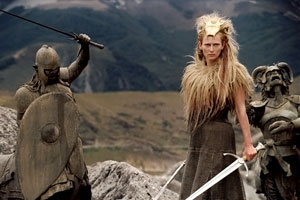 While all Christians look forward in eschatological hope for our True Home in the divine perichoresis of the Most Blessed Holy Trinity, known lovingly during the Middle Ages as the Beatific Vision, such essential twentieth century writers as C. S. Lewis and J. R. R. Tolkien acknowledge that our earthly vocations must include doing battle with exemplars of evil whose life and livelihood seem intent on destroying that which is true, good, and beautiful.
Lewis, as I note in this post, expressly states the utter need in extremis to do so. Tolkien, who like Lewis (in so many ways) fought and was wounded in the trenches of World War I, depicted the fight for Middle Earth as a mix and blend of warfare, providence, and bravery the likes of which just barely saved truth, goodness, and beauty by the narrowest of margins.
While contemplation of the Most Blessed Godhead is a vital part of our mission today as followers of Christ, is it all we are called to do? I think not. While in these "shadowlands", as Lewis called our troubled world, we are called to love and forgive even our enemy; but also defend all that we call good through legitimate defense. Occasionally the faithful thing to do is to do one's best to stop destroyers, practicing faith, hope, and charity in so doing.
Wednesday, June 13, 2007
Narnia in the Meantime
A visitor @ Mark Shea's blog lifted up an apparent Catholic Narnia Fan Website (not that one needs be Catholic to love the land of us Puddleglum types).
Sunday, June 10, 2007
Fearsome, Faithful Living +
From today's New York Times, what you need to know about what the Koran teaches regarding killing another human being, entitled Permission – The Guidebook for Taking a Life.
In a post, below, Monk from The Wacky Wannabee Musical Monk and I discussed what constitutes legitimate "security". It's only normal if one is exercising any concern for oneself and one's loved ones that we try to size up potential areas of danger ahead, and avoid them (walking in Central Park or on the Washington Mall in deserted, shadowy places sans visible people, etc.). But in reality, it is nearly impossible to take into account all such contingencies.
In C. S. Lewis's second book of his Space Trilogy, Ransom is on Perelandra (Venus, in the Massketeers' Guide to the Galaxy). Lewis tells how his hero made his way through the treacherous caverns of Perelandra: at one moment taking what would appear (if watched by an observer) overmuch caution, at another extreme risks, because he himself could not see but was climbing by feel alone.
In my opinion (in the same way that Saint Paul will occasionally step aside in the Epistles and say, "Now this is my opinion -- Paul" when not proclaiming the Gospel) -- this is Athos speaking now -- we must do three things in the face of such realistic threats:
(1) Not succumb to hate. We must pray for our enemies, as Our Lord commands [Mtt 5,44], and never willingly give in to "righteous" anger. Love [caritas, agape] is a decision. Like top-spin in ping-pong, it takes all the side-spin of evil off the ball served to us. Through God's grace, we choose not to return evil for evil. I will suggest a method for such prayer in the first comment (below).
(2) Exercise legitimate defense. The Catechism of the Catholic Church is clear: "Love toward oneself remains a fundamental principle of morality ..." (Remember, "Love your neighbor as yourself?") and "The defense of the common good requires that an unjust aggressor be rendered unable to cause harm." (Nos. 2264, 2265) This is posited on justice as Saint Thomas Aquinas understood it: to give what is due to God and to our neighbor; namely, what is right for the common good. This is perfectly in keeping with honoring and loving our aggressive "enemy" -- one wants to keep the enemy from carrying out unjust evil and violence, even if the enemy is accidentally injured or even killed in so doing (No. 2264).
(3) And, perhaps the most important point, do not provoke a potential enemy into aggressive and sinful behavior. This is scandal, and constitutes grave sin. Again, the Catechism:
And keep your eyes on Jesus! As the old Gospel chorus said: Turn your eyes upon Jesus, Look full in His wonderful face. And the things of earth will grow strangely dim, In the light of His glory and grace. +
In a post, below, Monk from The Wacky Wannabee Musical Monk and I discussed what constitutes legitimate "security". It's only normal if one is exercising any concern for oneself and one's loved ones that we try to size up potential areas of danger ahead, and avoid them (walking in Central Park or on the Washington Mall in deserted, shadowy places sans visible people, etc.). But in reality, it is nearly impossible to take into account all such contingencies.
In C. S. Lewis's second book of his Space Trilogy, Ransom is on Perelandra (Venus, in the Massketeers' Guide to the Galaxy). Lewis tells how his hero made his way through the treacherous caverns of Perelandra: at one moment taking what would appear (if watched by an observer) overmuch caution, at another extreme risks, because he himself could not see but was climbing by feel alone.
In my opinion (in the same way that Saint Paul will occasionally step aside in the Epistles and say, "Now this is my opinion -- Paul" when not proclaiming the Gospel) -- this is Athos speaking now -- we must do three things in the face of such realistic threats:
(1) Not succumb to hate. We must pray for our enemies, as Our Lord commands [Mtt 5,44], and never willingly give in to "righteous" anger. Love [caritas, agape] is a decision. Like top-spin in ping-pong, it takes all the side-spin of evil off the ball served to us. Through God's grace, we choose not to return evil for evil. I will suggest a method for such prayer in the first comment (below).
(2) Exercise legitimate defense. The Catechism of the Catholic Church is clear: "Love toward oneself remains a fundamental principle of morality ..." (Remember, "Love your neighbor as yourself?") and "The defense of the common good requires that an unjust aggressor be rendered unable to cause harm." (Nos. 2264, 2265) This is posited on justice as Saint Thomas Aquinas understood it: to give what is due to God and to our neighbor; namely, what is right for the common good. This is perfectly in keeping with honoring and loving our aggressive "enemy" -- one wants to keep the enemy from carrying out unjust evil and violence, even if the enemy is accidentally injured or even killed in so doing (No. 2264).
(3) And, perhaps the most important point, do not provoke a potential enemy into aggressive and sinful behavior. This is scandal, and constitutes grave sin. Again, the Catechism:
Scandal is an attitude or behavior which leads another to do evil. The person who gives scandal becomes his neighbor's tempter. He damages virtue and integrity; he may even draw his brother into spiritual death. Scandal is a grave offense if by deed or omission another is deliberately led into a grave offense. (No. 2284) "Temptations to sin are sure to come; but woe to him by whom they come!" (Lk 17,1 in No. 2287).So, as difficult as these days are, Our Lord gives us a viable path through them to Heaven by His grace: in seven wonderful words, prudence, justice, fortitude, temperance (the Cardinal Virtues), faith, hope, and love (the Theological virtues).
And keep your eyes on Jesus! As the old Gospel chorus said: Turn your eyes upon Jesus, Look full in His wonderful face. And the things of earth will grow strangely dim, In the light of His glory and grace. +
Subscribe to:
Posts (Atom)