Knowing How to Point a Finger
The president of Venezuela, Victor Chavez, apparently is taking the priest-king mantle upon himself in accusations against the Church here. Astonishing how relevant the work of René Girard -- mimetic theory -- is to the machinations of politicians. Especially to the "atheist" types who claim no such influence on themselves. Our Lord has a word for them in the Gospel of John, chapter 8. That bit about "your father was a murderer and a liar from the beginning."
Wednesday, May 23, 2007
Tuesday, May 22, 2007
Journey Outward - Journey Inward
The True Rhythm of the Saints
 Water Lilies (The Clouds) - Claude Monet
1903; Oil on canvas; Private collection
All the appeals to custom, to tradition, to authority, to the positive teaching of religion, to the gestures repeated since childhood are not meant to compel reason nor to supplement it, but to protect it against the vertigo of the imagination. And the only people to be scandalized are, in the words of St Augustine, ‘Those who do not know how rare and difficult a thing it is for the fleshly imagination to be subdued by the serenity of a devout mind.' -- Henri Cardinal DeLubac*
".... (Jesus) withdrew from there ... to a lonely place apart" -- Matthew 14,13a
*via our friend, Gil Bailie.
Monday, May 21, 2007
Sunday, May 20, 2007
Posting Problems
This is an edit of a post pointing out the new design of Anchoress's blog.
For some reason, comments were disabled in my post. (I think the comment disabling might have happened in the signing-in process, but I don't know.) I'm not sure how to fix it, but apologies in the mean time!
(2nd edit: Comments worked in the test post. Try this one again.)
(3rd edit: Fixed, I think.)
(4th edit: Yeah. If this ever happens to you, check the "Post Options" menu under the text area and make sure it's on "Allow")
Beating (Not So) Dead Horses
PBS, that refined repository of rehashed secularist orthodoxy, is running a series called Secret Files of the Inquisition. Natch, it ratchets up the anty in the area of "evidence" against the big, bad Catholic Church as a certifiable target for abuse, scorn, and general destruction. "We've got a live one, boys!" one can almost hear. The usual historiographical drivel is trotted out and paraded. From Father Neuhaus's blog,"We can no longer blame the favorite institutional scapegoats beaten to death by our master thinkers of the last two centuries. These beasts of burden have all collapsed long ago, just like Nietzsche's famous horse in Turin. One can go on beating dead horses for several decades, no doubt, especially in graduate seminars but, even there, there will be an end. No one can really believe that our families, the class system, the male gender as a whole, the Christian churches, or even a repressive university administration might be responsible for what is going on." - René Girard
"Nobody expects the Spanish Inquisition!" -- Monty Python
“It’s the usual recycling of the juvenile pap about ‘The Black Legend,’” [Neuhaus' friend] said. I surfed onto five minutes of last night’s episode, and she is right. There was a Franciscan friar preaching to an apparently clandestine gathering of village folk and the voice-over declaimed: “He spoke to them in their own language rather than the Church-approved Latin, which was considered utter blasphemy.” That would have come as a surprise to St. Francis, the Order of Preachers (Dominicans), and the thousands of others engaged in preaching missions throughout Europe.But rather than merely defend Mother Church, perhaps it is better to remember a different set of facts. During the entire 350 years of the Spanish Inquisition fewer people died (perhaps 4,000) than during a single day of the American Civil War. Crocker notes:
"The comparison isn't flip, for the issues were similar -- defining what it meant to be a Spaniard (or an American) and the limits of dissent (either in religion or in the right to self-determination, states' rights, secession, and slavery) ... Between 1551 and 1600, for example, the Spanish Inquisition claimed an average of four lives a year -- making Spain by far Christendom's safest haven in this time of religious strife. [228-229]By comparison, more than 150,000 of the peasantry died in two years of German peasant religious civil warfare between 1524-1526 -- sixty-five times the number of deaths the Spanish Inquisition claimed in its first ten (and by far its worst) years [Ibid, 249].
This is not to allay the wrongs and wrong-headedness of the Inquisition, but to point out that the hellfire that Martin Luther set loose in Germany deserves at least as much historical attention as the Inquisition (which examined future saints Teresa of Avila and John of the Cross for their orthodoxy).
But somehow, I don't expect PBS to do that. The Da Vinci Code has shown the true Victim of our age, and all modernism's slings and arrows are pointed at Mother Church.
Friday, May 18, 2007
The Sacred (Faithful) - Rossetti, PRB
 The Girlhood of Mary Virgin - Dante Gabriel Rossetti
[PRB 1849, Tate Gallery, London]
Rossetti's first major oil painting and the first to be exhibited with the mysterious letters 'PRB'. The models for Our Lady and her mother were Rossetti's sister, Christina, and their mother. It is replete with symbols -- Mary Virgin and St. Anne are embroidering a lily, symbol of purity, on a crimson cloth; a pile of books inscribed with the cardinal virtues; a seven-thorned briar and seven-leaved palm branch are tied with a scroll etched with tot dolores tot gaudia ('so many sorrows, so many joys'). And a child angel lightly touches the temporal plane, St. Joseph prunes a vine, and the Holy Spirit in the form of a dove looks piercingly with its jet black eye.
The Profane -Mariana - John Everett Millais, PRB
 Mariana - Sir John Everett Millais
[1851, The Makins Collection]
This scanned image of Millais' great Pre-Raphaelite painting does not do credit to the hues and shades in the original or a better print. He exhibited it at the Royal Academy in 1851, giving it no title. Instead, he gave only a few lines from Tennyson's poem, Mariana:
She only said, 'My life is dreary --
He cometh not,' she said,
She said, 'I am aweary, aweary --
I would that I were dead.'
He cometh not,' she said,
She said, 'I am aweary, aweary --
I would that I were dead.'
Millais derived the stained glass in the painting from windows in Merton College Chapel, Oxford. The garden was from Thomas Combe's garden, also in Oxford.
Thursday, May 17, 2007
Vox Nova
Amy Welborn lifted up a newish blog entitled Vox Nova. The diverse group says about itself:
We are writing to humbly request your help in getting the word out about our new Catholic social/political blog. We are a group of faithful Catholics of very different political persuasions--from libertarians to distributists, from capitalists to anarchists, from conservatives to collectivists. We are united in our conviction that Jesus Christ is the center of the universe and the full revelation of humanity to itself. As Catholics committed to the tradition and magisterium of the Church, we seek to provide smart and informed commentary and debate on culture, society and politics from the Catholic perspective. Because of the diversity of the contributers (mothers, professors, students, fathers, laborers, immigrants), this blog is sure to be uniquely interesting and lively.
Wednesday, May 16, 2007
"I Am European"
 (By Athos)
Charles Coulombe gives simply the most bracing analysis, clarion-call, and call-to-arms I have read heretofore on not giving up on the pays réel, the real Europe, Catholic and Royalist vs. the pays légal, the dyspeptic EU.
(Thanks to young Andrew Cusack.)
Away From Nihilism
And By A Lawyer, Too
In 2004, after a stint as an evangelical lawyer expounding the merits of natural law theory, J. Budziszewski converted to the Catholic Church. Even earlier, finding himself being swept by the currents of nihilism toward a vortex that readers of René Girard know something about, he caught the rope of Christian belief to extricate himself from a sticky end. You can read about it in his own words here.
What he says about the "stupidity of the intelligent" is too good to recap; you deserve to read it for yourself.
Right Reason interviews Budziszewski about his book, Natural Law for Lawyers.
Pope's Jesus of Nazareth -- References to St. Francis
 As some know, I am part of the Secular Franciscan Order (SFO), formerly known as the Third Order of St. Francis. So when I came upon this reference to St. Francis and the Third Order in Pope Benedict's new book, Jesus of Nazareth, I couldn't resist blogging the comment.
Jesus of Nazareth – Pope Benedict XVI
Chapter 4 – Sermon of the Mount
The Beatitudes
“Blessed are the poor in spirit – theirs is the Kingdom of God.”
But it may be a good idea – before we continue our meditation on the text – to turn for a moment to the figure whom the history of faith offers us as the most intensely lived illustration of this Beatitude: Francis of Assisi. The saints are the true interpreters of Holy Scripture. The meaning of a given passage of the Bible becomes most intelligible in those human beings who have been totally transfixed by it and have lived it out. Interpretation of Scripture can never be a purely academic affair, and it cannot be relegated to the purely historical. Scripture is full of potential for the future, a potential that can only be opened up when someone “lives through” and “suffers through” the sacred text. Francis of Assisi was gripped in an utterly radical way by the promise of the first Beatitude, to the point that he even gave away his garments and let himself be clothed anew by the bishop, the representative of God’s fatherly goodness, through which the lilies of the field were clad in robes finer than Solomon’s (cf. Mt 6:28-29). For Francis, this extreme humility was above all freedom for service, freedom for mission, ultimate trust in God, who cares not only for the flowers of the field but specifically for his human children. It was a corrective to the Church of his day, which, through the feudal system, had lost the freedom and dynamism of missionary outreach. It was the deepest possible openness to Christ, to whom Francis was perfectly configured by the wounds of the stigmata, so perfectly that from then on he truly no longer lived as himself, but as one reborn, totally from and in Christ. For he did not want to found a religious order: He simply wanted to gather the People of God to listen anew to the word – without evading the seriousness of God’s call by means of learned commentaries.
By creating the Third Order, though, Francis did accept the distinction between radical commitment and the necessity of living in the world. The point of the Third Order is to accept with humility the task of one’s secular profession and its requirements, wherever one happens to be, while directing one’s whole life to that deep interior communion with Christ that Francis showed us. “To own goods as if you owned nothing” (cf. Cor 7:29ff.) – to master this inner tension, which is perhaps the more difficult challenge, and, sustained by those pledged to follow Christ radically, truly to live it out ever anew – that is what the third orders are for. And they open up for us what this Beatitude can mean for all. It is above all by looking at Francis of Assisi that we see clearly what the words “Kingdom of God” mean. Francis stood totally within the Church, and at the same time it is in figures such as he that the Church grows toward the goal that lies in the future, and yet is already present: The Kingdom of God is drawing near…
-- pg 78-79

Monday, May 14, 2007
A Little Backbone, Please?
A brave or at least pugnacious high school-age Englishwoman is going to court to stand up for the Christian faith this summer. Aren't we finished with scapegoating the Way, the Truth, and the Life yet?
"The darkness of mythical origins give way to more decorous forms of befuddlement and self-deception, those of philosophies and ideologies. There is a sophisticated darkness of modern knowledge that is continuous with the darkness of mythology, and it is fitting that it would rely more and more on mythological expression, on the Oedipus myth, for instance, that may well be the myth par excellence of our post-Christian and neo-pagan confusion." - Rene Girard [via Cornerstone Forum "Quote of the Day"]
Lions and tigers and bears, oh my -- Capitalism and Marxism and Liberation Theology OH MY
 “What is real?” he mused in the speech, hours before heading back to Rome after five days in Brazil, the world’s most populous Catholic country. “Are only material goods, social and economic and political problems ‘reality’?” Without agreeing first on God, he argued to the bishops, society is unable to tackle the problems of poverty and social injustice.
“Just structures are,” he said, “an indispensable condition for a just society, but they neither rise nor function without a moral consensus in society on fundamental values.”
“Where God is absent — God with the human face of Jesus Christ — these values fail to show themselves with their full force: nor does a consensus arise concerning them,” he said.
To see the Times article click here.
He also raged with equal fire against Marxism and capitalism. By focusing solely on material concerns, he said, they “falsify the notion of reality by detaching it from the foundational and decisive reality which is God.”
“Both capitalism and Marxism promised to point out the path for the creation of just structures, and they declared that these, once established, would function by themselves,” he said. “And this ideological promise has proven false.”
Marxism, he said, left “a sad heritage of economic and ecological destruction.” Capitalism, he said, has failed to bridge the “distance between rich and poor” and is “giving rise to a worrying degradation of personal dignity through drugs, alcohol and deceptive illusions of happiness.”
Without specifically mentioning liberation theology by name, Benedict, in his speech to the bishops, criticized Catholics who argue that the church’s supreme moral duty is to denounce and resist social injustice. As the Vatican’s senior official on matters of doctrine and faith, he led efforts in the 1980s to stamp out the movement, then quite influential in Latin America, and on Sunday he again warned the clergy not to permit such concerns to eclipse their spiritual duties.
“This political task is not the immediate competence of the church,” he said. “Respect for a healthy secularity — including the pluralism of political opinions — is essential in the authentic Christian tradition.
“If the church were to start transforming herself into a directly political subject, she would do less, not more, for the poor and for justice.”
Link to Zenit for the full address.
Everyone, on all sides, even in the pews, shout and demand action and justice, yet few seem to heed THE Good News, as in the Gospel reading today: John 15:9-17
Jesus said to his disciples:
“As the Father loves me, so I also love you.
Remain in my love.
If you keep my commandments, you will remain in my love,
just as I have kept my Father’s commandments
and remain in his love.
Sunday, May 13, 2007
"To the Next Generation?"

6th Sunday of Easter +
Here in this society, which is an anti-intellectual society, the young people -- the “new generation” -- not by any means all, but some -- are beginning to experiment with the Dionysian in a noticeably American way. That is to say, “Skip the Nietzsche, skip the Heidegger, and get straight to the crazy frenzy. Crank up the rock-and-roll, and see where it will take us.Any attempt to answer the question of the purpose of human life was abandoned some time long ago in the twentieth century, as the prophetic Bailie knows. At the website of his Cornerstone Forum, he once quoted German theologian Max Picard who wrote:
"Christ came so directly from silence into the word . . . that the whole world between silence and language -- the world of mythology -- was exploded and bereft of its significance and value. The characters in the world of myth now became demons stealing language from man and using it to cast demonic spells. Until the birth of Christ they were the leaders of men, but now they became the mis-leaders, the seducers, of men." [Flight from God, 1934]But the world has changed. The gods of the fallen and violent human psyche have once more taken ascendancy in the west. Like the elves who are leaving Middle Earth in J. R. R. Tolkien's masterpiece, The Lord of the Rings, the influence of the Catholic Church in western civilization finds itself being beaten back on two fronts: the neo-pagan from among the west's own generations and the Saracen by means of immigration and explosive birth rates.
Against this forlorn historical backdrop come the words of the Psalmist, limning the alternative in stark contrast to what has taken place but might not have.
Attend, my people, to my teaching;
listen to the words of my mouth:
I will open my mouth in story,
drawing lessons from of old.
We have heard them, we know them,
our ancestors have recited them to us.
We do not keep them from our children;
we recite them to the next generation.
The praiseworthy and mighty deeds of the LORD,
the wonders that he performed ...
What he commanded our ancestors,
they were to teach their children;
That the next generation might come to know,
children yet to be born.
In turn they were to recite them to their children,
that they too might put their trust in God.
And not forget the works of God,
keeping his commandments. [Ps 78, 1-7]
Perhaps then the Gothic spire, the monastic bells, the guild, and the "source and summit of the Church" will look pretty good once again.
"Whoever loves me will keep my word, and my Father will love him, and we will come to him and make our dwelling with him." [Jn 14,23]+
Friday, May 11, 2007
A Dawning Within the Young Republicans

Dawn Eden is at it again. If you are not getting over to view her blog regularly, you are missing out. Check out her talk to the Young Republicans. Here is a short except:
As you know, being Republicans in New York City, there is the so-called counterculture – the feminists, global-warming fanatics, gay-marriage proponents, abortion activists, and so on – and then there is the real counterculture. The real counterculture are those who are working to preserve the moral values that are at the foundation of western civilization. As a longtime rebel, I was attracted to chastity because where the real counterculture lies, chastity is pretty close to ground zero.
Holy Mount Athos
My, my Ath, you keeping this place of your name sake for yourself? Imagine a small Greek island of 20 monasteries. I vote that we make the Holy Mount Athos our retreat this year. What do you think?
Thursday, May 10, 2007
WHAT I AM - YOU WILL BE ~ WHAT YOU ARE - I WAS
 Ossuary at the Romanian Skete Prodromos on Mount Athos.
Lest we think surfing the net is of utmost importance and we have all the time in the world to get around to the Two Great Commandments ...
(Thanks to Art Smuggler via Daniel Mitsui.)
Wednesday, May 09, 2007
CT & Beckwith Interview
Readers may be keeping up with the momentous conversion of Dr. Francis Beckwith, leading evangelical Christian, to the Catholic Church. This candid and cordial interview with Christianity Today is enjoyable and informative. Too, it resonates with the stories of many who enter full communion with Christ's "one, holy, catholic and apostolic Church."
Tuesday, May 08, 2007
Sarkozy - New Leader in France
 I do not usually post political articles however it seems, even to me, that the result of the election in France could have major implications throughout the world.
Here are a couple excerpts from conservative blogger, Cranmer on Sarkozy, the newly elected President of France.
The new Président de la République inherits from Jacques Chirac stagnant wages, a lagging economy, and pockets of civil unrest in the impoverished suburbs populated largely by immigrants. Some of these immigrant youths rioted and torched cars very recently, mainly in protest at their poverty and alienation. Monsieur Sarkozy referred to them as ‘scum’, and has pledged himself to be tough on immigration, to cut taxes and unemployment, to limit the disruption to public services during strikes, to cut public sector staff – in short, to abandon the French model and perform the radical surgery necessary for France to compete in a global market.
Setting aside his ‘Thatcher with trousers’ agenda, the election of Monsieur Sarkozy is a very significant development for two main reasons. Unlike most of the French ruling class, Monsieur Sarkozy is not an énarque – he did not go to the Ecole Nationale d'Administration. He is the son of a Hungarian immigrant and a French mother of Greek Jewish origin, and was baptised a Roman Catholic. He will be the first son of an immigrant to rule modern France, and he intends to do it his way.
He has voiced consistent opposition to Turkey's bid to join the European Union, and the Turks have just had their European dreams ended for as long as Monsieur Sarkozy occupies the Elysée Palace. It is not merely his disapproval of the imminent involvement of the military to reassert Turkey’s secularism, but he has a profound distaste for ‘political Islam’, which he perceives to be antithetical to the founding principles of the Fifth Republic. He also intends to scupper any notion that France will be the recipient of Muslim-Turkish migrant workers, and would doubtless invoke the amended French Constitution to do so.
Monsieur Sarkozy has come to power declaring: ‘I am not in favour of any kind of censorship, whether of men, ideas or religions’.
Hamas Kidnaps Mickey Mouse
Oh, the Horror
Hamas forces Mickey Mouse at gunpoint (just out of camera range) to rant, telling kids to do their bit for the liberation of Al-Aqsa mosque in Jerusalem or be answerable to Allah.
Monday, May 07, 2007
Pre-Raphaelite Artist - Millais
 The Blind Girl (1856) -- Sir John Everett Millais (1829 – 1896)
"Millais was in essence a great craftsman, and was not in any way an intellectual. He was a Victorian hearty, with a love of hunting, shooting, and fishing. Throughout his life he remained at heart a large enthusiastic schoolboy. He was a devoted father, and was particularly indulgent to his daughters. He had the gift of inspiring loyalty and affection amongst a wide circle of friends. Fellow artists who one would not expect to be sympathetic to Millais the artist regarded Millais the man with affection, Edward Burne-Jones was amongst his admirers. The artist himself did not feel that he had compromised his standards. In later life he said ‘ I may honestly say that I have never consciously placed an idle touch upon canvass; and that I have always been honest and hardworking.’ This is not the comment of a cynical, financially motivated individual.
"This is one of the painters most outstanding early Pre-Raphaelite works dating from 1854-1856, combining fidelity to nature, & social comment. The beauty of the picture makes it easier for the viewer to sympathise with the blind girl. The lack of any assistance to young, disabled beggars like the girl. The background landscape is not of a single area, being a combination of Sussex, & the home of Millais wife Effie near Perth. The painter always had difficulties in combining figures with landscapes, but in this picture combines both most successfully."
Sunday, May 06, 2007
Throwing Stones & Political Power - Part II
 In his book, Why Johnny Can’t Tell Right from Wrong, William Kilpatrick recounts how in the 1970's the "values clarification" movement lent academic and "social science" legitimacy to what Benedict XVI calls "the dictatorship of relativism." The new presupposition was that it was now a moral wrong to impose values on children. One was to let values ooze from the individual child like droppings of a noble savage. Once again, the academics, far from questioning such unheard-of practices, instead gave their stamp of approval to the zeitgeist from which they came: "peace, love, (dope)."
In the relativist world of Values Clarification, there are no right or wrong answers. Or right or wrong values, for that matter. This is Commandment Number One in the world of Values Clarification, the brain-child of the (pagan) Renaissance, turned Enlightenment, turned Romanticism, turned nihilism, turned ouroboros.
Just think if we taught chemistry this way. "Okay, class, go into the lab and start creating your own compounds. If you should happen to blow yourself up ... well, at least it will be an authentic search."
From these perfumed meadows of a Rousseau-esque idyllic fantasy world came the present "crisis of distinctions" (R. Girard) in which the west is floundering: the individual is everything; marriage is a convention of personal preference with no definition; child-bearing and child-rearing a ridiculous waste of personal time, effort, and money; and selfhood whatever I damn well please. From this we get such arbitrary, give-away-the-store legislation as Local Law Enforcement Hate Crimes Prevention Act of 2007.
"Hate crime," you see, is defined as anyone who balefully believes, says, or proposes anything against Values Clarification Commandment Number One (above). Or, as Dymphna says, "some victims are more equal than others, and any situation where the federal government can stick its nose is now an improvement over local law enforcement."
I was going to begin sharing some good news in Part II, but I can see that it will have to wait. However, those who have reached into both the New Testament and the scholarly work of Girard's mimetic theory know that unbaptized political power inevitably turns into a way to find new victims to sacrifice. In other words, new attempts at a very old way of scapegoating others in order to feel good about ourselves. The only -- the only -- way of avoiding this recurring pattern is the Way, truth, and life of Christ the King in humility and service.
In Part III, I will play "Dr. Cornelius" from C. S. Lewis's Prince Caspian and let you know a great secret: faith, hope, and charity exist and can be found in the one, holy, catholic, and apostolic Church, built upon Peter by the living, Eucharistic Lord, Jesus Christ. There is a bright, shining world above and beyond the dodgy world of relativism that is presently eating up itself.
Prelude to a Harry Potter Summer
Before adults have the delightful and confusing experience of seeing hundreds (if not thousands) of prepubescent children with huge, hundreds-of-pages-long books perched on their laps, heads down, and reading as if for their very lives, this is the best analysis of the Harry Potter phenomenon I have read.
Saturday, May 05, 2007
Benedict's Hopeful Vision?
 Gil Bailie continues to chronicle the pathetic downfall of Europe in his recent blog, ”Surrendering Europe”. For many of us, the difficulty lies in seeing how the gaping maw of secular and nihilistic Europe that long ago jettisoned its healthy Christian moorings can possibly pull itself back from the edge of self-annihilation via childlessness, rejection of life-long marriage, and the disposal of the family. The futuristic dystopian vision of childlessness and civil war is aptly and fearfully depicted in Alfonso Cuarón's film, Children of Men (2006).
Perhaps it is living long enough to recall a time when the definition of marriage was obvious, families with three or more children routine, and abortion a shameful aberration; but it is a dismaying time. Add to that the Saracen not outside the gate, but demanding shariah on European streets and in its municipalities ... well, it is no wonder that death knells are sounding across the blogosphere.
It is providential that we have a Pope who has taken it upon himself to help Europe come to itself, "slopping the swine" and bereft as it presently is "in a far country." We see in Benedict XVI God's man and Saint Peter's successor a man who loves what once was Christendom and has decidedly not given up on it.
That said, however, Hilaire Belloc, the great and largely forgotten 20th century man of letters (1st History, Oxford) and friend of Chesterton, saw the sad state of England coming more than a half century ago. According to Paul Likoudis (Ed. @ The Wanderer):
"England's condition was especially serious, Belloc warned, for the effort to cut the English from the traditions of the race through a 'Reformation' was now four centuries old and England was on the precipice of a brutal neo-paganism as a consequence ... To Belloc, only a person who thinks with the Church could see, looming on the horizon, the Neopagan Barbarian ready to storm the broken gates of Christendom" (Saint Austin Review, Sept.-Oct. 2003, 9-10).
England's cliffs of Dover long ago turned their backs on Mother Church. Only time will tell if BXVI will live long enough to see his hopes fulfilled, and the Father welcome his footsore and beaten down prodigal trapsing back to the gladsome Farm of truth, goodness, and beauty. Only time will tell; till then let us watch and pray "more than watchmen for the morning -- more than watchmen for the morning."
Throwing Stones & Political Power - Part I
Or, How to Play 'King of Accusing'
One of the astounding insights made by René Girard is the foundation of kingship and priesthood, or, more to the point for our days, political power. In his intuition of the "generative" power of violence, the accusatory gesture indicates who is the safe-to-dispose-of victim and the crowd circles ready to pounce. At this moment, the victim has every eye upon him or her -- an amazingly dangerous, and potentially powerful place to be. If this person can harness that power, interrupt the crowd's expelling or murderous momentum for just long enough, he or she can turn their violence intentions upon a different, "surrogate" victim. Then, the originally accused one becomes not the crowd's victim, but its king or priest -- the one who designates and accuses for the crowd.
When I was a new kid in the second grade at a different school, I was victim-fodder: an outsider, no friends yet, no advocates. I had sized up the hierarchy, the "pecking order" on the playground, however (little kids may be inexperienced, but even young human beings know what's what). What I didn't see coming was the rock thrown at me from behind. Thunk. Right behind my ear. It didn't really hurt, and, in a way, I was expecting it. But what scared me was the blood on my hand when I felt the place the stone struck. My blood.
That's when I started screaming bloody murder, which brought the teacher on-duty during recess over to me. She accompanied me, crying up a storm, into the infirmary to get patched up, and find out who did it.
After the (slight) wound was bandaged, I was asked who did it. I remember seeing an older kid standing where the stone might have come from (from behind, and out of my range of vision), the only candidate whom I could see, and I accused him. A teacher fetched the accused perpetrator of the crime. He denied throwing the stone. I shouted, "He did it!" even louder (crying, angry, righteous). And he didn't deny it any more.
DID he throw the stone? I don't really know. Maybe he figured that he didn't want to be involved any longer with this crazy little new kid who was yelling and crying and pointing his finger at him. Too nutty and uncool. So, he took the rap instead.
The thing is, we both won. He got to look "bad" for throwing it at me (even if it was someone else), and I got to show I was capable of being an accuser. Whoa -- that's power for a new kid in a different school. Better not mess with him any more.
Why am I telling this sad, sordid little schoolyard tale?
Because the news is filled with this same story today -- ad nauseam. Particularly in the realm of "hate crimes" and the stance of the Catholic Church on abortion, homosexuality, and other areas where the Church teaches that matter arranged in a unique and irreducible manner by an informing rational soul matters.
In Part II, I will address why the Church is neither the stone-throwing victimizer nor the hoarder of political power, but rather the only hope for a world filled with both. Peace. +
Thursday, May 03, 2007
Be of Good Cheer - Part II - Let Us Not Be Deceived - Getting to Know Ourselves
 The following is an excerpt from Gil Bailie's Emmaus Road Initative January 2006 talk, Human Nature & Human History
St. Gregory of Sinai said: "If we do not know what we were like when God made us, we shall not realize what sin has turned us into".
One need not believe as we Catholics do that grace perfects nature to believe as Christians and Jews always have, that creation is the Creator's first act of self-disclosure. And that precisely human nature bears the stamp of its Creator … (I)n as much as we are made in the image and likeness of God we receive our existence from God and the existence we receive is not that of a blank slate. On the contrary, it is highly specified and though it is indeed endowed with freedom, there are real limits to its ability to remake itself in its own image, the tendency at work in the modern project and the predominate theme of the post-modern one. We are made in the image and likeness of another - which means we are made to imitate another. We could only become who we are by becoming like someone else. And the closer that someone else is to God the better; and the question is, how close can we get? Christianity is the answer to that question.
"Desire,” Rene Girard tells us, “is always the desire to be another.” Whether one's desire is being mediated by the latest popular TV personality or the reigning National League batting champion or by Christ our deepest and defining impulse is to adopt as our own the attributes of another. "Choice always involves choosing a model," Girard writes, "and true freedom lies in the basic choice between a human and a divine model." We have to have a human model and we are made in the image and likeness of God. St. Paul said that Christ is the image of the invisible God. Jesus says, “Have I been with you for so long a time and you still do not know me, Philip? Whoever has seen me has seen the Father.” (John 14: 9)
<<
By the way, the Gospel reading today, May 3rd, happens to include this last statement from Jesus.
Life & Death Matters
It seems the ER gang will have to change their paradigm. Newsweek and a gaggle of researchers stumble upon when death is really still alive.
Wednesday, May 02, 2007
"Be of Good Cheer - I have Overcome"
 Daniel in the Lion's Den - Peter Paul Rubens, c. 1615;
National Gallery of Art, Washington
There are times when culling evidence of the demise of western civilization on the internet that one senses an overwhelming feeling of dismay. Saint Augustine and his faithful ones may have felt similarly during the collapse of the empire of Rome; perhaps those too who heard or read Joseph Stalin's reputed question, "How many divisions does the Pope have?"
As the waning season of Easter draws to a close, the events surrounding Our Lord's Resurrection may seem a bit distant. But we should not let them be! The naysayers, the wreckovators of the Church, the relativists and neo-gnostics roam, looking for the unwary and the down-hearted, the superficial and the vacuous as tasty morsels and fellow travelers to join them down the vortex of despair and ruin.
Appearances are extremely deceptive. The Roman Empire is gone, but what filled its shell but the Catholic Church? Where are Stalin's divisions now? Yet dialog between the "two lungs" of Christendom has never been so hopeful!
So, "Let not your hearts be troubled, neither let them be afraid"[Jn 14,1]. The One who was raised also said, "In this world you shall have tribulation. But be of good cheer; I have overcome the world" [Jn 16,33].
The God revealed by Jesus Christ, the God of glorious salvation history in the biblical narrative, is the Lord of history. Rarely do His people see how the salvation will take place, but, in hindsight, they revel in His doings, sing them in song, praise Him in glory, and worship Him in holiness.
Let us not flag in our worship, praise, song, or revelry. Remember Chesterton's Ballad of the White Horse, and the words of the Mother of God to Alfred:
"I tell you naught for your comfort,
Yea, naught for your desire,
Save that the sky grows darker yet
And the sea rises higher.
"Night shall be thrice night over you,
And heaven an iron cope.
Do you have joy without a cause,
Yea, faith without a hope? ...
"But the men signed of the cross of Christ
Go (merrily) in the dark."
Tuesday, May 01, 2007
The Archbishop's Special Delivery
And It Isn't a Nosegay
Gerald Augustinus at The Cafeteria is Closed reports that the Holy Father is lending support to Genoa's Archbishop Angelo Bagnasco, the president of the Italian bishops' conference, in the face of death threats: most recently, a bullet in the mail. Not "soft coercion." Not a subtle message. Point blank clear: message received.
Once again we note that the Catholic Church, in supporting the sacrament of Holy Matrimony, the "domestic church," and the common good, draws the usual lynch-mob of miscreants and degenerates. They understand that their "special interests" (read: neo-pagan, anti-Christ agenda) are only confronted by Catholic truth. Who else? Please show me if I'm wrong about that. We're supposed to forgive, turn the other cheek, not return evil for evil. They certainly don't have to. Any means -- political, judicial, ecumenical, death threats -- any means to disassemble the foundations of civility, sanity, and hope for humanity.
Catholic World News reports that Cardinal Camillo Ruini, who had preceded Archbishop Bagnasco as president of the Italian bishops' conference, told the Italian daily Corriere della Sera that Italian Church leaders would not be silenced by threats. “We will speak even more clearly and forcefully," he vowed.
For the clearest, most lucid expression of why support for our Church leaders matters and such violent threats cannot be ignored, pick up a copy of David P. Lang's superb slim volume, Why Matter Matters [Our Sunday Visitor, 2002]. Hint: Genesis 1, 31.
Sunday, April 29, 2007
Back By Popular Demand +
 William Holman Hunt (1853–4)
All right, not by popular demand. I just needed to see it plainly and forthrightly again.
The Light of the World is an allegorical painting by William Holman Hunt representing the figure of Jesus preparing to knock on an overgrown and long-unopened door, symbolic of the human conscience. The scriptural basis for this concept can be found in Revelation 3:19-21: "Behold, I stand at the door and knock; if any man hear my voice, and open the door, I will come in to him, and will sup with him, and he with me". According to Hunt: "I painted the picture with what I thought, unworthy though I was, to be by Divine command, and not simply as a good subject." It has sometimes been remarked that the door in the painting has no handle, and can therefore only be opened from the inside.
The painting was Hunt's most famous and successful work and was toured around the world. The original is now in a side room off the large chapel at Keble College, Oxford. Hunt painted a large copy towards the end of his life, which is now in St Paul's Cathedral, London.
The painting was Hunt's most famous and successful work and was toured around the world. The original is now in a side room off the large chapel at Keble College, Oxford. Hunt painted a large copy towards the end of his life, which is now in St Paul's Cathedral, London.
-- http://en.wikipedia.org/wiki/The_Light_of_the_World
Saturday, April 28, 2007

Friday, April 27, 2007
Christian Faith a Pharmakos?
Drug and Poison?
In an article entitled, "Christian Background To Political Correctness?" in the online journal Global Politician, Fjordman makes a disturbing yet largely accurate observation:
This nearly borders on a hat-in-hand Nietzschean position, but one can understand Fjordman's observation. The Church contains and guards the deposit of faith in Sacred Scripture and Tradition via the Magisterium. Yet the plethora of expressions of Christianity in greater or lesser degrees represents and misrepresents Catholic truth in word and action.
Fjordman notes that Christian ethics sans Christian beliefs can be deadly to a culture, as we see in the West:
In an article entitled, "Christian Background To Political Correctness?" in the online journal Global Politician, Fjordman makes a disturbing yet largely accurate observation:
Christian ethics have proved more durable than Christian beliefs.Furthermore, he notes that while he is not a Christian, he has deep appreciation for the contributions made by the Christian faith. However, the question that distresses him in the present cultural crisis facing the West is, "precisely because Christianity has so profoundly shaped our culture, isn’t it plausible that it may also, at least indirectly, have contributed to some of the flaws that currently ail us as well?"
This nearly borders on a hat-in-hand Nietzschean position, but one can understand Fjordman's observation. The Church contains and guards the deposit of faith in Sacred Scripture and Tradition via the Magisterium. Yet the plethora of expressions of Christianity in greater or lesser degrees represents and misrepresents Catholic truth in word and action.
Fjordman notes that Christian ethics sans Christian beliefs can be deadly to a culture, as we see in the West:
So, for those who still maintain the theological virtue of hope, it is not time to compromise with the state, as Fjordman suggests. It is time to evangelize the truth claims of the Gospel and the deposit of faith -- the beliefs -- vouchsafed by the Magisterium. For truly, Christian ethics, which a secular West won't even give credit to -- can, as Fjordman says, be deadly with Christian belief.One major component of Western self-loathing is the idea that we should we be punished for crimes, perceived or real, committed by our ancestors before we were even born. It could be argued that this idea has its roots in Christian thinking, in the concept of original sin, committed by Adam and Eve, but where all their descendants are subject to its effects. Christian ethics have proved more durable than Christian beliefs. Even when we have supposedly left the religion behind, we still believe we have to make atonement for the sins of our forefathers, but since we no longer believe that Christ has made that sacrifice for us and washed away our sins, we end up sacrificing ourselves instead...
Perhaps Christianity, despite its many great qualities, needs to be balanced out by other more worldly elements, such as attachment to nation states.
Thursday, April 26, 2007
American Idol Gives Back Celine and Elvis
Elvis and Celine Dion from Yahoo videos.
I figure that one of us Massketeers have to hold up the common fan -- though I love the beauty of classical and jazz music, I guess there are times when I just got to have my Elvis fix.
Tuesday, April 24, 2007
Growing Pains?
With due respect to fellow Massketeer, Porthos, and in the same vein, I might add, as "Paglia on Radio," I would like to share with our multitude of readers something borrowed from Dymphna at Gates of Vienna, namely, this video piece entitled ”The Trouble with Islam.”
Commonsensical, whimsical, mildly low on the level of discourse expected and demanded of our readership, but worthy of a look and a listen, in my humble opinion.
Monday, April 23, 2007
Sunday, April 22, 2007
The Farmer, Violinist, the Metro & 'Ugly as Sin'
Talk about a "slaps forehead, why didn't I think of that?" connection. The Yeoman Farmer makes a superb connection in regards to a cool article from the Washington Post Sunday Magazine, ”Pearls Before Breakfast” and Catholic Church architecture. Context matters, as if Daniel Mitsui didn't know that already. But chalk one up for Yeoman, outstanding in his field.
Beauty & the Quiet Mind
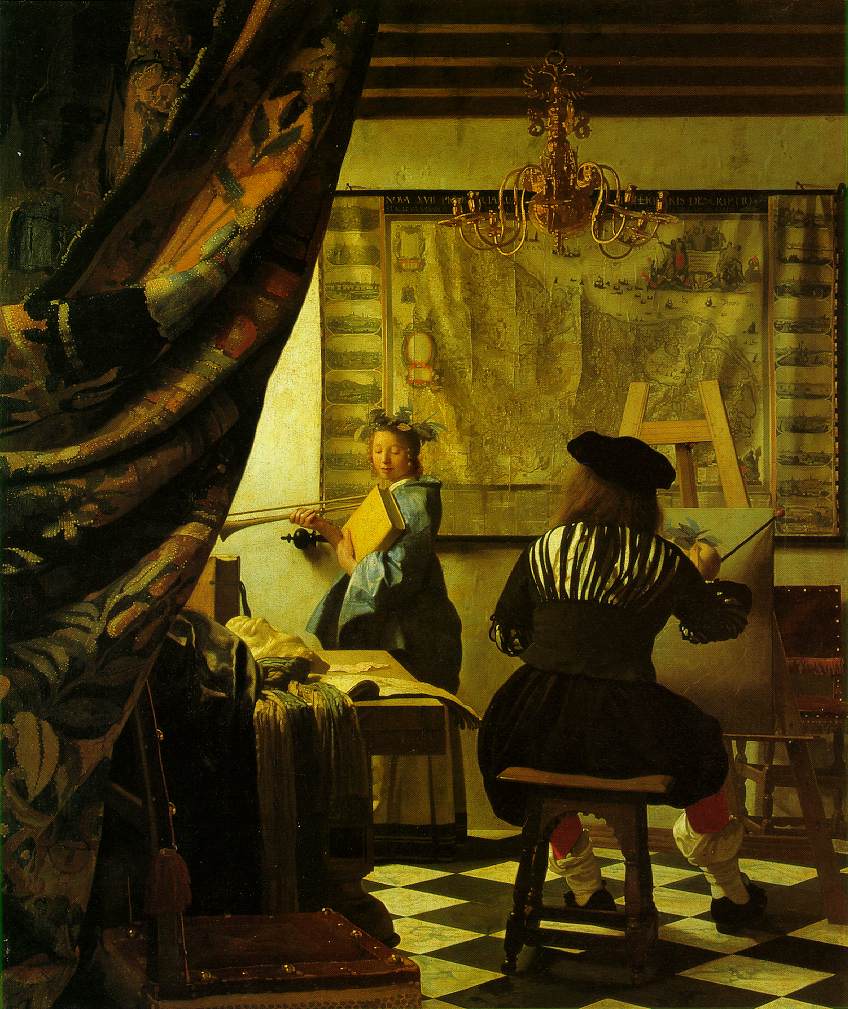 The Art of Painting - Jan Vermeer
c. 1666-73; Oil on canvas, 130 x 110 cm; Kunsthistorisches Museum, Vienna
Sylvia Shaw Judson gave us a slim volume entitled, The Quiet Eye, the philosophy of which being one of quieting one's inner life through art; using that which one looks upon to bring about a peace that is rare, given our usual states of conscious turmoil, hectic drivenness, and other conditions of unrest. This, of course, is the point of carving out time to spend on a retreat. But I find the paintings of Jan Vermeer to provide such opportunities of centering, reflection, contemplation (I believe fellow Massketeer Porthos does too, but I'll let him speak for himself.) Music by the Tallis Scholars is conducive to such contemplation as well.
Given the works of evil perpetrated upon students and faculty of Virginia Tech University, the alternatives -- a "mind enslaved" and a mind at rest in God's arms [Psalm 131] -- one would do well to heed the words shared by friend and mentor, Gil Bailie:
Given the works of evil perpetrated upon students and faculty of Virginia Tech University, the alternatives -- a "mind enslaved" and a mind at rest in God's arms [Psalm 131] -- one would do well to heed the words shared by friend and mentor, Gil Bailie:
(The polymorphously perverse mind) is a mind enslaved. It desires not only to possess the other, but to consume or destroy. It wishes not only to imitate the other, nor merely to possess itself in the other, but to destroy the other as the place where the self is alienated to itself.
All the appeals to custom, to tradition, to authority, to the positive teaching of religion, to the gestures repeated since childhood are not meant to compel reason nor to supplement it, but to protect it against the vertigo of the imagination. And the only people to be scandalized are, in the words of St Augustine, ‘Those who do not know how rare and difficult a thing it is for the fleshly imagination to be subdued by the serenity of a devout mind."
Thursday, April 19, 2007
Ismail Ax & the Primitive Sacred
Mark Gordon at Suicide of the West lifts up a frightening yet keen intuition about the shooter at VTU. Fatuous speculation? Not if one takes seriously René Girard's mimetic theory.
In the times when the cultural enterprise of a people are loosening mores, prohibitions, taboos that confined scandalizing behavior, Girard, Jean-Michel Oughourlian and Guy Lefort laid down the blueprint for a predictable gradient that leads nearly inexorably to complete social meltdown. Such "sacrificial preparation" mimics the founding violence that gave rise to culture in the first place. To believe with supreme naïveté that we moderns have outgrown such "primitive" behavior is worthy only of such folk as still believe in the myth of the autonomous self. You know, like the commissioners of the EU.
That a loner, bereft of the benefit of the light of the Gospel should stray toward violence that is a clear expression of what Girard calls the "primitive sacred" with dehumanization of its enemies and immunity from repercussions for violence performed upon them is only "natural" in every sense of the word. For, only the revelation of the deposit of faith vouchsafed by the Catholic Church offers freedom from this gradient of sin and death.
But regardless whether the shooter was or was not a recent convert to Islam, Nietzsche would have been proud of the lad, Cho Seung-Hu or Ismail Ax, for trying to jump start the old mechanism of the "eternal return." If we willingly relinquish Catholic truth, either in its full expression guarded by the Magisterium of Mother Church or watered-down versions of other christianities, we will see with dread and awe that the vacuum of secularity will be filled by Islam or other expressions of the primitive sacred.
That will be the doom of those who refuse to remain attached to the True Vine, Jesus Christ the only Son of the Father [Jn 15]. May the West awaken to the sounding alarm. And soon.
A Cursillo Prison Weekend for Aramis
 Matthew 25:35-40
For I was hungry and you gave me food, I was thirsty and you gave me drink, a stranger and you welcomed me, naked and you clothed me, ill and you cared for me, in prison and you visited me.'
Then the righteous will answer him and say, 'Lord, when did we see you hungry and feed you, or thirsty and give you drink? When did we see you a stranger and welcome you, or naked and clothe you? When did we see you ill or in prison, and visit you?'
And the king will say to them in reply, 'Amen, I say to you, whatever you did for one of these least brothers of mine, you did for me.'
My wife and I will be away this weekend participating on a prison Cursillo weekend. Though we have done a number of 'street' weekends, this will be our first Cursillo team expereience behind bars. Our local Cursillo community has been going into prison some 12 or 13 years. The candidates in the correctional center, as well as everyone on the team, could use your prayers. May the Holy Spirit penetrate all our walls and defense mechanisms to fill our hearts with His Love. Please pray for the guards and all staff personal as well.
Assuming that I behave and they let me out I will try to let you know how it goes the first of next week.
DeColores
Tuesday, April 17, 2007
Brit Docs Opt Out - Bravo

A growing number of British physicians are deciding to opt out of performing abortions. Dare one hope that a crack is opening and allowing the light of truth shine into the medical community? That those who have sought to redefine when human life begins are being stripped of their myths and machinations at long last?
Monday, April 16, 2007
Our Prayers Go Out +
 The Three Massketeers' prayers rise up and our hearts go out to the families of the victims of the tragic shooting spree on the campus of Virginia Tech University, Blackburg, Virginia. May the victims rest in peace. May all of us know that suffering does have meaning, and we can and should offer it up for the good of all souls, especially the soul least prayed for in Purgatory.
In the Mercy. +
Sunday, April 15, 2007
Divine Mercy Sunday +
 The Incredulity of St Thomas [1634] -- Rembrandt
Magnificat today gives a meditation from the writings of Father Hans Urs Von Balthasar. Before Mass started, I was nearly in tears reading these words. And in the homily, the good padre told his flock (I was a guest, returning from a weekend retreat) that in a day when God's name is routinely invoked to smite and destroy enemies, it is vital that we witness to the divine mercy of God, vindicated in the crucifixion and resurrection of Our Lord.
He told us in a succinct, magnificent homily the we should be "pioneers, like the pioneers who settled the old West. Only we should pioneer the good news of God's divine mercy through our mercy, our forgiveness, our compassion." With that, Von Balthasar:
So you, too, come up, Thomas. Come forth from your cave of sorrows. Put your finger here and see my hands. Extend your hand and place it in my side. And do not think that your blind suffering is more clairvoyant than my grace …
But since you are so wounded and the open torment of your heart has opened up to the abyss of your very self, put out your hand to me and, with it, feel the pulse of another Heart: through this new experience your soul will surrender and heave up the dark gall which it has long collected. I must overpower you. I cannot spare exacting from you your melancholy – your most-loved possession. Give it to me, even if it costs you your soul and your inner self thinks it must die. Give me this idol, this cold stony clot in your breast, and in its place I will give you a new heart of flesh that will beat to the pulse of my own Heart.
Give me this self of yours, which lives on its not being able to live, which is sick because it cannot die. Let it perish, and you will finally begin to live. You are enamored of the sad puzzle of your incomprehensible ego. But you have already been seen through and comprehended, for look: if your heart accuses you, I am nevertheless greater than this your heart, and I know everything. Dare to make the leap into the Light! Do not take the world to be more profound than God! Do not think that I cannot make short work of you! Your city is besieged, your provisions are exhausted: you must capitulate. What could be simpler and sweeter than opening the door to love? What could be easier than falling to one’s knee and saying: “My Lord and my God?”
Saturday, April 14, 2007
Thursday, April 12, 2007
Real Life Imitating Art
In The Dionysus Mandate, a young Downs Syndrome boy is recruited as a sacrificial victim:
But now a report has brought this occurrence in Dionysus Mandate into high relief:
Pray for the witness of Catholic truth, the Church, and our Holy Father. Pray for all innocents who are taken advantage of by evil. And read The Dionysus Mandate. Not for its art, but for its truth.
“How is the pharmakos for my ritual at Caesarea Philippi, sir?”Aly Lambert, the heroine of the story, later hears the fate of young Áchmed on her car radio:
“You read my mind, Lucent! We are on our way to visit him right now. Then we need to return to the airport.”
They walked down an alleyway filled with the open shade of a bright Friday afternoon in the Middle East. Praetorius opened a gate leading to the small courtyard of a rundown house. He proceeded to the open front door.
“Hello!” he called. “Hello?”
A Palestinian woman appeared and hid her smile behind a white shawl. She carried an infant in the crook of one arm. Herr Praetorius made polite inquiries and the woman invited him in as a trusted acquaintance. Neesam waited in the courtyard. Soon, the old man reappeared leading a small boy by the hand. Perhaps ten years old, his face bore the signs of Downs Syndrome. The old man knelt down slowly and introduced the boy to his companion.
“Lucent, I want you to meet Áchmed. We met here in Jericho some time ago in his father’s shop.
A report on BBC World News snapped her suddenly back into the present:All well and good. For fiction in a dystopian future wherein a willful return to human sacrifice is de rigueur among the powers that be.
“Turning to the Middle East, tourists in Israel made a disturbing discovery this morning in the vicinity of Caesarea Philippi. The mutilated body of young Palestinean boy was found at the entrance to the cave known as Pan’s Grotto."
Damn.
“Authorities speculate that an obscure occultist group may be responsible.”
“It was probably Neesam’s turn this time,” Aly muttered.
But now a report has brought this occurrence in Dionysus Mandate into high relief:
BAGHDAD, 10 April 2007 (IRIN) - BAGHDAD, 10 April 2007 (IRIN) - The dreams 13-year-old Barak Muhammad (not his real name) had of leading a normal teenage life were dashed when his father sold him to al-Qaeda militants. Being mentally handicapped, he said he was considered a burden by his family and was told he would be better off sacrificing his life for his country.I would love to say that this clearly delineates between the foes of the West and our Christ enlightened culture, but you, gentle reader, would see through the farce's façade, when abortion, euthanasia, and nixing of the "invalid" run rampant through the culture of death in Old Christendom and the New World.
"I don't have a mother and never went to school. I was dreaming of a day that I would go to school like my other brothers, but I was considered different. My father was always telling me that I was a mistake in his life, a boy that was just bringing expenses and problems," Barak said.
Nine-year-old Saleh Ahmed (not his real name) said he was forced to help insurgents after they forced their way into his home and threatened to kill his mother and sisters if his father did not hand him over.
"They told me to say that I'm happy working with them but it's not true. I want to go back home and stay with my mother," Saleh told IRIN in privacy. When his trainer, Abu Ahmed, returned to the room, Saleh changed his tune and said he was happy to fight US forces and would die to save his country.
Pray for the witness of Catholic truth, the Church, and our Holy Father. Pray for all innocents who are taken advantage of by evil. And read The Dionysus Mandate. Not for its art, but for its truth.


Noli Me Tangere
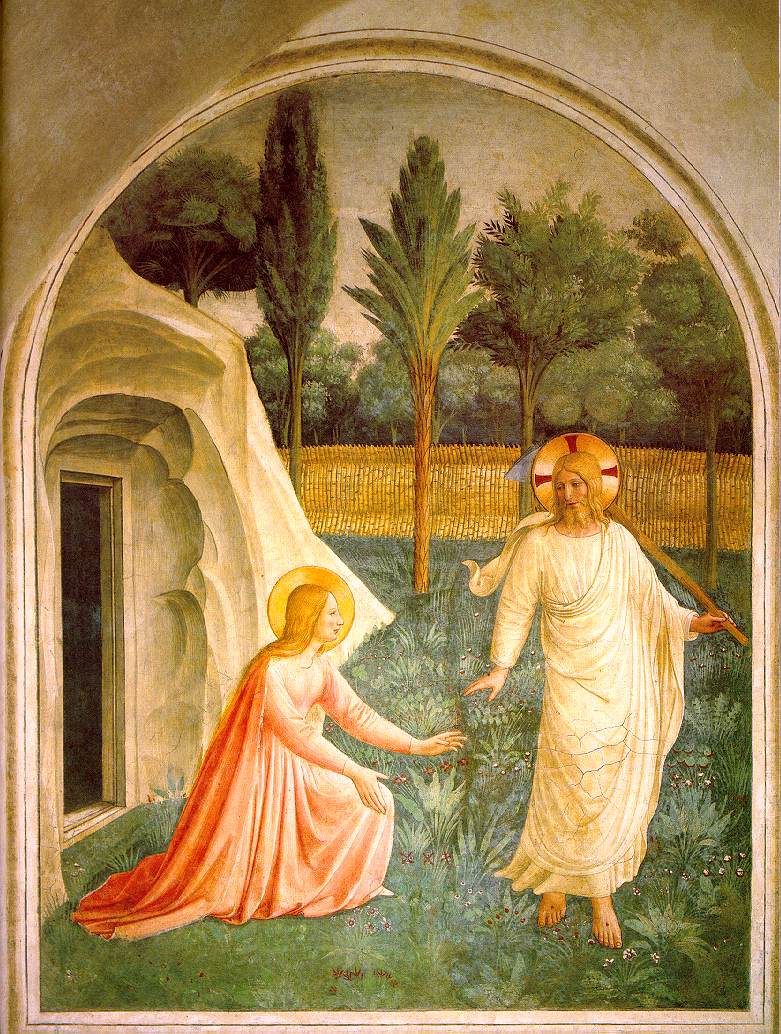 Noli Me Tangere - Fra Angelica
1440-41; Fresco, Convent of San Marco, Florence
From the ridiculous (below) to the sublime. Florentine painter, a Dominican friar, Fra Angelico lived from 1400-1455. Although in popular tradition he has been seen as `not an artist properly so-called but an inspired saint' (Ruskin), Angelico was in fact a highly professional artist, who was in touch with the most advanced developments in contemporary Florentine art and in later life travelled extensively for prestigious commissions. He probably began his career as a manuscript illuminator, and his early paintings are strongly influenced by International Gothic. But even in the most lavishly decorative of them all-- the Annunciation in the Diocesan Museum in Cortona-- Masaccio's incluence is evident in the insistent perspective of the architecture.
For most of his career Angelico was based in S. Domenico in Fiesole (he became Prior there in 1450), but his most famous works were painted at S. Marco in Florence (now an Angelico museum), a Sylvestrine monastry which was taken over by his Order in 1436.
Angelico died in Rome and was buried in the church of S. Maria sopra Minerva, where his tombstone still exists. Vasari, who referred to Fra Giovanni as `a simple and most holy man', popularized the use of the name Angelico for him, but he says it is the name by which he was always known, and it was certainly used as early as 1469. The painter has long been called `Beato Angelico' (the Blessed Angelico), but his beatification was not made official by the Vatican until 1984. [Web Museum]
Wednesday, April 11, 2007
Monday, April 09, 2007

Sunday, April 08, 2007
Saturday, April 07, 2007
Watermelon in Easter Hay
OK, well, look, transcendence does pop up in unusual places, like in some of Frank's arrangements and guitar work.
The Harrowing of Hell
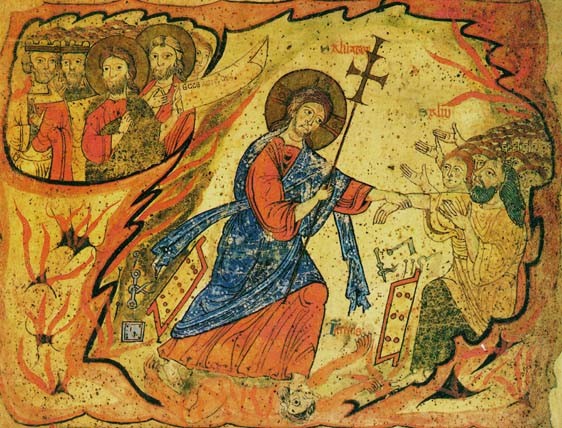 The Harrowing of Hell
"Writers of Old English prose homilies and lives of saints continually employ the subject, but it is in medieval English literature that it is most fully found, both in prose and verse, and particularly in the drama. Art and literature all through Europe had from early times embodied in many forms the Descent into Hell, and specimens plays upon this theme in various European literatures still exist, but it is in Middle English dramatic literature that we find the fullest and most dramatic development of the subject.
"The earliest specimen extant of the English religious drama is upon the Harrowing of Hell, and the four great cycles of English mystery plays each devote to it a separate scene. It is found also in the ancient Cornish plays. These medieval versions of the story, while ultimately based upon the New Testament and the Fathers, have yet, in their details, been found to proceed from the apocryphal Gospel of Nicodemus, the literary form of a part of which is said to date back to the second of third century. In its Latin form this "gospel" was known in England from a very early time; Bede and other Old English writers are said to show intimate acquaintance with it. English translations were made of it in the Middle Ages, and in the long Middle English poem known as "Cursor Mundi" a paraphrase of it is found."
-- From the online Catholic Encyclopedia, New Advent.
One may also consult or this.
And, finally, Dr. Will Willimon preached this sermon at Duke Chapel a few years ago.
Friday, April 06, 2007
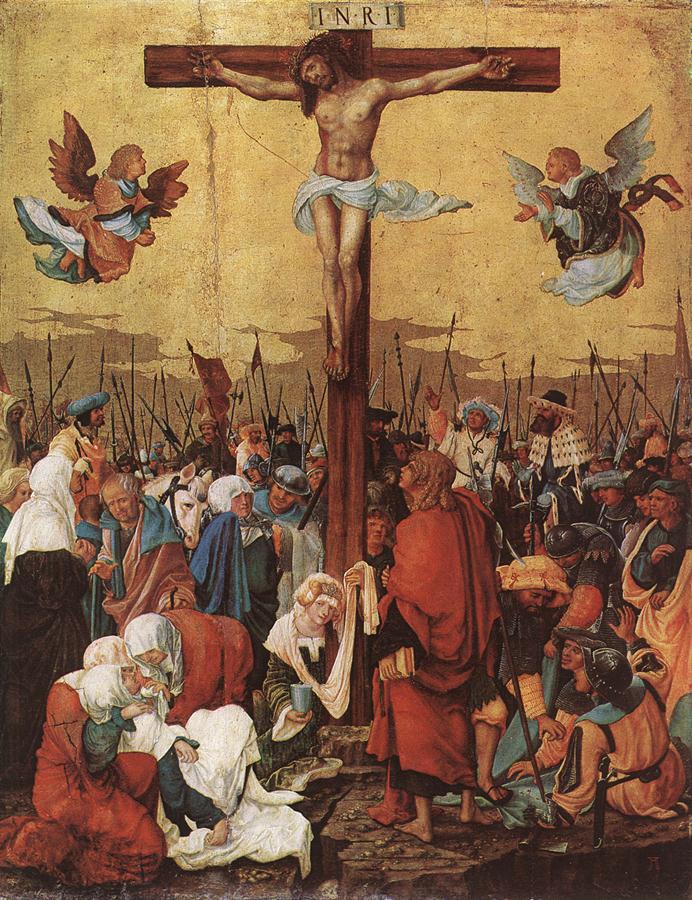
Triduum +
Death Shall Have No Dominion
In the annals of human love, there will always be those whose stories by which we will find ourselves feeling moved: Peter Abelard and Héloïse, Dante and Beatrix, perhaps even one's grandparent's -- particularly if you are wearing your grandmother's wedding band with the date of their wedding [1916] and they drove off to homestead in Montana on an Indian motorcycle with a sidecar. What makes one story more significant than that of another? What makes such a story rich not only with the love of man for woman, woman for man, but with the theologically hoped for but never proven element of eternity?
Our friend and mentor, Gil Bailie, founder and president of the Cornerstone Forum, describes in his reverie on Holy Thursday what this element is. In his usual diction that packs the punch of a poet who selects words like rocks from a riverbed, Gil builds a monument of living stones to human love of husband and wife valorized and vouchsafed by the sole source of human hope, our Eucharistic Lord. An apt meditation for the beginning of the Holy Triduum.
Wednesday, April 04, 2007
René Girard for Holy Week
First it was Mark Gordon lifting up praise for Girard and now we have FIRST THINGS article René Girard for Holy Week by Edward T. Oakes, S.J.
Here is an excerpt:
What a great Holy Week meditation - reading the anthropological study of mimesis through the lens of René Girard. In fact anytime is a great time for this.

Here is an excerpt:
Again, if you want to know why contemporary art keeps preening itself on its “daring transgressions,” you’ll find the answer in Girard. Also, if you’re a puzzled secularist, wondering why religion is making such a comeback in the headlines, you need only go to Girard for the answer. As Kirwin rightly notes: “Girard has explicitly distanced himself from Marcel Gauchet’s claim that Christianity has brought about the end of religion in the world. Rather, he suggests our current humanism will be perceived as merely a short interval between two forms of religion.” (I don’t think Girard has been at all taken off-guard by the resurgence of militant Islam.)
Of course, that still leaves open the question of what that “second form” of religion will look like in the future, to which Girard has only this quintessentially Christian answer to give: “What makes our hearts turn to stone is the discovery that, in one sense or another, we are all butchers pretending to be sacrificers. . . . One thing alone can put an end to this infernal ordeal, the certainty of being forgiven.”
What a great Holy Week meditation - reading the anthropological study of mimesis through the lens of René Girard. In fact anytime is a great time for this.

British Pluck
The Brussels Journal reports that British schoolteachers are dropping mention of the Crusades and the Holocaust. Any ideas why?
Without recourse to the "truth that will set you free" -- cf. below, "The Chaplet of Divine Mercy," -- one cannot hold one's ground, and one falls under the dread of the primitive sacred. In this case, symbolized by the scimitar.
Bernard Lewis in a recent speech, mentioned the two moments in European history when Islam was turned back successfully.
He had mentioned the two Muslim assaults on Europe: the Arab one that ended in the West, near Poitiers with the victory of Charles Martel in 732. And the one that started in the East, with the Turks, which was marked by the two assaults on Vienna, the second one in 1683, the high-water mark of Ottoman power in Europe.
And so, just toward the end, was this unremarked but remarkable sentence:We will see.
"Third time lucky?"

Tuesday, April 03, 2007
Today’s grace: Rene Girard & Gil Bailie

Today Mark Gordon at his blog, Suicide of the West, has a nice reflection on Rene Girard and Gil Bailie and the Anthropology of the Cross.
 He concludes with the following comment: I believe this discovery is the key to reintroducing Christianity to postmodern Western civilization. Best of all, I have found that on a personal level the further one drills into the implications of Girardian theory, the deeper one’s appreciation grows for the truth of the orthodox Christian faith. As you begin this journey, “Be not afraid!” The work of Girard-Bailie is a profound escort into the anthropological heart of the Gospel, the bosom of the Church and the Mystery of Jesus Christ.
We 3 Massketeers
 proudly raise are pens high and heartily agree with Mark and salute Rene Girard and Gil Bailie.
Monday, April 02, 2007
April 2, 2005

Easter 2005 was celebrated on March 27.
On April 2nd of that year, my wife and I took a trip to Holy Name Cathedral, formally the Cathedral of the Holy Name in downtown Chicago.
 We had never been there and, as we had just completed the RCIA program in our local parish, we couldn't get enough of anything that was Roman Catholic, and that is still true today.
Oh what beauty we found ourselves in. Once inside we made our way to one of the front pews and noticed a group of people over to the left of the altar. A baptism service was just about to begin. It was for a young Mexican-American little boy named Sebastian. The priest was fluent in both Spanish and English, and he had a gift for making everyone feel a part of this special moment. He went around the family and asked each their name and gave a short history and meaning of each name, some of this was in Spanish and some in English. We learned that Sebastian meant venerated or majestic.

Then at one point early in the proceeding, around 1:45pm CST, the priest made THE announcement; that as we are here in The Holy Name Cathedral in downtown Chicago celebrating this very special baptism, a true blessing of the Church, on the other side of the planet, Pope John Paul II had just past away. With that he paused ever so slightly and then continued on with the ceremony.
The news was not surprising to us, we knew that Pope JPII was in failing health, and so we sat there in silence, rosary in hand and tears rolling down our cheeks. Some time after the baptism we got up to leave, only to be stunned to see a near packed cathedral, as people, in reverence and silence, had filled the pews. When we got outside there were TV trucks and camera crews looking to capture a sound-byte from anyone on their reaction to the news of the Pope’s death (not of course little Sebastian's baptism). We slipped past all that and ducked into a small sidewalk café before heading back home. While we were in the café a TV was on and we watched the news - and there in this small café in downtown Chicago we learned so much more about our faith and our Church, that before this time, we hadn’t a clue.
As I said, April 2nd that year was a week after Easter. I know this because I had just completed the RCIA program and was still unable to participate in full communion that Easter due to the delay that my dioceses had in sending my Privilege of Faith paperwork to Rome. The death of JPII was now going to delay my entry into the Church even more.
Well, my paperwork finally came through and on a glorious evening in November 2005, I was confirmed and my wife and I celebrated a renewal of our wedding vows in the Catholic Church; all this on her birthday. What a blessing.
By the way, today, April 2nd is my birthday and I wonder about little Sebastian and how he and his family are doing. I pray that they are well.
Subscribe to:
Posts (Atom)