Showing posts sorted by relevance for query Thérèse of Lisieux. Sort by date Show all posts

Monday, February 05, 2007

Thérèse of Lisieux, the Little Flower


Sightings of the Little Flower, Thérèse of Lisieux have been occurring on our posts of late as well as in the book I am reading Christology From Within by Mark McIntost on Hans Urs von Balthasar. McIntosh writes in his book that von Balthasar feels that obedience is a means of self-discovery far better than our usual process of discerning, reflections or scrutinizing of ones own talents and potentialities.
“In the case of Thérèse, the self-discovering journey of obedience begins with the move into Carmel. Only in this way, says von Balthasar, could the potential dynamic in her life grow into an “infinity movement.”

“What Thérèse needs is that her personality should die, and that she should be reborn as a person at a level where she has to draw upon all her latent possibilities… Through entering this new state of life Thérèse is given the opportunity to shed her personal limitations and acquire the stature which is hidden for her in God and is only to be revealed through her mission to the Church."

Check out the following site for chapter III of Thérèse OF LISIEUX - THE STORY OF A MISSION, by Hans Urs Von Balthasar, Sheed and Ward, New York, 1954 - This chapter may open up the depth of the teaching of Saint Thérèse on the "little way" in a whole new and exciting way! Hans Urs von Balthsar shows just how radical, innovative this little saint is, and yet how traditional and how rooted in the Catholic vision. It is my own opinion that this book on Thérèse, just one chapter of which is reproduced here, may have contributed greatly to the ultimate decision made by our Pope, John Paul II, to declare Saint Thérèse a "Doctor/Teacher of the Universal Church." Her doctrine goes to the heart of the Gospel, and perhaps not all have really discovered its riches yet.... and it is my joy to make this available.

A side note: I must say that my wife and I did not think much of the movie Thérèse

Monday, February 19, 2007

Thérèse, Thérèse, and Thérèse

posted by Porthos

Athos and Aramis have been exchanging views off-blog about spiritual directors and such resources. Alas, isolated expat that I am, I cannot contribute much there. With spiritual direction, I just have to take what I can get. One of the things that I can get, though, is archived audios from EWTN. The three series below on Thérèse are excellent. Now, I'm slowly doing the third one, "Letters of Therese." The accompanying blurbs are from the archive listings.

Saint for the Third Millenium: St. Thérèse of Lisieux
"In this series, Fr. Charles P. Connor presents the life, spiritual direction and relevance of St. Therese of Lisieux for today’s Catholic and for the Church in all generations. He teaches us about the seemingly inexhaustible riches of what St. Therese of the Child Jesus offers the world and why she said: “The whole world will come to love me.”

The Little Flower
"This series hosted by Fr. Jacques Daley, O.S.B. teaches us about one of the most popular saints of the Church, Saint Thérèse of Lisieux, the Little Flower. Saint Thérèse is a beautiful example of how we are all called to be saints."

Letters of St. Thérèse
"The letters of St. Thérèse reflect her very human struggle to live out the vocation of love to which God called her. With great warmth and sensitivity, host Fr. Jacques Daley delves into these epistles of spiritual direction, spiritual teaching, and spiritual friendship."

Friday, October 15, 2010

We can do no good when we seek our self...The desire we cherish is key

From The Magnificat October 2010

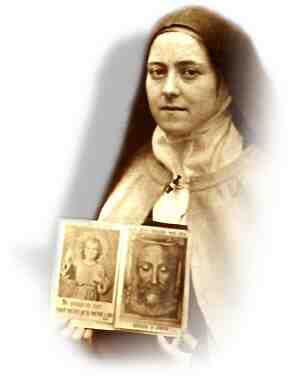
SAINT THÉRÈSE OF LISIEUX, Doctor of the Church, states in the spiritual classic The Story of a Soul, “O my God, your love has gone before me, and it has grown with me, and now it is an abyss whose depths I cannot fathom.” God’s love had captivated Thérèse ever since she received a special grace of conversion one Christmas as a child. Recalling that event, she writes, “I felt charity enter into my soul, and the need to forget myself and to please others.” Later, in a poem, Thérèse would declare, “You alone, O Jesus, could satisfy a soul that needed to love even to the infinite.”

But isn’t this the vocation of every human heart? Yet, as Thérèse laments in her autobiography, “On every side this love is unknown, rejected; those hearts upon whom you would lavish it turn to creatures; they do this instead of throwing themselves into your arms and of accepting your infinite love.” In fact, even “among his own disciples Jesus finds few hearts who surrender to him without reservations, who understand the real tenderness of his infinite love.”

Bold confidence before imperfections

One reason for our lack of surrender to God’s love is the “scandal” we feel over our own imperfection. Thérèse admits, “I understood how easy it is to become all wrapped up in self, forgetting entirely the sublime goal of one’s calling.” But the fact is that “God does not call those who are worthy but those whom he pleases.” Living and giving God’s infinite love begins from embracing this truth. “There is always present to my mind the remembrance of what I am,” says Thérèse. And that awareness of her real limitation only leads Thérèse to greater confidence.With unmatched authority she claims:

“God cannot inspire unrealizable desires. I can, then, in spite of my littleness, aspire to holiness. It is impossible for me to grow up, and so I must bear with myself such as I am with all my imperfections.”

And:

“I am astonished at nothing. I am not disturbed at seeing myself weakness itself. On the contrary, it is in my weakness that I glory, and I expect each day to discover new imperfections in myself.”

And:

“I always feel the same bold confidence of becoming a great saint because I don’t count on my merits since I have none, but I trust in him who is Virtue and Holiness. God alone, content with my weak efforts, will raise me to himself and make me a saint.”

Since, “perfection consists in doing God’s will, in being what he wills us to be,” the life of faith consists in uniting ourselves to that divine will. To this end, “it is prayer, it is sacrifice which give me all my strength,” counsels Thérèse. “These are the invincible weapons which Jesus has given me.” Love acts
“We can do no good when we seek our self.” Thus, it is a waste of time to attempt to measure ourselves or to chart our spiritual progress. For “the more one advances, the more one sees the goal is still far off. And now I am simply resigned to see myself always imperfect and in this I find my joy.” Even if it takes a long time, for “God made me understand that there are souls for whom his mercy never tires of waiting.” The desire we cherish is key: “God has always given me what I desire or rather he has made me desire what he wants to give me”; “I know that Jesus would not inspire the longings I feel unless he wanted to grant them.”
“A soul that is burning with love cannot remain inactive.” The experience of God’s mercy to us in our weakness moves us to love others. “I understand now that charity consists in bearing with the faults of others, in not being surprised at their weakness, in being edified by the smallest acts of virtue we see them practice.” Our natural limitation when it comes to loving can no longer be an alibi, for we have been given something supernatural: “It is no longer a question of loving one’s neighbor as oneself but of loving him as he, Jesus, has loved him.” So we join in the intention of Saint Thérèse: “I ask Jesus to draw me into the flames of his love, to unite me so closely to him that he live and act in me.” He will.

Rev. Peter John Cameron, O.P.
Copyright Magnificat
Thursday, March 25, 2010

Life without humility does not work

THE SPIRITUAL MASTERS OF THE CHURCH agree that the “virtue of humility attracted the Holy Trinity into the Blessed Virgin Mary’s heart” (Saint Thérèse of Lisieux). Saint Jerome says that God chose Mary to be his Mother “more on account of her humility than of all her other sublime virtues.” Saint Augustine comments that “Mary’s humility became a heavenly ladder by which God came into the world.” And Saint Bernard adds that, though Mary “pleased God by her virginity, she conceived by her humility.” As Our Lady herself attests after the Annunciation, God “has looked upon his handmaid’s lowliness” (Lk 1: 48). “In the new situation created by her divine maternity,” writes Father Raniero Cantalamessa, “Mary’s soul moved quickly and naturally to its point of truth, namely her nothingness, and nothing and no one could change this. In all this, the humility of the Mother of God is seen to be a unique miracle of grace.”


Humility before the gift

We want to share in that miracle of grace! Life without humility does not work. Father Simon Tugwell remarks that “most of our obstinacy covers up a certain degree of emptiness, a certain degree of dishonesty, of masquerading and posturing, of being uncertain of ourselves; that is why it has to be so unyielding. It can only preserve itself at the expense of a certain ruthlessness, maybe even cruelty and disregard of others.”

Humility begins in the awareness of what is most “down to earth” (“humility” from the Latin humus meaning “ground or earth”) – namely, that life is given. Everything I have and am is a gift from Another. This is why Saint Thomas Aquinas says that “humility’s rule lies in a judgment” – a judgment regarding the fact of our real nothingness. Without humility, our limitations tempt us in one of two ways: either we are scandalized by them, which makes us despondent, or we deny them, which makes us grandiose. But humility gives us a placid acceptance of our nothingness, saving us from the extremes of both self-contempt and “sanguine selfassurance” (Saint Thomas Aquinas).

Acknowledging the Presence

The example of the Blessed Virgin Mary shows us how humility makes one “submissive and ready to receive divine favor” (Saint Thomas Aquinas). There is a twofold dynamic to humility. On the one hand, as we have said, it is not possible to be humble if we deny our nothingness. But on the other hand, we cannot be humble if we fail to acknowledge the merciful presence of God acting in our life. This is the glory of Our Lady’s humility. “Humility mainly concerns a person’s subjection to God. It properly regards the reverence which bows down before God” (Saint Thomas Aquinas). Humility blesses us with a serene acquiescence before our nothingness that becomes a begging for the Infinite. God loves to be acknowledged by our nothingness.

“The one who humbles himself will be exalted” (Lk 14: 11; 18: 14), promises the One who was “humble of heart.” Authentic humility creates space in a soul that God refuses to leave empty; he fills it with himself. “No one makes himself naught except to let God fill the void” (L. Lavelle). A humble person is one who has decided to renounce pretentiousness in favor of the purpose that God has for him or her. “Perfect humility consists in constantly making oneself small for the sake of love, to elevate others” (R. Cantalamessa).

The mortification of humility

It is no surprise that recollection and vigilance distinguish the humble person’s life. “Humility disposes one to free access to spiritual and divine blessings” (Saint Thomas Aquinas). But those blessings come to us in the most subtle ways and – as Our Lady discovered – often as a surprise. Nothing is easier than for the noise of our self-assertive thoughts to drown out God’s voice speaking deep within us, delicately. Thus, humility craves silence… a silence that permits us to become detached from willfulness and absorbed in what God wills for us. Humility enables us to hear God communicating his love to us in just the way he wants to love us.

Rev. Peter John Cameron, O.P.
Copyright Magnificat

Tuesday, August 28, 2007

God as Metaphor vs. God as Fact -- GKC

Lord, Hear My Prayer Photograph by A. Aubrey Bodine
______________________________________________

You may talk of God as a mystification or a metaphor; you may boil him down with gallons of long words or boil him down to the rags of metaphysics. It is not merely that nobody punishes you, but nobody protests. But, if you speak of God as something like a tiger, as a reason for changing ones conduct, then the modern world will stop you if it can. We are long past talking about whether an unbeliever should be punished for being irreverent, it is now thought irreverent to be a believer.
-G.K. Chesterton
the false transcendent vs. the Real Transcendent

It may be a bit of an over-simplification to say that there are 2 types of people - those who try to live as if their lives made sense and those, as the mid-20th century Cardinal Archbishop Emmanuel Celestin Suhard of Paris wrote, "TO BE a witness does not consist in engaging in propaganda or even in stirring people up, but in being a living mystery; it means to live in such a way that one's life would not make sense if God did not exist." (Long before Dorothy Day came to know and cherish those words of Suhard's, she exemplified them in her own life.)

When we get stuck in the Enlightenment and post-Christian world of intellectualizing God we strip ourselves of the only source of Real Knowledge. It is this trap that we fall into when we feel drawn to take sides today in most religious discussions when in fact BOTH sides of the argument, all too often, are void of any transcendent or mystery. And when we foster, promote and encourage this sort of waywardness from mystery we are in fact partnering with the forces (another example of MT at work) which deteriorates our ontological density (the Christ-centeredness of the person in each of us).

Monday, April 11, 2011

Story of a Soul - Pope Says So

St.Thérèse costumed as St. Joan of Arc

Some years back, I was walking among items at the yard sale of our school's Oktoberfest. I found three (of the four) Liturgy of the Hours prayer books and a book I felt strangely drawn to: the Autobiography of St. Thérèse of Lisieux. I bought them all for a pittance and took them home.

While I've delved into the Hours, generally via the Little Office of the Blessed Virgin Mary, I never opened the Little Flower's autobiography. Until now.

Benedict XVI just encouraged us, you see, to read her Story of a Soul. Talk about timely. And, just in case I had any doubts about the importance of doing so, I notice that the translator of my copy happens to be ... Monsignor Ronald Knox. Hmm. Time to get started.

UPDATE: Listen or read here.

Tuesday, September 30, 2008

Oct 1 Feast Day of St. Thérèse of Lisieux


LETTER TO HER BROTHER MISSIONARIES

Our Divine Lord asks no sacrifice beyond our strength. At times, it is true, He makes us taste to the full the bitterness of the chalice He puts to our lips. And when He demands the sacrifice of all that is dearest on earth, it is impossible without a very special grace not to cry out as He did during His Agony in the Garden: "My Father, let this chalice pass from me!" But we must hasten to add: "Yet not as I will, but as Thou wilt." It is so consoling to think that Jesus, "the Strong God," has felt all our weaknesses and shuddered at the sight of the bitter chalice--that very chalice He had so ardently desired.

Your lot is indeed a beautiful one, since Our Lord has chosen it for you, and has first touched with His own Lips the cup which He holds out to yours. A Saint has said: "The greatest honour God can bestow upon a soul is not to give to it great things, but to ask of it great things." Jesus treats you as a privileged child. It is His wish you should begin your mission even now, and save souls through the Cross. Was it not by suffering and death that He ransomed the world? I know that you aspire to the happiness of laying down your life for Him; but the martyrdom of the heart is not less fruitful than the shedding of blood, and this martyrdom is already yours. Have I not, then, good reason to say that your lot is a beautiful one--worthy an apostle of Christ?

This letter and the following are addressed to a Seminarist.

Wednesday, September 19, 2007

Humble Confidence

A lady and saint that we Three -- and, I hope, we Four -- Mass'keteers have continuously held a torch for, St. Thérèse of Lisieux.

The author is Rev. Jean C. J. d'Elbeé, a French retreat master who has been profoundly affected by Saint Therese of the Child Jesus’ “little doctrine” He made it the subject of ten spiritual conferences contained in his book I Believe in Love. In the form of a personal retreat, he explains St. Therese’s teaching about confident love, leading readers to a profound personal encounter with Jesus Christ. Through his reflections on Therese’s life and teaching, Fr. d’Elbee unfolds for the reader the inner meaning of the psalmist’s cry, “Lord, You have opened my heart, and I run in the way of Your commandments.”