Wednesday, April 04, 2007

British Pluck

The Brussels Journal reports that British schoolteachers are dropping mention of the Crusades and the Holocaust. Any ideas why?

Without recourse to the "truth that will set you free" -- cf. below, "The Chaplet of Divine Mercy," -- one cannot hold one's ground, and one falls under the dread of the primitive sacred. In this case, symbolized by the scimitar.

Bernard Lewis in a recent speech, mentioned the two moments in European history when Islam was turned back successfully.
He had mentioned the two Muslim assaults on Europe: the Arab one that ended in the West, near Poitiers with the victory of Charles Martel in 732. And the one that started in the East, with the Turks, which was marked by the two assaults on Vienna, the second one in 1683, the high-water mark of Ottoman power in Europe.
And so, just toward the end, was this unremarked but remarkable sentence:

"Third time lucky?"
We will see.

The Chaplet of Divine Mercy


Part One

Part Two

Part Three

Tuesday, April 03, 2007

Today’s grace: Rene Girard & Gil Bailie


Today Mark Gordon at his blog, Suicide of the West, has a nice reflection on Rene Girard and Gil Bailie and the Anthropology of the Cross.
He concludes with the following comment: I believe this discovery is the key to reintroducing Christianity to postmodern Western civilization. Best of all, I have found that on a personal level the further one drills into the implications of Girardian theory, the deeper one’s appreciation grows for the truth of the orthodox Christian faith. As you begin this journey, “Be not afraid!” The work of Girard-Bailie is a profound escort into the anthropological heart of the Gospel, the bosom of the Church and the Mystery of Jesus Christ.

We 3 Massketeers proudly raise are pens high and heartily agree with Mark and salute Rene Girard and Gil Bailie.

Monday, April 02, 2007

April 2, 2005


Easter 2005 was celebrated on March 27.

On April 2nd of that year, my wife and I took a trip to Holy Name Cathedral, formally the Cathedral of the Holy Name in downtown Chicago. We had never been there and, as we had just completed the RCIA program in our local parish, we couldn't get enough of anything that was Roman Catholic, and that is still true today.

Oh what beauty we found ourselves in. Once inside we made our way to one of the front pews and noticed a group of people over to the left of the altar. A baptism service was just about to begin. It was for a young Mexican-American little boy named Sebastian. The priest was fluent in both Spanish and English, and he had a gift for making everyone feel a part of this special moment. He went around the family and asked each their name and gave a short history and meaning of each name, some of this was in Spanish and some in English. We learned that Sebastian meant venerated or majestic.

Then at one point early in the proceeding, around 1:45pm CST, the priest made THE announcement; that as we are here in The Holy Name Cathedral in downtown Chicago celebrating this very special baptism, a true blessing of the Church, on the other side of the planet, Pope John Paul II had just past away. With that he paused ever so slightly and then continued on with the ceremony.

The news was not surprising to us, we knew that Pope JPII was in failing health, and so we sat there in silence, rosary in hand and tears rolling down our cheeks. Some time after the baptism we got up to leave, only to be stunned to see a near packed cathedral, as people, in reverence and silence, had filled the pews. When we got outside there were TV trucks and camera crews looking to capture a sound-byte from anyone on their reaction to the news of the Pope’s death (not of course little Sebastian's baptism). We slipped past all that and ducked into a small sidewalk café before heading back home. While we were in the café a TV was on and we watched the news - and there in this small café in downtown Chicago we learned so much more about our faith and our Church, that before this time, we hadn’t a clue.

As I said, April 2nd that year was a week after Easter. I know this because I had just completed the RCIA program and was still unable to participate in full communion that Easter due to the delay that my dioceses had in sending my Privilege of Faith paperwork to Rome. The death of JPII was now going to delay my entry into the Church even more.

Well, my paperwork finally came through and on a glorious evening in November 2005, I was confirmed and my wife and I celebrated a renewal of our wedding vows in the Catholic Church; all this on her birthday. What a blessing.

By the way, today, April 2nd is my birthday and I wonder about little Sebastian and how he and his family are doing. I pray that they are well.

Monday of Holy Week +

Torrents of Peace

On this Monday of Holy Week, a quotation from Aldous Huxley from Gil Bailie's tape series on Dante's masterpiece, The Inferno:
“Who will ever believe or imagine that there can be torrents of peace which sweep away the dikes, which breach the levies, and shatter the sea wall? And yet this is what actually happens. God’s peace is like a river whose course is in one country and has been diverted into another by the breaking of a dike. This invading peace does things which do not seem proper to the nature of peace. For it comes with a rush, it comes with impetuosity. It comes like an element of another life, with the sound of celestial harmony and such swiftness that the soul is utterly overthrown, not because she has made any resistance to the blessing, but because of its very abundance. This abundance does no violence except to the obstacles in the way of its benediction. And all the animals that are not peaceable take flight before the onset of this peace.”

Sunday, April 01, 2007

Passion Sunday +

The Deposition - Caravaggio
1604; Pinacoteca Vaticana

Having heard the Passion Narrative at Vigil Mass, I'm struck by the way that the "old, old story" is what C. S. Lewis called "the myth become fact" and forever new. More recently, René Girard has seen that myths in fact veil actual murders, act as justification for them, and work alongside two other elements of human culture, ritual and prohibitions.

Now (in the Church's wisdom) as we look upon the end note of a sad tale replayed "since the foundation of the world," a prolepsis for what will take place this Holy Week, we have the opportunity to realize our culpability, our collusion, our aptness for falling into victimizing. We can pray along with the publican in Jesus' parable [Mtt 18:10ff], "Lord, have mercy on me, a sinner."

BLATHMAC'S LAMENT

Your People seized your son, Mary, they flogged him.

There struck him the green reed and fists across ruddy cheeks.

It was a hideous deed that was done to him;

that his very mother-kin should crucify the man who had come to save them.

A crown of thorns was placed about his beautiful head;

nails were driven through his feet,

others through his hands.

When they thought thus that Jesus could be approached,

Longinus then came to slay him with the spear.

The King of the seven holy heavens,

when his heart was pierced,

wine was spilled upon the pathways,

the blood of Christ flowing through his gleaming sides.

The flowing blood from the body of the dear Lord baptized the head of Adam,

for the shaft of the cross of Christ had aimed at his mouth.

By the same blood (it was a fair occasion!) quickly did he cure the fully blind man,

who openly with his two hands, was plying the lance.
+

Blathmac, who was a Culdee (part of the Celtic reform movement in the 8th century), composed this lament, asking the Blessed Virgin to come to him and keen for the dead Son of God.

Jeff Cavins on TV

Jeff Cavins, on our blogroll, is doing a walkabout series in the Holy Land with Raymond Arroyo, titled Path of the Messiah. Check it out.
EWTN schedule.

Saturday, March 31, 2007

To the Abbey

Near the 'canonical' end of The Dionysus Mandate [Ch. 18], the protagonist, Aly Lambert, goes to visit her spiritual director at an abbey.
Aly drove up the hill to the entrance of the Abbey. Two pillars of native riverbed rocks stood on either side of the entrance to the long and winding stretch of road leading to the monastery. Farmland and a grazing herd of cattle lined either side of this parcel of land west of the Blue Ridge mountains and Shenandoah River.

Father Gabriel was waiting for her in the Guesthouse’s conference room. Aly waved to the Guestmaster, Brother Stephen, who stood under the eaves waiting to greet her. He was used to seeing Aly’s old car arrive here for her monthly time with Father Gabriel. He smiled down at her from his six foot three frame and took her in with his gaunt eyes.

“Haven’t seen you in these parts for quite awhile,” he said smiling. “Skipped a time or two, didn’t you?”

“A lot going on, Brother Steve.”

“Always is.” He looked down at a cat rubbing against his leg. “Father Gabriel’s inside.”

After their hour session Aly drove back on Route 50 toward her apartment in the District. She pondered Father Gabriel’s parting words to her.

“Remember, Aly. If you choose an active revolt against Dionysus, you will be hunted and ultimately found. If so, you may very well become a Dionysus victim yourself.

“Yet I have many friends,” he said. “Among Trappists, Franciscans, Dominicans, Youth Apostles ... They will be happy to give you shelter and safe haven any way they can do so. In Italy, the Balkans, Lebanon, France, Israel, here. There won’t be any place that is really safe, however. This will be a dangerous path, Aly.”
The two monks depicted in this excerpt are two actual residents at the monastery at which I try to go on retreat at least twice a year. Brother Steve is the Guestmaster and loves his feline companions, and Father 'Gabriel' is Father [/medical doctor/poet] Mark. Both are faithful to their monastic vows of chastity, poverty, and stability for these many decades. Yet, like the confidant of Aly Lambert, above, these Trappist monks are astonishingly in touch with the world for which they pray through the Psalter and liturgical hours. Father Mark is one of the most knowledgeable readers of René Girard of my acquaintance. He knows the ins and outs of mimesis, desire, sacrifice, and redemption. His smile welcomes one into a collaboration of prayer, reason, faith, and compassion in and for a fallen world.

Cast far from your mind images of morose cowled monks hiding behind the cloister walls. We live and move supported by the "dynamos of prayer" that are Catholic monasteries and convents. And if I were in Aly Lambert's shoes, I, too, would rush to the abbey for sound spiritual direction on rebelling against the Generative Mimetic Scapegoating Mechanism [Hamerton-Kelly]. The contemplatives are thinking hearts and the leaven in the loaf of the Church. We are fortunate for their lives of work and prayer.

Friday, March 30, 2007

Nattering Nullities of Our Nation

Anchoress links this acid-tongued op-ed piece. Ouch.

Note to Anchoress: Have a great retreat, hon!

Commonplace, Enriching Work

Godspy reviews Look Homeward, America by Bill Kauffman (ISI Books, 2006). It looks to be a direct descendant of the Distributist movement of the early 20th century (those who don't know that Dorothy Day and Peter Maurin of the Catholic Worker movement grew from this branch of Catholic social theory ... well, need to know better). The use of such knee jerk terms as "radicals" and "anarchists" in the subtitle are, in my opinion, meant for book sales more than accuracy.

Reviewer Caleb Stegall emphasizes that this isn't a nostalgic romanticism, but a reorienting the fault line from the false dichotomy of right/left, Republican/Democrat to that "between materialists who recognize only a temporal order and those who admit to a higher, transcendent order." An unfortunate equating this movement with an idyllic "Americanism" can be skimmed over if one uses it simply as a marker pointing to a more transcendent goal. To wit, Kauffman writes:
[T]he most ennobling work we do is seldom
remunerated in greenbacks. Bearing and raising
a child, cultivating a garden, just being there for
a sibling or friend to lean on: this “work” is
compensated in a currency far more valuable
than Uncle Sam’s paper. This, in fact, is the
work that should be honored on Labor Day. The
work we do for “nothing.” (For everything,
really.) The work that enriches us as human
beings; that binds us to our families and our
neighbors; that shrouds even the most commonplace
of lives in glory. This is the work
whose coin, whose only coin, is love.
For an example of such ora et labora in action visit Christopher Blunt's The Yeoman Farmer blog.

Gratuitous Graphic Insertion


Because it was there.

Thursday, March 29, 2007

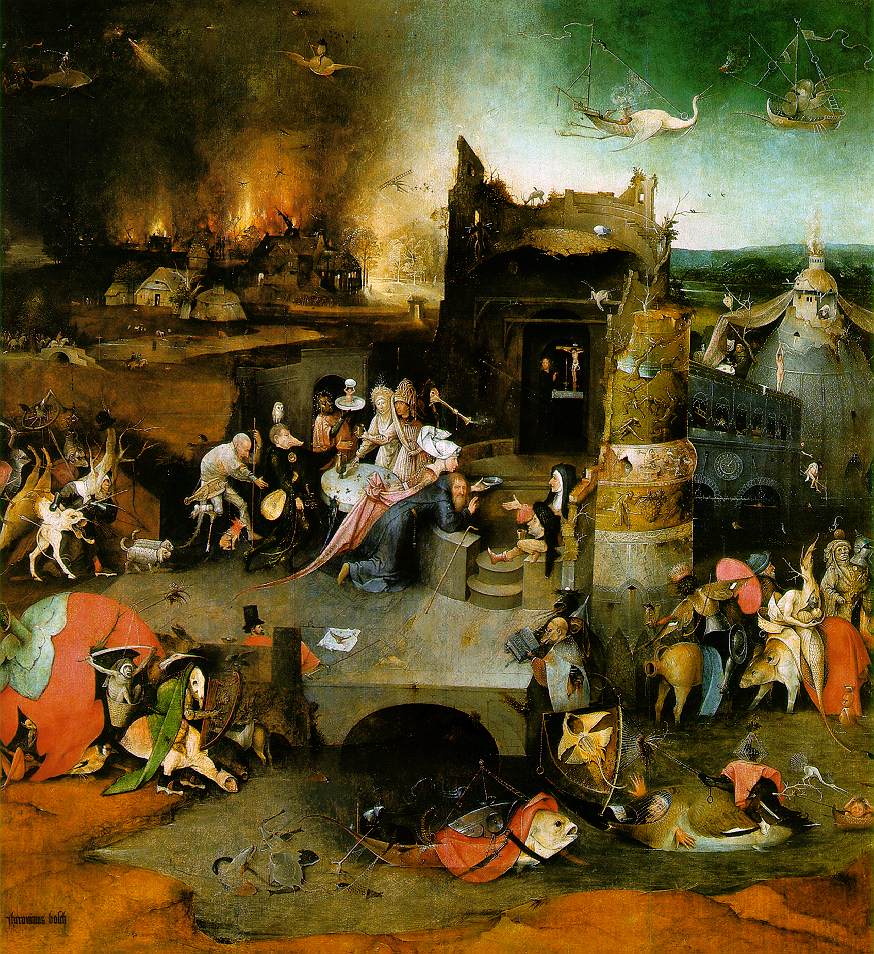
'Praying Among Ruins'


The Temptation of Saint Anthony - Hieronymus Bosch (c. 1450-1516)

Daniel Mitsui gives us a grave reminder at The Lion & the Cardinal:
There is a truth to this so simple that we often forget it: Satan is smarter than us. And he is stronger than us and he is more patient than us. Were he not, we would have no need of a Savior ... Satan hates the Church and he wants us to hate the Church. And he is smart enough and strong enough and patient enough to ruin everything that makes loving the Church easy. He was smart enough to ruin the seemingly immortal Middle Ages, so he is certainly smart enough to ruin the fragile traditionalist movement today ... A Church that is not permanently scarred is not the Body of Christ.
Read all of this sober Lenten meditation here.

Wednesday, March 28, 2007

Tuesday, March 27, 2007

Vocational Discernment - Spiritual Direction

Like magic - a post by Amy Welborn pointed to Aimee Milburn's blog, Historical Christian - Musings of a Roman Catholic Convert and her post On Vocational Discernment and Spiritual Direction, and behold it appears here. Recently the Massketeers have posted and commented on the troubled state of fatherhood and I have indirectly linked one’s calling or vocation to fatherhood with another’s calling or vocation to the priesthood. These are important ‘vocations’ that society has attempted to deconstruct and trivialize. We can help the vocations of fatherhood and priesthood by our reverent participation in the Body of Christ and bringing forth prayers and people seeking discernment and spiritual direction.

So if you are feeling sheepish a solid tool that we can hold out for people is spiritual direction – not only to help with direction for one’s life, but also as a calling or vocation to consider. Just as in my parish, we pray daily for more people to enter the religious life, we can pray for more people to help with that discernment process.

Look for my comment in the link On Vocational Discernment and Spiritual Direction.

Monday, March 26, 2007

Dark Night of the Soul (audio)

Complete audio of Dark Night is here.

Sunday, March 25, 2007

Feeling Sheepish

As one who appreciates a densely packed, diction intense, and aptly turned phrased book, the words of David P. Lang in his book, Why Matter Matters, should resonate with all reasonable and faithful Catholics:
When man's delicately woven biological and spiritual fabric is not respected, when its Creator is not reverenced, then might makes right and hell torments earth.
So then, read the following and make your own inferences. Baaaaa, humbug. Things get foolisher and foolisher ...

European (Soviet) Union?

Derk-Jan Eppink, cabinet member of commissioners, has learned the ropes in the European Union. Or, one could say, he has learned how not to be hung by the ropes in the EU. "I have learned all the necessary survival techniques to be a mandarin: intrigue, trickery and deceit," Commissioner Eppink notes.

Of greatest interest, Eppink notes the similarities between the former Soviet Union and the EU here.

Keep the insights of this worldly politician in mind as the Holy Father issues a dire and heartfelt warning to the back of a wayward son trudging off to a far country ...

Saturday, March 24, 2007

Apocalypse in the Balance

Woman Holding a Balance (1664) - Jan Vermeer
National Gallery of Art, Washington

It has been awhile since we've featured a work by Vermeer, but this one bears a repeat performance. I read an extremely thoughtful analysis by Robert Hamerton-Kelly about apocalypse, Revelation, and, of course, mimetic theory. If you have the time, gentle reader, I commend his explication to you here.

Giving up for Lent

Nice article at Godspy about God's mercy and our needs and imperfections.

Friday, March 23, 2007

Fatherhood -- Priesthood - Do they go hand-in-hand?

I would like to go back to our inquiry into fatherhood and ask what does fatherhood look like drinking the cup, as in this excerpt from Bailie's talk, Entering the Biblical Story at the Eucharistic Table? Notice how right away he dismisses John the Baptist as a role model.

The word (martyr) means to witness. Simply to be the kind of person who when something begins to swirl, when the melodrama gets set in motion, when accusations are made, can we step into the breach and absorb some of that animosity and break up the little knot that is forming?

Not by going in as John the Baptist would do and fighting it back in the other direction. But simply by stepping into that world and absorbing that tension (like the old Rolaids commercial, absorbs 47 times its own weight in access stomach acids…).

Can we be the kind of people that can move into that place, and drink the cup and be part of Christ forgiveness? The world is going to choke on its own unforgivenness if we don’t. That is our role in the world.

Is the whole idea of absorbing the tension of the ... (you name it) the family; or of the community; or of the world; is it really a key component of fatherhood?
It is not forgiveness on the cheap. So it is a subtle process, it requires character and dignity and courage and most of all it requires an enormous moral generosity. So Jesus is inducting us into service for history in a world which is going to now increasingly be deprived of its old mechanism for taking away its own sins on the cheap. He is bringing us into this mission of taking them away in such a way that not only honors our dignity and our freedom, but also rehabilitates us.
It has always seemed to me that fatherhood actually is a major ingredient to tension build-up within the family. How does father help others to hear the cock crow AND absorb the tension that the crowing usually results in?

When we hold up the image of a human father does it reveal a side that fails, at least in all cultural terms? It seems to me that fatherhood is always on the verge of being sacrificed. In other words, his role will often take him on a path of being expelled either by his family or by the culture.

Pulling out another excerpt from the Bailie talk:

... Eucharistic Mandate. He says that Christ often calls us to failure, not success just as He Himself was called to the Cross.

“The marvelous religion teacher, the hard working bishop who manages his diocese well, the mother of a family strongly rooted in the faith have done no more works than the dedicated religion teacher whose classroom is like a drudgery, or the zealous and caring bishop whose administration is constantly criticized or the loving mother whose family, despite her efforts, have all abandoned the Church. In many ways the last three have received a higher calling.” (Bailie here quotes from Wm. Riley)

Isn’t that amazing? We are called to move into that place of brokenness and to take up our cross. And to do it in such a way that the world hears the cock crow, and that the world feels the forgiveness of God. And that the world recognizes that we are not doing it on our own, or that we are not doing it because we are nice, or morally superior. We are doing it because Christ has laid His Hand on us.


I suggest that fatherhood needs to be looked at in relation - in particular, in relation to the Body of Christ, the Church and priesthood - not independently, as the head of the family, as if we could separate fatherhood and Church. It is actually by way of this separation that we have been able to deconstruct and dismantle fatherhood. I think that what I am saying is that the only real way to define, model and/or re-present fatherhood is through the strengthening of the Church and the priesthood. What do you think?