 A. O. Scott of - of all things - the New York Times gives a begrudgingly positive review for Prince Caspian. Bully.
Thursday, May 15, 2008
Prince Caspian - A. O. Scott
A. O. Scott of - of all things - the New York Times gives a begrudgingly positive review for Prince Caspian. Bully.


Wednesday, May 14, 2008
7 Gifts of the Holy Spirit
h/t Vultus Chirsti
What are the seven gifts of the Holy Spirit? The Catechism names them: wisdom, understanding, counsel, fortitude, knowledge, piety, and fear of the Lord. It is customary to associate each day of the Octave of Pentecost with one of the Seven Gifts of the Holy Spirit:
Pentecost Sunday: Wisdom
Monday: Understanding
Tuesday: Counsel
Wednesday: Fortitude
Thursday: Knowledge
Friday: Piety
Saturday: Fear of the Lord
Read his post HERE
Joseph Barsabbas - "son of an oath" or "son of conversion" or "son of quiet"

In today's reading Acts 1:15-17, 20-26 we hear "they prayed" and "gave lots to them and the lot fell upon Matthias, ..."
Here is what I found web-searching on the guy not chosen.
Joseph Barsabbas bar-sab'-as Barsabbas, or Barsabas; the King James Version Barsabas, bar'-sa-bas; for etymology, etc., of Joseph, see general article on JOSEPH): Joseph Barsabbas was surnamed Justus (Ac 1:23). Barsabbas was probably a patronymic, i.e. son of Sabba or Seba. Other interpretations given are "son of an oath," "son of an old man," "son of conversion," "son of quiet." It is likely that the "Judas called Barsabbas" of Ac 15:22 was his brother. Ewald considers that both names refer to the same person, but this is improbable. Joseph was one of those who accompanied the apostles "all the time that the Lord Jesus went in and went out among us, beginning from the baptism of John, unto the day that he was received up from us" (Ac 1:21,22). At the meeting of the brethren under the presidency of Peter in Jerusalem shortly after the crucifixion, he was, therefore, proposed along with Matthias as a suitable candidate for the place in the apostleship left vacant by the treachery and death of Judas Iscariot; but was unsuccessful (Ac 1:15-26). According to Eusebius (Historia Ecclesiastica, I, 12), Joseph was one of the 70 (Lu 10:1), and Papias records the oral tradition that he drank a cup of poison without harm (compare Mr 16:18). The Ac of Paul, a work belonging to the 2nd century and first mentioned by Origen, relates that Barsabbas, Justus the Flatfoot and others were imprisoned by Nero for protesting their faith in Christ, but that upon a vision of the newly martyred Paul appearing to the emperor, he ordered their immediate release. C. M. Kerr
So the little we know about Joseph Barsabbas seems to indicate that he understood that though he was not chosen to be one of the 12 he was not being rejected as a Christian. The lesson we may learn from Joseph Barsabbas is: 1) Do not wallow in self-pity. 2) Determine to imitate Christ in your thinking and character to the best of your ability. 3) Cultivate your talent. Tap into all of your ability for service in the kingdom. Who knows what the Lord may yet be able to do through you? 4) Do not go down the path of scandal - kill jealousy and rivalry in your heart. 5) Stay focused in your aim and constant effort to fulfill the greatest command (Mark 12:30,31).
Being a Christian is having already been chosen and having said yes to God. This is the ultimate.
Behind the Times
Fr Timothy Radcliffe, OP, bemusedly jibes Richard Dawkins as being 'So 19th century.'
Referring to recent assaults on the Christian faith from philosophers, scientists and others such as AC Grayling, Christopher Hitchens and Professor Dawkins, he said: "I do not think we should be the slightest bit alarmed. It would be a great mistake to cast ourselves in the role of some persecuted group. When people criticise Christianity, we should welcome this as an opportunity to engage in debate."
He said the greatest challenge facing Christianity today was a loss of hope. "It is tempting for people to see no way forward. The two main stories the young encounter are the 'war on terror' and ecological disaster. Faced with that, they may well inclined to wonder what future they have. They wonder what future their children will have. So it is very important that as Christians, we are seen to believe in the future of humanity."
Tuesday, May 13, 2008
Taylor Caldwell - Love of Words
My neighbor said that he supposed I am getting a lot of good reading done these days. Yes, I am. And praying. And journaling.
One thing I found and transcribed was an one-page essay by author Taylor Caldwell, entitled "There Was a Time." My tenth-grade English teacher passed it out long ago. If you would like to read it, here you go.
Catholic Church is the extension of Christ’s Life on earth

Meditation of the Day
If this Man were man only, however perfect and sublime, how is it that his sanctity appears to run by other lines than those of other saints? Other perfect men as they approached perfection were most conscious of imperfection; other saints as they were nearer God lamented their distance from him; other teachers of the spiritual life pointed always away from themselves and their shortcomings to that Eternal Law to which they too aspired.
Yet with this Man all seems reversed. He, as he stood before the world called on men to imitate him; not as others leaders have done, to avoid his sins: this Man, so far from pointing forward and up, pointed to himself as the Way to the Father; so far from adoring a Truth to which he strove, named himself its very incarnation; so far from describing a Life to which he too one day hoped to rise, bade his hearers look on himself who was their Life; so far from deploring to his friends the sins under which he labored challenged his enemies to find within him any sin at all. There is an extraordinary Self-consciousness in him that has in it nothing of “self’ as usually understood…
The Catholic Church is the extension of Christ’s Life on earth; the Catholic Church, therefore, that strange mingling of mystery and commonsense, that union of earth and heaven, of clay and fire, can alone be understood by him who accepts her as both Divine and Human, since she is nothing else but the mystical presentiment, in human terms, of him who, though the Infinite God and Eternal Creator, was found in the form of a servant, of him who, dwelling always in the Bosom of the Father, for our sakes came down from heaven.
- Monsignor Robert Hugh Benson (+ 1914) was a British convert to Catholicism who is best known for his novels about the faith.
h/t Doctors of the Catholic Church and Magnificat
Rational Faith
 FAITH IN THE ONE GOD is the only thing that truly liberates the world and makes it "rational". When faith is absent, the world only appears to be more rational. In reality the indeterminable powers of chance now claim their due; "chaos theory" takes its place alongside insight into the rational structure of the universe, confronting man with obscurities that he cannot resolve and that set limits to the world's rationality. To "exorcise" the world -- to establish it in the light of the ratio (reason) that comes from eternal creative reason and its saving goodness and refers back to it -- that is a permanent, central task of the messengers of Jesus Christ.
- Benedict XVI, Jesus of Nazareth [174]
OLD DEITIES, NEW SACRAMENT
W. A. Borst gets it. He writes at the New Oxford Review:
Read more …
Once you recover from the shock of the first encounter, it seems obvious, even predictable. But the first encounter is disturbing and disorienting: You feel as if you are present in old Carthage at a sacrifice to Moloch, the eater of children.
I refer to the encounter with a new inspiration on the part of proabortionists, an inspiration wondrous in its simplicity and staggering in its implications. To the claims of prolifers that religion forbids abortion, proabortionists can respond with fervor that they, too, are religious, they, too, are believers, and abortion is a spiritual practice and a sacred ritual. Abortion is an act of worship: Deus — or dea — vult.
Donahue vs. Obama
Bill Donahue, President of the Catholic League, says that presidential candidate Barack Hussein Obama has comprised his "Catholic National Advisory Council" entirely of "dissenters" from Magisterial teaching. Says Donahue, “not one of the 26 former and current public policy holders who constitute the group stand with the Catholic Church on all three major issues: abortion, embryonic stem cell research and school vouchers.” [h/t: New Advent]
Read more …
Monday, May 12, 2008
Speaking of Signs - Pentecost
h/t to Michael Dubruiel from his post yesterday at Annunciations
Speaking of "Signs"...
Speaking of "Signs"...
“The Church that is born at Pentecost”, Benedict XVI further explains, “is not in the first place a particular community - the Church of Jerusalem - but the universal Church, which speaks the languages of all peoples. From this are then born communities in every part of the world, particular Churches that are all and always actualisations of the only and unique Church of Christ”. In the ecumenical world and in some fringes of the Catholic Church, the preeminence of the particular Church is often emphasised, looking to the unity of the Church (and the pope) as a sort of optional association, a federation constituted externally. “The Catholic Church”, the pope adds, “is not . . . a federation of Churches, but a unique reality: ontological priority belongs to the universal Church. Without being Catholic in this sense, a community would not even be a Church”.
The pope then cites one of the main signs: that of reconciliation, both as the sacrament of confession (”How important, and unfortunately not sufficiently understood, is the gift of Reconciliation, which pacifies hearts!”) and as daily effort in society: “The peace of Christ is spread only through the renewed hearts of reconciled men and women who have been made servants of justice, ready to defend peace in the world solely with the power of truth, without descending to compromises with the mentality of the world, because the world cannot give the peace of Christ: this is how the Church can be the leaven of the reconciliation that comes from God”.
The Sign Pointing Towards "Being"
Today's 'Meditation of the Day' in the Magnificat and Doctors of the Catholic Church talks of 'being' and it set my thoughts swirling with a Girard quote or two that I would like to share. The meditation is from Sister Jean-Marie Howe, O.C.S.O., the retired abbess of the Cistercian Abbey of the Assumption de l’Acadie in New Brunswick, Canada. (I would have you start by looking at the word "sign," in the title of this meditation, and thinking of its meaning to be a pointing towards "being.")
The Sign (or "Being") Our Heart Is Attuned To
In monastic life, we speak of the “return to the heart” (reditus ad cor), the “life of the heart,” and “finding the place of the heart.” In essence, to find one’s heart is to find one’s “being,” for the heart “senses” or “picks up being.” Monastic life is full of “being,” filled as it is with spiritual realities, because it is filled with the Mystery of Christ. The awakened “heart” is attuned to “being,” attuned to the intimate reality contained therein, for the “heart” is a spiritual organ, a sort of radar that senses the spiritual wherever it is. Thus, the deep “heart” roots itself in “being,” whence comes its substance and a real attachment to God. It is by virtue of this contact with God that we are transformed, “really.”
I cannot let this opportunity pass without alluding to the colorful metaphor employed by Simone Weil to explain this type of transformation and also to unmask any illusions in this area. Allow me to quote just a bit of her text:
“There is no fire in a cooked dish, but one knows it has been on the fire.
“On the other hand, even though one may think to have seen the flames under them, if the potatoes are raw it is certain they have not been on the fire.
“It is not by the way a man talks about God, but by the way he talks about things of the world that best shows whether his soul has passed through the fire of the love of God. In this manner no deception is possible. There are false imitations of the love of God, but not of the transformation its effects in the soul, because one has no idea of this transformation except by passing through it oneself…
“But, like a woman’s pregnancy, this transformation is not effected by direct efforts, but a union of love with God.”
This loving union is…called “contact with” and indicates a union at the level of the “heart,” a substantial union that gives “being” and transforms the person. Persons transformed in this manner carry God, the Beloved, within their “hearts.” The words, actions, and even the mere presence of such persons has, as a direct result of coming into contact with “the” Other, a weight or a density that is “other.”
…One could say that our… attachment to God, at the level of the “heart” will transform the image of God that we are into the likeness of God that we were born to be. This is the growth of “spiritual being.”
She writes that "to find one's 'heart' is to find one's 'being'" and that at this deep level of the "heart" there has been "a substantial union that gives 'being' and transforms the person." And by way of using quotes from Simone Weil, Sr Jean-Marie inserts the deception that is caused by false imitations of "being." She differentiates the density of "heart" which is due to a union (or contact) with God verses a "heart" tossed about due to a lack substantiality in God. In other words, a "heart" with true substance has been opened and converted by a union with the Other, with God, the True Transcendence, in a fashion of imitatio Christi. A "heart" remaining within itself, refusing to be even exposed to the Other, has no alternative but to be caught up in the unending quest for substance in a wasteland of false imitations.
"Being" is a fact or a particular state of existence and the term used to describe the field of study of "being" is ontology. In Deceit, Desire and the Novel Girard writes
Imitative (mimetic) desire is always a desire to be Another. (83)He goes on to write of an "ontological sickness" where your source of being (or mimetic desire) comes from a coveting of what the other desires - in other words, to covet the other's essence. Girard slightly reworks this idea in Violence and the Sacred, and comes up with an essential form of human desire, which might best be described as desire-as-ontology.
Once his basic needs are satisfied (indeed sometimes even before), man is subject to intense desires, though he may not know precisely for what. The reason is that he desires being, something he himself lacks and which some other person seems to possess. The subject thus looks to that other person to inform him of what he should desire in order to acquire that being. If the model, who is apparently already endowed with superior being, desires some object, that object must surely be capable of conferring an even greater plenitude of being. (146)
It is when we attempt to grab for our "being" (and we must seek "being" as we are "made" or called into existence with and by this desire for meaing) we "fall" into sin and violence. Only through a loving obedience with God are we forged into a "being."
So it is that the Trinitarian Experience provides for the only infinite source of "being" where fullness of "being" may be experienced - all other attempts to come to "being" will inevitably lead to rivlry, scandal and violence.
Maybe the best way to describe the Trinitarian Experience (TE) is the Greek word, perichoresis which is the eternal infinite loving flow of person, idea and virtue that exists between the Father, Son and Holy Spirit, each fully receiving and giving of the other. Within this TE is a co-inherence that all three members of the Trinity inhere or exist within each other. Before everything, there is God, Father, Son and Holy Spirit - eternally existing in loving union so true that Three are One.
Again, perichoresis beautifully describes this intimate mutual indwelling, the mutual dance of indwelling/co-inherence of the three Persons of the Trinity. When God created humanity, He said, "Let us make man in our image, after our likeness" (Genesis 1:26). He created us in the image of His Likeness ("in our image"), meaning that His Trinitarian nature, the perichoresis, is somehow reflected in us. God's eternal intention for His children was that we would live with Him, with each other and with all Creation, in a dance of communion that would reflect the greater Perichoresis.
Sunday, May 11, 2008
The Kingdom of God - A Treasure Buried
Deacon Greg Kandra reminds us of the parabolic power of something that happened at a Metro station in D. C. when virtuoso Joshua Bell played his violin to thousands of commuters, and one or two (only) stopped: Pearls Before Breakfast, by Gene Weingarten. (He won a Pulitzer for it.)
No More Wistfulness
Tom Piatak at Taki's Magazine makes a startling admission, I Confess: I Don’t Understand Why Some Atheists Are So Angry.
Saturday, May 10, 2008
 SOLEMNITY OF PENTECOST 2006 HOMILY OF HIS HOLINESS BENEDICT XVI St. Peter's Square Sunday, 4 June 2006
The People of God, which had found its first configuration in Sinai, extends today to the point of surmounting every barrier of race, culture, space and time. As opposed to what occurred with the tower of Babel (cf. Gn 11: 1-9), when people wanted to build a way to heaven with their hands and ended up by destroying their very capacity of mutual understanding, in Pentecost the Spirit, with the gift of tongues, demonstrates that his presence unites and transforms confusion into communion.
Human pride and egoism always create divisions, build walls of indifference, hate and violence. The Holy Spirit, on the other hand, makes hearts capable of understanding the languages of all, as he re-establishes the bridge of authentic communion between earth and heaven. The Holy Spirit is Love.
But how is it possible to enter into the mystery of the Holy Spirit? How can the secret of Love be understood?...
This is the mystery of Pentecost: the Holy Spirit illuminates the human spirit and, by revealing Christ Crucified and Risen, indicates the way to become more like him, that is, to be "the image and instrument of the love which flows from Christ" (Deus Caritas Est, n. 33).
The Church, gathered with Mary as at her birth, today implores: "Veni, Sancte Spiritus! - Come, Holy Spirit, fill the hearts of your faithful and kindle in them the fire of your love!". Amen.
Power From Above
 Father Cantalamessa, ofmcap provides a look at Pentecost and jump starting your life.
Friday, May 09, 2008
Swimming the Tiber
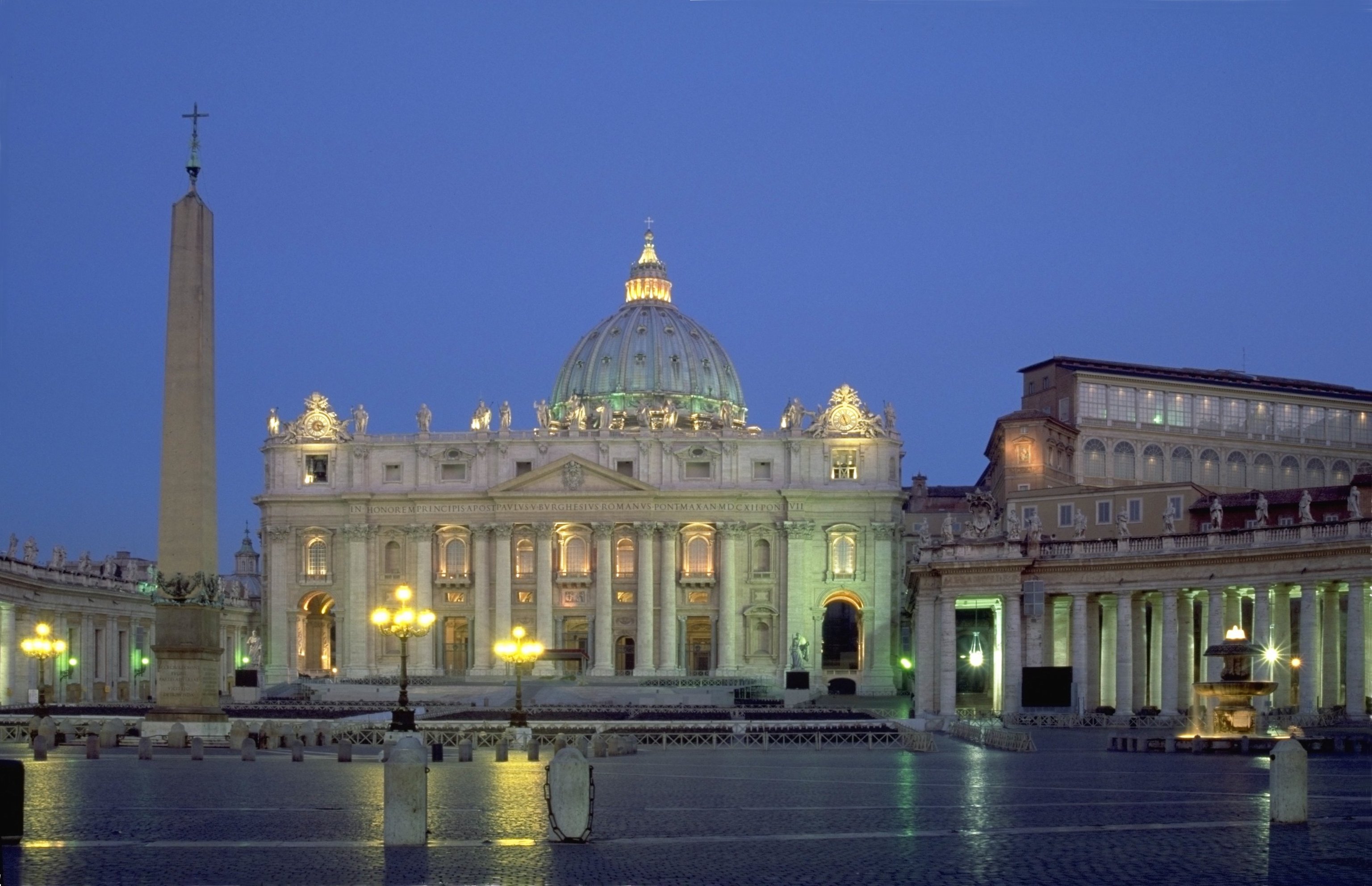 Virtue Online's Mike McManus examines the trend of Conversion to Catholicism. [h/t: Real Clear Religion]
Thursday, May 08, 2008
Modesty and Chivalry - Hard to Have One Without the Other
Humilty is the proper attitude towards greatness.
Another h/t The Dawn Patrol
Hey Josh | Resolutions are LAME ! Don't Dream - Set Goals
h/t Dawn Patrol
Sorry MLK, Jr. dreams don't come true - Goals do.
Freedom - Obedience - Authority
Meditation of the Day
How We Are Brought to Perfection
Allow me once more to recommend it to you and do not grow weary of learning it any more than I shall grow weary of teaching it. I would gladly shout out everywhere: Self-abandonment! Self-abandonment! And again self-abandonment. A self-abandonment without limits or reservations…Because the greatness of God and his sovereign dominion over us demand that all should bow, should be as it were beaten down and annihilated before his supreme majesty. His infinite greatness is wholly out of proportion to our littleness. It dominates everything, contains everything, is everything: for whatever exists and is not God, has received its being from him by creation, receives it indeed at each instant by conservation (which is an incessantly renewed creation), since the being thus received always remains plunged and lost in his bosom.
It follows that God is the Being of all beings; nothing is or lives or subsists except by him and in him. He is He-Who-is, and who is All in all things. Other beings compared with nothingness appear to be something, but compared with God they appear to be nothing. Their being and substance are borrowed, while God exists solely of himself and is no one’s debtor but his own. It is, therefore necessary that since everything necessarily belongs to him, all should return to him, and that his sovereign dominion should be glorified by all the creatures that his hands have made.
Creatures deprived of reason glorify him in their way by following with in violable exactitude and unwearying docility the movement that he communicates to them, but he rightly expects from his reasonable creatures a glory more worthy of himself, which results from their voluntary self-abandonment. How indeed can they make a more just and worthy use of their liberty than in giving back to God all they have received from him and offering him in advance all they may receive from him the future?
– Father Jean-Pierre de Caussade, S.J. was a French Jesuit, a writer, and a revered spiritual director.
Wednesday, May 07, 2008
Science Is Value Neutral, Right?
It's right out of That Hideous Strength's Belbury or the labs of Auschwitz: Half man, half chimp - should we beware the apeman's coming? Evil wears white lab coats and, pondering what could we do next, falls into the nemesis of all human history, hubris. [h/t: Mark Shea]
Tuesday, May 06, 2008
My Gratitude
 I just want to express my gratitude to my fellow Masss'keteers for the prayers and supportive well wishes that have come from their direction the past fortnight. I hope that, as in the case of brother Aramis, this foe will be defeatable and I will be able to return to an active and normal life -- in my case, my education ministry -- heaven willing and by the grace of our Eucharistic Lord. But either way, I offer it up for whatever good may be needed in the economy of God's Kingdom. I am privileged to receive so many prayers and good thoughts; I surely appreciate them.
UPDATE: The doctor gave me a green light this morning, 5/7/08. I see him again in 3-month intervals to make sure the bladder is clear. Need I say it -- Deo gratias. Yes, and yes, and yes again. Deo gratias. +
Christ Against Multiculturists
Stephen H. Webb
First Things May 6, 2008
Christians believe that God became human in Jesus Christ. If so, it follows that there is something called humanity. That is, humans have a nature, a shared or common nature. Human nature is not just a social construction. Human nature is real. And if it is real, then it is the same everywhere and at every time. It is, in a word, universal.
The idea that human nature is universal might seem simple to you, and it is. All true ideas are simple, because anyone can grasp them. Yet, believe it or not, you are about to enter a world that treats the idea of a universal human nature as simple-minded foolishness. The really sad thing is that your professors will not try to complicate this idea. To complicate an idea, you have to first take it seriously. Rather than argue about this idea, most of your professors will simply ignore it. You see, the idea of a universal human nature is contrary to everything most professors, at least in the humanities, believe. And that makes it one of the most radical ideas you can hold as a student.
The central dogma of higher education goes by many names, but its basic thrust is as easy to grasp as it is hard to miss. Whether it is called multiculturalism, social constructionism, or left-leaning liberalism, the bottom line is that higher education in America these days promotes cultural relativism. Colleges do not advertise this fact for obvious reasons, but look closely at what they say in their promotional literature. Colleges talk about broadening your perspective, expanding your horizons, and offering you new experiences, but they do not talk about teaching you how to make moral judgments, how to distinguish the beautiful from the ugly, and how to seek the truth. That is because secular liberal-arts colleges and public universities do not believe you should make moral judgments, contemplate the beautiful, or acknowledge universal truths. And they don’t believe these things because they do not believe there is something called human nature.
The college you have chosen to attend is no worse, and probably a little bit better, than most colleges when it comes to multiculturalism, but it is always wise to be prepared when you go to school. What you most need to know is that the “higher” in higher education no longer refers to the high culture of the greatest works of Western civilization. In fact, higher education has been trying to dismantle this culture for decades. Higher education today is all about lowering the great books and great ideas of the past to the same basic level. Rather than ask you to climb the great heights of the classics, professors these days will ask you to tear them down. Rather than ask you to test your intellectual strength by pitting yourself against the greatest thinkers of the past, professors will teach you the intellectual equivalent of etiquette and manners. You will learn how to talk without embarrassing yourself in polite, educated company. You will learn what to say, not how to think.
Education used to hold students to the highest standards of Western culture, but now it gives students bits and pieces of many cultures. Nonetheless, multiculturalism is not a plot devised by left-leaning liberals to dumb down America, though it often seems like that. Instead, multiculturalism follows inexorably from the rejection of a universal human nature. If there is no single human nature, then there is no single standard for human excellence either. Indeed, there is no single standard for anything, from rationality to morality. When rationality and morality are reduced to social constructions, the best we can do is learn how societies construct things, rather than why certain constructions endure the test of time. Learning becomes a matter of uncovering the social and historical context behind every book and every idea. Rather than ask what a text has to teach us, we now have to dig deep in order to ask what the text is trying to hide. And the answer to that question is presupposed from the start: What is foundational to all social constructions just happens to be what is so self-congratulatory about modern education. All books and ideas are trying to hide their prejudices about race, gender, and class. Learning is about identifying with the experiences of the victims of social injustice—experiences that will be held up for you as absolutely different from your own.
Multiculturalism might seem like a harmless game of cultural tourism mixed with a little detective work, with the crime (sexism and racism) always being the same, but it is actually much more serious than that. Liberal professors assume that you, the student, come to their classes believing in universal truths, and they think that it is their job to get you to leave such baggage behind. Since professors these days do not believe in human nature, they think that the most important thing they can do is to teach you that all values are relative. And they do this by trying to convince you that you do not understand other cultures because you are trapped in your own.
Here is how the game is played: They will first try to convince you that you are a racist, a sexist, and an enemy of social justice. Then they will argue that the victims of racism, sexism, and cultural elitism have a privileged view of these issues. It is as if the victim of the crime were to be given the first, last, and only word in a trial, with no cross-examination and no other witnesses called. Your job as a student in the multicultural classroom is to grant unquestioned authority to those who come from underprivileged or marginalized backgrounds. You have to do this because, you will learn, because Western culture has exploited every other culture, and your experiences are so shaped by Western culture that you cannot question those who criticize you. And thus you will become a good cultural leftist (which is the shape liberalism takes in the academy), or, if you are not convinced by these arguments, you will learn how to fake it for the sake of getting a good grade.
All of this is profoundly anti-Christian, which is why Christian students are typically the most radical questioners of higher education. Because Christians believe in a universal human nature, they also believe they can make universal truth claims about human nature. That does not mean that every statement about human nature is true. Of course not! A central part of education is learning how to argue by testing your own ideas about human nature against the ideas found in great books and the ideas espoused by your teachers and fellow students. Christians believe, for example, that because we are created in the image of God, every single person is of infinite worth, but Christians also believe that humans are fallen creatures, in need of grace and forgiveness. Christians are thus able to appreciate both the majesty and the misery of human actions. That is a powerful framework for questioning what you read and hear. What Christians do not believe is that every culture has its own truths and that the only way to learn about another culture is to refrain from seeking the universal truth.
To return to the central truth of Christianity, Christians believe that God experienced the totality of the human condition by becoming incarnate in Jesus Christ. That is, God did not need to become incarnate in each one of us in order to understand every one of us. Each one of us can experience a personal relationship with Jesus because Jesus was completely one of us. If cultural relativism is true, then Christianity is doomed, because God became incarnate in a very specific person at a particular time and place. From the perspective of multiculturalism, God could not have understood what it means to be human by becoming a Jewish carpenter from Nazareth. It follows that if God did understand man by becoming a man, then multiculturalism is a lie.
Applying this truth to the world of higher education, we can say that every human life is, in principle, sufficient for the discovery of every truth. You don’t need new experiences to become educated; you just need deeper ways of understanding your own experience. As a human being in the midst of passing into adulthood, nothing human is alien to you. You need to learn how to think more carefully, imagine more fully, and judge more humanely, but you do not need to learn that your beliefs are wrong because they are limited by your experiences and that the only way to broaden those beliefs is to immerse yourself in radically new experiences. What is true in any book you read or any idea you consider is true because it is true for everyone, and its truth is available to you because you already have the rudiments of what it means to be human.
Christianity inspired and informed the highest achievements of Western culture in order to challenge people to think about the eternal things, like heaven and hell, God, grace, forgiveness, and death. A college education should immerse you in the highest achievements of Western culture in order to give you the tools to enrich your experiences and refine you moral judgments. Education in this sense is about coming to know yourself, not because you construct your own reality, but because your nature is the same as everyone else’s. When a multiculturalist professor tells you that all truth is relative, ask him how he knows that, and when he tells you that Western culture is wicked and wrong, ask him what cultural criteria he is using to make that comparison. Better yet, do not ask your professors these questions, because multiculturalism is killing higher education as sure as the Romans killed Jesus. Share your questions with your friends, find a professor friendly to your faith, and keep higher education in your prayers.
Stephen H. Webb, ’83, is professor of religion and philosophy at Wabash College. His recent books include American Providence: A Nation with a Mission
Sunday, May 04, 2008


Saturday, May 03, 2008
Cantalamessa - The Ascension
 Father Raniero Cantalamessa gives his as per usual extraordinary commentary on the Gospel reading for the Feast of the Ascension, Why are you staring at the sky?
Friday, May 02, 2008
Quotes of the Day - René Girard

“What is frightening is the conjunction of massive technical power and the spiritual surrender to nihilism. A panic-stricken refusal to glance, even furtively, in the only direction where meaning could still be found dominates our intellectual life.”
"Choice always involves choosing a model, and true freedom lies in the basic choice between a human or a divine model."
"Deviated transcendency is a caricature of vertical transcendency. There is not one element of this distorted mysticism which does not have its luminous counterpart in Christian truth."
"'Genuine spontaneity' is not the absence of mimetic behavior but the most naive and innocent imitation of all, that of a little child, the attitude recommended by Jesus."
George Neumayr - A New Pentecost

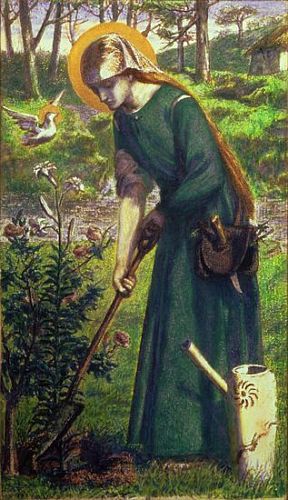
[h/t: New Advent] Speaking to the US bishops on April 16, Pope Benedict XVI made the arresting comment that an “almost complete eclipse of an eschatological sense” marks “many of our traditionally Christian societies.” America, he didn’t need to add, is one of them, but the very warmth of the welcome the Holy Father received in the US and the intensity of attention during his visit suggested a growing exhaustion with the eclipse of religion under secularism and a hunger for God’s revelation of man’s ultimate purpose.
Burdened by the yoke of an ideology that treats God as irrelevant to the ordering of society—an ideology which has at once destabilized public life, eroded the foundations of culture, and corrupted US Catholicism—Americans were ready for the Holy Father’s theme of “Christ Our Hope,” open to his arguments about the harmony of reason and revelation, and moved by his humility and piety.
Media pundits, stunned by this reaction, speculated on the papacy’s enduring significance. They offered various superficial reasons for it without arriving at the real one: it remains Christ’s way of staying present throughout history.
Into the darkness of godless voids—whether comforting the victims of priestly abuse near the beginning of the trip or kneeling in prayer at the pit of Ground Zero near the end of it—Christ’s vicar brought forth his light. In a false age, Pope Benedict offers truth; to the weary and enslaved, he represents grace. As the eye naturally turns to light, so people of good will turn toward holiness.
Often dismissed as a mere academic, the Holy Father showed characteristic honesty and courage in confronting pastorally the concrete effects of the crises he addressed intellectually. He delivered a talk one day to the bishops on the importance of fidelity to the doctrines and discipline of the Church, then the next day comforted those victims who suffered at the hands of a dissenting and lax clerical culture. He gave a speech to the General Assembly of the United Nations on the dangers of amoral power ideology, then two days later visited the “Ground Zero” site of its most extreme manifestation.
Thursday, May 01, 2008
Christianity's Reluctant Convert

From Athos' post Catholic Media Review on the up and coming movie Prince Caspian.
I thought this article Christianity's Reluctant Convert on CS Lewis needed a post onto itself. Ath, thank you for uncovering it.
April 30 - Memorial of St. Pius V, pope
 Tip Catholic Culture
St. Pius V, who was born in 1504, joined the Dominicans at the age of fourteen; he was sixty-two when he was elected Pope. His reign, through short, was one of the most fruitful of the sixteenth century. To Protestantism, which had proclaimed the Reformation, St. Pius replied by applying the decrees of the Council of Trent for the reform of the Church. He played a great part in the return of the clergy to ecclesiastical discipline. Against Islam, which threatened the West, he succeeded in forming a coalition of Christian forces: and by public prayers, organized everywhere at his request, he was instrumental in obtaining the decisive victory of Lepanto in 1571.

His holiness and austerity of life were notable, and he succeeded in bringing simplicity even into the papal household. He refused to wear the flowing garments of previous popes and insisted upon wearing his white Dominican habit even as head of the Church. To this day, the pope wears white, a custom begun by this Dominican pontiff.
Father, you chose St. Pius V as pope of your Church to protect the faith and give you more fitting worship. By his prayers, help us to celebrate your holy mysteries with a living faith and an effective love. We ask this through our Lord Jesus Christ, you Son, who lives and reigns with you and the Holy Spirit, one God, for ever and ever. Amen.
Joseph the Worker
 From Catholic Culture
The feast of St. Joseph the Worker was established by Pope Pius XII in 1955 in order to Christianize the concept of labor and give to all workmen a model and a protector. By the daily labor in his shop, offered to God with patience and joy, St. Joseph provided for the necessities of his holy spouse and of the Incarnate Son of God, and thus became an example to all laborers. "Workman and all those laboring in conditions of poverty will have reasons to rejoice rather than grieve, since they have in common with the Holy Family daily preoccupations and cares (Leo XIII)."
Ascension of the Lord
 Also from Catholic Culture [take your pick - cheers]
Besides the hope and the joyful expectancy of heaven so characteristic of the Ascension feast there is a note of melancholy. Before the final departure of Jesus, the Apostles must have been very much disturbed: each felt the distress of one who sees his dearest friend and companion going away forever, and finds himself alone to face all the difficulties of life. The Lord realized their state of mind and consoled them once more, promising the coming of the Holy Spirit, the Comforter: "He commanded them," we read in the Epistle (Acts 1:1-11), "that they should not depart from Jerusalem, but should wait for the promise of the Father... you shall be baptized with the Holy Spirit, not many days hence." But even this time the Apostles did not understand how much they needed to be enlightened and transformed by the Holy Spirit in order to accomplish the great mission which was to be entrusted to them! Jesus continued, "You shall receive the power of the Holy Spirit coming upon you and you shall be witnesses unto Me ... even to the uttermost part of the earth." For the moment, however, they were there, around the Master, weak, timid, frightened, like little children watching their mother leave for a distant, unknown land. In fact, "while they looked on, He was raised up, and a cloud received Him out of their sight." Two angels came to distract them from their great amazement and to make them realize what had happened. Then, placing their trust in the word of Jesus, which would henceforth be their only support, they returned to Jerusalem where, in the Cenacle, they awaited in prayer the fulfillment of the promise. It was the first novena in preparation for Pentecost: "All these were persevering with one mind in prayer with ... Mary, the Mother of Jesus" (ibid. 1:14).
Silence, recollection, prayer, peace with our brethren, and union with Mary: these are the characteristics of the novena we too should make in preparation for the coming of the Holy Spirit.
-- Excerpted from Divine Intimacy, Fr. Gabriel of St. Mary Magdalen, O.C.D.
Wednesday, April 30, 2008
Keeping Me In Stitches
If you want a PG-rated understanding of my present medical condition in situ, take a gander at this warzone.
Catholic Media Review
An interesting interview/review of Disney's upcoming film, Prince Caspian at Catholic Media Review.And a fine commentary from Catholic Education Resource Center is Christianity's Reluctant Convert, by Michael Coren.
Tuesday, April 29, 2008
For All You Do - Thank You
 Home Again - A Front Room Window
Besides the kind and loving support of Lady Athos and our younger son (our elder son being on a tight work-log at Best Buy), it was a privilege to have a visit from Dawn Eden who took a moment out of her busy (some might say hectic) schedule to visit my room yesterday and bring some reading material along too. Thanks, Dawn!
I was doubly blessed to have both Sister Mary Jo and Father Dan Hanley from St. James Parish bring Our Lord to me on Sunday - I need all the Grace I can get -- and the Rosary blessed by Pope Benedict XVI is in use for Christendom and for the blessing of "offering up" this experience however Heaven may choose.
The prognosis looks good: no radiaton or chemotherapy needed, but a 4-6 week recovery period and keeping close tabs on things, as they say. Lady Athos says I have about fifteen inches of incision, so I won't be doing my arched-back sit-ups or other exercise regime for some time (drat). Yet I have the astonishing good luck, or providence rather, to have a fellow Mass'keteer who preceded me on this adventure in brother Aramis. And I will lean on him and his experiences to inform me of what to expect and how to proceed.
Thanks to all for your prayers and daily intentions. You are of inestimable blessing and help.
With Love and Longing to Reciprocate Such Love, to Give Him Life for Life
“I will send the Advocate to you.”
What heart will be so hard and stubborn as not to be moved at the sight of such infinite love and the great dignity we have been given – and not because God owed it to us, but by his grace? None of us could look at this and contemplate it without transcending all sensuality, all our hardness and foolishness dissolved. When we see and know our own non-being and God’s goodness to us in giving us being and every grace that is added onto being, we will receive the most perfect light and knowledge of ourselves. Let your heart and soul be set afire in Christ gentle Jesus, with love and longing to reciprocate such love, to give him life for life. He gave his life for you: decide now to give your life for him, blood for blood…
That very charity, the Holy Spirit, with his hands has given and continues to give us God. He is constantly serving us every grace and gift, spiritual as well as material. How foolish, then, for you or anyone else to stay away from such delight! It seems to me every one of us should go – even on all fours if we can’t walk upright – to demonstrate our love for him by giving him our lives for the love of Life, to use our bodies to expiate our sins and failings just as we have used our bodies to offend.
– Saint Catherine of Siena (+ 1380), Doctor of the Church, was a Dominican, stigmatist, and papal counselor.
Friday, April 25, 2008
The Athos Update

Here at The Four Mass'keteers blog, we don't get much of a chance to stump the VATICAN INFORMATION SERVICE, who I am sure will be reporting on Athos' recovery soon, but we have it on good authority, that being Athos' lovely wife, that Athos came through surgery yesterday like a trooper. She went on to say that after surgery he was in a bit of pain, but things look good and that after his stay in the hospital of 5-7 days he will be returning home, with full recovery expected to take 4-6 weeks.
So please keep Athos and his family in your prayers as the healing process now begins.
Wednesday, April 23, 2008
Thanks for the Prayer - Here Goes
 I want to thank profusely the innumerable folk who have promised to pray for me, put my name on prayer-lists, visit Adoration Chapels tomorrow during my surgery to take care of a wayward "transitional cell carcinoma of the renal pelvis."
Father Dan Hanley graciously prepped me by all the ministrations afforded by Mother Church today, and for that I am and shall ever remain truly grateful.
Thing is: there is the appearance of helplessness in all of this spot of bother. And that is why I harbor a particular and ferocious antipathy for such Japanese thriller/horror flicks as The Grudge (2004) - the poor mortal humans can't do a blooming, bloody thing to stand against the onslaught of the inevitable doom. Pah! Phooh!
That is why, without doubt, I choose this of all nights to take in an altogether different flick; a piece of sub-creation (á la Tolkien) in which death is actual, but humans are real actors in this grand opera; namely, At World’s End. Here we are talking Purgatory, redemption, self-sacrifice, resurrection, and the Adventure of "offering it up."
I refuse to see this rigamarole as something other than an opportunity to practice the virtues, cardinal and theological. But I assure you, gentle reader, I will be tempted to do otherwise any number of times. So, pray for me. Here I go in the name of the Blessed Trinity, Father, Son, and Holy Spirit. Pray for us, Holy Mother of God, that we may be made worthy of the promises of Christ. Amen.
Edwin Muir

Look at it well. This was the good town once,
Known everywhere, with streets of friendly neighbours,
Street friend to street and house to house. In summer
All day the doors stood open; lock and key
Were quaint antiquities fit for museums
With gyves and rusty chains. The ivy grew
From post to post across the prison door.
The yard behind was sweet with grass and flowers.
A place where grave philosophers loved to walk.
Old Time that promises and keeps his promise
Was our sole lord indulgent and severe,
Who gave and took away with gradual hand
That never hurried, never tarried, still
Adding, subtracting. These our houses had
Long fallen into decay but that we knew
Kindness and courage can repair time's faults,
And serving him breeds patience and courtesy
In us, light sojourners and passing subjects.
There is a virtue in tranquillity
That makes all fitting, childhood and youth and age,
Each in its place.
Look well. These mounds of rubble,
And shattered piers, half-windows, broken arches
And groping arms were once inwoven in walls
Covered with saints and angels, bore the roof,
Shot up the towering spire. These gaping bridges
Once spanned the quiet river which you see
Beyond that patch of raw and angry earth
Where the new concrete houses sit and stare.
Walk with me by the river. See, the poplars
Still gather quiet gazing on the stream.
The white road winds across the small green hill
And then is lost. These few things still remain.
Some of our houses too, though not what once
Lived there and drew a strength from memory.
Our prople have been scattered, or have come
As strangers back to mingle with the strangers
Who occupy our rooms where none can find
The place he knew but settles where he can.
No family now sits at the evening table;
Father and son, mother and child are out,
A quaint and obsolete fashion. In our houses
Invaders speak their foreign tongues, informers
Appear and disappear, chance whores, officials
Humble or high, frightened, obsequious,
Sit carefully in corners. My old friends
(Friends ere these great disasters) are dispersed
In parties, armies, camps, conspiracies.
We avoid each other. If you see a man
Who smiles good-day or waves a lordly greeting
Be sure he's a policeman or a spy.
We know them by their free and candid air.
It was not time that brought these things upon us,
But these two wars that trampled on us twice,
Advancing and withdrawing, like a herd
Of clumsy-footed beasts on a stupid errand
Unknown to them or us. Pure chance, pure malice,
Or so it seemed. And when, the first war over,
The armies left and our own men came back
From every point by many a turning road,
Maimed, crippled, changed in body or in mind,
It was a sight to see the cripples come
Out on the fields. The land looked all awry,
The roads ran crooked and the light fell wrong.
Our fields were like a pack of cheating cards
Dealt out at random - all we had to play
In the bad game for the good stake, our life.
We played; a little shrewdness scraped us through.
Then came the second war, passed and repassed,
And now you see our town, the fine new prison,
The house-doors shut and barred, the frightened faces
Peeping round corners, secret police, informers,
And all afraid of all.
How did it come?
From outside, so it seemed, an endless source,
Disorder inexhaustible, strange to us,
Incomprehensible. Yet sometimes now
We ask ourselves, we the old citizens:
‘Could it have come from us? Was our peace peace?
Our goodness goodness? That old life was easy
And kind and comfortable; but evil is restless
And gives no rest to the cruel or the kind.
How could our town grow wicked in a moment?
What is the answer? Perhaps no more than this,
That once the good men swayed our lives, and those
Who copied them took a while the hue of goodness,
A passing loan; while now the bad are up,
And we, poor ordinary neutral stuff,
Not good nor bad, must ape them as we can,
In sullen rage or vile obsequiousness.
Say there's a balance between good and evil
In things, and it's so mathematical,
So finely reckoned that a jot of either,
A bare preponderance will do all you need,
Make a town good, or make it what you see.
But then, you'll say, only that jot is wanting,
That grain of virtue. No: when evil comes
All things turn adverse, and we must begin
At the beginning, heave the groaning world
Back in its place again, and clamp it there.
Then all is hard and hazardous. We have seen
Good men made evil wrangling with the evil,
Straight minds grown crooked fighting crooked minds.
Our peace betrayed us; we betrayed our peace.
Look at it well. This was the good town once.’
These thoughts we have, walking among our ruins.
Edwin Muir
John Henry Newman to be Beatified
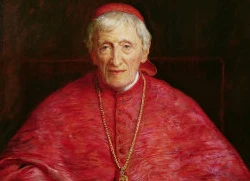
.- The Vatican has approved the beatification of Cardinal John Henry Newman, the English convert and theologian who has had immense influence upon English-speaking Catholicism, the Birmingham Mail reports.
Pray for us, Cardinal Newman, and for poor old England -- especially on this feast day of Saint George!
Speaking of the Sword of Eternal Truth
(h/t to Athos at Chronicles of Atlantis)
Rich Leonardi from the Seditious Catechist blog quotes PETER BRONSON at The Enquirer who notes something that a small group of us converts observed this past Monday at a funeral of one of our priests, Father Dacian. Peter Bronson writes,
Rich Leonardi from the Seditious Catechist blog quotes PETER BRONSON at The Enquirer who notes something that a small group of us converts observed this past Monday at a funeral of one of our priests, Father Dacian. Peter Bronson writes,
...somewhere during the funerals for two fallen firefighters April 9, I thought: Nobody does this better than the Catholic Church. When an uncertain world cruelly reminds us how fragile life can be, the magic, tradition, ritual and beauty of a mass soothes the aching heart. It speaks of eternal truth.
He goes on in the article:
This pope is a spiritual warrior against moral relativism.
"He believes there are clear truths in the world. That human dignity and human rights are rooted in faith," Fernandes said. "He wants us to get back to basics."
Benedict is a fierce defender of traditional marriage, which he calls the basic "cell" of society's body, where we learn justice, peace and love - eros and agape.
"One of the fundamental truths is that families are at risk and we need to fight for families," Fernandes said. "If the family is constantly under attack, if society is collapsing due to the collapse of the family, how can we expect peace to take root?"
If eternal truth is a two-edged sword, it cuts deep into the decay of moral relativism. That's painful for people who prefer bendable, harmless, Nerf truth. It's easier to just ignore eternal truth. Or distort it. Or attack it.
"The Catholic Church seems to be one of the last institutions standing up for marriage, the unborn, the rights of the elderly and the downtrodden," Fernandes said.
Pope Benedict won't back down from that tradition. That's why his visit means so much in this uncertain world.
Feast of Blessed Brother Giles of Assisi
Brother Giles helps us in our need to recover the holy fear of God. We have lost the fear of the Lord - and the absence of 'holy fear' makes us terrors unto ourselves and one another. Why? Because we know what humans who recognize no authority but themselves are capable of.
From The Little Flowers of St. Francis on this Franciscan feast day (April 23) of Blessed Brother Giles of Assisi:
OF THE HOLY FEAR OF GOD
He who fears not, shows that he has nothing to lose. The holy fear of God orders, governs, and rules the soul, and prepares it to receive his grace. If a man possesses any grace or any divine virtue, it is holy fear which preserves it to him. And he who has not yet acquired grace or virtue, acquires it by holy fear.
The holy fear of God is a channel of divine grace, inasmuch as it quickly leads the soul wherein it dwells to the attainment of holiness and all divine graces. No creature that ever fell into sin would have so fallen had it possessed the holy fear of God. But this holy gift of fear is given only to the perfect, because the more perfect any man is, the more timorous and humble he is.
Greatly ought a man to fear pride, lest it should give him a sudden thrust, and cause him to fall from the state of grace in which he is; for no man is ever secure from falling, so beset are we by foes; and these foes are the flatteries of this wretched world and of our own flesh, which, together with the devil, is the unrelenting enemy of our soul. A man has greater reason to fear being deluded and overcome by his own malice than by any other enemy. It is impossible for a man to attain to any divine grace or virtue, or to preserve therein, without holy fear.
He who has not the fear of God within him is in great danger of eternal perdition. The fear of God makes a man to obey humbly and to bow his head beneath the yoke of obedience: and the more a man fears God, the more frequently he adores him. The gift of prayer is no small gift, to whomsoever it is given.
HOW BROTHER GILES PRAISED OBEDIENCE MORE THAN PRAYER
As a brother was one day praying in his cell, his superior sent him an obedience to leave his prayer and go out to beg. The friar went forthwith to Brother Giles, and said to him: "Father, I was at prayer, and the guardian had bade me go forth to beg; now it seems to me far better that I should continue praying." Brother Giles answered: "My son, do you not yet know or understand what prayer is? True prayer is to do the will of our superior; and it is great pride in him who has submitted his neck to the yoke of holy obedience to desire to follow his own will in anything, in order, as he thinks, to perform a work of greater perfection. The perfectly obedient religious is like a horseman mounted on a mettlesome steed, which carries him swiftly and fearlessly on his way; but the disobedient religious, on the contrary, is like a man seated on a meagre, weak, or vicious horse, who is in danger of perishing by the way, or of falling into the hands of his enemies. I tell thee that, though a man were raised to so high a degree of contemplation as to hold converse with angels, yet were he interrupted in that colloquy by the voice of obedience, he ought immediately to leave communing with the angels, and obey the command of his superior."
Tuesday, April 22, 2008
A Liberal Episcopalian and the Pope Walk Into...
I can't stand it. THIS is against doctor's orders to take it easy.
Monday, April 21, 2008
Benedict and Belloc
 HILAIRE BELLOC, historian (First honors, Oxford), author, and friend of G. K. Chesterton, is known but not widely read today. This is too bad. He knows better the ailments of the dilapidated West than the talking heads, pundits, and politicians who happen presently to be alive.
Belloc describes in utter lucidity the gradient of the degradation of the West in the chapter of The Great Heresies entitled, "The Reformation." The entire book should be required reading for all concerned with the apparent demise of the West. Suffice it to say that the Protestant hegemony, a truly anti-Catholicism, broke up finally and certainly with the Great War, World War I.
But let it be noted that this breakdown of the older anti-Catholic thing, the Protestant culture, shows no sign of being followed by an hegemony of the Catholic culture. There is no sign as yet of a reaction towards the domination of Catholic ideas - the full restoration of the Faith by which Europe and all our civilization can alone be saved. [141]
To many who have no sympathy with Catholicism, who inherit the old Protestant animosity to the Church (although doctrinal Protestantism is now dead) and who think that any attack on the Church must somehow or other be a good thing, the struggle already appears as a coming or present atttack on what they call "Christianity." [143]
ENTER BENEDICT XVI ON HIS MISSION TO AMERICA. The Pontiff leaves the Vatican to celebrate his eighty-first birthday on American soil, meets with his American bishops, celebrates the Blessed Sacrament in two -- count 'em, two -- major league baseball fields, strolls Fifth Avenue, meets with young people and seminarians, and kneels in prayer at Ground Zero, praying for loving forgiveness in the face of heinous and murderous evil.
This aged leader of the Catholic Church has not given up on the West; nor is he about to look fearful before the specters that haunt our televisions, newspapers, or internet-browsing computer monitors. The Holy Father toddled through his stomping-grounds to show that he is Christ's Vicar -- the 265th since St. Peter himself -- and come hell or high water, he will come to bless, to serve, to love, and to spread the Gospel. How about us?
What return shall I make to Him who created me?
Meditation of the Day
Loving Jesus, Keeping His Word
Jesus Christ, my dear and gracious Lord,
You have shown a love greater than that of any man
And which no one can equal,
For you in no way deserved to die,
Yet you laid down your dear life
For those who served you and sinned against you.
You prayed for those who were killing you
That you might make them just men and your brothers
And restore them to your merciful Father and to yourself.
Lord, who showed such love to your enemies,
You have also enjoined the same love upon your friends.
My good Lord,
With what affection should I think of your love
Which is beyond measure?
What return shall I make for your boundless gifts?
For your loving kindness is beyond all telling,
The greatness of your gift surpasses all return.
Then what return shall I make
To him who created me and re-created me?
To him who has had mercy on me and redeemed me?
O God, you are my God,
My goods are nothing unto you,
For the whole world is yours and all that is in it.
Then what shall I, a beggar and poor,
A creeping thing of dust,
What return can I make to my God,
Except to obey his commandments, that we love one another…
You know, Lord, that I prize this love which you command,
I hold this love dear, and long for this charity.
This I ask, this I seek.
For this your poor man, your beggar,
Beats and clamors at the gate of your mercy.
And now, insofar as I have already received
The sweet alms you freely give,
I love all men, in you and for your sake
Though not so much as I ought or as I desire.
I pray your mercy upon all men,
Yet there are many whom I hold more dear
Since your love has impressed them upon my heart
With a closer and more intimate love,
So that I desire their love more eagerly -
I would pray more ardently for these –
Saint Anselm (+ 1109) was an abbot, bishop, philosopher, and theologian.
Sunday, April 20, 2008
Address to Young People
 Here is the text of the Holy Father's Address to Young People and Seminarians. An excerpt:
My own years as a teenager were marred by a sinister regime that thought it had all the answers; its influence grew – infiltrating schools and civic bodies, as well as politics and even religion – before it was fully recognized for the monster it was. It banished God and thus became impervious to anything true and good. Many of your grandparents and great-grandparents will have recounted the horror of the destruction that ensued. Indeed, some of them came to America precisely to escape such terror.
Let us thank God that today many people of your generation are able to enjoy the liberties which have arisen through the extension of democracy and respect for human rights. Let us thank God for all those who strive to ensure that you can grow up in an environment that nurtures what is beautiful, good, and true: your parents and grandparents, your teachers and priests, those civic leaders who seek what is right and just.
The power to destroy does, however, remain. To pretend otherwise would be to fool ourselves. Yet, it never triumphs; it is defeated...
[Snip]
What might that darkness be? What happens when people, especially the most vulnerable, encounter a clenched fist of repression or manipulation rather than a hand of hope? A first group of examples pertains to the heart. Here, the dreams and longings that young people pursue can so easily be shattered or destroyed. I am thinking of those affected by drug and substance abuse, homelessness and poverty, racism, violence, and degradation – especially of girls and women. While the causes of these problems are complex, all have in common a poisoned attitude of mind which results in people being treated as mere objects ─ a callousness of heart takes hold which first ignores, then ridicules, the God-given dignity of every human being. Such tragedies also point to what might have been and what could be, were there other hands – your hands – reaching out. I encourage you to invite others, especially the vulnerable and the innocent, to join you along the way of goodness and hope.
The second area of darkness – that which affects the mind – often goes unnoticed, and for this reason is particularly sinister. The manipulation of truth distorts our perception of reality, and tarnishes our imagination and aspirations. I have already mentioned the many liberties which you are fortunate enough to enjoy. The fundamental importance of freedom must be rigorously safeguarded. It is no surprise then that numerous individuals and groups vociferously claim their freedom in the public forum. Yet freedom is a delicate value. It can be misunderstood or misused so as to lead not to the happiness which we all expect it to yield, but to a dark arena of manipulation in which our understanding of self and the world becomes confused, or even distorted by those who have an ulterior agenda.
Saturday, April 19, 2008
Text: Pope Benedict's Homily
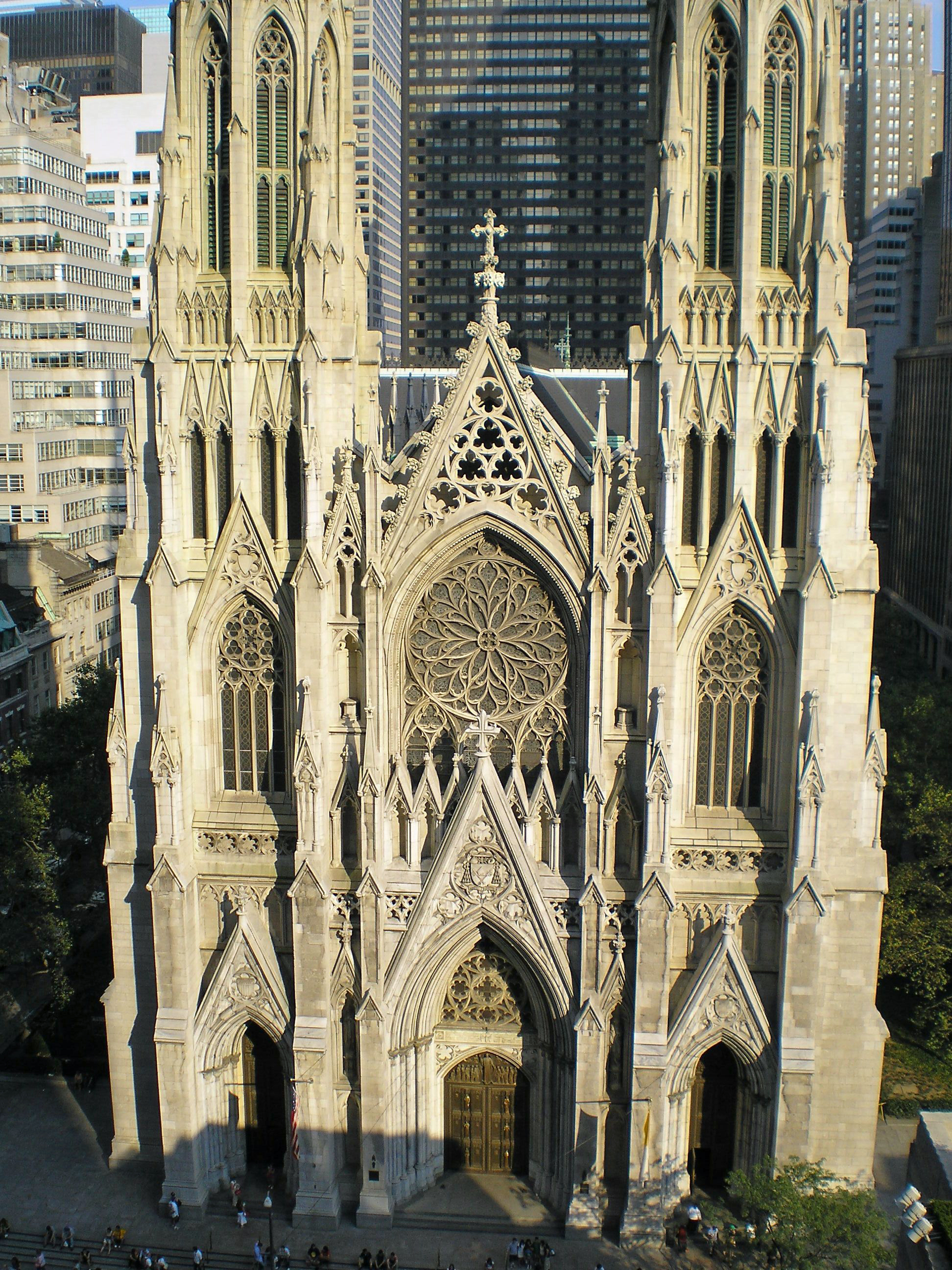 The New York Times provides the text of the Holy Father's homily at St. Patrick's Cathedral.
And, it appears the Mass'keteers are settling on a commentator of choice, Amy Welborn, who writes on Vintage Benedict and his “teachable moments."
UPDATE: Father James Martin calls this homily by Benedict "one of the best sermons ever. Period," in his NYT piece, Are You Weak Enough to be Pope?
Amy Welborn sums it up well
Amy Welborn revisits what she wrote on the one year anniversary of Pope Benedict XVI.
There are enormous problems in our Church and in our world. Some of us wish there would simply be some concerted head-knocking to take care of it all. But Benedict knows history, and he also knows what is at the heart of our problems: we have turned from Christ. Even in our Church, our fundamental problem is that too many of us have argued ourself out of serious, commmitted belief in Jesus Christ, modulating and contextualizing it to the point of emptiness. Too many of us have put ourselves at the center of this enterprise rather than Christ. Too many of us have simply sold out to whatever culture that surrounds us, letting it be our Lord, not Jesus Christ.
I have no great statements about his impact on the Curia or the bishops’ conferences or liturgical life or diplomacy. What I have heard over and over this year is a wise father gently, surely re-grounding us in Scripture and the witness there, as well as in the voices and art and holiness of Christians through the ages, articulating what we know is true about the strains, temptations and deserts in our lives, weaving it all together and in rather startling simplicity, pointing us to Jesus.
Friday, April 18, 2008
Bush Calls Pope Visit 'Unbelievable'
...to use his (Pope Benedict XVI's words) "each of us is willed; each of us is loved; and each of us is necessary."
Pope Benedict Addresses the United Nations
Short excerpt on Pope Benedict XVI's address to the UN today.
Benedict XVI to the United Nations
Fr. John Zuhlsdorf at What Does the Prayer Really Say has the Holy Father’s address to the United Nations here. Fr Z gives his commentary in red.
Luciferian Logic
 Borrowing the phrase "luciferian logic" from mentor and friend Gil Bailie, I post this from the honorable Senator Barack Obama, who says that A domestic terrorist is like pro-life Senator. Mark Shea would place this kind of thinking in the "Sin makes you stupid" category. While Shea is correct, Obama's statement also displays the way the sacrificial mechanism of our age generates its own justifying mythology, giving the minimalist ritual of abortion an aura of righteousness.
But, being a good "progressive", Mr. Obama doesn't know that he is simply a mouthpiece for the modern recrudescence of the primitive Sacred. Sadly, neither do millions who support him for president of the United States of America.
Thursday, April 17, 2008
Whapping Good Time
Coverage of the Holy Father’s Day in Washington by the Holy Whapping boys. Ah! What would we do without them?
Resource Guides for Teachers, Catechists and Youth Ministers
It is all what we would call, a teaching moment. Check the site out: "Catechesis on the papacy is an integral part of planning for the visit of Pope Benedict XVI to the United States in April. The Archdiocese of Washington, in collaboration with the United States Conference of Catholic Bishops' Secretariat for Evangelization and Catechesis, has created resource guides to support the work of teachers, catechists and youth ministers. These materials offer direction and referenced suggestions for the development of two to five hours of grade appropriate and parish/school appropriate lessons focused on the papacy and the papal visit. They also include material suitable for adults."
Conversion -- setting the heart on fire -- so often we struggle, at least we give ample excuse for not being on fire with our faith, when we are charged to help pass on the faith to another... This week we are being given all sorts of opportunities to express what all long for in their hearts -- faith, hope and love. So with proper guidance and understanding of the Sacramental Life we can help instruct our youth to be filled with the joy so abundantly displayed by our Holy Father this week.
Subscribe to:
Posts (Atom)