Doug Giles weighs in on benighted secularists who can't tell Christianity and Islam apart.
And this shows that what is happening in the West, at present, is a struggle to determine who defines the terms of discourse. I.e., "peace" equals _______ ? Sez who for you? What, or, for Christians, Who is the epistemological foundation for knowing anything for certain?
Monday, August 13, 2007


Sunday, August 12, 2007
That Man Is Me?
Via Father Stephanos over at Me Monk. Me Meander, a recommended article for men of faith, The New Catholic Manliness.
In it, Todd Aglialoro mentions something he finds commendable from a family ministry based in Houston, Paradisus Dei, entitled, ”That Man Is You.” A rigorous three-year process, "That Man Is You" is not a "pastoral" program for those who want their hands held. Rather,
Hmmm. Sounds like something the Three Mass'keteers might endorse and enjoy. Note well: Take time to read "The New Catholic Manliness" mentioned above. It includes such sub headings as "Toward a Crunchier Catechesis," that describes many new seminarians not engaging in psychobabble, felt banners, and "Jesus our friend."
In it, Todd Aglialoro mentions something he finds commendable from a family ministry based in Houston, Paradisus Dei, entitled, ”That Man Is You.” A rigorous three-year process, "That Man Is You" is not a "pastoral" program for those who want their hands held. Rather,
“Men respond to a challenge,” founder Steve Bollman says. “To offer them a ‘soft’ program doesn’t take into account how men work.”
So Bollman set out to provide that challenge—with early morning prayer groups; with demanding “covenants” that call men to be self-sacrificing leaders in their families; and with an intellectually rigorous 68-week program, spread over three years, that unites science, Scripture, theology, and spirituality in a “thinking-man’s quest” for the full truth of what it means to be a man—and a man of God. To date, more than 5,000 men in Texas, Canada, and satellite programs nationwide have participated.
Saturday, August 11, 2007
Compulsive Fascination, +/-
 While the New York Times surveys the ratcheting up of movie violence beginning with "Bonnie and Clyde," the Washington Post relates an escalating spiral of horrific breaking-and-entering violence in the suburbs. Hmmm. Gosh. No connection there. Hollywood, by all means, keep making bondage, torture, rape, and murder films ...
Mimetic theory pulls the veil off the reality about human "mimesis"; namely, our nearly ubiquitously unconscious compulsion to catch "desire" from one another. Paraphrasing pal and mentor Gil Bailie, highlight and delete anything in your memory banks about Freud and the word desire here. From the viewpoint of biblical anthropology, "desire" is a highly specified commodity that we "catch" from one another. (Ever wonder why the Sunday paper has all those sales flyers that fall out all over the place? Here's why: we don't wake up thinking, "Gee, I really want a new plasma, flat-screen TV." Our appetite must be whetted.) Madison Avenue knows this about us. We should know it too.
But "desire" isn't just about the "wanna-buy-it" syndrome. A French Girardian, Jean Pierre Dupuy, defined desire as “a secret fascination for the apparent autonomy of the other which cannot rest until it has demystified it.” Sounds a bit dense, doesn't it? But if you have ever been the object of this "intense fascination for the other, either positive or negative" (Bailie), you know how unpleasant it is. Such "desire" can flip-flop in the blink of an eye. (Think "Hosanna!" shouted on Palm Sunday and "Crucify him!" by the same crowd later the same week.) This intense fascination is at the heart of Girard's "model/rival" problem of the doubles.
What if a poor, benighted soul thinks that if he (or she) can just steal your possessions, indeed, dispose of you in the process, then he (or she) will have the happiness, the satisfaction, the ontological substantiation that he (or she) has always wanted? It gets that nutty.
And what if the movies show you how to do it? "It's only entertainment." Yeah, right.
And what if this compulsive desire affects not only individuals, but whole peoples, ethnic groups, religions, on a global scale as well? Welcome to our world, fallen and in need of a Savior.
St Clare - Sun & Moon Over Assisi excerpt

St Clare feast day - August 11
from my good friend Gerry Straub,
author of The Sun and Moon Over Assisi
A Good Catholic Girl
Clare was a good Catholic girl before she met Francis. She went to church, did good works and avoided evil. Yet, when she encountered Francis, she was introduced to something radically different from just being good. She suddenly realized that God wasn’t interested in our “just being good.” God desired far more than that…God wanted us to be so united with him that we become reflections of the divine.
Francis inspired Clare to dedicate herself to live in full accordance to the highest demands of the gospel. She put the whole gospel into her whole life. She lived for nothing but God. Her mind and heart were constantly centered in God. She entered fully into the most rigorous demands of poverty. She gave herself in charity to all. Prayer became her very breath. She lived love, and radiated with sanctity. Clare’s undying fidelity to the Lord and her vocation inspired everyone who knew her. Pope Alexander IV called Clare a “lofty candlestick of holiness.”
The light from the candlestick shimmers with one unequivocal message: God wants our all. God wants our trust, our humility, our openness, our hearts…God wants our entire beings, so his perfect love can be born again into the world.
How do I respond to that message? I must begin by renewing my commitment to God every day. I must try every day to deepen my relationship with God.
Clare calls me to ascend the ladder of contemplation.
…we must remember that young girls living in 13th-century Assisi did not have the right to determine their own future...Clare’s future was not her own. During the Middle Ages, noble women were expected to marry well and increase the family wealth. By the time she reached 18, Clare was already well past the marriageable age, and her parents were lining up suitors for her, and firmly pressing her to accept one of the many advantageous offers of marriage available to her. (Note: her parents wanted her to marry shortly after her 12th birthday, but Clare managed to get them to delay their plans.) But Clare had a much different marriage in mind - she wanted Francis to take her hand and give it to Christ. Her choice not to marry caused great turmoil and anguish in the household, and greatly disrupted the peace within the Offreduccio palazzo. It took great courage and determination for Clare to follow through on her dream to have no other spouse but Christ. First, she had to renounce her privileged position in the nobility, and, second, she had to refuse to follow the conventional monastic tradition (that was one of the few options open to women) because it too seemed to represent wealth and security.
During the Lenten season of 1212, Francis preached a series of sermons in San Giorgio and the Cathedral of San Rufino. Clare attended a number of these. Considering her love of beautiful sermons, Clare must have been thoroughly captivated by the fiery improvisations of this preacher-poet who was once known as “the king of the youth” and who was now inebriated with God’s love. She, too, felt she had to make a decision, a decision to follow Francis’ example and walk in the footsteps of Christ.
But it is important to remember it wasn’t Francis’ words that motivated Clare; what moved Clare was what she heard in her heart. Listen once again to Ingrid J. Peterson, O.S.F.:
“When Clare was influenced by Francis’ preaching, it wasn’t because his personal life was a model for her. It was not because she finally found her knight in shining armor, the man of her dreams; it was because Clare had a hunch that what Francis said about the Gospel and the poorness of Jesus is what she could put into action in her own soul. What Francis said touched Clare’s heart. In the thirteenth century, for a woman of the aristocracy to choose to live without property as a means of support was a risk, even of life itself.”
As a young girl, Clare saw the deep divisions within the community of Assisi; she was troubled by the conflict between the merchants with newly-acquired wealth and the old aristocracy, and by the ever widening chasm between the rich and the poor. Many members of the Church hierarchy, driven by a hunger for power and money, behaved so scandalously, they sparked the birth of numerous religious movements consisting of lay people who wanted to live a more Gospel-centered life that was animated by penance and a radical following of Christ and the Apostles. Clare’s sensitive soul responded to the extremes of greed and misery she witnessed by dedicating herself completely to the service of Christ’s poor. And so, the soil of Clare’s soul had been well-tilled and was ready to receive the message sown by Francis. Clare had already made a private vow of virginity and service to the poor. She was living as a penitent and was planning to give away her inheritance to the poor. The words she heard in San Rufino issuing forth from the mouth of Francis just hastened her along on her spiritual journey.
The Sun and Moon Over Assisi, pages 349, 354 – 355, Gerard Straub
Aramis here - I highly recommend this book. Gerry surrounds his own spiritual journey with great insights of the life of Francis and Clare as well as the history of Assisi and the painter Giotto.
Movies, Books, and "Graduation"
 In these waning days of summer, I went to the movies yesterday and saw "Bourne Ultimatum." Besides the over the top score that blasted movie-goers incessantly with postmodern percussion riffs, the camera veritas (read: hand-held, ever-moving, seasick-inducing) method of looking over characters' shoulders at one eye of another character left me wondering what my son was watching with my wife in "Underdog". Meanwhile, movie-goers will assure another multi-million dollar successful week for studios. Little wonder that both Thomas Merton and Walker Percy finally flung up their hands and walked out of theaters forever.
But the New York Times Sunday Book Review features a review of J. K. Rowling's Harry Potter and the Deathy Hallows by everyone's favorite snide evangelist of atheism, Christopher Hitchens. I will spare you his sarcasm toward the lemming-like of western society, but Hitch finishes his critique with:
"I recommend that they graduate to Philip Pullman, whose daemon scheme is finer than any patronus."In other words, Hitchens wants to keep the kiddies entertained but now with Philip Pullman's His Dark Materials trilogy, The Golden Compass, The Subtle Knife, and The Amber Spyglass. Just after Hitchens pokes his fork into the masses who purchase massive tomes about a boy wizard and who yearn to read about the "posh" and unattainable life of British boarding schools (and magical ones at that), he touts an atheistic equivalent that purports to "graduate" readers, apparently, to "grown up" reality.
"Graduate" tells all about Hitchens. The verb, for him, means to grow up, put in the toy box once and for all the infantile play things of theistic faith in a self-revealing, self-donating God, and join him in the drab gray, humanist, closed-box, realtime "reality" of the 21st century.
Hitch, like all card-carrying members of the humanist country club, believes that truth is ugly. This is his journalistic forte -- uncloaking truth, goodness, and beauty to show the contaminated, crass reality behind the persona (Hitchens coined the phrase to describe Mother Teresa of Calcutta, "the ghoul of Calcutta").
So, readers and, soon, watchers at the movies, get on the bandwagon of post-Rowling reality: Philip Pullman's books will soon be in theaters, starting on December 7th. Be prepared.
Friday, August 10, 2007
Back to the Drawing Board
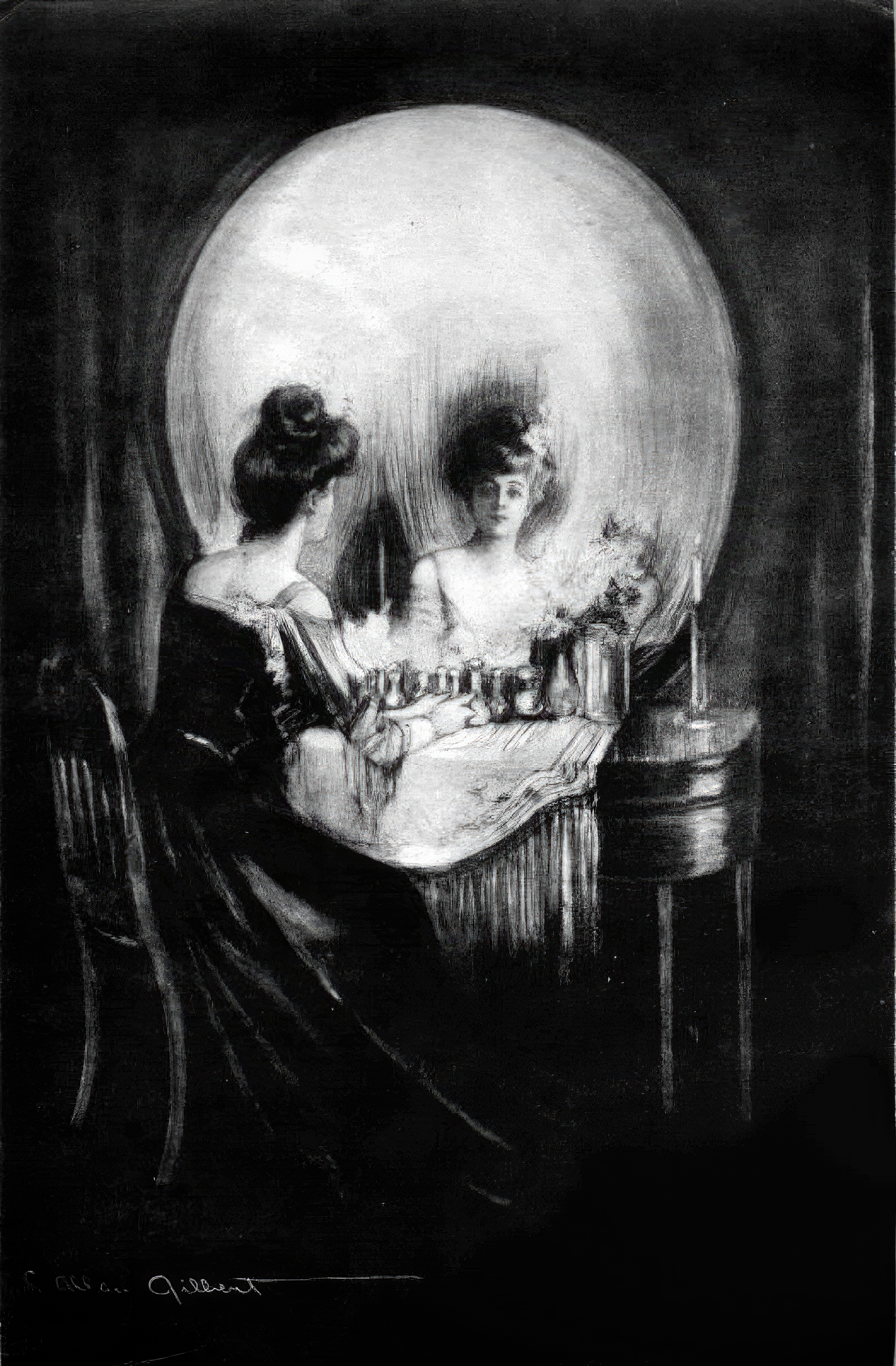 Having just posted on the difficulties of the juncture of Islam and science, here is a praiseworthy note: those who posited careers on human evolution going a certain direction are back to square one. Intellectual honesty and the scientific research method win out over fraud and burying evidence that would discredit hypotheses and theories heretofore assumed.
Read more here. And here.
Science, Islam, and the Holy Spirit
Pervez Hoodbhoy, chair and professor in the department of physics at Quaid-i-Azam University in Islamabad, Pakistan, where he has taught for 34 years, takes on an extremely relevant topic in his article in Physics Today, Science and the Islamic world—The quest for rapprochement.
Hoodbhoy makes two comments about the scientific endeavor and "attitude" of Islam:
Likewise, and relatedly:
What Hoodbhoy does not see -- as many do not in the realm of merely secular science, social or "hard" -- is that the tectonic attitudinal shift comes at the point of the organizing principle of conventional religion, anthropologically speaking. Until this happens, Islam will simply be another expression of what mimetic theory describes as the "primitive sacred."
And this is why the Christian faith is not merely another world religion, but a categorically different and superior expression of God's self-revelation in "Jesus Christ and him crucified." The Holy Spirit in the Christian faith in general and the Catholic Church in sharp particularity made science possible. As Girard says, "We didn't stop burning witches because we invented science. We invented science because we stopped burning witches."
For a fine explication of this, see Gil Bailie’s lecture on the Gospel of John (tape 10).
Hoodbhoy makes two comments about the scientific endeavor and "attitude" of Islam:
Science is fundamentally an idea-system that has grown around a sort of skeleton wire frame—the scientific method. The deliberately cultivated scientific habit of mind is mandatory for successful work in all science and related fields where critical judgment is essential. Scientific progress constantly demands that facts and hypotheses be checked and rechecked, and is unmindful of authority. But there lies the problem: The scientific method is alien to traditional, unreformed religious thought. Only the exceptional individual is able to exercise such a mindset in a society in which absolute authority comes from above, questions are asked only with difficulty, the penalties for disbelief are severe, the intellect is denigrated, and a certainty exists that all answers are already known and must only be discovered.
In the quest for modernity and science, internal struggles continue within the Islamic world. Progressive Muslim forces have recently been weakened, but not extinguished, as a consequence of the confrontation between Muslims and the West. On an ever-shrinking globe, there can be no winners in that conflict: It is time to calm the waters. We must learn to drop the pursuit of narrow nationalist and religious agendas, both in the West and among Muslims. In the long run, political boundaries should and can be treated as artificial and temporary, as shown by the successful creation of the European Union. Just as important, the practice of religion must be a matter of choice for the individual, not enforced by the state. This leaves secular humanism, based on common sense and the principles of logic and reason, as our only reasonable choice for governance and progress. Being scientists, we understand this easily. The task is to persuade those who do not.
And this is why the Christian faith is not merely another world religion, but a categorically different and superior expression of God's self-revelation in "Jesus Christ and him crucified." The Holy Spirit in the Christian faith in general and the Catholic Church in sharp particularity made science possible. As Girard says, "We didn't stop burning witches because we invented science. We invented science because we stopped burning witches."
For a fine explication of this, see Gil Bailie’s lecture on the Gospel of John (tape 10).
Thursday, August 09, 2007
The Miracle Maker
 By the way, I loaned my VHS copy of The Miracle Maker (a skubolonic title) to my now-dead Lay Leader of my last United Methodist church (may he rest in peace). He never returned it. I found a copy when visiting family in the Midwest. I highly recommend it, if only to hear the voices of William Hurt (Jairus), Ralph Fiennes (Jesus), and other highly acclaimed actors of our time doing claymation work. It is a moving presentation (and the Amazon prices are low).
Cardinal Newman Quotation
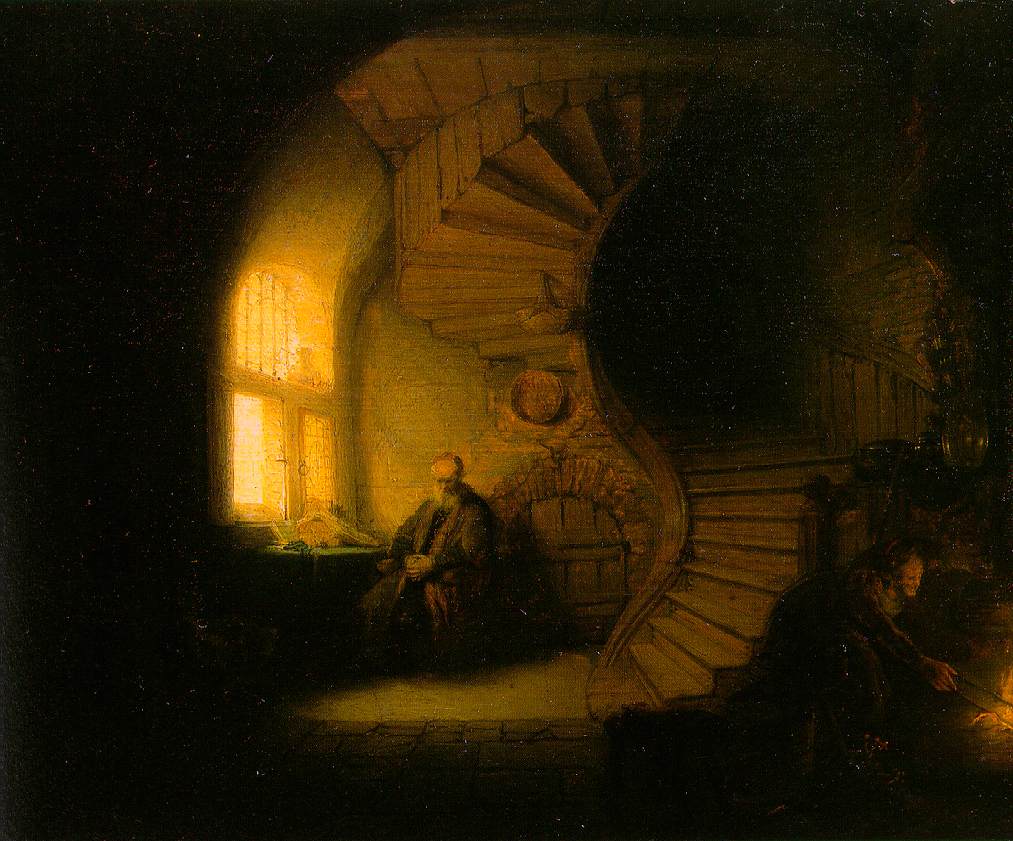 Philosopher in Meditation - Rembrandt (1632)
-- John Henry Cardinal Newman
Your Will be Done
How do we set our feet toward God if we are not on our knees responding to His Will?
Tip again goes to Doctors of the Catholic Church and the Magnificat
Today the Church honors Edith Stein who was born of Jewish parents and became an influential philosopher. Then she had a conversion to Catholicism and later became a Carmelite nun. She was arrested by the Nazi regime in 1942, along with all Catholics of Jewish extractions and transported by cattle train to the death camp of Auschwitz where she died in the gas chambers that same year.
Meditation of the Day
Beginning the Way of the Cross
The words “Your will be done” must be the rule of the Christian’s life in all their fullness. They must be the principle that regulates his day from morning to night, the course of the year and his whole life. It then becomes the Christian’s only concern. For all other cares the Lord will make himself responsible; this alone will remain with us as long as we live. From the objective point of view it is not absolutely certain that we shall always remain in the ways of God. Just as the first man and woman became estranged from God though they had been his children, so every one of us is always balancing, as it were, on the edge of the knife between nothingness and the fullness of the divine life. Sooner or later we shall be feeling this also subjectively.
In the infancy of the spiritual life, when we have just begun to surrender ourselves to the guidance of God, we see his guiding hand very strongly; it is clear as daylight what we have to do and what to avoid. But it will not remain like this. If we belong to Christ, we have to live the whole Christ-life. We must mature into his humanity, we must one day begin the way of the cross to Gethsemane and to Golgotha. And all sufferings that come from without are as nothing compared with the dark night of the soul, when the divine light no longer shines, and the voice of the Lord no longer speaks. God is there, but he is hidden and silent.
God became man in order once more to give us a share in his life. This is the beginning, and this the last end. But between these there is something else. Christ is God and man, and if we would share his life, we must share both in the divine and the human life. The human nature which he took enabled him to suffer and to die. The divine nature which he possessed from eternity gave his suffering and death infinite value and redemptive power. Christ’s suffering and death are continued in his mystical body.
Saint Teresa Benedicta of the Cross (Edith Stein; +1942) was a German philosopher and a convert from Judaism who became a Carmelite nun and was put to death at Auschwitz.
Every Day Offers a Choice
tip to Doctors of the Catholic Church
Coming back from a trade show in Las Vegas I found this mornings reflection in the Magnificat particularly powerful.
Commentary: Wisdom will enter your heart, Discretion will watch over you, Saving you from the way of evil men, from men of perverse speech. Who leave the straight paths to walk in ways of darkness. (cf. Prv 2: 10-13)
Every day offers a choice: what sort of reading, what sort of TV, what sort of conversation, what sort of friends will we choose to welcome into our home?
Coming back from a trade show in Las Vegas I found this mornings reflection in the Magnificat particularly powerful.
Wednesday, August 08, 2007
Christian Convert Speaks from Prison
A GodTube embedded at David Morrison's place.
NOTE: Video not working, so I cut the link. It only worked the first time I watched it . . . ?? Thanks to Ath for the heads up, and apologies.
NOTE: Video not working, so I cut the link. It only worked the first time I watched it . . . ?? Thanks to Ath for the heads up, and apologies.
Rap - Soundtrack for the Apocalypse
 And the Breakdown of Law
Myron Magnet in City Journal gives not only an excellent article on the circular thinking of the 77 Duke University profs who condemned the lacrosse team in print before the verdict of "not guilty" was handed down, but also lays out the reasons (mimetically speaking) for rap music to be the soundtrack for the sacrificial apocalyptic meltdown of the West:
Let me start with a disclaimer. I know that rap’s house has many mansions—there is even Christian rap—and I believe that some rap varieties are constructive. I know that nice kids listen to nasty music and remain uncorrupted. And I know that an old (if not yet dead) white male who thinks rock and roll died when Buddy Holly went down in a 1959 plane crash with Ritchie Valens and the Big Bopper is rushing into terra incognita in discussing this topic. But I also know that most of the rap that the wider world knows is gangsta rap, and to read the lyrics, listen to the songs, and watch the videos of some of the most popular rap songs is instructive, diagnostic, and disturbing.
Now thug and gangsta culture is leading to the happy, clappy world of misogyny and "hos":
The great accomplishment of civilization has been to replace the reign of force with the rule of law, and to humanize the animal realities in which our lives are embedded by means of manners and rituals that give those realities a human meaning. And if the rule of law fares poorly in rap, civilization’s great effort to transform the animal facts of reproduction into love and marriage doesn’t do so well in gangsta-land, either. This is what so much of our culture is about—our manners and morals, poetry and song and film, from the Song of Solomon and the medieval French romances to “The Way You Look Tonight”: yes, I have these feelings, but not just for anyone; it’s you personally I love, so much that I want you always. And many of the popular songs of the 1940s and 1950s, making the promise of permanence explicit, end with talk of marriage. Human beings undergo an education of the feelings, and popular culture’s love songs were once great instructors in this school.
It’s a long drop to the dogghouse and Doggystyle. And since it’s culture that molds feelings and behavior, when the “Why don’t we do it in the road” spirit of sexual liberation of the 1960s declined in the ghetto into “Do you want it over here? Do you want it over there?,” feelings and behavior were bound to follow. Rap is a school that hardens and coarsens rather than cultivates the feelings and, presenting women as disposable and interchangeable objects for use, dehumanizes rather than humanizes the relations between the sexes.
Tuesday, August 07, 2007
Iraqi Christians - Convenient Scapegoats
"And Herod and Pilate became friends with each other that very day, for before this they had been at enmity with each other." -- Luke 23,12
A postulate of mimetic theory is that during moments of contagious social and/or psychological turmoil, groups will endeavor to find a scapegoat. How come? It is because someone that we can both agree upon to be source of the disturbance is the "lowest common denominator," so to speak, upon which we can both agree. It doesn't even need to be true.
Scapegoats are notoriously decided upon, at times, for ridiculously childish reasons. A humped back. A particular hue of skin color. An "evil eye." René Girard has more than proven in the realm of world literature in general and the anthropological data in particular that such selection comes with one more essential characteristic. The scapegoat needs to have no one to support him or her. Hence, the old woman who lived just beyond the edge of the village, should a drought occur or a child or two die, would be in grave danger of being perceived as a ... what? WHAT did you just think!? Now, how did you know that? Who taught you? How did that enter your mind? The work of the Paraklete (Holy Spirit) IS at work, isn't it?
So it should come as no surprise that a Vatican personage recently observed that Christians in Iraq were actually safer during the dictatorship of Saddam Hussein than during the present mayhem of "democracy" ( ...... ___ ) in Iraq. Again, how come? I think you know already.
The Iraqi sunni and shiai in their centuries-old feud, once circumvented by Saddam's tyrannical iron-fist, now are in a sacrificial melt-down of catastrophic proportion. What small underclass of people in Iraq are (now) unprotected, different, and sitting ducks? As my students say, who in Iraq hear absolutely no one saying, "I got your back"?
Iraqi Christians, "paradoxically, were more protected under the dictatorship," said French Cardinal Jean-Louis Tauran, who will become head of the Pontifical Council for Interreligious Dialogue Sept. 1. The entire article concerning his comments may be viewed here.
Please see our sidebar subcategory "Mimetic Theory & René Girard" for many excellent resources in understanding more clearly the global crisis in which all persons now struggle.
Sunday, August 05, 2007
The Paralyzing Double Bind
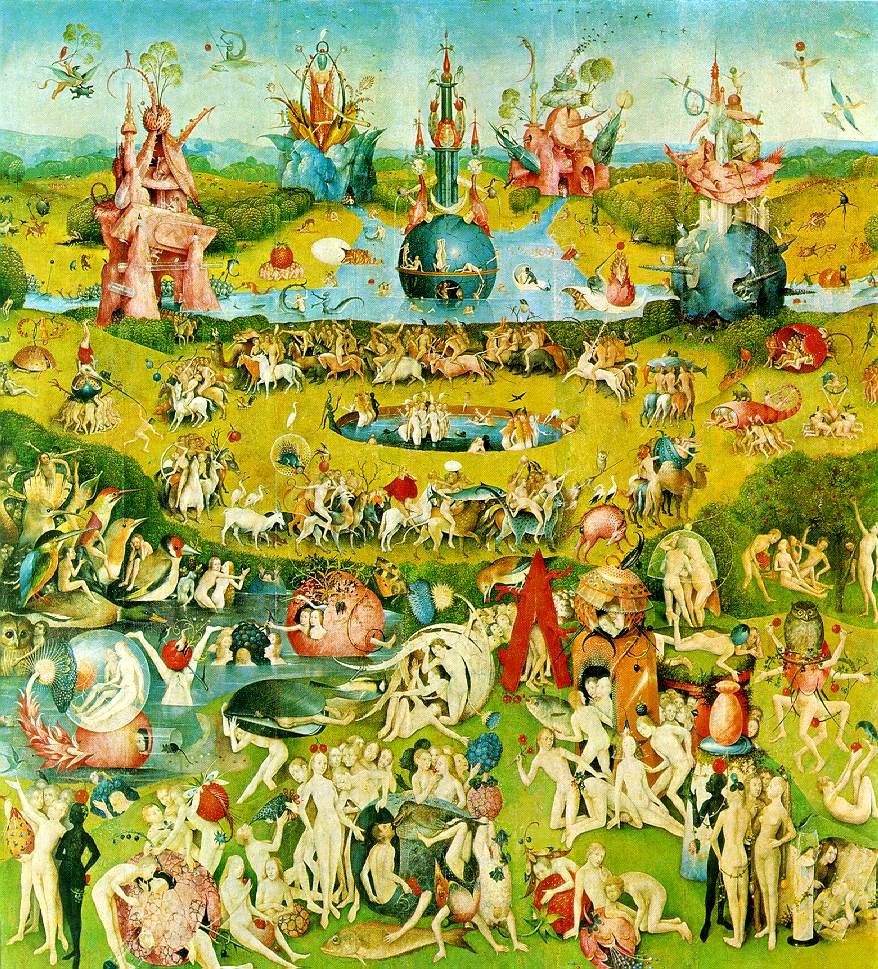 Gil Bailie reflects on the effects of probably the greatest flat earth surmise to date in his Cornerstone Forum post: Reflections on Faith and Culture: Honesty and Integrity.
Positive Mimetic Desire
The meditation from the Magnificat for Sunday August 5th is a glimpse into positive mimesis or healthy mimetic desire. Here is an excerpt from Elisabeth Leseur Selected Writings:
(Aramis here) Our freedom (positive mimetic desire) comes in an obedience to desire - desire here meaning a compulsive preoccupation with God - only what God wills for us. We, on the other hand, may see ourself in a certain good work or we may be fixated to see ourself in a marriage, but if this sight comes out of a compulsive preoccupation with others (negative mimetic desire), even though these things may have honorable intentions attached to them, we must acknowledge that it may not be what God desires for us. The disciples asked Christ, "Where do you abide?" And Christ answered, "Come and see." Come and see, through prayer and worship, what God desires so that when you are revealed in Christ, you are uniquely His.
This is the path most of those in the communion of saints followed to heighten their religious sensibilities and strengthen their ontological density. When I think of St. Francis going to convert the Sultan, though he did not convert the Sultan, the very fact that he walked away with his life has always provided me with a sense of what Girard, Bailie, de Lubac and others must mean when they talk about ontological density - a faith so strong that even in facing enemies one is more Christ (a compulsive preoccupation with God) than oneself (a compulsive preoccupation with others ).
My God, I belong and always wish to belong to you, in suffering or in pain, in spiritual dryness or in joy, in illness or in health, in life or in death. I want only one thing: that your will be done in me and by me. More and more I seek, and desire to seek, only one end: to promote your greatest glory through the accomplishment of your desires for me.
I offer myself to you in wholehearted interior sacrifice and ask you to dispose of me for your service as the most common, most useless instrument, in favor of those you love. Make me either passive or active, practicing in turn and as the hour requires the contemplation I love best and other good works according to your will.
Let me always be strict with myself, more gentle, loving, and helpful to others, to make you loved through me, always hiding my efforts, prayers, and mortifications. Make me very humble and draw my heart to yours, my beloved Savior and God.
(Aramis here) Our freedom (positive mimetic desire) comes in an obedience to desire - desire here meaning a compulsive preoccupation with God - only what God wills for us. We, on the other hand, may see ourself in a certain good work or we may be fixated to see ourself in a marriage, but if this sight comes out of a compulsive preoccupation with others (negative mimetic desire), even though these things may have honorable intentions attached to them, we must acknowledge that it may not be what God desires for us. The disciples asked Christ, "Where do you abide?" And Christ answered, "Come and see." Come and see, through prayer and worship, what God desires so that when you are revealed in Christ, you are uniquely His.
This is the path most of those in the communion of saints followed to heighten their religious sensibilities and strengthen their ontological density. When I think of St. Francis going to convert the Sultan, though he did not convert the Sultan, the very fact that he walked away with his life has always provided me with a sense of what Girard, Bailie, de Lubac and others must mean when they talk about ontological density - a faith so strong that even in facing enemies one is more Christ (a compulsive preoccupation with God) than oneself (a compulsive preoccupation with others ).
Tears of a Clone - When There's No One Around?
 At Play in the Lab of the Lord
Phyllis Zagano, a reputable source and concerned educator, points a bright light into the darkness of the gnostic alchemy of cloning in the Kansas City Star.
Dr. Zagano, Senior Research Associate-in-Residence at Hofstra University, also once held the Aquinas Chair of Catholic Studies at St. Thomas Aquinas College.
In the article, she points out, "Both so-called therapeutic and interspecies cloning — in China, in South Korea, in Spain — are floating toward North America. How has the world become so foolish about creation? Is the United States next to ride this dangerous wave?"
Saturday, August 04, 2007
War Time Lexicon

Sunday, Bloody Sunday
 Michael Joseph gives us a blow-by-blow comparison of the Prez's version vs. Bono at Vox Nova. Choice, very choice.
Friday, August 03, 2007
Ontological Density cont.


Excuse this over-simplification...the difference between existence and being
Descarte - I think, therefore I am
verses
Buber's I-Thou Relationship
The following excerpt is from tape 6 The Gift of Self by Gil Bailie:
"We all exist, we wake up one fine day and we look down, there we are, we look around and there is the world, we are aware that we exist, we have reflective self consciousness. That is existence. But there is something else and that is being... The biblical tradition – 3000 plus years of tradition – speaks almost unanimously on this matter and it says that we are called into being. We may exist waking up, blink our eyes and there we are, that is existence. But we are called into being, and it is only in response to that call that we really experience being. Martin Buber says, “Real existence or being is comprehensible only in connection with the nature of the being with whom one stands in relation.” Buber writes later on, “He who ceases to make a response (to this call) ceases to hear the Word.”
(Gil) So when we cease to make a response and we cease to hear the Word then what gradually begins to happen is the loss of ontological density.
(Aramis here) Grasping the significance of our waning of ontological density - the separation from the call and therefore response to the call - helps one realize the importance to abide in the only True Source of Transcendence.
Couple Quotes Regarding Ontological Density
There may be no more important a task today then the study of our ontological density. (This post links to a previous one 6 Degrees to the Waning of Ontological Density.)
(Aramis here) (I grant the exceptions, however) There has hardly been a person raised in our modern societies that has this reference of the Other - of The Real Transcendence as in Jeremiah, Jesus or Paul. The modern question of whether one believes in God or not, points to this lack of urgency or reality of God in our world (demonstrating the waning of ontological density) and therefore we are not much more than walking shells today. Jung says “once man is cut off from the nourishing roots of instinct, he becomes the shuttle cock of every wind that blows….and nothing short of a catastrophe can bring him back to health.” (1945,201). Well Girard and Oughourlian tell us of the only 2 ways of restoring stability (health) and that is either: 1) through the false transcendence of the sacrificial and scapegoating mechanism which no longer works due to the biblical revelation; or 2) the Real Transcendence of the God who Christ revealed on the cross. I maintain that I must surrender my desire (compulsive, preoccupation with the other) so that I more readily re-present Christ in all my relations.
(Aramis here) Now this man has ontological density! I don't think we comprehend the magnitude of scandal in this world with so many of us operating with paper thin ontological density - representing little or no attention spans, ultra short fuses, and knee-jerk reactionary responses to any suggested alternative to a primative sacred. The friend who de Lubac paints us a portrait of in the above quote should be a role model for us to imitate.
tip of the hat to Gil Bailie and his tape series The Gift of Self - tape 5.
“Every being is more than itself. All things are related to a reality above and beyond themselves. From this reference alone can they be perfected and carried to fulfillment. Failing their reference to the Other all things, all orders of reality, become empty shells.”
Romano Guardini
(Aramis here) (I grant the exceptions, however) There has hardly been a person raised in our modern societies that has this reference of the Other - of The Real Transcendence as in Jeremiah, Jesus or Paul. The modern question of whether one believes in God or not, points to this lack of urgency or reality of God in our world (demonstrating the waning of ontological density) and therefore we are not much more than walking shells today. Jung says “once man is cut off from the nourishing roots of instinct, he becomes the shuttle cock of every wind that blows….and nothing short of a catastrophe can bring him back to health.” (1945,201). Well Girard and Oughourlian tell us of the only 2 ways of restoring stability (health) and that is either: 1) through the false transcendence of the sacrificial and scapegoating mechanism which no longer works due to the biblical revelation; or 2) the Real Transcendence of the God who Christ revealed on the cross. I maintain that I must surrender my desire (compulsive, preoccupation with the other) so that I more readily re-present Christ in all my relations.
“I knew a man, a priest, who spoke in almost the same tone in his room, in a church, in a lector hall. Who expressed himself in almost the same terms whether before little children or among philosophers. Who said the same things to the infidels or our modern society, to pagans from the far-east and to the faithful. In his discourse, which never attained eloquence, the machinery of proof was always reduced to a minimum. There was no debate. It was as free before strangers as in a group of intimate friends. His politeness, exquisite by the way, ignored the conventional pleasantries. Never a man, in a sense, who was less adapted, but this man was all things to all men and of his plentitude everybody partook.”
Henri de Lubac
tip of the hat to Gil Bailie and his tape series The Gift of Self - tape 5.
Faith the Center of All Things
 Commentary from Magnificat: I have not come to call the righteous to repentance but sinners. (Lk 5:32) The most difficult part of ongoing conversion is admitting that we really are sinners and allowing God to see and forgive us as we are, with all our faults unmended and all our flaws showing, especially the ones over which we seem to have no control.
Meditation of the Day
Faith the Center of All Things
I believe it is important to acquire a fresh awareness of the fact that faith is the center of all things – “ Fides tua te salvum fecit,” the Lord said over and over again to those he healed. It was not the physical touch, it was not the external gesture that was operative, but the fact that those sick people believed. And we too can only serve the Lord energetically if our faith thrives and is present in abundance.
In this context, I want to emphasize two crucial points.
First, faith is above all faith in God. In Christianity it is not a matter of an enormous bundle of different things; all that the Creed says and the development of faith has achieved exists only to make our perception of the Face of God clearer. He exists and he is alive; we believe in him; we live before him, in his sight, in being with him and from him. And in Jesus Christ, he is, as it were, with us bodily.
To my mind, this centrality of God must appear in a completely new light in our thoughts and actions.
Futhermore, this is what enlivens activities which, on the contrary, can easily lapse into activism and become empty.
This is the first point I want to stress: faith actually, looks to God with determination and thus impels us to turn to look to God and set out toward him.
The other thing concerns the fact that we ourselves cannot invent faith, composing it with “sustainable” pieces, but we believe together with the Church. We cannot understand all that the Church teaches, nor must all of it be present in every life.
Yet it is important that we are co-believers in the great “I” of the Church, in her living “We,” and therefore by find ourselves in the great community of faith, in that great subject in which the “You” of God and the “I” of man truly touch each other; in which the past of the words of Scripture becomes the present, times flow into one another, the past is present and, opening itself to the future, all into time the brightness of eternity, of the Eternal One.
This complete form of faith, expressed in the Creed, a faith in and with the Church as a living subject in which the Lord works: it is this form of faith that we must seek to put truly at the heart of our endeavor.
Pope Benedict XVI was elected to the See of Saint Peter in 2005.
tip of the hat to Doctors of the Catholic Church and to Magnificat.
Tuesday, July 31, 2007
6 Degrees to the waning of Ontological Density

Excerpt from tape 3 The Gift of Self by Gil Bailie:
Lack of ontological density means a self that is insubstantial and it is seeking in self-defeating ways some way of substantiating itself. There are 2 ways of substantiating the self: 1) that way that perfectly parallels the cultural system that generates false transcendence; and 2) the experience of true transcendence. The false transcendence is generated out of the sacrificial scenario and true transcendence corresponds with prayer and the God revealed by Christ on the Cross – which can never be the false transcendence because it is the God of the victim and not the victimizers. The god of the victimizer is the false transcendence.
There is a psychological parallel to this: real ontological density is what the prophets experienced; it is what Jesus extremely experiences when he said, I do nothing but what the Father bids me to do and the Father and I are One. This is supreme ontological density. Prophets, mystics, saints, the humble faithful, etc, etc have partaken of that ontological density, to one degree or another, at the heart of it is real transcendence. The simulated form of ontological density is the desire of others – if I can get enough others to desire me or to admire me – even to hate me – I can feel that I exist. A simulation of ontological density is generated socially by somebody putting herself or himself in the eyes of others.
For tape 3 excerpts click here.
For me, Aramis, I have to admit, this point has become more and more obvious. I have become more aware of some people who are close to me who have little ontological density - basically they rely on being a 'character' seeking approval anywhere they can find it. Some have been diagnosed and take medications and some live on the edge - only a short fuse from blowing up. Logic and reason do not strengthen dialogue nor relationships with them and so I end most days down on my knees in prayer for them.
Hilaire Belloc - Warning
Counselor Gen over at Real Clear Religion gives her readers a fine sample from the historian Hilaire Belloc's prescient warnings regarding the disintegration of Christianity and the resurgence of the Crescent here.
The Gift of Self - Gil Bailie - tape 3 excerpt
Quote from Rene Girard:
“Desire (compulsive, preoccupation of the other) leads to madness and death if there is no victimage mechanism to guide it back to 'reason' and to engender this 'reason'. The mysterious link between madness and reason takes on a concrete form.”
Gil comments: The mysterious link between madness and reason is that “reason” is gemmed up out of the sacrificial (scapegoat) scenario. Reason always needs differences and the sacrificial crisis or the crisis of the contagion of desire destroys all differences and therefore makes reason impossible. There can be no reasoning going on in a world where there are no differences. Reason always needs distinction and the dissolution of all those distinctions is what occurs in crisis of undifferentiation – the crisis of desire – or what is brought about by an avalanche of mimetic desire.
...
Gil continues
...desire (compulsive, preoccupation of the other) leads to madness and death if there is no victimage mechanism to restore reason; and now there is no victimage mechanism to restore reason; so the old logos – the old forms of knowledge (epistemology) is dying – it cannot function because the apparatus for generating its necessary distinctions out of the undifferentiated chaos of an avalanche of desire – it doesn’t work anymore. So less and less are we able to put-to-work the old epistemological strategies.
Read more excerpts from tape 3 here.
The following is a thought of Aramis: With the dying of the old logos - the waning of the old epistemological strategies, if you will, means that as we continue to argue and debate within this knowledge base the more and more we will be falling into mimetic doubles and scandal. There is only one way out and that is by abiding in prayer, being a reflection of Christ to and for the other - for without transcendence, knowledge, even knowledge that reveals the problems of desire is useless and it can only lead to rivalry and violence in an attempt to re-kindle the victimage mechanism.
Italian Elvis Priest - Is he real or is he Altar-native Rocker?
To God be the Glory by Antoniu Petrescu & Cecilia Hwang
The music starts 2:48 into this video clip.
If you are not sure what you just watched, check this site out.
And if Italian does not stump you, click here for his web page.
This one, Antoniu Petrescu - Elvis tribute -An American Trilogy - live,
is almost over-the-top.
tip of the hat to Dawn
The music starts 2:48 into this video clip.
If you are not sure what you just watched, check this site out.
And if Italian does not stump you, click here for his web page.
This one, Antoniu Petrescu - Elvis tribute -An American Trilogy - live,
is almost over-the-top.
tip of the hat to Dawn
Monday, July 30, 2007
Quote of the Day -- Henri de Lubac
-- from Paradoxes of FaithWe do not know what man is, or rather, we forget. The farther we go in studying him, the greater our loss of knowledge of him. We study him like an animal or like a machine. We see in him merely an object, odder than all the others. We are bewitched by physiology, psychology, sociology, and all their appendages.
Are we wrong, then, to pursue these branches of learning? Certainly not. Are the results bogus, then, or negligible? No. The fault lies not with them, but with ourselves, who know neither how to assign them their place nor how to judge them. We believe, without thinking, that the 'scientific' study of man can, at least by right, be universal and exhaustive. So it has the same deceptive - and deadly - result as the mania of introspection or the search for a static sincerity. The farther it goes, the more fearful it becomes. It eats into man, disintegrates and destroys him.
Girard in the Public Square
Chris Morrissey alerts to this well-written piece on religion and Girard in Prospect.
Interview with an Exorcist
 Saint Francis exorcised demons in Arezzo -- Giotto
Sunday, July 29, 2007
William Holman Hunt - PRB
 The Finding of the Saviour in the Temple (1860)
Every year his parents went to Jerusalem for the Feast of the Passover. When he was twelve years old, they went up to the Feast, according to the custom. After the Feast was over, while his parents were returning home, the boy Jesus stayed behind in Jerusalem, but they were unaware of it. Thinking he was in their company, they traveled on for a day. Then they began looking for him among their relatives and friends. When they did not find him, they went back to Jerusalem to look for him. After three days they found him in the temple courts, sitting among the teachers, listening to them and asking them questions. Everyone who heard him was amazed at his understanding and his answers. When his parents saw him, they were astonished. His mother said to him, "Son, why have you treated us like this? Your father and I have been anxiously searching for you." "Why were you searching for me?" he asked. "Didn't you know I had to be in my Father's house?" But they did not understand what he was saying to them.
Catholic Education Resource Center Concern
Catholic Education Resource Center features an article by Charles Colson. It is a warning regarding the "Local Law Enforcement Hate Crimes Prevention Act of 2007." Our friend, Gil Bailie, blogged on the same concern back in May here (WARNING: graphic idiocy depicted).
When less than 2% of the U. S. population sways legislative and the judicial branches of government to this relativist nonsense -- be in constant prayer.
When less than 2% of the U. S. population sways legislative and the judicial branches of government to this relativist nonsense -- be in constant prayer.
Sunday Night Live with Fr. Benedict Groeschel
Another good one. Can be dowloaded directly here on audio.
Pope Benedict's book, Scripture scholarship, the Historical/Critical method, devotion, and other stuff. Given to a large audience at EWTN's Family Celebration. Worth a listen!
Pope Benedict's book, Scripture scholarship, the Historical/Critical method, devotion, and other stuff. Given to a large audience at EWTN's Family Celebration. Worth a listen!
"Ordinary Christians"
 From rather arid, parched Protestant familial Indiana, I, Athos, am enjoying a pre-sacramental fast before the sun rises this 17th Sunday in Ordinary Time. I am reading from Tolkien – A Celebration, edited by Joseph Pearce. In one of the essays, Tolkien is quoted from an essay he presented in honor of Charles Williams. His words, I think, counter one of the greatest criticisms I hear leveled at the Catholic Church; namely, the old saw about "old men who won't relinquish power." Tolkien, for all of his scholarly awards and fiction notoriety, always considered himself only an "ordinary Christian." Perhaps this is the reason why:
...in God's Kingdom the presence of the greatest does not depress the small. Redeemed Man is still man. Story, fantasy, still goes on, and should go on. The Evangelium has not abrogated the legends; it has hallowed them, especially the "happy ending". The Christian has still to work, with mind as well as body, to suffer, hope, and die; but he may now perceive that all his bents and faculties have a purpose which can be redeemed. [71]
Our "ontological substantiation" comes from participating and assisting in the Most Blessed Sacrament of the Holy Eucharist. It is the "source and summit" of the Catholic Church; it is the headwaters of all grace to the many Christianities downstream of Her; it is the greatest treasure for all who cherish the Church that Jesus Christ founded for us and our salvation.
"Ordinary Christians" is a noble title. There is none nobler in the realm of God's Kingdom of light and life.
Friday, July 27, 2007
Europe's Changing Skyline

The mythologist Joseph Campbell (Hero With a Thousand Faces) once said in his popular interview with Bill Moyer that the height and size of buildings tell the values of a culture. Thus, the cathedral in the Middle Ages stood tall with other buildings like baby chicks clustered around them. Then the great buildings of commerce of the Medici's told of a far different value. And now …
Watch, Laugh, and Learn
For those who missed them, and don't like to go into "Scroll Down Purgatory" as far as the Black Family Vault at Gringotts Goblin Bank, here is the website for the superb catechetical series, That Catholic Show.
Another Great Journey Home Testimony
from a young hedonist turned priest. It may be up for a few more days. Go to EWTN's siteand pull down the Multimedia menu to Archived Video. Select Journey Home on the secondary menu on the right.
Thursday, July 26, 2007
Find Yourself Packing It On? Blame Friends
We get it yet we don't get it! After being made aware of Girard and mimetic theory little exercises like reading the paper becomes a whole new experience. See the following article here and re-member Girard's term 'desire' - compulsive preoccupation with the other(s). But alas, you get to the end of the article and see how 'science' bogs down under its own weight.
Interesting how the headline writer follows the Girardian/MT progression from desire to scapegoating (and you know where it goes from there...).
Also check out the link Can Obesity Spread? When you go to link a page comes up with a video and the title, "Is obesity Contagious?
We get it yet we don't get it!
 Click here (wait a few seconds for it to activate) for an interesting display on OBESITY Trends in America.
Wednesday, July 25, 2007
Quote of the Day - Henri de Lubac
 If man could enter inside himself and have a vision of himself both penetrating and sincere, simple and straightforward, he would no longer dare take refuge in all the alibis of psychological and sociological analysis. He would no longer dare to imagine that anything which is not the changing of his heart by a Stronger than He can ever free him. – Cardinal Henri de Lubac (1896-1991)
Henri de Lubac page with a listing of his books translated and published by Ignatius Press.
Jesus of Nazareth - His Dance
CONNECTING THE DOTS
Athos tagged me and so as I was collecting my thoughts on Jesus I went back to reviewed Pope B16's book, Jesus of Nazareth. What a treasure this book is: speaking on the parable of The Good Samaritan, page 198-199;
"The topical relevance of the parable is evident. When we transpose it into the dimensions of world society, we see how the peoples of Africa, lying robbed and plundered, matter to us. Then we see how deeply they are our neighbors; that our lifestyle, the history in which we are involved, has plundered them and continues to do so. This is true above all in the sense that we have wounded their souls. Instead of giving them God, the God who has come close to us in Christ, which would have integrated and brought to completion all that is precious and great in their own traditions, we have given them the cynicism of a world without God in which all that counts is power and profit, a world that destroys moral standards so that corruption and unscrupulous will to power are taken for granted. And that applies not only to Africa. We do of course have material assistance to offer and we have to examine our own way of life. But we always give too little when we just give only material things."WOW, just look at this: "Instead of giving them God, the God who has come close to us in Christ, which would have integrated and brought to completion all that is precious and great in their own traditions, we have given them the cynicism of a world without God in which all that counts is power and profit, a world that destroys moral standards so that corruption and unscrupulous will to power are taken for granted."
We have Girard's MT spelled out about as clearly as one can get. If we are NOT presenting ourselves, and our 'gifts', in the name of the Transcendent Other we will be coming in the name of the human other(s) which will inevitably work its way into ressentiment and lead to rivalrous situations, scapegoating and violence. On all levels of exchange; of interaction; of relationship this lesson is critical.
The idea of the human experience is totally wrapped up in relationship and we post-Christians have allowed ourselves to be distracted by all sorts of ‘desires’ – I mean here ‘desire’ from a Girardian perspective which is a compulsive, preoccupation with the others – that we have trivialized both, the human experience and relationship. As we have trivialized the human experience and relationship our substantiality – our ontological density wanes and we are prone to fall into greater and greater bouts of ressentiment, double-binds and scapegoating. In the long haul this scandalous spirit is what we pass on to others. So in the case of our aid detached from God to the people of Africa; they may receive a ‘good’ however, they will also assimilate that spirit of the human experience from which it is given.
There is no better way to examine our lifestyle, as recommended by Pope Benedict XVI in the quote above, then through the human experience of a relationship with Jesus who invites us into the life of the Trinity. To be able to enter into relationship with others may be what it means to be made in the image of God. “Relationship is at the heart of the Trinity” is a way of saying relationship is at the heart of who God is. To be in relationship with God is to be IN LIFE, inside the life of the Trinity. Some may say that outside of that relationship nothing exists, but think of it as the gnashing of teeth, because outside of that relationship we fall into this waning of ontological density which leads to ressentiment, rivalry and violence. Jesus, and the God of Abraham and Moses who raised him from the dead – revealing him as the Chosen One of God, and the Spirit of that resurrection let loose on the world is one way to describe the Triune God.
What does relationship look like? Do we see it as a procession characterized by order and dignity, formality, and logical progression? A dance, on the other hand, is joyous, spontaneous, and vital. The God of the Trinity imaged as dance is lively. In dance, life erupts in spontaneous celebration. God invites us into the dance of the Trinity, INTO LIFE!
In our holy history, throughout the Bible, in the life of the Church, in our own lives, we see a Triune God who invites, who crosses the dance floor, who takes us by the hand and draws us into the baptism dance of abundant life. We demur, we protest, we lack rhythm, and we even step on God’s toes. But God persists. The Triune God dignifies and reclaims us by compelling us to join the dance. (Michael A. Van Horn, Homily Service, Serving the Word, 6-2007, adapted)
But wait! Sermons all too often end there with some sentimental or romantic version of the dance. No, the DANCE brings us back to the two great commandments: 1) love God with your whole being and 2) love your neighbor; and so our part, no matter our awkwardness, is to always be inviting others into the DANCE.
Look at what we have here; God who exists in a perfect, tri-personal relationship is the image of the dance, what the Greek theologians have called perichoresis, [peri-CHOR-ee-sis] that dance of the Triune God. But this dance is not merely a description of the Godhead. This dance also describes our participation in the divine life: God invites us to join in the dance, enticing the whole world to enter into the holy life, the holy dance, the holy relationship of Trinity. However if we bring scandal to the relationship through our desire – through a negative compulsive, preoccupation with the other, then we are breaking from the dance – breaking from the relationship with the transcendence and tumbling down into ressentiment and rivalry.
Are we giving too little of ourselves in the way we have attempted to bring relief to our sisters and brothers in Africa? Giving of ourselves and our material aid – giving in this spirit of dance - in relationship is what the Church and particularly Pope Benedict XVI is prescribing and it is in this spirit of relationship that we grow in substantiality – in ontological density. And this spirit of relationship acts as a wave of faith, hope and love to envelope other relationships – other cultures and here we begin to envision true peace – the New Jerusalem can be seen descending from heaven to earth (Revelation 21:1-4; Revelation 22:1-3).
 When I googled "perichoresis dance" this Rublev icon of The Trinity came up most frequently. So I end with how Gil Bailie closed his post Abraham, the father of faith which was a reflection on this same icon:
As the German poet, Rilke, said at the conclusion of his poem, Archaic Torso of Apollo:
. . . there is no place on it
that does not see you. You must change your life.
Tuesday, July 24, 2007
BBSD +
 I found this exquisite image at a blog I have not visited before, Anita Moore's V for Victory!.
Jesu, joy of man's desiring
Holy wisdom, love most bright
Drawn by Thee, our souls aspiring
Soar to uncreated light
Word of God, our flesh that fashioned
With the fire of life impassioned
Striving still to truth unknown
Soaring, dying round Thy throne
Through the way where hope is guiding
Hark, what peaceful music rings
Where the flock, in Thee confiding
Drink of joy from deathless springs
Theirs is beauty's fairest pleasure
Theirs is wisdom's holiest treasure
Thou dost ever lead Thine own
In the love of joys unknown
Sunday, July 22, 2007
Tagged - Loving Jesus +
 Gen over at Real Clear Religion recently "tagged" me to respond to the "Christ Meme". The rules are as follows:
Those tagged will share 5 things they love about Jesus and must tag 5 other bloggers. Those tagged must provide a link in the comments box here with their name so that others can read them.
I have seen this "Christ Meme" elsewhere, and I doubt that there are five bloggers left who have not been so tagged, but first things first: 5 things I love about Jesus (that are hardly original):
(1) Jesus gave us a human face. The Torah was not enough, the prophets weren't enough. We needed the "Word made flesh" [John 1,14] in order to engage in positive mimesis and "catch", or better yet, fall in love with the God Who first loved us; and our neighbor as ourself.
(2) Jesus gave us full proof of God's love for us in that He went to the horrible center of human sin, offered Himself up there "for all time a single sacrifice for sins" [Hebrews 10,12], and showed once and for all that it was not God's nature that was bloodthirsty. Rather, it is the nature of fallen humanity that is. His Resurrection (and its effects) the true vindication of God's nature; namely, that "while we were yet sinners, Christ died for us" [Romans 5,8].
(3) Jesus did not leave us with a fading memory of a hero; He gave us His "one holy Catholic and apostolic Church" and a faithful Vicar to shepherd us through the ages. In the "source and summit" of the Catholic Church, the Holy Eucharist, we are given His body, blood, soul, and divinity -- the Real Presence of Our Lord -- in this eternal sacrifice of the Mass. In the Sacraments Jesus through His Church provides all that every human being on earth needs to get to Heaven.
(4) Jesus gives us His Mother to be our Mother, and she, His perfect disciple, points us toward her Son. The Marian Church is not over against the Petrine Church; they are one and the same for all eternity.
(5) Jesus, the Second Person of the Most Holy Trinity (circling back to No. 1, above) shows us, reveals to us in Sacred Scripture, Sacred Tradition, and through the Magisterium how to live, die, and be born again into Trinitarian life with the one, true God. Through infused grace, we can take part in obeying the Two Great Commandments (Love the LORD your God with all your heart, soul, mind, and strength; and love your neighbor as yourself) through the theological virtues of faith, hope, and charity. His law of love is perfect freedom.
Now, I tag:
(1) Aramis, my fellow Mass'keteer
(2) The Fair Maiden Dawn Eden
(3) The Musical Monkster
(4) Henry Karlson, and
(5) YOU, gentle reader ...
Saturday, July 21, 2007
Daughters of St. Paul
Two more beautiful videos after Porthos gifted us with Angelus
Regina Coeli (Latin Easter chant)
Corpus Christi
Comments from Singingsisters about this second video:
Eucharistic procession from Chicago's Holy Name Cathedral, with background music sung by the Daughters of St. Paul ("O Sacrum Convivium," from the album "Adoration").
Translation of Latin hymn follows.
O Sacred Banquet,
in which Christ is consumed,
the memory of his passion is recalled,
the mind is filled with grace,
and a pledge of future glory is given to us.
Alleluia!
(Antiphon to the Magnificat, Liturgy of the Hours, Evening Prayer II of the Feast of the Body and Blood of the Lord.)
One Thing Needful +
 Luke 10:38-42
Jesus entered a village
where a woman whose name was Martha welcomed him.
She had a sister named Mary
who sat beside the Lord at his feet listening to him speak.
Martha, burdened with much serving, came to him and said,
“Lord, do you not care
that my sister has left me by myself to do the serving?
Tell her to help me.”
The Lord said to her in reply,
“Martha, Martha, you are anxious and worried about many things.
There is need of only one thing.
Mary has chosen the better part
and it will not be taken from her.”
Gil Bailie - "Secular Sacraments"
From Gil Bailie, President of the Cornerstone Forum, a reflection on "Religious Freedom & (So-called) Tolerance":
Our greatest freedom, the freedom of religion and of conscience, is being challenged on all sides -- by Qur'an-mandated Islamic intolerance abroad as well as by homegrown "tolerance" vigilantes, who have elevated sodomy and abortion to the status of secular sacraments, and who consider Christianity's moral objections to these things to be indictable hate crimes.Read further …
Third Man Theme
Only three top strings left on a guitar I got at a used store, but I figured out how to play the The Third Man theme on those remaining strings. But I like the original better.
If I Can't Dance to It, It's Not My Jihad
A beautiful sentiment is expressed in this music video. No word yet from Osama bin Laden on it yet. After all, Jihadist fundamentalists believe all music is haram -- forbidden.
600 B.C., Huh?

You're going to like this if you receive unannounced visits from those wonderful bicycle-riding, clean-cut, white-shirt clad Mormon lads now and then. Carson Weber has a Mormon-stumper for you, and here it is. Enjoy!
The Church & Europe
John Allen on the Vatican’s changing relationship with Europe. Jimmy Akin distills it nicely here.
Fr. Groeschel and Fr. Cantalamessa on the Trinity
Fr. Raniero Cantalamessa, the Papal Preacher oft quoted by Athos and Aramis, is Fr. Groeschel's guest on Sunday Night Live. The topic is the Trinity. Download here.
Friday, July 20, 2007
Pope on Vacation 7-15-07
 Chick here and imagine walking in the mountains, rosary in hand, quiet all around...
From Father Z: "On the Italian SKY TG24 there is some unedited footage of the Holy Father on vacation in the Italian Alps. Nothing spectacular happens. We just see the Holy Father relaxed and interacting with some folks. You see something of his very gentle disposition, which I got to know when I worked in the Palazzo del Sant’Uffizio."
At the end of the video watch for the small child who reaches out for the cross.
Hat tips to Annunications - Michael Dubruiel and Father Z
Humility is the Word for the Day

When I read this in the Magnificat today it reminded me of the Mark Shea article that Athos posted here and how humility is such an important trait for us to have. I also think of this picture of St Clare holding up the Monstrance in defense of the monastery. She knew that it was not by her works that would save, but only by His Works. She emptied herself, rushed to Our Lord and presented Him to her enemies for protection. He must increase, but we must decrease. (Jn 3:30)
Meditation of the Day
A wise man said: The man who hides his fault cannot be saved, but the Lord has mercy on one who acknowledges his sin and repents. If you suffer injustice, the world will despise you. The Lord’s heart is set against the proud to humble them, and humility receives mercy forever.
If you take a humble role in all human affairs you will raise yourself above the rulers of the world. Let everyone see that you are really humble, and bow to others first as if they were the important ones. He who is renowned for his wisdom is humble among men, in spite of his wisdom and learning, and is wise in what he find in his spirit. Blessed is he who offers himself in everything he does, for he is raised above all.Those who make themselves humble for the Lord’s sake, and diminish themselves to the Lord, praise the Lord; and those who endure hunger and thirst for the Lord’s sake he will honor with suitable gifts.
Those who comfort others for his sake he will clothed in splendid garments, and those who are poor and in distress for his sake he will comfort with true riches…
The eyes of the Lord are on the humble: the prayers of the humble are heard as soon as they are spoken. Service and humility turn a human being into God on earth. Faith and mercy quickly lead to wisdom.
Blessed are those who for the love of the Lord plunge headlong into trials and troubles without anger or sadness; when they escape they soon reach safety in the harbor of the divinity, and through their good works come to God’s home and have rest from their troubles, rejoicing in their hope. Those who run the race of life in hope are not frightened by the trials on the way, nor do they cease from following it; on reaching the end of their course they see the Lord, and praise him for having saved from them perdition and from the many adversities they suffered in their ignorance.
John Moschus (+c.619) was a Byzantine monk and spiritual writer.


Thursday, July 19, 2007
An Important Clip, IMO
This link will take you to a short (28 +/- minute) video of a very well-spoken former Jihadist who no longer agrees with the "political ideology" of imposing sharia "upon the world."
Subscribe to:
Posts (Atom)