Wednesday, June 13, 2007

I once was lost, but now am found - Feast Day of St. Anthony of Padua


These words from John Newton seem to reflect a devotion similar to what many might pray to St. Anthony. We know Anthony as the saint to pray for lost items, yet he was gifted in many areas of life. It was by chance that Anthony was asked to preach for the friars at an ordination and it was then that they discovered one of his great gifts, that of preaching the Good News. Francis soon wrote to Anthony:
I Brother Francis send wishes of health to Brother Anthony, my bishop. It pleases me that you teach sacred theology to the brothers, as long as in the words of the Rule you "do not extinguish the Spirit of prayer and devotion" with study of this kind.
“(N)ot to extinguish the Spirit of prayer and devotion with study”…within this admonishment comes the view that in everything we teach we present it fully in the Spirit of prayer and devotion. Boy, how we have lost that in our schools, universities and, I am afraid, in many of our families. Let us lift up our prayers to St. Anthony today asking for help to see and speak everything through the Spirit of prayer and devotion.

Guys check out the basilica of St. Anthony. Click here to see more on St. Anthony

Why Shop @ a Farmers' Market

Narnia in the Meantime

A visitor @ Mark Shea's blog lifted up an apparent Catholic Narnia Fan Website (not that one needs be Catholic to love the land of us Puddleglum types).

Village Atheists

There are several prominent authors presently promulgating books regarding what they consider to be the idiocy of believing in God. Since it is a time-honored practice to consider one's opponent as a valuable voice in the low tavern of life, the Three Massketeers choose not to dismiss their wrong-headed opinions out of hand, much the way Professor Ransom considered MacPhee an invaluable member of the group gathered at St.-Anne's-on-the-Hill in Lewis's That Hideous Strength. (Yes, yes, modeled on Lewis's tutor who taught him syllogistic thinking: "I have no opinions!")

As resources, Michael Liccione suggests the follow ways for ”Dealing with Dawkins.”

[Tip: Amy Welborn]

Tuesday, June 12, 2007

The Other Musical Monk


It was inevitable. I mean, somebody had to do this . . .

Saint Eulalia + PRB

St. Eulalia - John William Waterhouse [1885] - The Tate Gallery, London

This painting earned Waterhouse, member of the Pre-Raphaelite Brotherhood, his election as an Associate of the Royal Academy. Waterhouse avoids manipulation by depicting the vulnerability of the dead saint, life "going on," and the ostensible power of the state in a now-peaceful moment after her martyrdom.

Prudentius says that the body of St. Eulalia was shrouded by a miraculous fall of snow when lying exposed in the forum after her martyrdom.

"A Spanish martyr in the persecution of Diocletian (12 February, 304), patron of the cathedral and city of Barcelona, also of sailors. The Acts of her life and martyrdom were copied early in the twelfth century, and with elegant conciseness, by the learned ecclesiastic Renallus Grammaticus (Bol. acad. hist., Madrid, 1902, XLI, 253-255). Their chief historical source is a Latin hymn of the middle of the seventh century by Quiricus, Bishop of Barcelona, friend and correspondent of St. Ildephonsus of Toledo and of Tajo, Bishop of Saragossa. This hymn, identical with that of Prudentius (Peridstephanon, III) for the feast of St. Eulalia of Merida (10 December, 304), was preserved in the Visigothic Church and has reached us through the Mozarabic Liturgy.

"There is no reason to doubt the existence of two distinct saints of this name, despite the over-hasty and hypercritical doubts of some. The aforesaid Quiricus of Barcelona and Oroncius of Merida were present at the tenth council of Toledo (656). The latter had already founded (651) a convent of nuns close by the basilica of the celebrated martyr of his episcopal city, had written a rule for its guidance, and given it for abbess the noble lady Eugenia. Quiricus now did as much for the basilica and sepulchre of the martyr of Barcelona, close to whom he wished to be buried, as we read in the last lines of the hymn. The inscriptions on many Visigothic altars show that they contained relics of St. Eulalia; except in the context, however, they do not distinguish between the martyr of Barcelona and the one of Merida. On an altar in the village of Morera, Province of Badajoz, we find enumerated consecutively Sts. Fructuosus and Augurius (Tarragona), St. Eulalia (Barcelona), St. Baudillius (Nimes, and St. Paulus (Narbonne). The Visigothic archeology of Eastern Spain has been hitherto poor in hagiological remains; nevertheless, a trans-Pyrenean inscription found at Montady near Béziers mentions a basilica dedicated to the martyrs Sts. Vincentius, Iñes, and Eulalia (of Barcelona). Until 23 November, 874, the body of the Barcelona bartyr reposed outside the walls of the city in the church of Santa Maria del Mar. On that date both the body and the tomb were transferred to his cathedral by Bishop Frodoinus. In memory of this act hehe set up an inscription yet preserved in the Muséo Provincial of Barcelona (no. 864); see also volume XX of Florez, "España Sagrada", for a reproduction of the same. Not long before this the martyr, St. Eulogius, having occasion to defend the martyrs of Cordova for their spontaneous confession of the Christian Faith before the Muslim magistrates, quoted the example of St. Eulalia of Barcelona, and referred to the ancients Acts of her martyrdom. Her distinct personality is also confirmed by the existence of an ancient church and monastery in Cordova that bear the name of the Barcelona martyr; this important evidence is borne out by the Mozarabic calendars examined by the learned Dom Ferotin." -- New Advent

Her Feast Day is February 12.

Monday, June 11, 2007

Fearsome, Faithful Living + Part 2

Athos' post Fearsome, Faithful Living + stirred in me a response that turned into something more than a mere comment - so I decided to post it here.

Dear Ath, beware that you and Monk do not fall into some kind of model/rival scandal. Pondering this post left me thinking about 3 great remarks from 3 great teachers:

1) Gil Bailie's comment from The Truth of the Cross tape, "The Gospel is like the Supreme Court. Let’s say that you are going to do something that is going to cost you many millions of dollars; however you are a little anxious that it is somehow against the law, or it might be unconstitutional. You go to the Supreme Court and say that we are going to do this and it is very expensive, is that unconstitutional? The Supreme Court will tell you that they cannot tell you because we cannot give advisory opinions. So they say, go spend your millions and if someone sues you, come back in and then we will tell you. The Gospel is the same way. It answers no idle questions. It answers no questions that are asked for merely curiosity sake. But it does answer questions that arise with urgency, and new questions always arise. When we are moved due to historical situations, because of existential situations, go to the Gospel and ask it, ask the Christ Gospel, to answer our needs, it will answer us, but we will have to come to it with that kind of need." and

2A) Model-Rival. Strictly speaking, if a model is a person in our immediate life setting (parent, authority figure, peer), then he or she is always potentially a rival. Likewise, a rival in this same immediate setting is always basically a model, although this may not be apparent to the subject. The model-rival is associated with an object of desire which the subject wants to obtain, but the important thing is not as much the object as the defeat of the model-rival. Continually putting oneself in situations of rivalry may be exhilarating if one is winning, but losing may lead to extreme depression. The situation becomes a crisis if the person is entrapped in a model-obstacle relationship.

2B) Model-Obstacle. The model-obstacle is someone or something over whom the subject cannot win, or in some cases it would be accurate to say that the subject will not allow himself to defeat the model/obstacle, for to achieve that would be to lose the model. All sorts of self-defeating behavior, including addictions (so well described in Dostoyevsky's writings), stem from this predicament. From the standpoint of the mimetic theory, it can only be understood in terms of the mimetic, interdividual character of human existence. The person in this predicament could be described as stumbling over or being blocked by the skandalon. The skandalon of the Gospels is a an obstacle or stumblingblock (the older meaning of "scandal" in English and French, from the Latin and Greek). The skandalon is associated with Satan. This is seen particularly, e.g., in the Gospel of Matthew. Jesus has spoken of his suffering, death, and resurrection, and Peter rebukes him for saying he will suffer and die. Jesus in turn rebukes Peter: "Get behind me, Satan! You are a skandalon to me... " (Matt. 16:23). That is, "you are a scandal, an obstacle, a hindrance to me." Here Satan, usually named as the personification of the mimetic model-obstacle, is "deconstructed" or "demythologized" in that Jesus uses the name to express the mimetic rivalry that obsesses Peter. Peter wants to identify himself with a worldly winner and in anger he begins telling his master what he can and cannot do. Something quite similar is reported concerning James and John, who ask to be Jesus's chief lieutenants when he comes into his glory (Mark 10:35-45; Matt. 20:20-28).
The preceding is taken from "The Girard Reader," edited by James G. Williams.

and 3) being a follower of the Franciscan way; once Brother Leo asked Francis what perfect joy is? Francis related that if, they, when wet, cold, and muddy, knocked on a convent door, and the porter refused to let them in but drove them away like a couple of thieves, beating them with clubs until they nearly died, "and if we endure all this so patiently, and think of the sufferings of Christ, the All-praised One, and of how much we ought to suffer for the sake of our love of him - O Brother Leo, mark thou, that in this is perfect joy."

Question: Prior to the Protestant rebellion would such wonderings (such as what constitutes legitimate "security" that you and Monk tossed around) have even entered the minds of anyone?

Sunday, June 10, 2007

Fearsome, Faithful Living +

From today's New York Times, what you need to know about what the Koran teaches regarding killing another human being, entitled Permission – The Guidebook for Taking a Life.

In a post, below, Monk from The Wacky Wannabee Musical Monk and I discussed what constitutes legitimate "security". It's only normal if one is exercising any concern for oneself and one's loved ones that we try to size up potential areas of danger ahead, and avoid them (walking in Central Park or on the Washington Mall in deserted, shadowy places sans visible people, etc.). But in reality, it is nearly impossible to take into account all such contingencies.

In C. S. Lewis's second book of his Space Trilogy, Ransom is on Perelandra (Venus, in the Massketeers' Guide to the Galaxy). Lewis tells how his hero made his way through the treacherous caverns of Perelandra: at one moment taking what would appear (if watched by an observer) overmuch caution, at another extreme risks, because he himself could not see but was climbing by feel alone.

In my opinion (in the same way that Saint Paul will occasionally step aside in the Epistles and say, "Now this is my opinion -- Paul" when not proclaiming the Gospel) -- this is Athos speaking now -- we must do three things in the face of such realistic threats:

(1) Not succumb to hate. We must pray for our enemies, as Our Lord commands [Mtt 5,44], and never willingly give in to "righteous" anger. Love [caritas, agape] is a decision. Like top-spin in ping-pong, it takes all the side-spin of evil off the ball served to us. Through God's grace, we choose not to return evil for evil. I will suggest a method for such prayer in the first comment (below).
(2) Exercise legitimate defense. The Catechism of the Catholic Church is clear: "Love toward oneself remains a fundamental principle of morality ..." (Remember, "Love your neighbor as yourself?") and "The defense of the common good requires that an unjust aggressor be rendered unable to cause harm." (Nos. 2264, 2265) This is posited on justice as Saint Thomas Aquinas understood it: to give what is due to God and to our neighbor; namely, what is right for the common good. This is perfectly in keeping with honoring and loving our aggressive "enemy" -- one wants to keep the enemy from carrying out unjust evil and violence, even if the enemy is accidentally injured or even killed in so doing (No. 2264).
(3) And, perhaps the most important point, do not provoke a potential enemy into aggressive and sinful behavior. This is scandal, and constitutes grave sin. Again, the Catechism:
Scandal is an attitude or behavior which leads another to do evil. The person who gives scandal becomes his neighbor's tempter. He damages virtue and integrity; he may even draw his brother into spiritual death. Scandal is a grave offense if by deed or omission another is deliberately led into a grave offense. (No. 2284) "Temptations to sin are sure to come; but woe to him by whom they come!" (Lk 17,1 in No. 2287).
So, as difficult as these days are, Our Lord gives us a viable path through them to Heaven by His grace: in seven wonderful words, prudence, justice, fortitude, temperance (the Cardinal Virtues), faith, hope, and love (the Theological virtues).

And keep your eyes on Jesus! As the old Gospel chorus said: Turn your eyes upon Jesus, Look full in His wonderful face. And the things of earth will grow strangely dim, In the light of His glory and grace. +

Embed Experiment: Zappa, Inca Roads


Not for everyone, this Zappa piece is nevertheless a brilliant composition, at least in Porthos' personal canon, especially the 2 1/2 minute guitar solo that starts 2 minutes in--one of the best and most searching guitar solos ever. Nice percussion and xylophone, too.

The breathless techno video presentation/message is well-done but not of interest to me--it's just that this is the only YouTube of the studio version of Inca Roads . . . I do not endorse the philosophy here, which for the most part is alien to me. (I hope the author who was nice enough to put it together does not mind that ungrateful reflection . . .)

Collapse of Europe Conference

It is great to know that our-man-on-the-scene, Gil Bailie, of the Cornerstone Forum, will be attending a conference on the collapse of Europe at Pepperdine University, Malibu. Participants will include Ayaan Hirsi Ali, Mark Steyn, Daniel Pipes, Avi Davis, James Q. Wilson, and a boatload of other top flight folk.

It's great to know Gil will be present. See his thoughts about the event here.

See for yourself what the conference will be about. And you might want to pray that security is beefed up today and tomorrow at Pepperdine ...

Fr Cantalamessa on Memory

ROME, JUNE 8, 2007 (Zenit.org).- Here is a translation of a commentary by the Pontifical Household preacher, Capuchin Father Raniero Cantalamessa, on the readings from this Sunday's liturgy.

* * *

Do This in Memory of Me
Solemnity of the Most Holy Body and Blood of Christ
Genesis 14:18-20; 1 Corinthians 11:23-26; Luke 9:11b-17

In the second reading of this feast, St. Paul presents us with the most ancient account we have of the institution of the Eucharist, written no more than about 20 years after the fact. Let us try to find something new in the Eucharistic mystery, using the concept of memorial: "Do this in memory of me."

Memory is one of the most mysterious and greatest powers of the human spirit. Everything seen, heard and done from early childhood is conserved in this immense womb, ready to reawaken and to dance into the light either by an external stimulus or by our own will.

Without memory we will cease to be ourselves, we will lose our identity. Those who are struck by total amnesia, wander lost on the streets, without knowing their own name or where they live.

A memory, once it has come to mind, has the power to catalyze our whole interior world and route everything toward its object, especially if this is not a thing or a fact, but a living person.

When a mother remembers her child, who was born a few days ago and is left at home, everything inside her flies toward her baby, a movement of tenderness rises from her maternal depths and perhaps brings tears to her eyes.

Not just the individual has memory; human groups -- family, tribe, nation -- also have a collective memory. The wealth of a people is not so much measured by the reserves of gold it holds in its vaults, but rather by how many memories it holds in its collective consciousness. It is the sharing of many memories that cements the unity of a group. To keep such memories alive, they are linked to a place, to a holiday.

Americans have Memorial Day, the day in which they remember those who fell in all the wars; the Indians have the Gandhi Memorial, a green park in New Delhi that is supposed to remind the nation who he was and what he did. We Italians also have our memorials: The civil holidays recall the most important events in our recent history, and streets, piazzas and airports are dedicated to our most eminent people.

This very rich human background in regard to memory should help us better understand what the Eucharist is for the Christian people. It is a memorial because it recalls the event to which all of humanity now owes its existence as redeemed humanity: the death of the Lord.

But the Eucharist has something that distinguishes it from every other memorial. It is memorial and presence together, even if hidden under the signs of bread and wine. Memorial Day cannot bring those who have fallen back to life; the Gandhi Memorial cannot make Gandhi alive again. In a sense, the Eucharistic memorial, however, according to the faith of Christians, does do this in regard to Christ.

But together with all the beautiful things that we have said about memory, we must mention a danger that is inherent to it. Memory can be easily transformed into sterile and paralyzing nostalgia. This happens when a person becomes the prisoner of his own memories and ends up living in the past.

Indeed, the Eucharistic memorial does not pertain to this type of memory. On the contrary, it projects us forward; after the consecration the people say: "We proclaim your death, O Lord, and confess your resurrection, until you come."

An antiphon attributed to St. Thomas Aquinas ("O sacrum convivium") defines the Eucharist as the sacred feast in which "Christ is received, the memory of his passion is celebrated, the soul is filled with grace, and we are given the pledge of future glory."

Saturday, June 09, 2007

The Good Earth


Tomatoes from the summer of '06. This is Lady Porthos' work, not mine, but I've got to bolster up my Agrarian creds to curry favor with Ath.

An additional Distributist contribution. (It's Eva, and not Zsa Zsa as previously reported in the comment boxes.)

Bush Speech in Prague

On freedom and tyrrany, addressing dissidents past and present.

via Hedgehog Blog via Powerline

Solemnity of the Most Holy Body and Blood of Christ +

Madonna with the Host - Jean-Auguste-Dominique Ingre (1780-1867)
Musee d'Orsay, Paris

Mika Nakashima Amazing Grace LOVEMIKA.NET

Great voice and wonderful piano. Sit back and close your eyes and enjoy. Afterwards, check out our new play list from the side bar.

The Hilton Diaries

"Lately I'm identifying with the Jews and all the horrible things that happened to them during Vietnam."

(Offered with mild Girardian guilt about celebrity scapegoating.)

Via Tim Blair

Sound the Retreat!


[Guesthouse - Holy Cross Abbey] Once every so often, I feel the need to make a silent retreat. Coming from a rather low church evangelical background (first the E. U. B. Church, then United Methodist), the very word "retreat" sounded like a failure of nerve, a backward movement in the face of an advancing enemy, a lack of resolve. It took a special go-between establishment called the Church of the Saviour and one of its mission fellowships, The Potter’s House, and its one-time spiritual director (1973-1976), Conrad Hoover, to show me otherwise.

A spiritual retreat is anything but a "backward movement." Yet another member of The Church of the Saviour, author Elizabeth O’Connor, wrote magnificently that as always Our Lord modeled the way we need to continue to carry out his ministry of reconciliation; namely, in a rhythm of active ministry and pulling back in prayer, contemplation, and reflection. This rhythm, the "journey inward and journey outward" keeps us from burn out, on the one hand, and navel-gazing, on the other.

At the same time that I was engaged in spiritual direction with Conrad, I was attending a monthly ecumenical book study led by two monks at Holy Cross Abbey, Berryville, Virginia, at the invitation of a fellow United Methodist pastor. In that monthly group of pastors and religious, we read the works of great Christian spiritual writers, among which were the works of Thomas Merton.

"Hmm," I thought, "this is a funny thing. Merton was a Cistercian. This Abbey is Cistercian. Ms. O'Connor and Conrad are recommending this 'retreat' notion and a 'journey inward, journey outward.' Means nothing to my background as a Protestant Christian. Maybe it's worth a try."

And so began a pattern in my life of going on retreat, nearly always at Holy Cross Abbey, for the past 27 years. And I highly recommend it to you, gentle reader.

Friday, June 08, 2007

Peter Kreeft (via Monk)

Musical Monk has pointed us to the work of Peter Kreeft. There is very good stuff to be found there.

Just thought I'd highlight the site in a main post rather than down in the comment boxes. Monk can't do that since he's not a 'Teer. Yet.

Fausta on the Dorian Graying of Media

Fausta posts on media coddling of human rights immorality. Via Pajamas Media.

At first I thought it was immortality. In fact, I thought it was "immortality" until I was 1/2 - 2/3 through the post.

My declining eyesight aside, who's to say this link won't prompt a visit from Fausta herself? Such things have happened. (Granted, she's a big shot blogger now.)

Charles Wild's "The Choir of Amiens Cathedral" (France)


Hat off to Daniel Mitsui

Oh, my! Amiens Cathedral

Hey guys, can our next retreat be in Amiens France?

Puts into Crisis the Wisdom of Men


Thanks to Amy Welborn

Continuing with the mystery highlighted with our post St. Norbert we bring you Pope Benedict's message during the Solemnity of the Body and Blood of Christ (Corpus Christi). Jesus' Incarnation and Presence “puts into crisis the wisdom of men”.

Calling the assembly’s attention to the miracle of the Eucharist, Benedict XVI noted that “when the priest proclaims after the consecration, ‘This is the Mystery of our faith!’ he proclaims the mystery just celebrated, and manifests his stupor in front of the substantial conversion of the bread and wine into the body and blood of the Lord Jesus, a reality which surpasses all human understanding.”


CRISIS -- c.1425, from Gk. krisis "turning point in a disease" (used as such by Hippocrates and Galen), lit. "judgment," from krinein "to separate, decide, judge," from PIE base *krei- "to sieve, discriminate, distinguish" (cf. Gk. krinesthai "to explain;" O.E. hriddel "sieve;" L. cribrum "sieve," crimen "judgment, crime," cernere (pp. cretus) "to sift, separate;" O.Ir. criathar, O.Welsh cruitr "sieve;" M.Ir. crich "border, boundary"). Transferred non-medical sense is 1627. A Ger. term for "mid-life crisis" is Torschlusspanik, lit. "shut-door-panic," fear of being on the wrong side of a closing gate.

The 'wisdom of men' is at crisis.

Mad Man in the Street

Mary Eberstadt on secularization and the decline of religion in Europe and the decline of the family.

Thursday, June 07, 2007

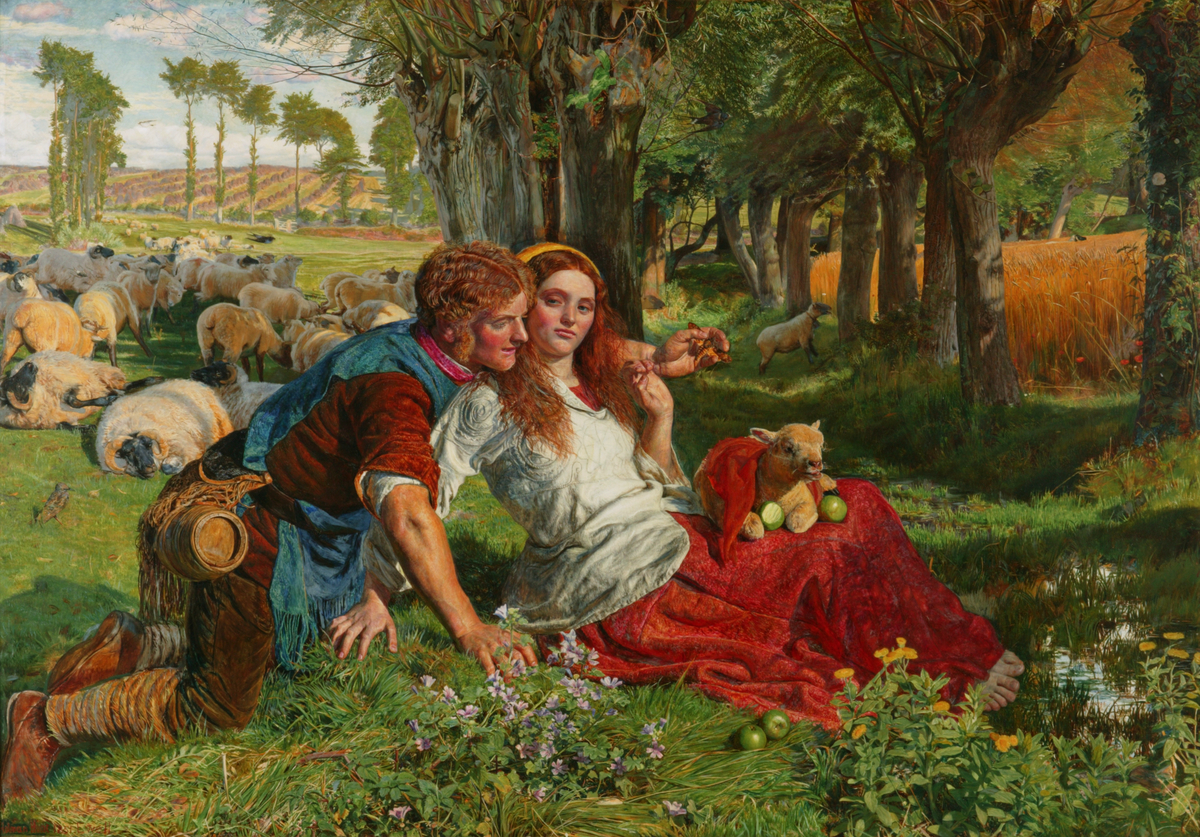
'The Hireling Shepherd'

William Holman Hunt (1827-1910)

The painting, The Hireling Shepherd, by Hunt is replete with biblical imagery [Cf. John 10:1-18]. Hunt brought together Rossetti and Millais and in all likelihood was the artist most responsible for the formation of the Pre-Raphaelite Brotherhood.

But it is interesting to note several other things about the PRB. First, they named themselves for someone -- or, more accurately, for a time period prior to someone, namely, the artist Raphael. Why go to the bother of cryptically calling yourself by a time period that preceded an artist when you happen to be aspiring artists living in England?

Look at the dates of Raphael. He was born in 1483 and died in 1520. Notice anything? Not yet?

Okay, then let's look at two other dates that juxtapose interestingly. First, the birth year of a man who would change western Christendom for better or worse, Martin Luther: 1483. And now a date by which this firebrand German monk would have set fire to dry tinder with such tracts as his Epitome in which he declared "that the true Antichrist is sitting in the temple of God and is reigning in Rome -- that empurpled Babylon -- and that the Roman curia is the Synagogue of Satan" [Will Durant, The Reformation: A History of European Civilization from Wyclif to Calvin: 1300-1564, 351].

Secondly, many themes of the PRB came lovingly from plays by William Shakespeare, who as I have posted recently, is attaining a measurable reputation for being a "papist" in post Reformation England.

Thirdly, in their own lifetimes, the PRB artists were castigated for painting themes that narrowly skirted accusations of being pro-Catholic Church. I will share these in future posts.

But the most important piece of evidence that the PRB was not merely a romantic sigh for a lost Medievalism, I think, is the first point above. It was the Brotherhood's agreement to cloak their identity in a kind of counter-Protestant Reformation mentality, artistry, and loyalty. It was just sufficiently obscure and forthright that a curious investigator could easily connect the historical "dots" but most would not.

I would be interested in knowing if others -- and probably much more scholarly than I -- have traced these pieces of evidence. I will happily bow to former and better research if that so happens.

Meanwhile, I like to think I have discovered why I love the Pre-Raphaelite paintings so much.

To learn more about Raphael please link to Artsy’s Raphael page.

What IS the Wrath of God?

One of the most profoundly misunderstood concepts among Christ's followers is that known as God's wrath. Here to help us is our friend, mentor, and pal of the Three Massketeers, Gil Bailie.

The following comes from Gil's taped lecture entitled, "The Mystery of History." For more opportunities to hear Gil speak, either in person or on CD/tape, go to his website linked above.
What is “God’s wrath?” Does Jesus reveal a wrathful God? It’s a very central question. Clearly John [of Patmos] is talking about the wrath of God. And clearly the crucifixion and resurrection represent a judgment; a very solemn one with enormous consequences. But how are we to reckon with this notion of the wrath of God?

I will suggest to you the following, not based on my suppositions or my speculation, but based on what I think is in John’s Apocalypse. We don’t realize how profoundly John is reinterpreting the Old Testament images and symbolism that he is using to express his Christian faith. We don’t realize how in concert the Book of Revelation is with all the other New Testament texts. You see, this has to be in concert with I Corinthians 13; this has to be in concert with the Gospels that speak of the mercy of God and that show us God incarnate in the One Who was constantly forgiving and bidding his disciples to turn the other cheek and go the extra mile. John’s Apocalypse has to be in concert with that. And it is, I think, read correctly.

What then is the wrath of God? I would say that the wrath of God is forgiveness. The wrath of God is forgiveness. Sin is its own punishment. Dante knew that. Surely God knows it. All we have to do is look around. Sin is its own punishment. It doesn’t need a shove from God. In the natural course of its transformation from heady self-assertion into dreary despair and alienation. Sin is deprived of all its consolations, save one: the sinner can sulk in the spiteful knowledge that his misery is imposed by a harsh and vindictive God. And he can curse God for condemning him to the hellish conditions in which he finds himself.

But when God forgives through Christ on the cross, then the sinner either accepts forgiveness or he rejects it and is forced to inhabit a hell whose doors stand wide open. And to be tormented thereby by the realization that the torment itself can be blamed on no one but himself. That’s hell. That is the wrath of God made possible by the revelation of God’s infinite mercy and forgiveness that Jesus brings to us. The wrath of God is God eliminating the notion of a wrathful God, and thereby condemning those who refuse forgiveness and cling to their sinful rebellion to the hellish torment of realizing that with one heartfelt mea culpa it could all be otherwise.

Franciscan Monks that Rock

Monks That Rock help spread the Good News to many young who otherwise may be dancing to a different tune.

Wednesday, June 06, 2007

Why I Am a Catholic - 6 Reasons

By KaterinaMaria:

Saint Norbert —1080-1134.


June 6 - St. Norbert

Norbert became archbishop of Magdeburg in central Germany, a territory half pagan and half Christian. In this position he zealously and courageously continued his work for the Church until his death on June 6, 1134.

On the occasion of his ordination to the priesthood, Norbert said,
"O Priest! You are not yourself because you are God. You are not of yourself because you are the servant and minister of Christ. You are not your own because you are the spouse of the Church. You are not yourself because you are the mediator between God and man. You are not from yourself because you are nothing. What then are you? Nothing and everything. O Priest! Take care lest what was said to Christ on the cross be said to you: 'He saved others, himself he cannot save!'"

As most of Europe withers away in indifference to the Christian Word, we pray that Pope Benedict XVI is able to turn the tide in Germany. Read about a saint who, in a distant past, did so much in converting the hearts and souls of Germany.

From American Catholic:
A different world cannot be built by indifferent people. The same is true in regard to the Church. Sad to say, the so-called updating of the Church has not engendered the different Church which was so devoutly and hopefully envisioned by Vatican Council II. A principal reason for this failure was—and is—the indifference of vast numbers of nominal faithful, their indifference to ecclesiastical authority and essential doctrines of the faith. Unswerving loyalty to the Church and fervent devotion to the Eucharist, as practiced by Norbert, will continue immeasurably towards maintaining the people of God in accord with the heart of Christ.

The Great God Debate

Following up on Athos' Hitch post below, the debate between Christopher Hitchens and Mark D. Roberts on Hugh Hewitt's show can be read in transcription or listened to here at Townhall (if you scroll around a bit).

I have not had a chance to read or hear it, and so can give no impressions yet.

Correction: Transcripts are not actually up yet, but you can still listen.

Tuesday, June 05, 2007

Spiritual Direction & the Pagan

Recently, Aramis and I had a discussion about spiritual direction and directors. As a recovering Jungian and former member of the C. G. Jung Society of Tidewater Virginia (in my "New Age Zen Methodist" phase of spirituality) I can vouch the number of persons who go asearching for transcendence in all the wrong places.

In the arid secularist times in which we live in the west, it is nearly inevitable that this will happen. René Girard's mimetic theory predicts with a high degree of probability that without the moral infrastructure and authentic transcendence provided by the Christian revelation, persons will slip into what he calls "the primitive sacred." Either by willful rejection of the teachings of the Church's Magisterium, that vouchsafes the deposit of faith in Sacred Scripture and Tradition, or by ignorance of the same, persons will re-enter the world of paganism. (The Old Testament prophets knew this perfectly well.) It is, as Nietzsche said a choice between Christ or Dionysus. There is no middle ground. Not for liberals. Not for conservatives.

In this knowledge, I penned a fictional form of catechesis entitled The Dionysus Mandate to show the multiple ways that people can find themselves sliding into "the primitive sacred." In the excerpt below, I depict two women religious who are well away from the safe-keeping of the Sacraments and well into the influence of the neo-pagan. A third woman riding with them is also a neo-pagan, but more seriously into an effort to re-institute the darker elements of pagan religion:

Mel noticed three women in a late model Swedish car. Two in the front seat seemed to exude attentiveness to their surroundings reminiscent of nuns from a parochial school. Mel flipped the page of his sketchbook and began a drawing of the threesome.

“Isn’t this divine? Did you just hear that man over there? He was saying he thought he saw a shark’s fin!” the younger woman in the front seat asked. She had short-cropped blond hair and a large, open, smiling face. “Ah! It’s so good to get away from the retreat center for awhile! I can’t think of anywhere I’d rather be than at the ocean.”

“Did you remind Father Edmund to use the Medicine Wheel with his parish group from Saint Gummarus?” the older woman asked.

The younger woman, Susanna Ruggieri, said, “I showed him around. They especially liked all the books we have on Jungian spirituality in the library. They’re big into the collective unconscious in that parish. You should have seen the envy on their faces when I told them we would be spending the eclipse conference with Father Luke Coyote!”

Her companion, Mary Fran Ugolino, a stylish woman of slighter build and silver hair, picked up a brochure. “’An Experience in Pre-Christian Transcendence and Gaia Consciousness,’” she read. “I spoke with Father Luke last Saturday evening. He made a point of saying he was looking forward to seeing me again.”

A copy of the former Catholic priest’s newest book, The Sacrament of Non-commitment: Open Marriages, Freedom and Love for Today, sat between them on the console. His frequent affaires de cœur with admirers of both sexes made for best seller material.

The third woman, in the backseat, seemed quiet and sullen. Her sunglasses and auburn-hair partially hid her expression from the enthusiastic women in the front seat. How did I ever get stuck with these idiots for a ride? she thought.

“Frederika!” Susanna said, turning quickly. “Be sure to register for the ‘Gaia Consciousness Workshop’ as soon as we get there! It will be tomorrow morning after Father Luke’s plenary address. I’ve heard we actually get to dance to songs taped during a voodoo ceremony!”

Frederika shifted and looked out the window, rolling her eyes. Gaia voodoo dancing, my sweet a**.

[32-33]

Dawn of a New Beginning - July 2, 2007

Athos posted on Dawn's new venture earlier (see here), however I think it deserves more fanfare. Not only will July 2 represent a new beginning for Dawn Eden, but you can bet she will be a great model and teacher for young people on many campuses throughout the country. Read about Dawn here, as she will be starting a new vocation as director of the Cardinal Newman Society's new Love and Responsibility program. Hey Dawn, we need to link you up with Gil Bailie and his Emmaus Road Initiative as well as he has a great retreat entitled: BODY LANGUAGE: The Word Made Flesh "Male and Female He Made Them."

We know that you will inspire a whole new generation of people. If there is anything we 3 Massketeers can do to help please let us know.

SAINT BONIFACE MARTYR, APOSTLE OF GERMANY—680-754 A.D.


June 5 - St. Boniface Feast Day

(In the year 718) The Pope (Gregory II) welcomed him warmly, kept him in Rome until spring of the following year, when traveling conditions were favorable, and then sent him forth with a general commission to preach the word of God to the heathen...

(3 years later) In Rome on St. Andrew's Day, November 30, 722, Pope Gregory II consecrated him as regionary bishop with a general jurisdiction over "the races in the parts of Germany and east of the Rhine who live in error, in the shadow of death."
To read of the struggles and success of Boniface link here.

Today we need to pray for another Saint Boniface and for a restoration of the soul of Germany and the rest of Europe. Though the following article is not the most current on Germany and Europe it addresses the problem pretty well. From the Boston Globe Catholic Church withers in Europe,
The Rev. Joseph Fessio, a professor at Ave Maria University in Naples, Fla., who in the 1970s studied in Germany under Ratzinger, said, ''The reason they aren't excited is because his whole country has lost its faith. Get the stats on births, the number of abortions, the divorce rate. The place is a disaster. Catholic Europe is dying because it has lost its soul. And it is too lost to even know that St. Benedict gave it a soul and that the new pope, Benedict XVI, is Europe's last, best hope to restore that soul."

Winfried Roehmel, director of the press office for the Archdiocese of Munich, said that about one-third of Germany is nominally Catholic. But he said fewer than 13 percent attend Mass with any regularity.
Lord, your martyr Boniface spread the faith by his teaching and witnessed to it with his blood. By the help of his prayers keep us loyal to our faith and give us courage to profess it in our lives. Grant this through our Lord Jesus Christ, your Son, who lives and reigns with you and the Holy Spirit, one God, for ever and ever.

The Thrill Chaste to DC

Big news, Washington, DC Metro folk. Author Dawn Eden has accepted the job of directing the Love and Responsibility program of the Cardinal Newman Society and will be moving to DC at the end of the month.

For any who missed it, Dawn breezed in a fortnight ago and convened a kaffeeklatsch for DC area bloggers.

Welcome, Dawn! (Time to buy your Smart Card.)

Monday, June 04, 2007

That Catholic Show - Charity 'n Mercy


[Tip: Amy Welborn]

Lasting Love

The Washington Post Metro section today reports on a beautiful occasion: 500 couples -- count'em, 500 -- couples coming together to renew their wedding vows. Not just after 2 years, or 10 years, but after (at least) 25 years of marriage. The paper reports that fully one-half of the couples present had been married for half a century.

The WHOLE STORY.

Sunday, June 03, 2007

The Bard in Times of Persecution - Today


As the official anarchists seem daily to increase the probability that traditional marriage and the family will be redefined into a state of limbo, one must ask how shall Catholics who hold firm to the Church's teachings and practices of faith and morals cope with the status of being outlaws on the one hand (from the viewpoint of the laws of the land) and the state of being the persecuted, on the other? That traditional marriage and the family are being lauded in this round of culture wars should not make one think formidable foes are not making headway in kicking down standards of faith and morals.

But before trying to address this difficult situation in which the majority lose the right to choose what is "for the people and by the people," let me say that it is not simply the Catholic families who will be facing perpetual coersion to accept, teach, and live diometrically opposed to their consciences regarding faith and morals. It will be also be persecution of persons who embrace orthodox Christian teaching, evangelical, mainline, fellowship, fundamentalist, of every ethnic group, race, and creed if such laws as this are enacted

How shall we live with integrity in what was once a Christian nation in a spiralling vortex of degeneracy? May I suggest that we open our English lit books to what is becoming more and more a fact about Catholics who lived during the (so-called) English Reformation?

In her book, Shadowplay, Claire Asquith joins a growing host of scholars who show that the Bard of Stratford not only died a "papist", but lived as one too. In a fine article in Godspy, one may read portions from Shadowplay. It is not for nothing that René Girard says that he learned much of what came to be mimetic theory by his close reading of Shakespeare. A remarkable examination of Shakespeare's understanding of the nature of kingship, power, violence, and human nature makes for extraordinarily entertaining and educational viewing in Looking for Richard by Al Pacino (that's right, Al Pacino).

Eamon Duffy, Professor of the History of Christianity at Cambridge has also shown that beyond what passed as "officially" acceptable behavior during the English Reformation did not destroy "Mary's dowry," Catholicism in England. (Do not neglect to read and subscribe to Saint Austin Review, especially the Jan./Feb. 2007 issue, ”The Quest for Shakespeare.”)

All persons who cherish the Judeo-Christian tradition that has brought so much dignity, truth, beauty, and goodness to the human race, revealed perfectly in the "Word made flesh" (Jn 1,14), and who do not want to see this tradition erased by yet another neo-pagan utopian project this time based on sexual politics and the persecution of Catholic truth, still have a great teacher in William Shakespeare.

Hitch vs. Hitch

Peter Hitchens' review of his brother's anti-Christian (and every other religion) book here.

Saturday, June 02, 2007

Will These Bones Live, O Man?

At Patum Peperium, "Father M" (he really is; he's heard my confession before) weighs in with this piece on relics in his blogging place of residence: Ex Ossibus.

What's the deal with relics in the Catholic Church? New Advent has a fine introduction here.

But without a doubt, Fr. John Zuhlsdor gives us a most beautiful article relating realities of life, death, bones, relics and the resurrection in his The Bones of Augustine. Read and enjoy, good reader.

St. Joan of Arc - Pray for us +

Our pal, Musical Monk shows his fantastic skills with this striking image – awesome message. May the goodly Saint Joan join us in praying for the safety of all the unborn and for the wisdom of their mothers.

Daffodils and Babes

A friend sent me along this dubiously aesthetic Wordsworthian rap clip and this stunning morphing women in art clip set to Bach's unaccompanied cello.

Three Days of the Condor

"We have games. We play games." Aren't the games we play amazing? From this one minute outtake you would think that our lives are nothing more than games and that they are the only thing that matters... Looking at the newspaper today, it is not a stretch to see it as one big sports page.

Reflecting on our daily walk, do we live as if everything depends on the games, stuck in the swirling trap of mimetic rivalry, or do we live as if something outside of this world has a hold of us? Maybe we could pray on that today...

Solemnity of the Most Holy Trinity +

Father Raniero Cantalamessa via ZENIT:

The Gospel for the solemnity, drawn from Jesus' farewell discourses, deals with three mysterious subjects which are inextricably united, the Father, the Son, and the Holy Spirit: "When the Spirit of truth comes, he will lead you into the whole truth. … All that the Father has is mine" -- the Son! Reflecting on these and similar texts the Church arrived at its faith in the Trinitarian God.

Many ask: But what is this puzzle of three who are one and one who are three? Would it not be easier to believe in a God who is just one, as the Muslims do? The answer is simple. The Church believes in the Trinity, not because it likes to complicate things, but because this truth has been revealed by Christ. The difficulty of understanding the mystery of the Trinity is an argument in favor of, and not against, its truth. No man left to himself would have ever come up with this mystery.

After the mystery has been revealed to us, we intuit that, if God exists, it can be no other way: one and three at the same time. There can only be love between two or more persons; if therefore "God is love," there must be in God one who loves, one who is loved, and the love that unites them.

Christians are monotheists; they believe in a God who is one, but not solitary. Who would God love if he were absolutely alone? Perhaps himself? But then his love would not be really love, but rather egoism or narcissism.

I would like to consider the great and formidable teaching about life that comes to us from the Trinity. This mystery is the maximum affirmation that there can be both equality and diversity: equal in dignity but different in characteristics. And is this not the most important thing that we must learn if we are going to live well in this world? That we can be, that is, different by the color of our skin, because of culture, sex, race and religion, and yet enjoy equal dignity as human persons?

This teaching has its first and most natural field of application in the family. The family must be an earthly reflection of the Trinity. It is made up of persons of different sex (man and woman) and age (parents and children) with all the consequences that derive from these differences: different sentiments, different attitudes and tastes. The success of a marriage and a family depends on the measure by which this diversity knows how to tend toward a higher unity: unity of love, intentions and collaboration.

It is not true that a man and a woman must have the same temperament and gifts; that for them to agree, they must both be either cheerful, vivacious, extroverted and instinctive, or both introverted, quiet and reflective. Indeed we know what negative consequences can follow, even at the physical level, from marriage between relatives within a restricted circle.

Husband and wife do not have each to be the "better half" of the other in the sense of two halves perfectly equal, as an apple cut in two, but in the sense that one is the missing half of the other and the complement of the other. This was God's intention when he said: "It is not good for man to be alone; I will make him a help similar to him" (Genesis 2:18). This all presupposes the strength to accept the difference of the other, which is the most difficult thing for us to do and in which only the most mature marriages succeed.

From this we also see how erroneous it is to consider the Trinity a mystery that is remote from our lives, one to be left to the speculation of theologians. On the contrary, it is a mystery that is very close to us. The reason is very simple: We were created in the image of the Trinitarian God, we bear this imprint and we are called to realize the same sublime synthesis of unity and diversity.

Dreadnought on the Anti-Human Agenda

in the Baltic and Central Europe. Seems to me an important piece.

Thursday, May 31, 2007

Sir, Yes, Sir, Deacon Payne!

"It's results we want ... You can profess Chalcedon or you can take a beatin'." [Tip: Gerard Augustinus]


Tertullian, BXVI, & Non-Violence

Over at Vox Nova, Henry Karlson distills down what Benedict XVI says about Tertullian regarding non-violence. Or, shall we say about radical Christian non-retaliation?

Union with God (EWTN)

This is a low key but (for me) useful series centering on St. Francis de Sales' teaching on devotion. I've been slowly going through it over the past month or two as spare half hours come up. The blurb: "Explore St. Francis de Sales 'Introduction to the Devout Life' with Fr. Frederick Miller."

It might be a bit elementary for the other 'Teers and readers. I thought it really started to get practical around Episode 8.

Much of this seemed rather more like confirmation than instruction per se, as in, "So that's what's happening!"

If you feel so led!

Wednesday, May 30, 2007

Mimetic Theory & Rene Girard

This post is for some of our visitors of late who may not be familar with the list on Mimetic Theory & Rene Girard down the side panel of our blog... This blog is dedicated to advancing MT along with the Roman Catholic Church's teaching that is using anthropology as a new language partner.

Mimetic Theory & Rene Girard - along the side panel of this blog.

Cornerstone Forum - Gil Bailie

Are the Gospels Mythical? First Things - Rene Girard

Christological Truth About History - Gil Bailie

Violence & The Sacred - Gil Bailie (part 1)

Mystery of Sin - Gil Bailie (part 2)

NPQ Interview Rene Girard

Touchstone Interview Rene Girard

Religion & Violence - Gil Bailie

Girard Without the Cross? - James Williams

Girard Among the Girardians - First Things

Colloquium On Violence & Religion - COV'R

We strongly encourage visitors to check out these links.

DC Dawn Patrol

Back in January, I wrote a post lauding the Joan-of-Arc spirit of Dawn Eden. What a treat it was to get to spend some time with her yesterday evening. Knowing she would have last night open, Dawn invited a number of frequent visitors and comment-writers at her blog, The Dawn Patrol, to share a "kaffeeklatsch".

It was a chaste thrill having an espresso, talking with others (who now have faces as well as monikers), and getting a picture taken with her (see above).

Come back when you can stay longer, Dawn!

By the way, the kaffeeklatsch happened on G. K. Chesterton's 133rd birthday -- nice.

Pope's Jesus of Nazareth - Good Samaritan


From the Jesus of Nazareth in Chapter Seven, Pope Benedict XVI takes up the story of the Good Samaritan. (p 197)
And now the Samaritan enters the stage. What will he do? He does not ask how far his obligations of solidarity extend. Nor does he ask about the merits required for eternal life. Something else happens: His heart is wrenched open. The Gospel uses the word that in Hebrew had originally referred to the mother’s womb and maternal care. Seeing this man in such a state is a blow that strikes him “viscerally,” touching his soul. “He had compassion” – that is how we translate the text today, diminishing its original vitality. Struck in his soul by the lightning flash of mercy, he himself now becomes a neighbor, heedless of any question or danger. The burden of the question thus shifts here. The issue is no longer which other person is a neighbor to me or not. The question is about me. I have to become the neighbor, and when I do, the other person counts for me “as myself.” (my emphasis)

If the question had been “Is the Samaritan my neighbor, too?” the answer would have been a pretty clear-cut no given the situation at the time. But Jesus now turns the whole matter on its head: The Samaritan, the foreigner, makes himself the neighbor and shows me that I have to learn to be a neighbor deep within and that I already have the answer in myself. I have to become like someone in love, someone whose heart is open to being shaken up by another’s need. Then I find my neighbor, or – better – then I am found by him.


Jesus of Nazareth by Pope Benedict XVI

Tuesday, May 29, 2007

Gardening Contribution


As per Athos' post below. The house of Porthos is at least trying to do its part . . .

Courtesy of Lady Porthos, who, though not Christian, has a sort of thing for Our Lady. Blurry, amateurish digiphoto courtesy of Porthos.

Monday, May 28, 2007

Memorial Day +

Anamnesis - Remember Who You Are
Brothers Aramis and Porthos know my fondness for Distributist ideas and ideals. But on this Memorial Day in the United States, and elsewhere around the world, it is easy to forget the connection between our agrarian heritage -- our biblical mandate of good stewardship of the Earth and every person's closeness to the need to grow food, whether we recognize it or not.

We laud the work of such farmers as the Yeoman Farmer, whose blog provides a well needed wonderful dose of wisdom, faith, and reality. (Go and read!)

But this Memorial Day, may I humbly implore you to carve a scant fifteen minutes from your (all too) busy schedule to watch this video by Matthew Kraus.

Make it part of your devotional time today. It may change your life.

Sunday, May 27, 2007

Pentecost +


The Pentecost - 1596-1600 - El Greco
Museo del Prado, Madrid

Saturday, May 26, 2007

The Church, Sex, & Illuminati Enemies

"What is frightening is the conjunction of massive technical power and the spiritual surrender to nihilism. A panic-stricken refusal to glance, even furtively, in the direction where meaning could still be found dominates our intellectual life. " -- René Girard

"This is precisely what the primitive sacred does: it’s the mysterium conjunctionis in this strange way. It’s always an oxymoron. It’s the world in which madness and ecstasy, in which violence becomes ecstatic, madness becomes ecstatic. The difference between madness and joy vanishes. And all other differences vanish: the difference between pleasure and pain; between life and death; between male and female vanish in the heart of this frenzy." – Gil Bailie

I ask forgiveness in advance for this long post, but the topic calls for more words than usual.

WE LIVE IN AN AGE OF SCANDAL. Perhaps not the quintessential age of scandal, but our age of scandal. The Church holds strong views on such topics as sexuality, procreation, marriage, and “disordered passions,” although these views go largely unheeded, unnoticed, or dismissed. Without the Catholic Church to draw the line in the sand firmly and consistently this world of scandal would have no way of knowing anything for certain. Is this cruel? It is actually the greatest kindness given to a fallen and wayward human race. But for many who are suffering from the ravaging effects of sin-sickness, the Church and her truth is a red flag waved before a bull that wants nothing more than to charge at any obstacle it perceives.

Does the Church hate or revile such persons made imago dei? Of course not. Yet the converse is clearly not true: those who promote lifestyles that do not generate love and life appear on a hell-bent mission to destroy all the good that the Catholic Church holds precious and of vital importance to the salvation of all people.

Mimetic theory of René Girard sees “negative imitation” and the breakdown of sexual distinctions as symptoms of cultural crisis: a “crisis of distinctions” that constitutes a “sacrificial preparation” leading to cultural collapse. Are the enemies of Catholic truth, marriage, and family conscious of taking part in such an enterprise? Hardly. When caught in such behavior and thinking, lucidity and righteousness are concomitant with viewing one’s enemy (i.e., the Catholic Church) as completely evil and deserving destruction. This is the opposite of how the Church sees those who hate her: it is one-sided “hate affair" that does not perceive their own demise if they are successful in destroying their enemy.

A "hurry-up" microcosm of this gradient is seen in the murderer who, finally, kills himself. This shows the hatred for what it truly is, self hatred turned outward: a lost soul who could not find or accept the forgiveness that would set free. Where else but the Church can this forgiveness be found? We are humans who need the corporeal, the visible, the actual -- not disembodied spirits of some gnostic dream!

Probably nowhere today is this the case as in the area of those who simultaneously want to break down all mores around promiscuous sex of all kinds and want explode the “domestic church” – marriage and the family – from within it and by changing definitions of them.
Regardless of what the medical and research communities have to say, the self-appointed enemies of the Catholic Church and the family are out to break and despoil human normalcy at any cost.

I am going to state clearly and unequivocally that these sexual-political movements are categorically a state of histrionic “negative imitation,” using the phrase of René Girard, with the Catholic Church and her truth. It is an ontological “stiff-arming” that goes to the very heart of a person at odds with the matter of which we are created, the design in which we are created, the God who so created us, the common good to which we are beholden, and even the person himself or herself who harbors such obdurate inclinations. In short, it is "flipping off" Natural Law and saying, “I can be whatever I want to be! Just see if I won’t!”

On a cultural scale, in the west we see a panoply of new, disturbing, and tyrannical laws -- nothing short of a 300-pound “canary in the mineshaft.” A symptom that tells us that the west – the EU, the United States, Canada – is experiencing cultural disintegration. The tying of the hands of the vast majority of denizens of the west by the oligarchical illuminati of Enlightenment secular rationalism who are spearheading the effort to criminal – criminalize! -- normalcy is based on luciferian logic of the first order, as well as one of the greatest religious foes of the Christian faith ever fanned by the flames of hubris; namely, Gnosticism.

But these illuminati wouldn’t be bothered with such tripe and piffle charges from the benighted people of faith who cling to the Barque of Peter. They know what is “good” for the human race …

The Catholic Church, the last and greatest bastion of revealed truth, is in for great attacks in the present and future days by persons who are too blind to see that they are bowing at the altar of an unholy, pagan heresy (Gnosticism) that will, inevitably, take them – and the rest of western civilization and all worthy of cherishing and holding onto – back to slavery and sterility of the worst kind. (The unwitting politicians who “go along to get along” with the policies of the illuminati are mere dupes.) The English Reformation of Henry VIII will perhaps look pleasant by comparison.

But the Church prays for these souls hell-bent on the destruction of all that is true, beautiful, and good. Let us not lose heart! We have lived through persecution and tribulation in this world as Christ’s representatives. Our Lord assures us:
“They hated me (too) without cause … I have told you this so that you might have peace in me. In the world you will have trouble; but take courage, I have conquered the world” [Jn 15:25, 16:33]

Friday, May 25, 2007

Pope's Jesus of Nazareth - Peter's Confession

This quote, from Chapter Nine, takes up Peter’s Confession:

The great period of preaching in Galilee is at an end and we are at a decisive milestone: Jesus is setting out on the journey to the Cross and issuing a call to decision that now clearly distinguishes the group of disciples from the people who merely listen, without accompanying him on his way – a decision that clearly shapes the disciples into the beginning of Jesus’ new family, the future Church. It is characteristic of this community to be “on the way” with Jesus – what that way involves is about to be made clear. It is also characteristic that this community’s decision to accompany Jesus rests upon a realization – on a “knowledge” of Jesus that at the same time gives them a new insight into God, the one God in whom they believe as children of Israel…

… The disciples are drawn into his solitude, his communion with the Father that is reserved to him alone… They are privileged to see what the “people” do not see, and this seeing gives rise to a recognition that goes beyond the “opinion” of the people. This seeing is the wellspring of their faith, their confession; it provides the foundation of the Church. – p 290-291


Chapters could be written from a single page, even single paragraph of this book and this is no exception. A couple points for me: the word, decisive: decision used in the above passage. The origin comes from the word decide c.1380, from O.Fr. decider, from Latin decidere "to decide," lit. "to cut off," from de- "off" + cædere "to cut". Sense is of resolving difficulties "at a stroke." Like the word sacrifice, to decide brings us to a critical (or a more accurate word may be crucial) anthropological aspect of being human. We are called to decide, to leave behind one existence for another. It is interesting how today we find all sorts of justifications to put off making critical decisions, but Jesus continues to demand that we follow him, and his way always goes by way of the Cross.

There is also something here that makes me think of vocation - marriage - calling. At some point we arrive at a time where Jesus asks us for a decision that costs nothing more than our lives.

Like the ripple effect when a pebble is tossed into a lake, Jesus starts with a small core group of disciples sending them forth to make disciples of the whole world. And this discipleship is not grounded on opinion, but rather by witnesses.


Jesus of Nazareth by Pope Benedict XVI

What Makes You Come Alive?

Oh Athos, I do believe you are onto something. Simply put, your previous post, Wars and Rumors of Wars is signaling a need - a need for us to examine our survival as a species - a need for an encounter with something, or rather someone outside of the return to the mimetic doubling of the world. What strikes me today is how important it is to begin to see the world differently, to see the world through the lens of a Girardian anthropology – suddenly all sorts of bewildering events of the times or ‘sciences’ are put to right – such things as violence, evolution, politics, life, death, the old sacred and sacramental existence.

One important aspect to Girard’s anthropology is the in-breaking of the Incarnation and how this is our only hope from the rivalry and violence. And so it is from this perspective we must ask ourselves, who (or rather, whose) are we and why are we?

Soren Kierkegaard said: “It is easier for a person who is not a Christian to become a Christian than it is for a person who is a Christian to become a Christian.” This statement can be true because so often we Christians allow the culture to subsume our calling, which is to be, as we are made, in the likeness and image of God – that is being church for the world.

In this strange world of Catholic blogs I am often led to wonder, are we Catholics who are American or are we Americans who are Catholic? It does make a difference. Is our ontology political/economic or are we religious beings? Not to trivialize a visit to the ballot box, oh no, however when all our substantial thought is focused on the political/economic (or philosophic) are we not falling into a possible state of trivializing the religious within us and then how we are allowing our ‘person’ to be broken into by the still small voice of God.

As we venture (as a species) from the old (primitive) sacred to the sacramental it is a growing imperative that we pray on this Howard Thurman challenge, “Don’t ask yourself what the world needs, ask yourself what makes you come alive, and do that, because what the world needs is people who have come alive.” What makes you come alive, not from the standpoint of the old sacred, which anthropologically would have one spiraling back into the vicious cycle of mimetic doubling and violence (or worse, Nietzsche’s eternal return); but what makes you come truly alive sacramentally? I so often hear the demand for answers, even amongst ourselves, as if obtaining these empirical answers are what life is all about and yet we forget about … the question and the mystery of coming alive. It is through this new partnership of anthropology and theology that will help us live into this on-going mystery of coming alive.

If this post speaks to you then may I suggest that you go right out and pick up one of the following books today!

Violence Unveiled by Gil Bailie

I See Satan Fall Like Lightning by Rene Girard

The Girard Reader by Rene Girard

Banished from Eden by Raymund Schwager

Jesus of Nazareth: How He Understood His Life by Raymund Schwager

And of course the 3 Massketeers’ choice selection:
The Dionysus Mandate: A Fable of Desire & Death by Walker Hunt Golding

This is just a sampling of the many books out there. Of course you can glean much in a visit to one of the numerous blogs and websites on Rene Girard. The 3 Massketeers have listed some of the sites on our sidebar and this again is only a sampling of sites. The important thing is in the asking and in the remembrance: how are you coming alive sacramentally today – breaking from the mimetic doubling that the “world” would have you engaged in?

Thursday, May 24, 2007

Wars and Rumors of Wars

Lest we lie at our ease, it is imperative to remember that René Girard has posited that terrorism has now reached a pandemic, global scale. A "rivalry" so vast, that the United States has become a model in the "model/rival" scenario of mimetic theory and is, thus, simultaneously admired and loathed by those who seek to destroy the nation.

Case in point: a prophecy more than a blueprint is now published for taking down America.

What is imperative in such tumultuous times is to avoid at all costs falling into a true "crisis of the doubles," as Girard has coined the phrase. This is what occurs when the model -- in this case, the United States -- begins to mimic the ways and wiles of its rival; namely, those who are amazingly fascinated positively and negatively with the USA at one and the same time.

This may prove extremely difficult to do, for although our land is still "Christ haunted," it has been a long, long time since we took seriously such things as the Ten Commandments, the prophetic writings, and the Sermon on the Mount. The nullity of our values is a vacuum aching to be filled. A rival with such strong ties to the "primitive sacred" is tailor-made for us to fall into a true doubling rivalry.

My brother in Christ, Aramis, has been chiding Porthos and me to read Banished From Eden – Original Sin and Evolutionary Theory in the Drama of Salvation for some time. From what I've read, it should be required reading by those planning "Homeland Security" all the way down to concerned parents and educators.

If violence accounts partly for the rapid growth of the brain size of homo sapiens, we must begin to come to grips with the entrenched nature of violence in the human race. Only then do we have a prayer of recognizing the Way, the Truth, and the Life out of such violence: his name? Jesus Christ. His means? The Catholic Church, Sacred Scripture, Tradition, the Magisterium, and the grace of the Sacraments.

Only humble acceptance of such saving grace through faith can prepare the remnants of western civilization for the days ahead.

Wednesday, May 23, 2007

See You After Work, Honey!

La Belle Dame Sans Merci: John William Waterhouse (1849-1917)

The Three Massketeers, after all, must leave our fair ladies now and anon to clear the countryside of dragons, assist at the Blessed Sacrament, and bring home the bacon.

Elizabeth Fox-Genovese - From Death to Life

The holocaust continues, thanks to a new generation of crusaders against the least seen, heard, and most vulnerable victims.

The good news is when a Saul of Tarsus falls to his knees -- or in this case, her knees. Elizabeth Fox-Genovese, acclaimed feminist scholar and historian, started out strongly supporting women's "right" to abortion, but over the years, she became an outspoken defender of life.

The Eleonore Raoul Professor of the Humanities and Professor of History at Emory University, Dr. Fox-Genovese was the founding director of the Institute for Women's Studies. She was raised in a nominally Christian home and only after many years did she feel herself drawn to the Catholic Church. She finally decided to attend Mass at the Cathedral of Christ in Atlanta. She writes, "There, directly in front of me, was ... a Lord whom as yet I barely knew and who nonetheless seemed to hold me fast."

Much to her colleagues' dismay, she wrote Feminism is Not the Story of My Life in 1996. Dr. Fox-Genovese died January 2, 2007 "after a long illness," as it is said. One might say, alternatively, she victoriously entered into full communion with the Church Triumphant after a successful and faithful "transvaluation of values" of the culture of death to the values of culture of life abundant.

For the story of Dr. Fox-Genovese's conversion in her own words in First Things, go to A Conversion Story