Saturday, March 31, 2007

To the Abbey

Near the 'canonical' end of The Dionysus Mandate [Ch. 18], the protagonist, Aly Lambert, goes to visit her spiritual director at an abbey.
Aly drove up the hill to the entrance of the Abbey. Two pillars of native riverbed rocks stood on either side of the entrance to the long and winding stretch of road leading to the monastery. Farmland and a grazing herd of cattle lined either side of this parcel of land west of the Blue Ridge mountains and Shenandoah River.

Father Gabriel was waiting for her in the Guesthouse’s conference room. Aly waved to the Guestmaster, Brother Stephen, who stood under the eaves waiting to greet her. He was used to seeing Aly’s old car arrive here for her monthly time with Father Gabriel. He smiled down at her from his six foot three frame and took her in with his gaunt eyes.

“Haven’t seen you in these parts for quite awhile,” he said smiling. “Skipped a time or two, didn’t you?”

“A lot going on, Brother Steve.”

“Always is.” He looked down at a cat rubbing against his leg. “Father Gabriel’s inside.”

After their hour session Aly drove back on Route 50 toward her apartment in the District. She pondered Father Gabriel’s parting words to her.

“Remember, Aly. If you choose an active revolt against Dionysus, you will be hunted and ultimately found. If so, you may very well become a Dionysus victim yourself.

“Yet I have many friends,” he said. “Among Trappists, Franciscans, Dominicans, Youth Apostles ... They will be happy to give you shelter and safe haven any way they can do so. In Italy, the Balkans, Lebanon, France, Israel, here. There won’t be any place that is really safe, however. This will be a dangerous path, Aly.”
The two monks depicted in this excerpt are two actual residents at the monastery at which I try to go on retreat at least twice a year. Brother Steve is the Guestmaster and loves his feline companions, and Father 'Gabriel' is Father [/medical doctor/poet] Mark. Both are faithful to their monastic vows of chastity, poverty, and stability for these many decades. Yet, like the confidant of Aly Lambert, above, these Trappist monks are astonishingly in touch with the world for which they pray through the Psalter and liturgical hours. Father Mark is one of the most knowledgeable readers of René Girard of my acquaintance. He knows the ins and outs of mimesis, desire, sacrifice, and redemption. His smile welcomes one into a collaboration of prayer, reason, faith, and compassion in and for a fallen world.

Cast far from your mind images of morose cowled monks hiding behind the cloister walls. We live and move supported by the "dynamos of prayer" that are Catholic monasteries and convents. And if I were in Aly Lambert's shoes, I, too, would rush to the abbey for sound spiritual direction on rebelling against the Generative Mimetic Scapegoating Mechanism [Hamerton-Kelly]. The contemplatives are thinking hearts and the leaven in the loaf of the Church. We are fortunate for their lives of work and prayer.

Friday, March 30, 2007

Nattering Nullities of Our Nation

Anchoress links this acid-tongued op-ed piece. Ouch.

Note to Anchoress: Have a great retreat, hon!

Commonplace, Enriching Work

Godspy reviews Look Homeward, America by Bill Kauffman (ISI Books, 2006). It looks to be a direct descendant of the Distributist movement of the early 20th century (those who don't know that Dorothy Day and Peter Maurin of the Catholic Worker movement grew from this branch of Catholic social theory ... well, need to know better). The use of such knee jerk terms as "radicals" and "anarchists" in the subtitle are, in my opinion, meant for book sales more than accuracy.

Reviewer Caleb Stegall emphasizes that this isn't a nostalgic romanticism, but a reorienting the fault line from the false dichotomy of right/left, Republican/Democrat to that "between materialists who recognize only a temporal order and those who admit to a higher, transcendent order." An unfortunate equating this movement with an idyllic "Americanism" can be skimmed over if one uses it simply as a marker pointing to a more transcendent goal. To wit, Kauffman writes:
[T]he most ennobling work we do is seldom
remunerated in greenbacks. Bearing and raising
a child, cultivating a garden, just being there for
a sibling or friend to lean on: this “work” is
compensated in a currency far more valuable
than Uncle Sam’s paper. This, in fact, is the
work that should be honored on Labor Day. The
work we do for “nothing.” (For everything,
really.) The work that enriches us as human
beings; that binds us to our families and our
neighbors; that shrouds even the most commonplace
of lives in glory. This is the work
whose coin, whose only coin, is love.
For an example of such ora et labora in action visit Christopher Blunt's The Yeoman Farmer blog.

Gratuitous Graphic Insertion


Because it was there.

Thursday, March 29, 2007

'Praying Among Ruins'


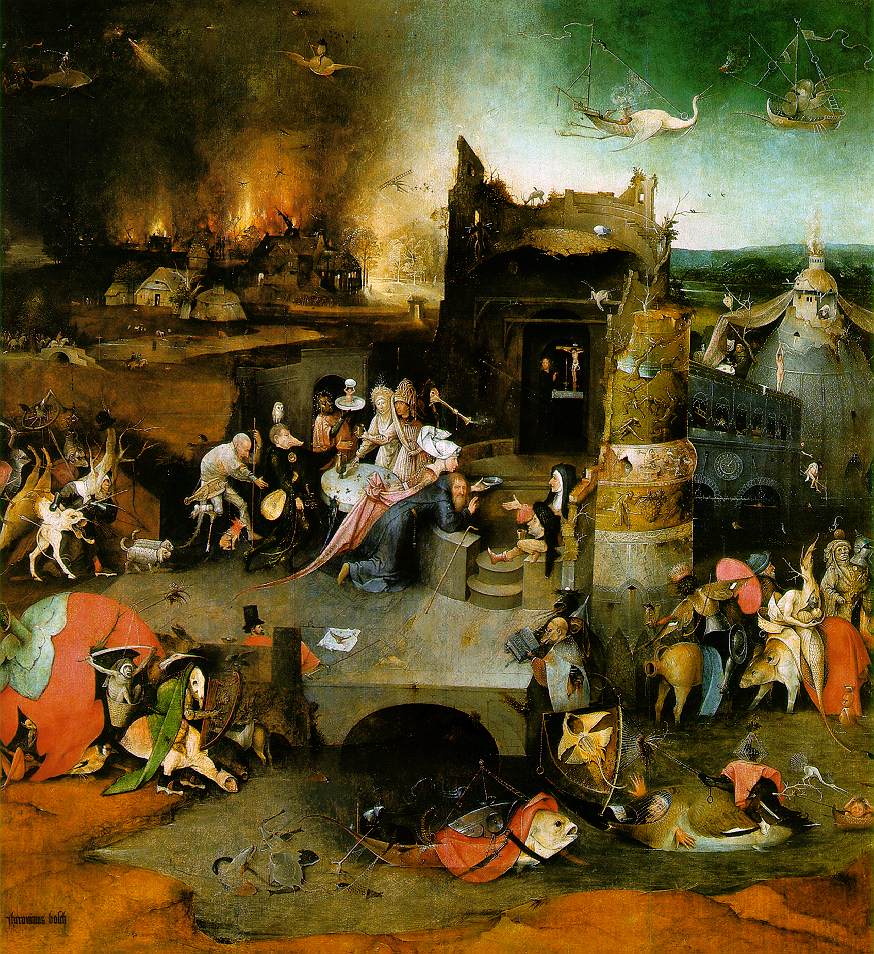
The Temptation of Saint Anthony - Hieronymus Bosch (c. 1450-1516)

Daniel Mitsui gives us a grave reminder at The Lion & the Cardinal:
There is a truth to this so simple that we often forget it: Satan is smarter than us. And he is stronger than us and he is more patient than us. Were he not, we would have no need of a Savior ... Satan hates the Church and he wants us to hate the Church. And he is smart enough and strong enough and patient enough to ruin everything that makes loving the Church easy. He was smart enough to ruin the seemingly immortal Middle Ages, so he is certainly smart enough to ruin the fragile traditionalist movement today ... A Church that is not permanently scarred is not the Body of Christ.
Read all of this sober Lenten meditation here.

Wednesday, March 28, 2007

Tuesday, March 27, 2007

Vocational Discernment - Spiritual Direction

Like magic - a post by Amy Welborn pointed to Aimee Milburn's blog, Historical Christian - Musings of a Roman Catholic Convert and her post On Vocational Discernment and Spiritual Direction, and behold it appears here. Recently the Massketeers have posted and commented on the troubled state of fatherhood and I have indirectly linked one’s calling or vocation to fatherhood with another’s calling or vocation to the priesthood. These are important ‘vocations’ that society has attempted to deconstruct and trivialize. We can help the vocations of fatherhood and priesthood by our reverent participation in the Body of Christ and bringing forth prayers and people seeking discernment and spiritual direction.

So if you are feeling sheepish a solid tool that we can hold out for people is spiritual direction – not only to help with direction for one’s life, but also as a calling or vocation to consider. Just as in my parish, we pray daily for more people to enter the religious life, we can pray for more people to help with that discernment process.

Look for my comment in the link On Vocational Discernment and Spiritual Direction.

Monday, March 26, 2007

Dark Night of the Soul (audio)

Complete audio of Dark Night is here.

Sunday, March 25, 2007

Feeling Sheepish

As one who appreciates a densely packed, diction intense, and aptly turned phrased book, the words of David P. Lang in his book, Why Matter Matters, should resonate with all reasonable and faithful Catholics:
When man's delicately woven biological and spiritual fabric is not respected, when its Creator is not reverenced, then might makes right and hell torments earth.
So then, read the following and make your own inferences. Baaaaa, humbug. Things get foolisher and foolisher ...

European (Soviet) Union?

Derk-Jan Eppink, cabinet member of commissioners, has learned the ropes in the European Union. Or, one could say, he has learned how not to be hung by the ropes in the EU. "I have learned all the necessary survival techniques to be a mandarin: intrigue, trickery and deceit," Commissioner Eppink notes.

Of greatest interest, Eppink notes the similarities between the former Soviet Union and the EU here.

Keep the insights of this worldly politician in mind as the Holy Father issues a dire and heartfelt warning to the back of a wayward son trudging off to a far country ...

Saturday, March 24, 2007

Apocalypse in the Balance

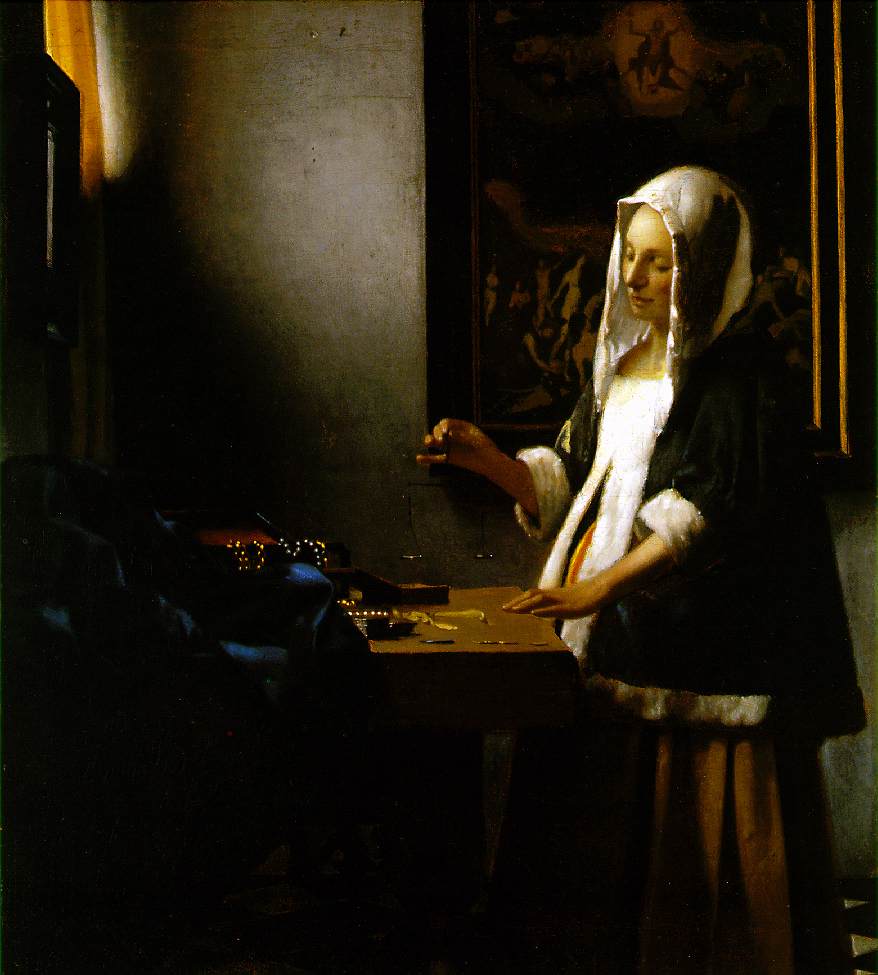
Woman Holding a Balance (1664) - Jan Vermeer
National Gallery of Art, Washington

It has been awhile since we've featured a work by Vermeer, but this one bears a repeat performance. I read an extremely thoughtful analysis by Robert Hamerton-Kelly about apocalypse, Revelation, and, of course, mimetic theory. If you have the time, gentle reader, I commend his explication to you here.

Giving up for Lent

Nice article at Godspy about God's mercy and our needs and imperfections.

Friday, March 23, 2007

Fatherhood -- Priesthood - Do they go hand-in-hand?

I would like to go back to our inquiry into fatherhood and ask what does fatherhood look like drinking the cup, as in this excerpt from Bailie's talk, Entering the Biblical Story at the Eucharistic Table? Notice how right away he dismisses John the Baptist as a role model.

The word (martyr) means to witness. Simply to be the kind of person who when something begins to swirl, when the melodrama gets set in motion, when accusations are made, can we step into the breach and absorb some of that animosity and break up the little knot that is forming?

Not by going in as John the Baptist would do and fighting it back in the other direction. But simply by stepping into that world and absorbing that tension (like the old Rolaids commercial, absorbs 47 times its own weight in access stomach acids…).

Can we be the kind of people that can move into that place, and drink the cup and be part of Christ forgiveness? The world is going to choke on its own unforgivenness if we don’t. That is our role in the world.

Is the whole idea of absorbing the tension of the ... (you name it) the family; or of the community; or of the world; is it really a key component of fatherhood?
It is not forgiveness on the cheap. So it is a subtle process, it requires character and dignity and courage and most of all it requires an enormous moral generosity. So Jesus is inducting us into service for history in a world which is going to now increasingly be deprived of its old mechanism for taking away its own sins on the cheap. He is bringing us into this mission of taking them away in such a way that not only honors our dignity and our freedom, but also rehabilitates us.
It has always seemed to me that fatherhood actually is a major ingredient to tension build-up within the family. How does father help others to hear the cock crow AND absorb the tension that the crowing usually results in?

When we hold up the image of a human father does it reveal a side that fails, at least in all cultural terms? It seems to me that fatherhood is always on the verge of being sacrificed. In other words, his role will often take him on a path of being expelled either by his family or by the culture.

Pulling out another excerpt from the Bailie talk:

... Eucharistic Mandate. He says that Christ often calls us to failure, not success just as He Himself was called to the Cross.

“The marvelous religion teacher, the hard working bishop who manages his diocese well, the mother of a family strongly rooted in the faith have done no more works than the dedicated religion teacher whose classroom is like a drudgery, or the zealous and caring bishop whose administration is constantly criticized or the loving mother whose family, despite her efforts, have all abandoned the Church. In many ways the last three have received a higher calling.” (Bailie here quotes from Wm. Riley)

Isn’t that amazing? We are called to move into that place of brokenness and to take up our cross. And to do it in such a way that the world hears the cock crow, and that the world feels the forgiveness of God. And that the world recognizes that we are not doing it on our own, or that we are not doing it because we are nice, or morally superior. We are doing it because Christ has laid His Hand on us.


I suggest that fatherhood needs to be looked at in relation - in particular, in relation to the Body of Christ, the Church and priesthood - not independently, as the head of the family, as if we could separate fatherhood and Church. It is actually by way of this separation that we have been able to deconstruct and dismantle fatherhood. I think that what I am saying is that the only real way to define, model and/or re-present fatherhood is through the strengthening of the Church and the priesthood. What do you think?

Thursday, March 22, 2007

The 'CNN Effect'

or, An Sophomoric but Accurate Student Video Version of Mark Steyn's Insights into a Spineless West ...

By way of Andrew Cusack, Esq.

Life of Mary (Rainer Maria Rilke)


Speaking of poetry, Anchoress directs us to a cycle of poems on Mary's life, translated into English over at
The Cafeteria Is Closed.

Epiphany

Poetry by John Kenna. Permission has been granted by "Cousin John" to post his poetry here.

              Epiphany

   In the night my flowering apple tree has been changed, has become an angel
   dressed in a pink so fine no tongue can lie about it. Maybe it's the hue of truth
   or the stuff of the soul. Her blooms stop all my words. A dusky fall of magenta
   petals scatter from her limbs like hundreds of cerise birds. As she spreads her
   wings to fly, they land on the grass just coming up from winter's lengthy doze.

   She speaks an unknown language to the moon. Around her roots the very void
   crouches inside itself and begins to brighten into a beauty that comes right up
   to my eyes and stops. It is too large to come inside me, too glorious for my
   all too human dark, and I must turn and go back down the dusty mountain.

                                                bjk

Wednesday, March 21, 2007

"Unforgiveness"

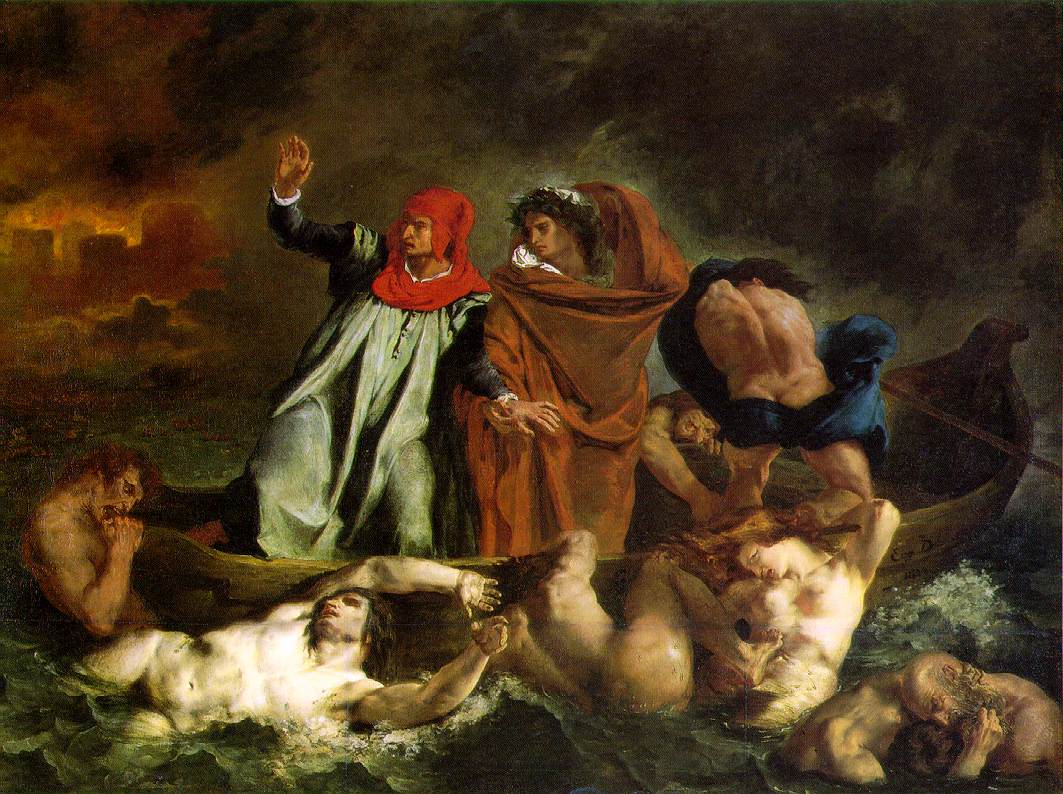
The Barque of Dante - Eugène Delacroix
1822; Oil on canvas; Musee du Louvre, Paris

The excellent series to which Aramis alluded also speaks to the excruciating problem of the unforgiven. It is not triumphalism on the part of persons who are in a state of grace to say this, just because they know and practice the Sacrament of Penance. The Sacraments are gifts of God for real, living, breathing humans, free but for the recognition of one's sins and the need for absolution, repentance, and expiation. But, of course, this more than implies the need to demarcate sinfulness for what it is, not to attempt to normalize sin and call it "choice", "lifestyle", or "infringement of rights." René Girard says as much in a recent interview when he discusses the Ten Commandments.

The problem of unforgiveness sets up an escalating cacophony in the echo-chamber of our human cosmos. Bailie:
When we look out and we read the morning paper and we see the six o’clock news, we see ignorance and sin and insensitivity and all the rest of it. And sometimes we establish some kind of moral stance about it. But if we look at it as Christians, what we see is this crying out of this massive unforgiven. All the terrible things ... that are going to happen in the future are going to be committed by unforgiven people. And Jesus, as the [Misfit] in Flannery O’Connor’s short story says, “thrown everything off” by destroying the system that used to take away the sins of the world ‘on the cheap’ at the expense of the scapegoat. And so the unforgiveness festers. And Jesus now is ... giving us another way of taking away sin. The biblical God is not going to take away sin with a wave of the wand. Why?

This has to do with the whole theodicy question, why does God allow all the terrible things in the world. God is not going to take away at the wave of the wand because that would rob us of our freedom and dignity. God wants love and love has to be freely offered. And if you’re going to create enough freedom so that love can be freely offered, you’re going to have to live in a world made perilous by what people do with that freedom. You can’t have it both ways.

God has put all his bets on love and therefore on freedom. And therefore what we do with that freedom can be a catastrophe. But God is not going to take away our sins by robbing us of that freedom, because it would rob us of our covenantal love for our Creator.

How’s he going to take it away, then? He could only take away our sins ... on the cheap by waving a wand, but will take them away instantly if we ask to have them taken away. All we have to do is first recognize our sinfulness, or complicity, that is to say, “Hear the cock crow,” and the key is to ask for forgiveness -- and we can’t ask for forgiveness until we recognize our sinfulness, and we can’t recognize our sinfulness until we go to the pit of that little “machine” which used to wash it away and we suddenly see what we’ve been doing. We hear the cock crow and we have that moment of conversion. So his blood is shed so that sins may be forgiven, not taken away on the cheap -- and be forgiven be a moment of conversion. So his blood is shed so that sins may be forgiven -- not taken away on the cheap -- but be forgiven because we have recognized them and asked for forgiveness. And then, Jesus says, “Take this and drink it. This is my blood.”

Brief Summary on Girard and Anthropology

Following up on the Girard - YouTube post...

Here is yet another excerpt from Entering the Biblical Story at the Eucharistic Table A talk given by Gil Bailie. If you get tired of these just let me know, because if left up to me I would vote that we spend all of our time digger deeper into these talks...

This is from the Q & A segment at the end of the tape.

Q: Can you talk about the mechanism of violence and anthropology?

Gil:
When the 19th century anthropologist went out, by the way I am talking anthropology – I have a definition of anthropology that I haven’t told you yet. Anthropology is the study of cultures by people who no longer have one.  And you will notice that it was invented by the west about 200 or rather 150 years ago. Somebody once said about poetry; don’t write a poem unless you have to and you could say the same thing about anthropology. Don’t invent the science of anthropology unless you have to. We had to about 150 years ago. And the first anthropologists went out and started studying these other cultures and they came back with all sorts of data and they sorted through it and they said ah-ha! All over the place, wherever you look we have these dying and rising gods. We have these stories that are very interesting. There is a crisis; and there is a death; and there is reconciliation or a resolution or some kind of resurrection. They were all Enlightenment people so that means they didn’t know squat about religion, so they had this insight – the insight was Christianity was just another myth. And that idea was so radical at first that only the academics talked about it. That was before academics became famous and had press conferences. Then it trickled out and people started studying these things and it comes into the modern times, and I don’t want to scapegoat because I have read these people and gleaned a lot from their work, but Mircea Eliade, Joseph Campbell and all those people for whom Christianity is just another dying and rising myth. Gradually that language seeps into the church. Only in the last 30 years have we Christians started talking that way; unbelievable that we would talk that way.

Okay, anthropologists said that Christianity is just another myth because it is exactly the same thing as what they discovered all over the world. And we Christians said, no, no, it is not the same thing - ours is different. Oh yea, the anthropologists asked, how is it different? Well,..., ah,…, ah,…, well, you see, nails hurt more or something like that. We tried to account for it in whatever way or we fled the scene. Girard said, NO. You have to begin there. You have to say YES, you are right. If you want to recover Christianity’s universality, you don’t flee from that revelation you a firm it. Yes of course it is structurally identical to all of that. It had to be: it has it be, because all of that is a telling of the story that is false. All of that tells you the story from the point of view of the victimizing community. You get the crisis; you get the death; and you get reconciliation, but you never get the innocence of the victim, NEVER. Christianity presents something that is structurally identical and reverses the whole valence by creating a community of people who come together because they have heard the cock crow; they have seen the innocence of the victim; the scales have fallen from their eyes; they have seen the idolatry of the world and they have begun to see the face of the living God. So it has to be the same. And this is what I was trying to say earlier, when the world says no, we don’t counter that with some kind of over-against: yes, yes, yes – no, no, no like some chant in the school yard. We go deeper into the mystery until we can bring up an affirmation that brings in that negation that can affirm that negation itself, which is exactly what happened in this example of Girard saying yes, it is the same.

Casting the First Stone

The Woman taken in Adultery (1644)
REMBRANDT [1606 - 1669] - National Gallery

“Let the one among you who is without sin
be the first to throw a stone at her.”
Again he bent down and wrote on the ground.
And in response, they went away one by one,
beginning with the elders.
So he was left alone with the woman before him.
Then Jesus straightened up and said to her,
“Woman, where are they?
Has no one condemned you?”
She replied, “No one, sir.”
Then Jesus said, “Neither do I condemn you.
Go, and from now on do not sin any more.”

This Sunday's Gospel reading from John chapter 8 is, by some biblical scholars' estimation, lucky even to be included in the canonical New Testament. But the councils of the late fourth century were more than wise to include this pericope. The entirety [Jn 8, 1-11] shows the breadth and capacity of the mercy of the Word made flesh, Jesus Christ who, as Saint Augustine points out, is always revealing to us the nature of the Triune God, Father, Son, and Holy Spirit.

We recognize the crowd bringing the woman to Jesus. We know them like the back of our hand; we may even be implicated by similar scapegoating, self-righteous behavior. The same old same old. Yada, yada, yada.

But in Jesus we see goodness, forgiveness, grace for fresh starts, and a twinkle in the eye that does not, in turn, reject and scapegoat the scapegoaters, but rather offers One who stands with the victim in the tide of the onslaught of the unforgiven.

“Neither do I condemn you. Go, and from now on do not sin any more.”

May each of us follow our divine Model, Master, Friend, and Savior -- Offer mercy and steadfast love [agape, hesed] this Lent. Make a friend. Be a friend. Bring a friend to Christ. Or sit with a friend at the feet of Christ and enjoy the "one thing needful" together. +

Tuesday, March 20, 2007

Nabucco - Verdi


Porthos seemed to be begging for some culture, some art, or classical music. Well, here you go...and see how beautifully it connects back to the Mass.

The first reading this morning 3/20 is from Ezekiel (47:1-9,12) as he tells of a hopeful vision for a people in exile. Father Gregg, in his homily, relates the story behind the opera, Nabucco by Verdi. Link here.

Sit back and enjoy. Click here for the synopsis of the opera.