or, An Sophomoric but Accurate Student Video Version of Mark Steyn's Insights into a Spineless West ...
By way of Andrew Cusack, Esq.
Thursday, March 22, 2007


Life of Mary (Rainer Maria Rilke)

Speaking of poetry, Anchoress directs us to a cycle of poems on Mary's life, translated into English over at
The Cafeteria Is Closed.
Epiphany
Poetry by John Kenna. Permission has been granted by "Cousin John" to post his poetry here.
Epiphany
In the night my flowering apple tree has been changed, has become an angel
dressed in a pink so fine no tongue can lie about it. Maybe it's the hue of truth
or the stuff of the soul. Her blooms stop all my words. A dusky fall of magenta
petals scatter from her limbs like hundreds of cerise birds. As she spreads her
wings to fly, they land on the grass just coming up from winter's lengthy doze.
She speaks an unknown language to the moon. Around her roots the very void
crouches inside itself and begins to brighten into a beauty that comes right up
to my eyes and stops. It is too large to come inside me, too glorious for my
all too human dark, and I must turn and go back down the dusty mountain.
bjk
Wednesday, March 21, 2007
"Unforgiveness"
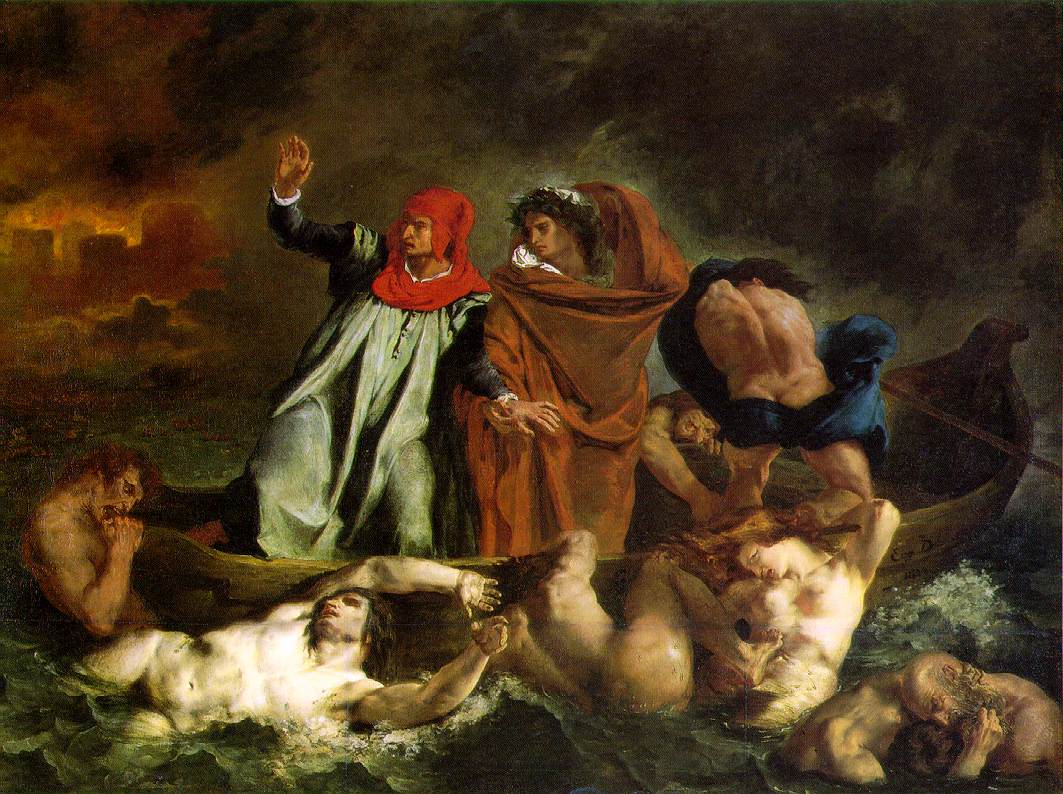 The Barque of Dante - Eugène Delacroix
1822; Oil on canvas; Musee du Louvre, Paris
The excellent series to which Aramis alluded also speaks to the excruciating problem of the unforgiven. It is not triumphalism on the part of persons who are in a state of grace to say this, just because they know and practice the Sacrament of Penance. The Sacraments are gifts of God for real, living, breathing humans, free but for the recognition of one's sins and the need for absolution, repentance, and expiation. But, of course, this more than implies the need to demarcate sinfulness for what it is, not to attempt to normalize sin and call it "choice", "lifestyle", or "infringement of rights." René Girard says as much in a recent interview when he discusses the Ten Commandments.
The problem of unforgiveness sets up an escalating cacophony in the echo-chamber of our human cosmos. Bailie:
The problem of unforgiveness sets up an escalating cacophony in the echo-chamber of our human cosmos. Bailie:
When we look out and we read the morning paper and we see the six o’clock news, we see ignorance and sin and insensitivity and all the rest of it. And sometimes we establish some kind of moral stance about it. But if we look at it as Christians, what we see is this crying out of this massive unforgiven. All the terrible things ... that are going to happen in the future are going to be committed by unforgiven people. And Jesus, as the [Misfit] in Flannery O’Connor’s short story says, “thrown everything off” by destroying the system that used to take away the sins of the world ‘on the cheap’ at the expense of the scapegoat. And so the unforgiveness festers. And Jesus now is ... giving us another way of taking away sin. The biblical God is not going to take away sin with a wave of the wand. Why?
This has to do with the whole theodicy question, why does God allow all the terrible things in the world. God is not going to take away at the wave of the wand because that would rob us of our freedom and dignity. God wants love and love has to be freely offered. And if you’re going to create enough freedom so that love can be freely offered, you’re going to have to live in a world made perilous by what people do with that freedom. You can’t have it both ways.
God has put all his bets on love and therefore on freedom. And therefore what we do with that freedom can be a catastrophe. But God is not going to take away our sins by robbing us of that freedom, because it would rob us of our covenantal love for our Creator.
How’s he going to take it away, then? He could only take away our sins ... on the cheap by waving a wand, but will take them away instantly if we ask to have them taken away. All we have to do is first recognize our sinfulness, or complicity, that is to say, “Hear the cock crow,” and the key is to ask for forgiveness -- and we can’t ask for forgiveness until we recognize our sinfulness, and we can’t recognize our sinfulness until we go to the pit of that little “machine” which used to wash it away and we suddenly see what we’ve been doing. We hear the cock crow and we have that moment of conversion. So his blood is shed so that sins may be forgiven, not taken away on the cheap -- and be forgiven be a moment of conversion. So his blood is shed so that sins may be forgiven -- not taken away on the cheap -- but be forgiven because we have recognized them and asked for forgiveness. And then, Jesus says, “Take this and drink it. This is my blood.”
Brief Summary on Girard and Anthropology
Following up on the Girard - YouTube post...
Here is yet another excerpt from Entering the Biblical Story at the Eucharistic Table A talk given by Gil Bailie. If you get tired of these just let me know, because if left up to me I would vote that we spend all of our time digger deeper into these talks...
This is from the Q & A segment at the end of the tape.
Q: Can you talk about the mechanism of violence and anthropology?
Gil:
When the 19th century anthropologist went out, by the way I am talking anthropology – I have a definition of anthropology that I haven’t told you yet. Anthropology is the study of cultures by people who no longer have one. And you will notice that it was invented by the west about 200 or rather 150 years ago. Somebody once said about poetry; don’t write a poem unless you have to and you could say the same thing about anthropology. Don’t invent the science of anthropology unless you have to. We had to about 150 years ago. And the first anthropologists went out and started studying these other cultures and they came back with all sorts of data and they sorted through it and they said ah-ha! All over the place, wherever you look we have these dying and rising gods. We have these stories that are very interesting. There is a crisis; and there is a death; and there is reconciliation or a resolution or some kind of resurrection. They were all Enlightenment people so that means they didn’t know squat about religion, so they had this insight – the insight was Christianity was just another myth. And that idea was so radical at first that only the academics talked about it. That was before academics became famous and had press conferences. Then it trickled out and people started studying these things and it comes into the modern times, and I don’t want to scapegoat because I have read these people and gleaned a lot from their work, but Mircea Eliade, Joseph Campbell and all those people for whom Christianity is just another dying and rising myth. Gradually that language seeps into the church. Only in the last 30 years have we Christians started talking that way; unbelievable that we would talk that way.
Okay, anthropologists said that Christianity is just another myth because it is exactly the same thing as what they discovered all over the world. And we Christians said, no, no, it is not the same thing - ours is different. Oh yea, the anthropologists asked, how is it different? Well,..., ah,…, ah,…, well, you see, nails hurt more or something like that. We tried to account for it in whatever way or we fled the scene. Girard said, NO. You have to begin there. You have to say YES, you are right. If you want to recover Christianity’s universality, you don’t flee from that revelation you a firm it. Yes of course it is structurally identical to all of that. It had to be: it has it be, because all of that is a telling of the story that is false. All of that tells you the story from the point of view of the victimizing community. You get the crisis; you get the death; and you get reconciliation, but you never get the innocence of the victim, NEVER. Christianity presents something that is structurally identical and reverses the whole valence by creating a community of people who come together because they have heard the cock crow; they have seen the innocence of the victim; the scales have fallen from their eyes; they have seen the idolatry of the world and they have begun to see the face of the living God. So it has to be the same. And this is what I was trying to say earlier, when the world says no, we don’t counter that with some kind of over-against: yes, yes, yes – no, no, no like some chant in the school yard. We go deeper into the mystery until we can bring up an affirmation that brings in that negation that can affirm that negation itself, which is exactly what happened in this example of Girard saying yes, it is the same.
Casting the First Stone
 The Woman taken in Adultery (1644)
REMBRANDT [1606 - 1669] - National Gallery
“Let the one among you who is without sin
be the first to throw a stone at her.”
Again he bent down and wrote on the ground.
And in response, they went away one by one,
beginning with the elders.
So he was left alone with the woman before him.
Then Jesus straightened up and said to her,
“Woman, where are they?
Has no one condemned you?”
She replied, “No one, sir.”
Then Jesus said, “Neither do I condemn you.
Go, and from now on do not sin any more.”
This Sunday's Gospel reading from John chapter 8 is, by some biblical scholars' estimation, lucky even to be included in the canonical New Testament. But the councils of the late fourth century were more than wise to include this pericope. The entirety [Jn 8, 1-11] shows the breadth and capacity of the mercy of the Word made flesh, Jesus Christ who, as Saint Augustine points out, is always revealing to us the nature of the Triune God, Father, Son, and Holy Spirit.
We recognize the crowd bringing the woman to Jesus. We know them like the back of our hand; we may even be implicated by similar scapegoating, self-righteous behavior. The same old same old. Yada, yada, yada.
But in Jesus we see goodness, forgiveness, grace for fresh starts, and a twinkle in the eye that does not, in turn, reject and scapegoat the scapegoaters, but rather offers One who stands with the victim in the tide of the onslaught of the unforgiven.
“Neither do I condemn you. Go, and from now on do not sin any more.”
May each of us follow our divine Model, Master, Friend, and Savior -- Offer mercy and steadfast love [agape, hesed] this Lent. Make a friend. Be a friend. Bring a friend to Christ. Or sit with a friend at the feet of Christ and enjoy the "one thing needful" together. +Tuesday, March 20, 2007
Nabucco - Verdi

Porthos seemed to be begging for some culture, some art, or classical music. Well, here you go...and see how beautifully it connects back to the Mass.
The first reading this morning 3/20 is from Ezekiel (47:1-9,12) as he tells of a hopeful vision for a people in exile. Father Gregg, in his homily, relates the story behind the opera, Nabucco by Verdi. Link here.
Sit back and enjoy. Click here for the synopsis of the opera.
Protestant Stations of the Cross

offered here by Dr. Mark Roberts. Because no such good inclinations should go unlinked.
Hat Tip: Hugh Hewitt
Monday, March 19, 2007
Girard and Vattimo Exchange (You Tube)
The alert Athos directs us in the comment boxes to an excellent You Tube exchange between the philosopher Gianni Vattimo and René Girard. It runs just under 100 minutes, and is mostly (except for Girard's answers) in Italian. This is linked from the COV&R 2007 site.
Sunday, March 18, 2007
Fr. Phil: "You WIll Betray Christ"
Fr. Phil's homilies not only pack a punch, but also induce visits and admiring comments from cool ladies. I have no reason to believe that his homily from the 4th Sunday of Lent will be any different:
Can you smell the wood of the cross from here? It’s still too far to see…just the smell of it is closer. Just about eighteen days more in this desert and we will be there to see him nailed to the wood. Then it will be the scent of wood and blood. Maybe vinegar and sweat as well. And some stinging smoke from the trash fires. And more caking dust. Will you run with the disciplines from Gethsemane? Will you walk with him along the sorrowful way and jeer with the other invisible bodies, adding your cowardly squeak to all the other taunts and cries from those he loved and fed and healed? Will you deny him to protect your safety, to conceal your once-professed love? Will you betray him? Of course you will. And so will I. It is what we do when given the choice to die for a friend or live for a cause. These moments of truth-telling make prudence easy and courage foolish. Praise God then that He does not wait for us to come to Him but rather comes to us first. His memory is holy and ours in need of sanctification.
Paul teaches the contentious Corinthians that “…God was reconciling the world to himself in Christ, not counting their trespasses against them and entrusting to them the message of reconciliation.” So, we are forgiven and then given the ministry of forgiveness to spread in the world, the work of bringing together those split apart, broken under, distant and made alien. The first reconciliation is with God. No other bond of friendship or love makes the least bit of sense outside the bond of love that our Father has for us. That we love is His doing. We cannot love without Him. And without love we can know nothing of Him or His creation—nothing about ourselves, others, or the things of this world. Just beyond the moment of creation itself, to be reconciled to God through Christ Jesus is the primitive move of love. Nothing stands before His love and remains broken, sick, injured, lonely, or distant…nothing, that is, but the stubborn refusal to be loved.
And why would anyone refuse to be loved by Love Himself? To be loved by God is to be changed forever. Clenched fists, an obstinately set jaw, a cold-heart do not easily release control to airy promises of safety and bliss. Even divine promises of safety and bliss. This an anxiety so profound that the Legions of Hell are frightened for us—even they believe! But we are capable of choosing still whether or not we will be changed forever by our desire for God or left squalling helplessly in our mulish refusal at the door to eternal darkness. There are worse choices than betrayal. There is the decision against love. And then crippling despair.
Though reconciliation with God is first, it is not the only reconciliation required of us. To love God is something too easily left in the world of forms, the merely abstract gesture of good will toward divine being. Something more concrete, more worldly is required of our love. We must be reconciled to one another in Christ. The Prodigal Son returns to a party thrown in this name. His father welcomes him home without reservation because he is the father’s son. Despite the son’s gross irresponsibility and near criminal immorality, the father opens his arms to receive the wretch, drapes him in his finest robes, slaughters a fat calf, and celebrates the feckless life of this reprobate. Sorry. I’m with the obedient brother on this one. Why the celebration? The natural consequences of the son’s irresponsibility are absolutely just. He wasted his inheritance, scattering it like seed on sand, and reaped the bitter harvest. He deserves his fate. Yes, exactly, he deserves his fate and his father’s harsh judgment! But he receives mercy, forgiveness, and a welcome home party. He is reconciled in love b/c he was dead and now lives. B/c he was lost and now he is found. Our faith is about excess and waste, overflowing love and beautifully squandered gifts. There is nothing pretty or genteel about the cross. Nothing efficient about the empty tomb. Love reconciles like a thunderstorm soaks dry earth.
We will betray Christ before he reaches the cross. Despite our fervent fasting and pristine prayers, despite our honest intent and good will, despite everything we did, do, and will do during Lent, we will come to the decision that it is best to live for the cause than to die for our friend. And we will go on…to be reconciled to God, to one another, and to become the ambassadors for Christ that Paul urges us to be. We will remember our betrayal as a sign of weakness, anxiety, sin. We will recall again and again the exact moment we did not speak up for Christ, the exact moment we let some insult to his faith slide by, the exact moment we chose to be his enemy dressed as his friend. We will remember when we choose to blend in with the crowd, to throw a stone or two on the sorrowful way, to shout a curse at his stripped and bleeding back. We will remember our betrayal. But he won’t.
Can you smell the wood of the cross? There are many more steps between here and now and the foot of the tree. The hot sand blows stinging hard and everything and everyone you’ve left behind calls to you out of friendship to come back. What’s ahead after all? Blood, bits of flesh, spit, gall, deception, cruelty, violence…your betrayal of a friend. You can turn back now. Do it. Just for a second. Look back to Ash Wednesday. What do you see? Hot promises? Eager intentions? A hunger for holiness? I’m going to do it this time!? Sure. And will you? Not likely. You’ll make it to the cross alright. But you won’t make it there any holier than when you left on Ash Wednesday. Do you think the purpose of Lent is to make you holy? Holier? The purpose of Lent is to show you your need for God. You will make it to the cross b/c God wants you at the cross. Holy or not. Your dieting and fasting and fussing about prayer and alms are at best distractions if they don’t serve to clear up God’s will for you: smell the wood, then see the wood, then taste it. Then feel it against your skin, your hands, your back and feet, feel it—burning, wet, raw, sharp. You are Christ. Lent is not your time to flee from weakness and temptation. Run to them! Lent is your time to pray like the Prodigal Son, “Father, I have sinned against heaven and you, I no longer deserve to be called your son…” And then wait for God the Father to forget your sins and drape you in His finest robes and slaughter the fattest calf to welcome you home again.
Sniff the air. The cross is coming closer. The cup is full. Will you drink from it? Or will you pour it into the desert sand?
Huhlariuss Myoozahkull Hyjinks
are embedded by Anchoress here. Lotta fun. Athos might appreciate the Scottish riverdance halfway through the second one.
These put me in mind of the beloved PDQ Bach, who (I find) is sadly under-present at You Tube.
Saturday, March 17, 2007
COV&R Conference
I am rather impressed by the focus and scope of the 2007 Colloquium on Violence and Religion (COV&R) conference in Amsterdam. It seems to me that the organization is finally living up to its name post 9/11. Maybe Fr. Andre Lascaris has something to do with this one.
Fatherhood as part of the forgiving mission of Christ
Can we image fatherhood in terms of the forgiving mission of Christ rather than some retro man of the past?
Another excerpt from Entering the Biblical Story at the Eucharistic Table
A talk given by Gil Bailie
Another excerpt from Entering the Biblical Story at the Eucharistic Table
A talk given by Gil Bailie
I want to talk about the Last Supper...
So Jesus has very little time. He gets to Jerusalem and it looks like the hour is approaching. There is no more time for sermons – there is no more time for explanations – there is time for very little, what is he going to do? It is very important to Jesus that he leaves them capable of receiving the truth, which will be available to them after the cross. So what does he do? He has a pass-over meal. And the pass-over meal is about getting out of Egypt. Some of what I am going to do below will be in a campy/Monty Python way…, but I think that there is something incredible here that we have not come to grips with.
I am going to reverse the order – let us start with the cup. He takes the cup and He says, “This is the cup of my blood which will be shed so that sin may be forgiven.” He is interpreting the cross. This is the cup of my blood, which will be shed so that sins may be forgiven. Now remember, when Jesus shows up, we humans have always had a way of taking away sins. We take away sins by putting it on the back of our scapegoat, getting rid of it and feeling righteous. Jesus is about to destroy that way by showing us the face of the innocent victim. What happens if he destroys that system and walks away and does nothing else? What happens, and in some extent is what is happening, which is, we begin to choke on our own unforgivenness, which is a synonym for resentment and virtually a synonym for sin. Unforgivenness, the world is filling up with unforgivenness. When we look out and read the morning paper and we see the 6 o’clock news we see this ignorance and sin and insensitivity and all of the rest of it. Sometimes we establish some sort of moral stance about it, but if we look at it as Christians what we see is this crying out of this massive unforgivenness...all the terrible things that are going to happen in the future are going to be committed by unforgiven people.
And Jesus has thrown everything off by destroying the system that used to take away the sins of the world on the cheap at the expense of the scapegoat. And so the unforgivenness festers, and festers. Jesus is now giving us another way of taking away sin. The Biblical God is not going to take away sin with a wave of the wand. Why? This has to do with the whole theodicy question, ‘why does God allow all the terrible things to happen in the world?’ God is not going to take away sins by the wave of the wand because that would rob us of our freedom and our dignity. God wants love and love has to be freely offered. And if you are going to create enough freedom so that love can be freely offered you are going to have to live in a world made perilous by what people do with that freedom. You cannot have it both ways. God has put all his bets on love, and therefore on freedom and therefore, what we do with that freedom can be a catastrophe, but God is not going to take away our sins by robbing us of our freedom because it would rob us of our covenantal love for our Creator.
How is He going to take it away then? He will take them away instantly if we ask that they be taken away. All we have to do is, first of all recognize our sinfulness, our complicity, that is to say, hear the cock crow and ask for forgiveness. The key is to ask for forgiveness. And we can’t ask for forgiveness until we recognize our sinfulness. And we can’t recognize our sinfulness until we go to the pit of that little machine that use to wash it away and we see what we have been doing. We hear the cock crow and we have that moment of conversion.
And so His blood is shed so that sins may be forgiven, not taken away on the cheap, but forgiven because we have recognized them and asked for forgiveness. And then Jesus says, “Take this and drink it. This is my blood.” He goes back to the question which Jesus asked about His own passion when people asked him, ‘who is going to sit at your right hand?’ He asks, “Can you drink the cup that I am going to drink?” That question is asked at the end of Mark’s Gospel – at the Eucharist in Mark’s Gospel it said He gave them this cup and they all drank of it, and they all died a martyr’s death. It is that kind of implication.
In the Eucharist we are offered that cup, why? It is because we are incorporated into the forgiving mission of Christ. When Jesus says in Matthew’s Gospel, you have the keys to the kingdom whose sins you forgive, they are forgiven and whose sin you retain, they are retained - we should understand how significant this statement is. It seems silly to introduce a baseball metaphor at this point, but if a pitcher lets a couple guys on base and the manager decides to put in another pitcher, and somebody gets a hit and those guys come in, they are on the ERA of the pitcher who got pulled out. When Jesus says, whose sins you forgive, they are forgiven, whose sins are retained; they are retained. He is saying, I think, all the unforgivenness that you could have solved and didn’t is on your ERA – it’s on your record. You are in charge of all the unforgivenness that you could forgive and don’t. Can you drink this cup? Can you drink this cup? What does it mean to drink this cup in order that sins might be forgiven?
All this means, I think, is that we must be able to step into that place, not that we are going to become martyrs, most of us do not have the courage for it, but martyrs in another way. The word means to witness. Simply to be the kind of person who when something begins to swirl, when the melodrama gets set in motion, when accusations are made we can, at the risk of our own reputation, our own standing in the community, our own livelihood whatever it happens to be, can we step into the breach and absorb some of that animosity and break up the little knot that is forming? Not by going in as John the Baptist would do and fighting it back in the other direction. But simply by stepping into that world and absorbing that tension (like the old Rolaids commercial, absorbs 47 times its own weight in access stomach acids…). Can we be the kind of people that can move into that place, and drink the cup and be part of Christ forgiveness? The world is going to choke on its own unforgivenness if we don’t. That is our role in the world. This is not cheap forgiveness. The forgiven one has to hear the cock crow, and we shouldn’t go around being lily-white liberals that we are forgiving easy and never being part of the cock crowing. People have to hear the cock crow - we have to hear it. Jesus, when He forgives people, He always says, “go, and sin no more.” It is not forgiveness on the cheap. So it is a subtle process, it requires character and dignity and courage and most of all it requires an enormous moral generosity. So Jesus is inducting us into service for history in a world which is going to now increasingly be deprived of its old mechanism for taking away its own sins on the cheap. He is bringing us into this mission of taking them away in such a way that not only honors our dignity and our freedom, but also rehabilitates us.
John Fleming Interview (podcast)
Anchoress points to a neat interview with Middle Ages scholar John Fleming, conducted by Fausta.
Transcript here.
Thursday, March 15, 2007
Lenny's Father ...
We can never pretend to gauge the love and mercy of God the Father. But, as Gil Bailie points out in this important post, the example of a father who practices his faith in attending Mass and living the faith and morals of the Church is of inestimable importance to passing on the faith to his children.
In the gargoylesque novel, The Dionysus Mandate, Lenny Schultheiss, AKA mort-rocker Doris Dahmer, has several flashbacks on his twisted path to redemption. This one (below) shows a sad estrangement between young Lenny and his distant, verbally abusive father.
The Massketeers are all fathers. We claim no special expertise, no extra dose of faith, hope, or charity. But where and when we are now, we lay before our children (where and when they are now) our witness to Catholic truth, the deposit of faith, and our fealty to the Church that Our Lord died and rose again to found. May our fatherhood and faith be filled and the difference made up by the grace and merits of the Son, the Word made flesh. Lord knows, we can't do it on our own.
In the gargoylesque novel, The Dionysus Mandate, Lenny Schultheiss, AKA mort-rocker Doris Dahmer, has several flashbacks on his twisted path to redemption. This one (below) shows a sad estrangement between young Lenny and his distant, verbally abusive father.
A tall, gaunt man sat on a railroad tie. He stared down at the water between the ferries. Oil slicks undulated around bits of trash and debris. His waist-length black hair lifted lightly in the breeze. A voice from his childhood barked into his consciousness.The rôle of father and the task of fatherhood is a sublimely difficult one, especially today when "father" is synonymous with "dolt", "fool", and "know-nothing"; depicted as a Homer Simpson imbecile by prime time comedy writer stiffs.
“Lenny, damn it! Get your hands out of that filth, boy!” His father’s voice growled at him from a distance of two decades. “Don’t you have a lick of sense?”
“I was just lookin’ at it, Dad.”
The gutter in front of their house often carried a mixture of water and chemicals from the rusting steel-mills of his hometown in Pennsylvania.
“How can you be so stupid, boy? I think I’ll start callin’ you Doris. How’s that sound, Doris? Doris? Doris?”
His father picked up the family cat rubbing against his trousers. Then he cuffed off Lenny’s winter hat for good measure. The boy bent over to pick up his cap and watched his father walk away. The man caressed the cat as he walked toward the house.
“You love that cat more than me!” Lenny shouted toward his father’s back. “I hate him,” he said to his playmate.
Lenny’s father dropped the cat on the front porch and entered the front door, wiping his feet. “Play good, Doris!” he called back at Lenny. “Hee hee hee.”
The boy rubbed tears on the sleeves of a plaid winter coat. His young face settled into a stony expression. He followed his father’s footsteps through the dirty snow and returned, carrying the cat.
“Here,” Lenny said. He threw the cat to his friend. He cupped his hands and lifted oily water to his lips.
“Gees, Lenny, don’t drink that!” his playmate said.
Lenny looked his friend in the eye. “Why not? You think my father would give a crap?”
“Well, he’ll probably beat the crap out of you if he sees you do it!”
Lenny looked down at the water in his hands, then toward the house. He drank it. He fought back a choking cough and smiled.
“Ah! Just like whiskey. Let’s go. Bring the cat.”
They walked around the house. Lenny led his friend to their secret hideout between decrepit garages.
“You ever kill a cat before, Billy?” Lenny asked.
“Come on! Please, Lenny! You’re not really going to, are you?”
“How many ways are there to skin a cat?” Lenny Schultheiss grinned and took the cat from his friend.
“Lenny, baby! Come on!” A young woman’s voice called him back to the present moment. “We have to go! They’re starting to load the ferry!”
The man tucked his long hair back up under a cap and stood up. I can bury you, Dad, but I can never get rid of you, can I?
The Massketeers are all fathers. We claim no special expertise, no extra dose of faith, hope, or charity. But where and when we are now, we lay before our children (where and when they are now) our witness to Catholic truth, the deposit of faith, and our fealty to the Church that Our Lord died and rose again to found. May our fatherhood and faith be filled and the difference made up by the grace and merits of the Son, the Word made flesh. Lord knows, we can't do it on our own.
Mediators - Distracted or Directed?
 Here is another excerpt from Bailie's, Entering the Biblical Story at the Eucharistic Table. This time from the Q&A session of the talk where he elaborates on the relatedness of desire and suffering.
The Buddhist recognizes that the problem is desire that is very good, so do we Christians, or at least we should or we used to before we threw Augustine out. But for Christians it is not to shut down desire and it is not to avoid suffering. For Christians it is to awaken desire and turn it toward its proper object, turning it away from all the fancy glitter things that distract us, and toward God. And because we humans need to see the face of God, we absolutely needed the incarnation. Jesus gives us that incarnation so that our desires, and we are not talking about the goofy kinds of raw desires, but our longing, like metal filings can be re-oriented in the right way, so that our desire is awakened. This is what Dante is all about, awakening that desire and turning it to all kinds of mediators: Beatrice, the Beloved, Sister Immaculate, John of the Cross, whoever it is, awakened by all kinds of mediators and directed back to its true source. Augustine starts the Confessions with the first paragraph he ends it with, “We are restless until we rest in Thy.” We take that restlessness which is our desire, we don’t try to shut it down, we turn it toward its proper object and we understand that suffering can be redemptive. That is really powerful. When you recognize that this can be redemptive, not just for me, because if it is for me than it goes back to this little project of me getting into heaven, elbowing my way in. But my suffering can be redemptive to somebody on the other side of the planet – to somebody in another age. And this is what prayer can do. We have to believe these things because they are true. We use to have, as little Catholic children in the playground, prayers or we would offer up our suffering to the poor souls in purgatory, which now today everyone has a little condescending smirk, but it is absolutely true. Our suffering can be redemptive not just for us, but maybe not primarily for us, but for others. It is a great gift and once you recognize that, suddenly this pain has dignity and vocation.
Over the course of my faith journey I became aware of just how undeveloped my passion or desire was - lukewarm at best. My mediators were your usual actors, business types or sports heros, whose image or essense was manufactured and not real. To wake me up from this stupor, setting me on fire for life, took repeated smacking of a 2X4 against my forehead (divorce and stroke) until no longer did I continue to try to find fulfillment gazing upon manufactured idols. I can look back now and notice numerous mediators coming into my life directing me to Christ; and the more I gazed into their eyes the more my desire and passion grew and (what seemed like) suddenly I burst into a love for the church - being a member of the body of Christ became my passion.
So not only are mediators important, helping one to be directed and not distracted, but by being directed toward our true source we become aflame with the Holy Spirit - true Christ-links in the world.
Wednesday, March 14, 2007
The Meaning of the Mass 3of3
Archbishop Fulton Sheen finishes up his 3 part series on The Mass with these words, We live by what we slay.
The Sacrifice, a Eucharistic or Dionysus Mandate?
 Athos mentioned the absolutely great tape made by Gil Bailie, "Entering the Biblical Story at the Eucharistic Table." Here is an excerpt from the conclusion of that talk. I think it stands as a relief to the wonderful glimpse we are getting from Athos' book, Dionysus Mandate.
Then there is a little passage of a book on Revelation by William Riley, Irish Biblical scholar who passed away a few years ago that I would like to leave you with. He has a wonderful way of helping understand our work in the church and it also comes out of our Eucharistic Mandate. He says that Christ often calls us to failure, not success just as He Himself was called to the Cross. “The marvelous religion teacher, the hard working bishop who manages his diocese well, the mother of a family strongly rooted in the faith have done no more works than the dedicated religion teacher whose classroom is like a drudgery, or the zealous and caring bishop whose administration is constantly criticized or the loving mother whose family, despite her efforts, have all abandoned the Church. In many ways the last three have received a higher calling.” Isn’t that amazing? We are called to move into that place of brokenness and to take up our cross. And to do it in such a way that the world hears the cock crow, and that the world feels the forgiveness of God. And that the world recognizes that we are not doing it on our own, or that we are not doing it because we are nice, or morally superior. We are doing it because Christ has laid His Hand on us.
A side comment: In the quote above, he tells of the calling one receives. Well this implies that one is open and receptive to receiving the call. I look at all the distractions in our world, many of which go to the extreme, and realize just how hard it is for anyone today to hear their calling -- resulting in what Athos has coined, Distracted to Death... So even if one does go to Mass, without the extreme surrendering, or death of 'self', at the Mass, one will likely leave the service unprotected - clinging to the false sense of 'self' - venturing into distractions of death.
Tuesday, March 13, 2007
Sheen - Meaning of the Mass +

Archbishop Fulton Sheen may summarily answer a few questions that were raised by Aramis in his post, I Must Remember that I Can Only Invite - The Lord Does the Rest.
This is the second of three clips of Archbishop speaking of the Mass on You Tube, but for me, the most powerful.
Monday, March 12, 2007
I Must Remember that I Can Only Invite - The Lord Does the Rest

In commenting on Athos' post I used a quote from Yeats, who penned "The best lack all convictions, while the worst/Are full of passionate intensity." I asked in the comment how we can rev-up our lives. Well it didn’t take long to find an answer as I came across this post from Welborn’s open book.
The message starts off with, How can we communicate the joy of Catholic worship and I would make sure we see in the word, 'joy' a sense of passionate intensity - and I hope that all see in the concept of 'Catholic worship' the Eucharist – the sacrifice and the body and blood of Our Lord.
Father Dwight Longenecker continues:
To the outsider I know this seems arcane, irrelevant and difficult to understand. To many Catholics it seems the same. They wonder why worship cannot be more 'relevant' and more easy to understand. Perhaps they wonder why the worship cannot be more joyful, more upbeat and more 'with it'. I cannot explain.
I cannot explain in the way I cannot explain a Mozart aria, a Beethoven quartet or a Raphael Madonna. I cannot explain the lift and surge of liturgy as I cannot explain the heft of a poem or the fullness of the silence in the rest of music. I cannot explain the transcendence of beauty,the knowledge of eternity electric in the frail physical things. I cannot explain the connection with the infinite in the interstices of the psalms, the intimacy of goodness in the rapt face of a child in worship, the contact with reality in the smoke of incense, the deep rumble of the organ, the delicate dance of light or the poignant harmony of plainsong. I cannot explain the certainty of sanctity known in the wrinkled hands of an old woman in prayer, or the certainty of grace in a teenaged boy kneeling in silence--a smile of joy impressed upon his face as if by an unseen power.
I cannot explain any of these things, but I can invite you to the feast.
Subscribe to:
Posts (Atom)