Wednesday, June 11, 2008

The Idea of the Autonomous Self Continues to Eat Away at Our Core Being

Descartes was a major player in the slide into the erroneous autonomous self.
I will now close my eyes, I will plug my ears, I will turn aside all my senses … in this way, concerned only with myself, looking only at what is inside me, I will try, little by little, to know myself, and to become more familiar to myself.
Here we have the modern self’s originating gesture, what Henri de Lubac called “the mania of introspection or the search for a static sincerity.” “The farther it goes,” de Lubac insisted, “the more fearful it becomes. It eats into man, disintegrates and destroys him.” William Temple expresses an analogous misgiving when he refers to Descartes’ withdrawal into himself as “the most disastrous moment in the history of Europe.”

From Gil Bailie's THE SUBJECT OF GAUDIUM ET SPES RECLAIMING A CHRISTOCENTRIC ANTHROPOLOGY OF THE HUMAN PERSON

Perfect Joy -- The Little Flowers of St. Francis


Meditating on the thought for today found in the Magnificat (see a snippit below), I was reminded of the words of Saint Francis as he taught what perfect joy is. You can find "Perfect Joy" at http://www.feastofsaints.com/perfectjoy.htm

Here is the meditation:

"It is necessary that the saints should live among us, that they should be subject, like us, to all the wretchedness of our human condition, and that they should even seem to be overwhelmed by it; for in this way they teach us to be indifferent to all the glory of the world, proving to us in a striking manner that our true good lies elsewhere. The essence of holiness often manifests itself most clearly in the frustration the saint endures, in the pain which is inflicted on him, or which he inflicts on himself, in torture or in martyrdom... Yet our imagination needs these great examples as a measure of the distance there is between holiness and success... (holiness) is indifferent to worldly success and indeed despises it."

-- Louis Lavelle - (+ 1951) was a professor at the Sorbonne, Paris, France, and was a prominent Christian philosopher.

(Emphasis is mine as I reflect on so many frustrations I seem to run into in my daily walk with God.)

Girard the Immortel (Must Read)

René Girard: Stanford's provocative immortel is a one-man institution. Here is a tidy introduction to Girard's mimetic theory I highly recommend. [Big h/t to Gen @ Real Clear Religion]

Tuesday, June 10, 2008

As my two eyes make one in sight


Blessing of the Wheat at Artois
Painted by Jules Breton (1827 - 1906)
Completed in 1857, oil on canvas, 50.5 ins. x 125.25 ins.
Courtesy of the Musées des Beaux-Arts d'Arras, France

About this Painting
Quoted from "The Rural Vision, France and America in the Late Nineteenth Century"
By Hollister Sturges - Copyright © All Rights Reserved:

"....His most ambitious canvas up to this time, The Blessing of the Wheat at Artois....exhibited at the 1857 Salon, translates the customs of this rural community on an epic scale.....Breton gathered all segments of the village society in a religious ceremony.....in his rendering of a priestly procession on the plain of Courrières, Breton emphasized that the Christian faith of the Community was intact. In this ancient, rustic ritual intended to ensure the abundance of the harvest, the priest beneath the canopy carries the host in the monstrance out into the fields. Rural notables, village maidens, and others make up the procession, and as they pass, peasants kneel before them in pious gratitude. This epic picture emphasizes the social harmony of the agricultural community, which in turn brings forth the fruits of a bountiful nature."

In this painting I came to realize what I have tried to put into words and always feeling that the words fell hard on the paving stones. I see in this painting our basic yearning, need and desire to live as one. Like this Robert Frost poem:

But yield who will to their separation,
My object in living is to unite
My avocation and my vocation
As my two eyes make one in sight.
Only where love and need are one,
And the work is play for mortal stakes,
Is the deed ever really done
For Heaven and the future's sakes.

- from Two Tramps In Mud Time.

Be Not Tempted to Despair

It seems to me that people of Christian faith in our time, in our age, are tempted to fall into the bane of Denethor, Steward of Gondor in J. R. R. Tolkien's Lord of the Rings. (Pictured above in Peter Jackson's version and played so well by John Noble.)

At an unparalleled degree Christians in the West feel pummeled by attack after attack: our faith is scoffed at by pretentious scholars and celebrities (those famous for being well-known); our morals flaunted by individualists run amok and negative imitators who are caught in a state of scandal, both of whom are lauded by journalists; and a separatist religion of the Scimitar whose rivalry toward Judaism and Catholicism knows no boundary.

We look in our "palantir" - internet, cable television, advertisements with shreds of "news" - and we feel driven to believe falsely that hope for all that is good, true, and beautiful in our world is on the wane, capsizing, or being deconstructed.

But I know differently. I have for the past seven years been privileged to be a part of an endeavor that will eternally give me hope. I have taught in a Catholic School. I have been surrounded by colleagues and friends who hear the sound of bugles at dawn and see the bright dawning of an eschatological sunrise. And during my six-week long recuperation, I have felt the power of their prayers and intentions for me, for my students whom I abandoned through no fault of my willing (unless a "transitional cell carcinoma" was willed by me somehow), and for the good of Catholic education.

Governments, nations, political parties, caucuses, and special interests can and will disappoint being merely human groupings. But the Catholic Church - of whom we would ALL be a part 1,500 years ago - was begun by Our Lord, is sustained by Our Lord, and is promised to continue by Our Lord ... until He comes again (Mtt 16,18 & 28,20) come hell or high waters.

So, do not fall for the deceptions of "Sauron" or "Sarumens" who are legion, gentle reader. Keep your armor polished and your sword sharpened. Stand tall and join the merry revels and rejoicing of the glad Company who know by His Real Presence among us that we are a part of the Body of Christ. There is no darkness that can keep our heart and voice from singing. We are the King's men (and women), and we pledge our fealty to Him.

Sunday, June 08, 2008

Collins - PRB

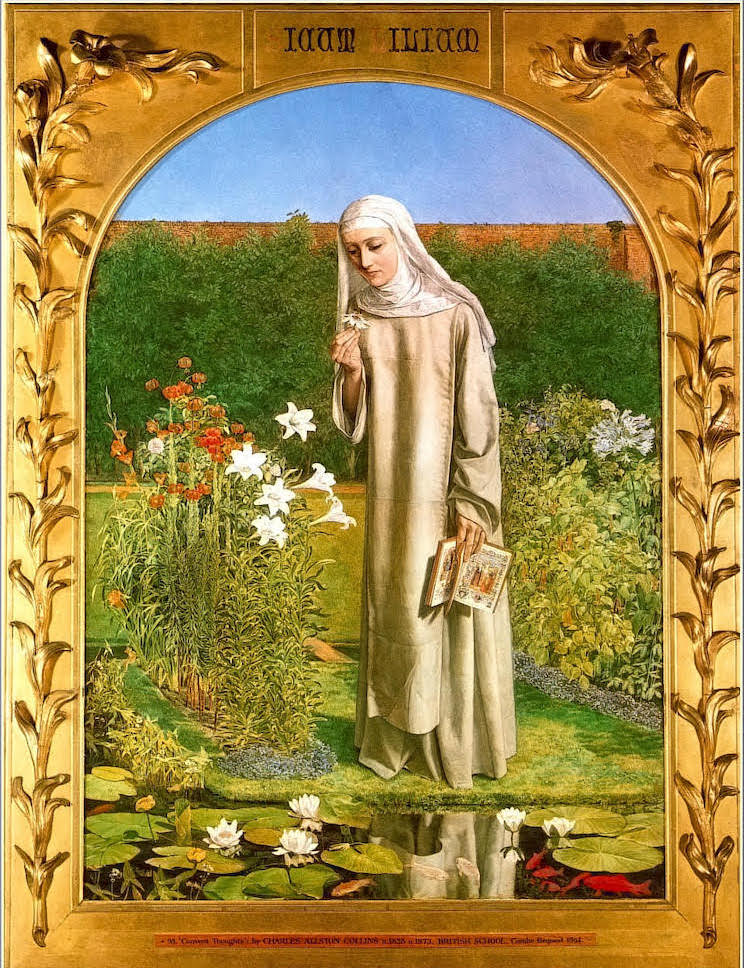
Convent Thoughts (1851) - Charles Allston Collins

According to Christopher Wood (The Pre Raphaelites), "Collins's picture is typical of the early, gothic phase of the movement, and the religious piety of these works led many critics to accuse the painters of being Roman Catholic sympathizers. The mood of this picture is generally similar to Rossetti's early works, but the flowers and garden reflect Millais's influence" (22).

But Clare Asquith relates something more telling in her tome, Shadowplay - The Hidden Beliefs and Coded Politics of William Shakespeare: "Unknown to Pericles, (Thaisa) retires to a convent - a common refuge for women exiled from England." (250, my emphasis)

Packington's Pound (Anon.)

From the ridiculous to the sublime: Valéry Sauvage on the lute. [h/t: The Iconoclast]

Saturday, June 07, 2008

Friday, June 06, 2008

Mythopoeia

Wind in the Willows - Kenneth Graham

Artistic creativity in Modernity and Post-modernity followed along the lines of what Paul Ricoeur the "Masters of Suspicion" - Marx, Nietzche, and Freud. All agreed that truth is ugly and, therefore, art to be truthful must also be ugly.

What has happened in the wake of this philosophical underpinning is western art as dragged through the gutter (with a few attempts at rebellion against this morbidity).

As proof that in human nature resides a spark of something far greater, we still find such masterpieces as The Hobbit and Lord of the Rings - in both book and film format - resoundingly popular and hailed by new generation after new generation.

Tolkien himself, Catholic and professional philologist, was singularly instrumental in helping C. S. Lewis, fellow Oxford don, come to a firm belief in Christ as the Son of God. Tolkien dedicated a poem, "Mythopoeia", to Lewis ('Philomyth to Misomyth') wherein he spoke of bringing Lewis to the realization that in the Gospels, "myth became fact" (as Lewis latter wrote in his book, God in the Dock), and by our very nature, we are "sub-creators" being made ourselves imago dei.

Below is a portion of "Mythopoeia". It may explain why that spark of creativity still flares up in moments of true beauty among us.

The heart of man is not compound of lies,
but draws some wisdom from the only Wise,
and still recalls Him. Though now long estranged,
Man is not wholly lost nor wholly changed.
Dis-graced he may be, yet is not de-throned,
and keeps the rags of lordship once he owned:
Man, Sub-creator, the refracted light
through whom is splintered from a single White
to many hues, and endlessly combined
in living shapes that move from mind to mind.
Though all the crannies of the world we filled
with Elves and Goblins, though we dared to build
Gods and their houses out of dark and light,
and sowed the seed of dragons - 'twas our right
(used or misused). That right has not decayed:
we make still by the law in which we're made.

Fr Stan Fortuna - why people suffer - part 1

An in your face approach - very Franciscan don't you know - to a most challenging message. Part 1

If you can handle more parts 2 and 3 are at this link.
http://www.youtube.com/watch?v=-_ahRF7DPEI

Called to Communion is Ever So Linked with the Mystery of the Person

We are social creatures. Yet, we Judeo-Christians believe that we are called out of the culture, out of the crowd, out of the mob, called out of our complicity in sacred violence to become a new creation, a person... But what is a person? From the first book of the Bible we are told that we are made in the image and likeness of God. But what does that look like? In the New Testament the full implications of this is revealed in Jesus Christ and the sending of the Holy Spirit.

So we are made in the image and likeness of that God - the God of Three Persons, The Trinity. (From Gil Bailie - THE SUBJECT OF GAUDIUM ET SPES RECLAIMING A CHRISTOCENTRIC ANTHROPOLOGY OF THE HUMAN PERSON)
The mystery of the person as embedded in Trinitarian and Christological thought was regarded as revelatory only of the Persons of the Trinity and of the unique person of Christ.
And so each of the “Persons” of the Trinity plays a “role” in the gift of personhood to humanity.

And in the same way, we each play a role in the gift of personhood to our sisters and brothers.

From Pope Benedict XVI (Joseph Cardinal Ratzinger) - Called to Communion - Understanding the Church Today:

Forgiveness, together with its realization in me by way of penance and discipleship, is first of all the wholly personal center of all renewal. But because forgiveness touches the very core of the person, it gathers men together and is also the center of the renewal of the community (the Church). For when the dust and filth that disfigure God's image in me are removed (by the grace of forgiveness & reconciliation), I thereby become similar to the other who is likewise God's image; above all I become similar to Christ, who is the image of God without qualification, the model according to which we have all been created.
Gil Bailie asks the most pertinent question we can ask today:

Can the call to personhood be made today so as to be heard? The answer is yes, and in my view the way to make it and to make it intelligible is to show how anthropologically sound – and how spiritually and psychologically gratifying – is the uniquely Christian understanding of the person, the person as seen in the light of a Christocentric anthropology. In recovering the mystery of the person thus understood, the anthropological insights of René Girard are simply indispensable.


In the end, like it or not, this understanding of what it means to be a person will be upheld only within The Catholic Church of Rome.

I conclude with Pope Benedict XVI as he extols each and everyone of us to take up our role in the Church as we participate - not with lukewarmness, but in the Fullness of Truth, Goodness and Beauty of the Body of Christ.

The Church will be all the more the homeland for man's heart, the more we listen to God and the more what comes from Him is of central importance in her: his Word and the sacraments He has given us. The obedience of all toward Him is the guarantee of our freedom.
We are truly 'inter-dividual' rather than individual and so we are free in as much as we surrender our will and fully participate in the Church - the Body of Christ.

Wednesday, June 04, 2008

Mark Shea - Faith & Reason

And speaking of trusting, fellow convert traveler Mark Shea has a nice piece at Catholic Exchange, In Doubtful Things, Liberty:
One often hears about the supposedly monolithic or totalitarian character of the Catholic Church. You know the drill. The Pope tells everybody what to think. Catholics all have to believe exactly the same thing. Freedom of thought is anathema for Catholics. Et Cetera.

I heard much of this and believed it—till I got to know Catholics. Then I discovered the truth of Chesterton’s remark: “Catholics agree about everything. It is only everything else they disagree about.”

The reality of Catholic (and biblical) teaching is this: There are a few cosmic truths upon which the Church absolutely insists we must agree if we are to claim the name of “Catholic”. These are more or less summarized in the Creeds and in the few dogmatic teachings of the Church pertaining to such matters as, say, the Real Presence in the Eucharist, the Immaculate Conception and so forth.

Beyond this, not only does the Church not demand we march in lock-step, she positively encourages a sort of loony diversity that is much more like a garden of wildflowers or a really crazy zoo in which the keepers are the ones who cage themselves (by means of poverty, chastity, and obedience) so that the strange and exotic creatures called “the faithful” might roam free.
A nice piece to steer your friends and relatives to, especially the ones who say things like, "How can you stop thinking for yourself and become a Catholic?"

Who You Gonna Trust

Check out The Anchoress. Scroll down and click on Who ya gonna trust?

Idolatry - false gods & false devils - Chesterton

Anchoress picks out another great Chesterton quote.

“Idolatry is committed, not merely by setting up false gods, but also by setting up false devils; by making men afraid of war or alcohol, or economic law, when they should be afraid of spiritual corruption and cowardice.” - G. K. Chesterton, Illustrated London News 9/11/09

Skeptical About Atheists

If Only Atheists Were the Skeptics They Think They Are by Edward Tingley, The Skeptical Inquirer. [h/t: New Advent]

And, as The Anchoress reminds us of GKC's words to early 20th century atheists, Reason itself is a matter of faith. It is an act of faith to assert that our thoughts have any relation to reality at all.
- Orthodoxy


Tuesday, June 03, 2008

Through It All - Christ is Our Hope

Only when the future is certain as a positive reality does it become possible to live the present as well.

In "Spe Salvi - in hope we were saved" Pope Benedict XVI provides us a glimpse into the only possible future we have - a future built in Christian hope.

In this encyclical on hope Pope Benedict XVI notes that St.Paul reminded the Ehpesians (Eph 2:12) that "before their encounter with Christ they were ‘without hope and without God in the world.'" (On Christian Hope, #2). Pope Benedict goes on to stress:

Only when the future is certain as a positive reality does it become possible to live the present as well. So now we can say: Christianity was not only "good news" --- the communication of a hitherto unknown content. In our language we would say: the Christian message was not only "informative" but "performative."

That means: the Gospel is not merely a communication of things that can be known---it is one that makes things happen and is life-changing. The dark door of time, of the future, has been thrown open. The one who has hope lives differently; the one who hopes has been granted the gift of a new life.
+ + +

Over the weekend I listened to 4 top graduating seniors from one of our public high schools and each spoke about living in the "now" - giving almost no reference to what kind of future there may be waiting for them. It was as if they were acknowledging the lurking "dark door of time, of the future" and so their advice was that you better enjoy what you have while you can.

It has been 8 years since I last attended a graduation ceremony. I know that they usually include a lot of hooping 'n hollering and a big beach ball tossed among the graduates getting all psyched for party-time, however, as I remember, in the celebration there would be some reference made to the challenge and hope in the future...not so much here. I wondered if this was so because it was a public high school with guidelines prohibiting the expression of faith, as it has become more and more apparent that true hope can only come from faith.

"Here too we see as a distinguishing mark of Christians the fact that they have a future: it is not that they know the details of what awaits them, but they know in general terms that their life will not end in emptiness. Only when the future is certain as a positive reality does it become possible to live the present as well."

Let us remember to imitate Mary's YES and the YES of Jesus Christ to live in the fullness of this new life - being models of this life-changing hope for others.


Monday, June 02, 2008

Who's Your Daddy

Jesus' inquisitors in the 8th chapter of John's Gospel want to check on his pedigree, his ancestry.

"Where is your father?" they ask him (v. 19)

"You know neither me nor my Father. If you knew me, you would know my Father also," he replies.

They say a little later, "We are descendants of Abraham and have never been enslaved to anyone..." (v. 33, as their Roman overlords probably listened in)

Jesus says to them, "If you were Abraham's children, you would be doing the works of Abraham. but now you are trying to kill me ... Abraham did not do this. You are doing the works of your father ... You belong to your father the devil and you willingly carry out your father's desires. He was a murderer from the beginning ... he is a liar and the father of lies" (vv. 39b-44a, my emphases).
+ + +

Jesus is juxtaposing his Father with that "father" of the Pharisees whom they mis-recognize as Abraham. Jesus first corrects them about Abraham, saying that if he were their father, they would do the works of Abraham; namely, faithfully loving God with heart, soul, mind and strength, and neighbor as oneself. Then he pulls back the veil that thinly masks the violence they actually carry out like the pagans. THIS, he says, is the true "father" of their actions. They use laws as "trip-wires" to catch new victims to throw into the sacrificial mechanism started by the "murderer from the beginning ... a liar and the father of lies."

As we noted in the series of posts on Paganism, Then and Now, mimetic theory, the cultural anthropology of René Girard, posits precisely what Jesus puts in these few words of comparing the "murderer from the beginning ... and the father of lies" of conventional human culture vs. the Father God whom Jesus came to reveal to a sinful, violent, and bloodthirsty humanity. (To get caught up in gender political correctness here would be to do great disservice to the canonical Scriptures and cannot but sidetrack the importance of these matters. "Father" it will be and shall remain.)

Gil Bailie in his extraordinary explication of Girard's opus - Violence Unveiled - notes that the pre-Socratic philosopher Herclitus saw that
War [polemos] is the father and king of all things; he has shown some to be gods and some mortals, he has made some slaves and others free ... Everything originates in strife ... Strife is justice; and all things both come to pass and perish through strife. (My emphasis)
Mimetic theory also posits that each mere human culture always tries to guarantee that (a) it is utterly unique in its ability to bring about peace and prosperity; and (b) its cultic deity "sanctions" its violence against the usurping "other" who are (clearly) less than human ("sons of pigs, apes," etc.). Each human culture promises an "Exit" out of the labyrinth of violence and evil - finally! - only for individuals to discover that the exit-sign is just another entrance into the maze of human folly and bloodshed (I borrow "labyrinth", Bailie's apt metaphor for the primitive Sacred).

Girard posits here the difference between what he calls an "internal mediator" and an "external mediator." The former is one of the myriad savior figures who have led the human race astray during our sad, mortal history "full of sound and fury, signifying nothing." The latter, on the other hand, would be a truly divine figure who comes from outside our human cultural house of mirrors and, thus, is capable of informing us of a completely different and superior way of living, moving, and having our being. One, as Girard says, who comes "to turn this long page of human history once and for all."

And so we see the need for choosing with extreme care and caution who to follow, whose "father" to believe, what organizing principle to set at the center of one's being. One that will just lead us back into the labyrinth of the "same ol' same ol'?" Or, a true "external Mediator" worthy of our heart, our life, our eternal well-being?

Who you gonna trust? may well be the most important question you ever answer.

Just 'Cause

I happen to think these are two of the greatest fantasy movies made for kids: The Lion, the Witch, and the Wardrobe and The Never-ending Story. [h/t: IBA]

Is it too late to remake Prince Caspian? You know, like, to include all those "boring" non-battle scenes just like in The Lion, the Witch, and the Wardrobe? The way Lewis wrote it? It is too late? Sigh. Too bad. I was just hoping ...

We all need a 'centre' to our lives

Pope Benedict XVI talks on the HEART OF JESUS: A SYMBOL OF CHRISTIAN FAITH June 1, 2008.

Hermanoleon Clipart

"We all need a 'centre' to our lives, a source of truth and goodness from which to draw in the various situations and exertions of daily life. Each of us, when we pause in silence, needs to feel not only the beating of our own heart but, deeper down, the pulsing of a reliable presence, perceptible with the senses of faith, yet real: the presence of Christ, heart of the world."

To get another understanding of the importance of why you should know who is at your 'centre' check out Athos' post, Who's Your Daddy.

Shallow America

Americans, says Lawrence Haas at Family Security Matters, are shallow and "un-serious". Against foes the likes of which brought us 9/11 we are woefully unprepared due ideological blinders, some Democratic, some Republican. (I would add a boat-load of other blinders mainly around progressive "enlightened" multiculturalism.) But Haas states:

Even when we focus on radical Islam, we are woefully ignorant about it. Unlike Communism, which we broadly understood was shaped by Marx and applied by Lenin, Stalin, Mao, and others, we don't know from whence radical Islam came. With few exceptions among elites and the public, we don't recognize that terrorist attacks on the United States and the West over the last 30 years are the latest phase of a 1,400-year struggle by radical Islam to defeat the forces of modernity and return society to the time of Mohammed. We don't know the interconnected ideologies and roles of the Muslim Brotherhood, the Whahhabis, and the Khomeinists in reviving this struggle in the 20th Century.

Blissfully ignorant of the beliefs, the outlook, the goals, and the methods of our adversaries, we are profoundly un-serious about the dangers that they represent. We are un-serious about the military commitment, the resources, and the measures required to defeat radical Islam both abroad and at home. Democrat, Republican, and independent - we are all un-serious. But our political affiliation determines just what it is we are un-serious about. To put it another way, Democrats are un-serious about some aspects of the challenge ahead while Republicans are un-serious about others.

Read all of Lawrence Hass' A Shallow State of War: Reflections from an Un-Serious Nation

Sunday, June 01, 2008

h/t Doctors of the Catholic Church and Magnificat

Day by Day

Doing the Will of the Father

But in spite of all these turns, and usually after the lapse of a considerable period of time, the realization finally dawns: God really exist; Christ really exists; the Church has really been founded by his will, and manifest his creative activity in history.

This is not merely a provisional engagement, one that can be revised in the light of subsequent engagement, one that can be revised in the light of subsequent experiences, but a final, irrevocable decision that he makes. He binds his person; by a bond of loyalty, he attaches his inner being to the reality which confronts him. The engagement expresses itself in a profession of faith, and is consummated by the act of baptism, which introduces the new convert to the mystery of an ever-creative God, in the rebirth by water and the Holy Spirit.

Now he bears within him the seed of a new life. He stands upon the threshold of a new existence. A new form of existence presses for recognition, and the life of faith begins, with all its manifold duties…

Faith may be either discovered or rediscovered. In either case, there remains an unpredictable difference. Which Christian reality is experienced the most immediately or most vividly? It may be Christ, whom one first encounters. The seeker then sees in him the essence of everything, its power, its glory; through him he finds the Father; through him he accepts the Church.

Or it may be the Church one discovers first, attracted by the solidity of her permanence, the forcefulness of all that she purports to be, the richness of her spiritual content; but she, too, points to Christ.

Or it may be the living God, who looms before all else in consciousness, and gradually it becomes clearer that truth and holiness, in their pure state, can be had only from the mouth of Christ, and only in the Church does Christ speak with untrammeled freedom.

– Monsignor Romano Guardini (+ 1968) was born in Italy and was a renowned theologian and writer.

Saturday, May 31, 2008

Friday, May 30, 2008

Paganism - Then and Now

At Chronicles of Atlantis, I post a three-part series entitled, Paganism - Then and Now. Here are the links: Part I Part II Part III

Thursday, May 29, 2008

Now For Something Completely Different

Motorhome Racing! You drive it there, you sleep in it, you race it, you drive it home (?)

Myth, Ritual & Modern Prohibition Release

In a conversation (if comboxing can be called conversation) with Pastorius at Infidel Blogger’s Alliance, I spoke of the way that conventional cultures are the concretization of three offshoots of cultural founding violent origins, according to René Girard: myth, ritual, and prohibition.

Of these, prohibitions were taboos that warned and were strongly enforced due to the powerful flash-points they guarded. Murder, adultery, theft, false witness - any of them were capable of setting fire to a community with retributive violence that, human nature being what it is, could escalate and spiral into culture-destroying events. (Look in the Old Testament book of Leviticus for scores of examples.)

But, it is important to recall that when the centripetal power of a culture's religion (L. religare - to bind back) began to lose its power to maintain social and psychological cohesion, the priesthood knew that ritual, if properly performed, would re-establish the cultic "pull" at the heart of their culture. It would "bind" the people "back" to the founding violent origin once again. To help surcharge the ritual event, often taboos and prohibitions would be relinquished - violent prisoners released on the streets, sexual "friskiness" allowed, etc. This would "ratchet up" what Girard, Oughourlian, and LeFort discuss in Things Hidden Since the Foundation of the World: "sacrificial preparation."

Then, when the sacrificial ritual took place, the denouement would be all the more cataclysmic and cathartic. This is what Nietzsche longed for in his notion of the "eternal return" of pagan religion: a culture-restoring worship of the dark gods of blood.

So? So what? Well, those who study mimetic theory say that the present events -- the relinquishing of taboos -- carry with them all the indicators of a "sacrificial preparation." Certainly those who believe they are carrying out some deformed brand of multicultural "progress" don't realize this. They think they are just helping to bring about an utopian dream to reality. So this, for example, does not frighten anyone - except those with residual cultural memory of what the "crisis of distinctions" (Girard) can do to a culture.

For now ritual does not work - at least not this side of the crucifixion and resurrection of Christ. (Why it no longer works is a topic for a different post.) Now, sacrificial events carry with them "moral hangovers," PTS syndromes, and worse. Robert Hamerton-Kelly even hypothesizes that now ad hoc self-appointed "priest" of the primitive Sacred try to surcharge sacrificial events with greater numbers of victims and great prestige of victims: genocide or regicide. This is a prime indicator that a culture's sacrificial center is failing; i.e., the Aztecs. It is no longer "economical". Democracy itself, he says, is the result of the death of kings, but modern western attempts to invoke the sacrificial mechanism are failing yet murderous in the extreme.

If you doubt this, think about what the 1960's were if not an attempt at the kind of frenzy leading to sacrifice. Think JFK, MLK, Jr., RFK. Think (further back) the Holocaust. Think (now closer) Rwanda. Darfur. 9/11.

And lest the West think it is coming to its senses, think of the millions - millions! - of abortions that take place, and the quietest, least heard victims offered to Moloch today.

John Paul II spoke lengthily of the "culture of life" vs. the "culture of death." How, if not with mimetic theory, would you try to understand the bloody 20th century, let alone what looks like an even bloodier 21st?

Wednesday, May 28, 2008

The Mask and The Person

Artist Michael D. O'Brien writes: Man is a mystery to himself, cannot fully know himself except in Jesus Christ. Seeking to know himself without genuine knowledge, he wears masks, false images of himself. Sometimes he creates a new mask. At other times he examines the mask as if it were a true image of himself.

The Mask and The Person - Looking at the anthropology behind the two, Gil Bailie writes in THE SUBJECT OF GAUDIUM ET SPES RECLAIMING A CHRISTOCENTRIC ANTHROPOLOGY OF THE HUMAN PERSON:

The Greeks, for their part, used the word prosopon for the mask the actor wore on stage, and it was also via this reference to the actor wearing a mask that the Greek idea of the person first appears, suggesting, some have thought, an intriguing affinity between these two concepts: mask and person, and inspiring John Zizioulas to wonder:

. . . it is here that (by coincidence?) the term “person” (prosopon) appears in ancient Greek usage. . . . But how and why did this meaning come to be identified so quickly with the mask (prosopeion) which was used in the theater? What connection does the actor’s mask have with the human person?
“It is precisely in the theater that man strives to become a ‘person’”, writes Zizioulas. In “speaking through” the mask of another, the actor dispossesses himself of his “own self” in order to be possessed by the other. “I live, now no longer I, but … Persephone or Creon or Iphigenia lives (temporarily) in me.” As a result of his mask, says Zizioulas:

. . . the actor, but properly also the spectator – has acquired a certain taste of freedom, a certain specific ‘hypostasis,’ a certain identity, which the rational and moral harmony of the world in which he lives denies him. . . . as a result of the mask he has become a person, albeit for a brief period, and has learned what it is to exist as a free, unique and unrepeatable entity.
Of course, the hypostasis the actor is able to briefly experience figured decisively in the development of both the doctrine of the Trinity and the doctrine of the divinity of Christ. The fourth century controversies which led to these doctrines were finally resolved by what Zizioulas calls “a philosophical landmark, a revolution in Greek philosophy,” a revolution which consisted of recognizing the hypostatic underpinnings of the persona. In pondering the mystery of the Christ, the early Council fathers – anticipating a 20th century Council’s insistence that “only in the mystery of the incarnate Word does the mystery of man take on light” – were compelled by the mystery of the incarnate Word to discover the hypostatic mystery of personhood itself, a discovery which, in the words of Dennis Edwards, “gave a radically new weight to the idea of person.” “The revolution of the person,” writes Paul Evdokimov, “is the event of Christianity,” and human desire is simply “the inborn nostalgia to become a ‘person’.”

See our sidebar for the link to this important document by Gil Bailie.

Tuesday, May 27, 2008

Bryn Terfel

Bryn Terfel sings the Welsh lullaby, Suo-Gan: [h/t: Cat @ Brits at Their Best]

Prayers for Dawn II

Let's remember to keep our intrepid gal about town, Dawn Eden, in our daily intentions while she is undergoing and recovering from her thyroidectomy. Two of the Mass'keteers have had brushes with the big 'C' - so we lift Lady Dawn up in her time of healing and medically-imposed time of seclusion and prayer.

Sunday, May 25, 2008

Distracted to Death

I watched the Indianapolis 500 Race today - born and bred Hoosier that I am - from the wilds of Northern Virginia. For a more innocent age, the Indy 500 served as an annual attraction of great magnitude every Memorial Day weekend. But today, as commercials demanded my attention (and the race continued in a small screen, upper left), I felt bitterness and pity for the citizens of this not-so innocent age.

Modern life is one vast misdirect: rings of hypnotists each with an even more fascinating object swinging before the eyes of persons to keep us from dwelling on … on ... what? The inevitability of the end of one’s life. Prime time TV: watch the melodramas of this and that desperate soul – they are all more “real” than your, than my, puny and insignificant life. Right?

"THE ONE WHO DIES WITH THE MOST TOYS WINS!" proclaims a stupid bumper sticker. And my guess is that 95% of people reading it agree: it is stupid.

But we are still mesmerized by a vast hoard trying to convince us -- and largely succeeding -- that life THIS side of death is not meant to be spent thinking about ETERNITY. Think instead of your sex appeal, your sexual identity and/or conquests, your teeth, your fashion statement. Of, if you are combative, your enemies, their plans, your counterplans, revenge ... ANYTHING not to think about what will happen after you die.

J. R. R. Tolkien is often accused of painting the innocence of his brain-children, hobbits, as impossibly naive, agrarian, and communitarian. Actually, Tolkien knew they were suspicious, largely ignorant, and prejudiced. But he knew, too, that modern society was a sad, deplorable parody for the way human beings were meant to live. By contrast, the Shire was far preferable, humane, and not "distracted to death."

As one who has had a brush with the big C - a "transitional cell carcinoma of the renal pelvis" - I resent the time I have wasted, the priorities I have misaligned, the squandered energy, money, and love - when I could have been living, moving, and having my being more in accord with what the Catholic faith considers vital as preparation for Eternity.

In my reprieve, I am rethinking many, many matters. Why wait? Why not join me?

Books? Who Reads Books?

A nifty essay on libraries and books (remember them?) by Robert Darnton,
... the strongest argument for the old-fashioned book is its effectiveness for ordinary readers. Thanks to Google, scholars are able to search, navigate, harvest, mine, deep link, and crawl (the terms vary along with the technology) through millions of Web sites and electronic texts. At the same time, anyone in search of a good read can pick up a printed volume and thumb through it at ease, enjoying the magic of words as ink on paper. No computer screen gives satisfaction like the printed page. But the Internet delivers data that can be transformed into a classical codex. It already has made print-on-demand a thriving industry, and it promises to make books available from computers that will operate like ATM machines: log in, order electronically, and out comes a printed and bound volume. Perhaps someday a text on a hand-held screen will please the eye as thoroughly as a page of a codex produced two thousand years ago.

Meanwhile, I say: shore up the library. Stock it with printed matter. Reinforce its reading rooms. But don't think of it as a warehouse or a museum. While dispensing books, most research libraries operate as nerve centers for transmitting electronic impulses. They acquire data sets, maintain digital re-positories, provide access to e-journals, and orchestrate information systems that reach deep into laboratories as well as studies. Many of them are sharing their intellectual wealth with the rest of the world by permitting Google to digitize their printed collections. Therefore, I also say: long live Google, but don't count on it living long enough to replace that venerable building with the Corinthian columns. As a citadel of learning and as a platform for adventure on the Internet, the research library still deserves to stand at the center of the campus, preserving the past and accumulating energy for the future.

Read all of The Library in the New Age.

Corpus Christi

LAST NIGHT AT VIGIL MASS, Father Hanley, our Parochial Vicar, spoke about Our Lord's words in the Gospel of John, chapter six. He told us that Jesus instituted the Sacrament of the Mass for (at least) three reasons, and there are two responses we can make that will help us draw ever closer to Our Lord.

(1) Jesus instituted the Blessed Sacrament so that we can always find Him. He is in every Catholic Church in the Reserved Sacrament. (2) He took on flesh because God saw all that he made and "it was good." We aren't bodiless spirits; we are body and soul. The "Word became flesh" (Jn 1,14) to redeem us fully, completely, as God intended. And (3) He wants to be as near to us as possible - body, blood, soul, and divinity. When we love, that is how we are: we want to be close. We can be no closer to Him than in this Blessed Sacrament; at least on this side of death.

We can always make a mental and physical gesture when we drive by a Catholic Church: doffing our hat, bowing our head, crossing ourself, saying, "Hello, Lord. Thank You for your eternal Sacrifice," or other such words. Then, the night prior to receiving the Holy Eucharist, we can pray, "Lord, tomorrow I will be with You, receive you - body, blood, soul, and divinity. Please prepare me, and make me an instrument of our grace in our world."

The Real Presence of Our Lord in the Blessed Sacrament is a primary reason I entered into full communion with the Catholic Church. Bless the Lord for this holy Mystery.

+ + +
Go to the encounter with him in the Blessed Eucharist, go to adore him in the churches, kneeling before the Tabernacle: Jesus will fill you with his love and will reveal to you the thoughts of his Heart. If you listen to him, you will feel ever more deeply the joy of belonging to his Mystical Body, the Church, which is the family of his disciples held close by the bond of unity and love.
- Pope Benedict, Message to Dutch Youth

"It is existentially impossible to despair in the presence of Jesus."
- Edward Schillebeeckx, as quoted by Gil Bailie

Friday, May 23, 2008

Fr Barron - Benedict on Faith, Reason & USA

h/t: Creative Minority Report

A New Book on Benedict XVI

Click on this site to hear about this new book. Benedictus: New book on the Holy Father. Read the article, Benedict XVI, As Seen Up Close at Zenit HERE.

"The key to the person and the ministry of Benedict XVI is the love of God," Cardinal José Saraiva Martins said, affirming that the Pontiff's first encyclical, "Deus Caritas Est," "represents the particularity of this Pontiff."

The prelate (Cardinal Saraiva Martins) continued: "He is always guided by a fatherly love that does not resign itself to seeing his children drown in mediocrity.

The article concluded with my favorite description of Pope Benedict XVI:

And since "faith and reason are the two wings that raise us to the truth," Archbishop Amato concluded, "it is precisely the truth, love for the truth and the proposal of truth that is the common thread giving continuity to Ratzinger, before as prefect, now as Pope."

Corpus Christi Church of NY


h/t Andrew Cusack and click HERE to see more of this beautiful church.

The Two Bodies of Christ

In the second reading St. Paul presents the Eucharist as a mystery of communion: “Brothers and sisters: The cup of blessing that we bless, is it not a participation in the blood of Christ? The bread that we break, is it not a participation in the body of Christ?”

Communion means exchange, sharing. Now, this is the fundamental rule of sharing: that which is mine is yours and what is yours is mine. Let’s try to apply this rule to Eucharistic communion. In doing so we will see its greatness.
He concludes ...
Sadly, John the Baptist had to repeat: “There is one among you whom you do not know.” The feast of Corpus Christi was born precisely to help Christians be aware of this presence of Christ among us, to keep alive what John Paul II called “Eucharistic wonder.”

Read the entire homily, Gospel Commentary for Corpus Christi By Father Raniero Cantalamessa, OFM Cap

Bare, Ruined Choirs

The Ruins of Holyrood Chapel, Edinburgh, Effect of Moonlight [Oil on canvas, 1824] -- Louis Daguerre

That time of year thou may'st in me behold
When yellow leaves, or none, or few, do hang
Upon those boughs which shake against the cold;
Bare ruin'd choirs where late the sweet birds sang.

(Sonnet 73)

Thursday, May 22, 2008

Wednesday, May 21, 2008

'Witches' Die in Kenya

Tragic and barbaric expression of the primitive Sacred in Kenya from Breitbart: Mob burns 15 women to death over witchcraft. [h/t: Feminine Genius]

She Took the Caddy

... Left me a mule to ride. But these farmers say that’s just fine. "It's the way of the future."

I'd better get my bike out and put the car on blocks.

Truly Counter-Cultural

As René Girard points out with breathtaking acumen, culture is a by-product of the founding violence of the primitive Sacred. From the originary scene of the scapegoating crowd and the victimization of the one or the few comes ritual, myth, and prohibitions that will concretize into what we call 'culture'. Our myths, regardless of our individual cultures, bear witness to these sacred origins.

Now in a brilliant stroke of understanding, Bishop Allen Vigneron in Oakland, CA, observes:
Referring to the God-authored “purposes” of marriage – “(1) the mutual loving support of husband and wife and (2) their loving service of life by bringing children into the world and raising them to be virtuous and productive” – Vigneron said that “the experience of history … has taught us that no government has the power to change the order which God has inscribed in our nature.
“The conviction that same-sex couples cannot enter marriage” is implicitly professed in baptismal promises, where Catholics profess “the Church’s faith that the Father Almighty [is] the Creator of heaven and earth.” But, though “confirmed by faith,” the Catholic understanding of marriage “can be known from reason,” wrote Vigneron. Thus, to work that the state recognize only natural marriage is “not an imposition of an ideology but a service of the truth which we make for the common good.” It is “not a form of discrimination, but undergirds our freedom to live according to God’s plan for us.”
René Girard, as a faithful son of the Catholic Church and her truth, would, in my estimation, fully agree with the good bishop. For the Magisterium of the Church understands the wiles of sin, the "father of lies and a murderer from the beginning" (Jn 8), and the manner conventional culture is an instrument of temptation in the hands of evil yesterday (Mtt 4,1-11) and today.

Read all of “Our way of life will become counter-cultural.”

A Simple Solution to a Vexing Problem

Somebody should have thought of this a long time ago. Er, well, I guess they did. [h/t: Mark Shea]

Henry Poole

Deacon Greg Kandra wants you to meet Henry Poole - See what you think, bro.

Tuesday, May 20, 2008

St Bernardine of Siena - the saint's name I choose upon entering the Catholic Church

Saint Bernardine of Siena was especially known for his devotion to the Holy Name of Jesus.
The Name of Jesus is the refuge of the penitent sinner,
a refuge full of meekness in which majesty effaces itself, tenderness becomes sweeter, Divine mercy appears in Its grandeur. The Name of God is awesome; in it is found the ardor of the flame which consumes, the wrath which chastises, the weight which crushes; but all these things have been tempered in the wellspring of mercy by Jesus Christ Who was smitten with love for us in the womb of the Virgin Mary. There, that ardor has lost its violence, that wrath has become forbearance, that overwhelming weight has become light . . . "O my God," exclaims the Prophet, "say to my soul: I am thy salvation." [Psalm 34: 3] May Thy Name be heard by my ears; Thy voice is full of sweetness and Thy face full of beauty.

Meditation of the Day

How To Overcome Temptation of Self-Importance

The Name of Jesus is truly a consolation to the afflicted and a protection against the evils of suffering and concupiscence. Not matter what, God will not allow his servants to succumb to temptation , for in no way will be allow them to be conquered by their afflictions. There is no despair or forgetfulness in the sweet Name of Jesus if only we call upon it with the greatest possible intensity…

Yes indeed, for those souls inflamed with love, the Name of Jesus is a happiness beyond measure, the Name of Jesus alone can reveal the intoxicating nature of his love and express the passionate longing of his heart. One should seek no other reward. It not a man often happy to expose himself to danger for a friend, even though the knows him to be subject to the impermanence of his mortal nature! How much more so should we do this for God our Jesus, who is immortal and who, as everyone knows, was so glad to suffer for us…

Saint Augustine says that the Name of God, when it is written in the hearts of the just, bestows on them such great courage that they endure patiently being unconquered, said: if you do to me the things that you threaten, only let the Name of Jesus be heard, and the tortures will be mild; and if you attack me with fire, the angels will administer to me with the saving dew of heaven. Because of the power of this Name, the holy martyrs triumphed over all their torments, whence the prophet says in Psalm 34: “through we will despise them that rise up against us, “ and again in Psalm 123: “our help is in the Name of the Lord who made heaven and earth," which is to say that this Name is so powerful that in our torments it consoles and assists us. Nor is it to be wondered that the martyrs sustained so much suffering with so much joy when it was this Name that supported them.

- Saint Bernardine of Siena (+ 1444) was an Italian Franciscan and great preacher who spread devotion to the Holy Name. Click here to read more of this saint and the Litany of the Most Holy Name of Jesus.

h/t Doctors of the Catholic Church and Magnificat

Monday, May 19, 2008

Meek Living - Realistic?

Blackberry Gathering (1912) - Elizabeth Forbes

A COMMON THREAD among some 20th century Catholics was a desire for a simpler life, dictated in part by liturgy, in part by the rhythm of the day, in part by one's locale and auspices of the land. Tolkien lauded this all his adult life through "the Shire" and its inhabitants, hobbits. Thomas Merton went to his hermitage. Dom Bede Griffiths to his ashram. The Distributists to the teachings of the Church and "subsidiarity". E. F. Schumacher, Small Is Beautiful. (Even James Hilton in his Lost Horizon. Though he wasn't Catholic, we won't hold that against him.)

Is it, do you think, too great a promise by Our Lord that "the meek shall inherit the land" [Mt 5,5]?

Saturday, May 17, 2008

Trinity Sunday

Icon with the Trinity (1411) - Andrei Rublev (1360-c.1430)

IN THE FIFTEENTH CENTURY, Andrei Rublev, a saintly painter-monk of the Russian Orthodox Church, depicted (the) heavenly visitors (who appeared to Abraham by the terebinth of Mamre) in an icon referred to as "The Old Testament Trinity." It was judged by the Russian hierarchy to be the most Orthodox representation of the doctrine of the Trinity rising from their religious culture ... The table around which the angels sit is itself a kind of symbolic mountain and the rectangular opening in the icon represents that place where the bones of dead saints are ritually kept, the tomb of the elect beneath the altar of sacrifice.

(A) circle draws us into the icon making us participants in the heavenly repast. We complete that circle by joining in the sacra conversazione. We dance the dance and partake of the feast. The sky in the icon is gold for we are transported outside of time and space into a sacred precinct.

House, tree, mountain, altar, chalice, wings, scepters, purple, green, red, gold ... we are caught up in the iconography devised by a saint to describe an ineffable mystery draped in the theology of color and arranged in a geometry of grace.
-- Fr. Michael Morris, O. P., MAGNIFICAT [May 2008, Vol. 10, No. 3]

The Fear of the Lord


1) By Humility and the fear of the Lord
Are riches and honor and life.
Proverbs 22:4

2) HIS HOLINESS BENEDICT XVI: To believe is not only a way of thinking or an idea; ... it is a way of acting, a manner of living. To believe means to follow the trail indicated to us by the Word of God. In addition to this fundamental act of faith, which is an existential act, a position taken for the whole of life, Mary adds another word: "His mercy is on those who fear him".

Together with the whole of Scripture, she is speaking of "fear of God". Perhaps this is a phrase with which we are not very familiar or do not like very much. But "fear of God" is not anguish; it is something quite different. As children, we are not anxious about the Father but we have fear of God, the concern not to destroy the love on which our life is based.

Fear of God is that sense of responsibility that we are bound to possess, responsibility for the portion of the world that has been entrusted to us in our lives. It is responsibility for the good administration of this portion of the world and of history, and one thus helps the just building of the world, contributing to the victory of goodness and peace.

Parish Church of St Thomas of Villanova, Castel Gandolfo Tuesday, 15 August 2006

3) - St. Francis, Admonition 27

"Where there are charity and wisdom,
there are neither fear nor ignorance.

Where there are patience and humility,
there are neither anger nor disturbance.

Where there are poverty and joy,
there are neither greed nor avarice.

Where there are rest and meditation,
there are neither anxiety nor restlessness.

Where there is fear of the Lord to guard an entrance,
there the enemy cannot have a place to enter.

Where there is a heart full of mercy and discernment,
there are neither excess nor hardness of heart."

4) Timor Domini - Saturday: The Gift of Fear of the Lord - The Gift of Fear of the Lord is the antidote to pride and the beginning of the humility by which the soul arrives at union with God.


From the Gospel reading today, Mark 9:2-13, the homily given at the parish I attend on Saturday mornings and my background with mimetic theory I realized our need for a healthy fear of the Lord. A heartfelt fear of the Lord provides us strength to not only hear the Word of the Lord, but to be His instrument in this world. The absence of a fear of the Lord will inevitably cast one into a fear of others (mimetic entanglements), and this is experienced today as a strange and twisted terror that comes with trying to be politically correct, always futile in the end. Without a fear of the Lord we hand ourselves over to any and all mimetic whims of the mob - compromising (or to trivialize) our love of God and others... Without a fear of the Lord we allow the desires of the mob to give birth to sin; and when sin is accomplished, it brings forth death. (James 1:15b)

Friday, May 16, 2008

Prince Caspian - Re-writing CSL Sux

Only being outside my house on short walks (2) over the past 4+ weeks, I got my beloved to take me out to see Prince Caspian this morning at the earliest possible showing. Having done so, I am sorry to say that the second installment in the Chronicles of Narnia franchise has already succumbed to Peter-Jackson-itis. What do I mean?

While the first film, The Lion, the Witch, and the Wardrobe, stayed fairly close to the book of the same title by C. S. Lewis, the screenwriters of Prince Caspian, for reasons known only to themselves, decided to veer wildly away from Lewis's narrative. The film careens into an attack by the old Narnians upon the castle of the usurper King Miraz at the behest of High King Peter who seems to have been infected with the same bug that Peter Jackson gave to his film version of Aragorn in Lord of the Rings: he is uncertain, overbearing trying to compensate for it, and given to bouts of ubermensch grandiosity. This is not worthy of Peter in the book, Prince Caspain. It is not worthy of Aragorn ('Strider') in Lord of the Rings.

The one true characterization here (Lucy is worse than book self; Susan is better and gets to kill a great many more Telmarines with her bow and arrows) is Edmund. He is wiser, stabler, a go-to fellow you truly want in your corner. (Even Aslan comes off as an Ubermensch extraordinaire rather than a savior-figure for all.)

Screenwriters need to keep focus groups out of their decision making about rewriting classics like the Chronicles of Narnia. I hate to think how far the next one will go afield.

Multicultural "Truth" and "Freedom"

Andy McCarthy observes at The Iconoclast: In Casey, the Supreme Court told us (in what Justice Scalia aptly mocked as the sweet-mystery-of-life passage): “At the heart of liberty is the right to define one’s own concept of existence, of meaning, of the universe, and of the mystery of human life.” If that's the "rationale" they are applying, is there anything the judges can't impose on us if they put their minds to it?

Triune Love: A Hope that Does Not Deceive


Toward the beginning of this little book, Balthasar writes:
"Truth is not a thing, nor is it a system. It is One, or rather, The One, possessing and determining itself in its infinite freedom. It is genuinely self-determining and thus holds together; it is not like a shapeless ocean, flowing aimlessly and endlessly in all directions." (p. 19)
And he concludes describing (h/t Cynthia R. Nielsen at Per Caritatem), an insoluble paradox of Marism and Hegelianism and then presents Christianity as that which alone weds transcendence and immanence in triune love revealed in the shape of Jesus Christ. Turning first to Marxism, he writes:
"the joy of self-surrender for this eschatological ideal (which I personally shall not live to enjoy) is actually greater than the envisioned happiness of a humanity that will no longer have any need to go beyond itself in such a heroic manner. In the same way, for Hegel, ‘absolute knowledge’ was of less moment than the joy of collaborating, through self-sacrifice, in its discovery. For modern man, struggling and suffering man, who is more significant than God the spectator; painful yearning for the Absolute is more significant than the painless, self-enclosed ‘knowledge of knowledge’. The difference is that in modern times there is also an awareness of the process itself (evolution). No doubt that is why every day we calmly accept reports of ever-intensifying war and famine, and the threat of total destruction of mankind at all levels, as the inevitable public sacrifice that must be offered to a transcendent ideal that increasingly disappears into the mist. Once we realize, however, that in practical terms this ideal is unattainable, it is a fact that the genuine sacrificial joy that could have sustained us during the early stages fades away. It becomes clear, from the secular standpoint, that the path on which we have set out (and there is no other) cannot be followed to its completion.

A miracle needs to take place: the most unyielding categorical imperative of self-transcendence must coincide with the most blissful inclination of love. And this is only possible in Christianity, where God is not ‘thought thinking itself’ (Aristotle] and ‘absolute knowledge’ [Hegel] but triune love—a love that comes to us from its origin in the shape of the incarnate Son, taking upon himself, on his Cross, our ultimate failure and hence our loss of joy, and in himself transforming our attempts to go beyond ourselves into new joy through a ‘hope that does not deceive’” (pp. 160-161).

Crisis of Distinctions - California

Citizens of California may be scratching their heads today at their Supreme Court’s recent decision. Just as sure as Barrack Hussein Obama got John Edwards’ “blue-collar” endorsement immediately following Hillary Clinton’s victory in WV, Ellen DeGenerese announced her impeding “marriage” to “longtime love,” Portia de Rossi – surprise, surprise. (What happened to her “longer ago love” Anne Heche?)

Peter Sean Bradley, attorney-at-law in the once great state of California, says the following:
A few questions:

First, why not polygamy? Why is "two" a "magic number"? Could it be because we have two arms? Could it be because we have two eyes?

Or could it be because there are two sexes, and now that the idea that the complementarity of the different genders is now considered outmoded and irrelevant, why should "two" be a limitation any more than the idea that a "man" and a "woman" constitute a married couple?

Second, haven't we always known that this was going to happen? It didn't matter how often the voters stated their sovereign preference by wide margins that they wanted to structure their society around the idea that marriage was intrinsically and essentially connected to procreation, we've always known that gay marriage would make its march through the elite governance system.

And now it has happened.

What has happened to the ideal of democracy? The idea that citizens govern rather than are subjects of their governors seems to have died a silent, unlamented death.
Good questions, all. From the viewpoint of Girard's mimetic theory, we are seeing the dissolution of the structures put into place by means of the sacrificial mechanisms of the primitive Sacred: the so-called "crisis of distinctions" which is the harbinger of another sacrificial preparation. It is a breakdown of the rituals, myths, and prohibitions of the Sacred that is necessary for another culture-founding, culture-reviving spasm of violence.

Trouble is, another factor has been at work in the West; namely, the Gospel. In conventional cultures, when a crisis of distinctions reached its denouement, an "economic" apoplexy of violence would occur -- Nietzsche's Eternal Return -- and order would be restored, either through a carefully orchestrated ritual event performed by the priesthood or an actual new originary event of founding violence.

Now, however, the Gospel has given moral "qualms" about such events in the West (notice that in lands of the "Scimitar", no such qualms even cross the minds of street rabble - such matters are framed in terms of 'honor', 'disrespect', revenge as 'sacred duty,' etc.). Therefore, the prestige of sacrificial victims or the number of sacrificial victims has increased in an unconscious effort to surcharge the sacrificial mechanism: regicide or genocide.

Difficult times lie ahead for people of faith, people of peace, people who believe in the Gospel.

St. Margaret of Cortona - Patron Saint of My Regional Fraternity of the SFO

Today, May 16th, my regional fraternity of the Secular Franciscan Order celebrates St. Margaret of Cortona, the second Magdalene, who became a bride of Christ...

(Read more on St. Margaret by clicking on the quote below.)
"I have put thee as a burning light," Our Lord said to her later, "to enlighten those who sit in the darkness. I have set thee as an example to sinners, that in thee they may behold how My mercy awaits the sinner who is willing to repent; for as I have been merciful to thee, so will I be merciful to them."
She had made up her mind long ago, and she would not go back now. She shook herself and rose to go; but where? The road down which she went led to Cortona; a voice within her seemed to tell her to go thither. She remembered that at Cortona was a monastery of Franciscans. It was famous all over the countryside; Brother Elias had built it, and had lived and died there; the friars, she knew, were everywhere described as the friends of sinners. She might go to them; perhaps they would have pity on her and find her shelter. But she was not sure. They would know her only too well, for she had long been the talk of the district, even as far as Cortona; was it not too much to expect that the Franciscan friars would so easily believe in so sudden and complete a conversion? Still she could only try; at the worst she could but again be turned into the street, and that would be more endurable from them than the treatment she had just received in Laviano.

The rest of Margaret's life is a wonderful record of the way God deals with his penitents. There were her child and herself to be kept, and the fathers wisely bade her earn her own bread. She began by nursing; soon she confined her nursing to the poor, herself living on alms. She retired to a cottage of her own; here, like St. Francis before her, she made it her rule to give her labor to whoever sought it, and to receive in return whatever they chose to give. In return there grew in her a new understanding of that craving for love which had led her into danger. She saw that it never would be satisfied here on earth; she must have more than this world could give her or none at all. And here God was good to her. He gave her an intimate knowledge of Himself; we might say He humored her by letting her realize His love, His care, His watchfulness over her. With all her fear of herself, which was never far away, she grew in confidence because she knew that now she was loved by one who would not fail her. This became the character of her sanctity, founded on that natural trait which was at once her strength and her weakness.

And it is on this account, more than on account of the mere fact that she was a penitent, that she deserves the title of the Second Magdalene. Of the first Magdalene we know this, that she was an intense human being, seeking her own fulfillment at extremes, now in sin, now in repentance regardless of what men might think, uniting love and sorrow so closely that she is forgiven, not for her sorrow so much as for her love. We know that ever afterwards it was the same; the thought of her sin never kept her from her Lord, the knowledge of His love drew her ever closer to Him, till, after Calvary, she is honored the first among those to whom He would show Himself alone. And in that memorable scene we have the two traits which sum her up; He reveals Himself by calling her by her name: "Mary," and yet, when she would cling about His feet, as she had done long before, He bids her not to touch Him. In Margaret of Cortona the character, and the treatment, are parallel. She did not forget what she had been; but from the first the thought of this never for a moment kept her from Our Lord. She gave herself to penance, but the motive of her penance, as her revelations show, was love more than atonement. In her extremes of penance she had no regard for the opinions of men; she would brave any obstacle that she might draw the nearer to Him. At first He humored her; He drew her by revealing to her His appreciation of her love; He even condescended so far as to call her "Child," when she had grown tired of being called "Poverella." But later, when the time for the greatest graces came, then He took her higher by seeming to draw more apart; it was the scene of "Noli me tangere" repeated.

About the painting above: The Ecstasy of St Margaret of Cortona
Italian artist Giovanni Lanfranco played an important role in the development of Roman Baroque painting. The dynamic composition, dramatic play between dark and light, and active draperies in works such as The Ecstasy of St Margaret of Cortona influenced many artists, including fellow Italian Gianlorenzo Bernini. Created between 1618 and 1620, this work is in the Palazzo Pitti in Florence, Italy.

Why We Take Up Our Cross

h/t Magnificat

“If Christ were born a thousand times in Bethlehem, but not in you, you would remain lost forever…The Cross on Golgotha cannot redeem you from evil if it is not raised up also in you.”

Angelus Silesius
Angelus Silesius was a German mystic of the Counter-Reformation. He was born and baptized Johannes Scheffler in 1624 in the province of Silesia. In 1653, he converted to Catholicism from Lutheranism and spent the rest of his life avidly trying to reconvert the people of Silesia. Today, however, he is known primarily for his mystical poetry, which was cast primarily in the form of 'Alexandrines', which are simple rhymed couplets. Of course, they lose much in translation, and many seem quite naïve, but the depth of feeling cannot be denied, and many more can be seen to approach haiku and other short, mystical poetry from around the world.

Father Hans Urs von Balthasar (+ 1988), a Swiss Catholic theologian, wrote:
God, who condescends graciously to his creature, does not want to lay hold of him and fulfill him in an external manner, but rather in the most intimate way possible. Historical revelation in the Son aims at a transformative subjective appropriation; its goal is the revelation of the Holy Spirit of freedom and adoption within the human spirit. The Church Fathers already insisted that all objective redemption would be useless if it were not relived subjectively as a dying and rising with Christ in the Holy Spirit; this truth echoes over and over throughout the Middle Ages … and the Baroque period.
“If Christ were born a thousand times in Bethlehem, but not in you, you would remain lost forever…The Cross on Golgotha cannot redeem you from evil if it is not raised up also in you.”
(Angelus Silesius: Cherubinischer Wandersmann, 1:61; cf. 5:160; 2:81; 5:325). As found in Balthasar, Love Alone is Credible, p. 42.