Sunday, June 10, 2007
Embed Experiment: Zappa, Inca Roads
Not for everyone, this Zappa piece is nevertheless a brilliant composition, at least in Porthos' personal canon, especially the 2 1/2 minute guitar solo that starts 2 minutes in--one of the best and most searching guitar solos ever. Nice percussion and xylophone, too.
The breathless techno video presentation/message is well-done but not of interest to me--it's just that this is the only YouTube of the studio version of Inca Roads . . . I do not endorse the philosophy here, which for the most part is alien to me. (I hope the author who was nice enough to put it together does not mind that ungrateful reflection . . .)


Collapse of Europe Conference
It is great to know that our-man-on-the-scene, Gil Bailie, of the Cornerstone Forum, will be attending a conference on the collapse of Europe at Pepperdine University, Malibu. Participants will include Ayaan Hirsi Ali, Mark Steyn, Daniel Pipes, Avi Davis, James Q. Wilson, and a boatload of other top flight folk.
It's great to know Gil will be present. See his thoughts about the event here.
See for yourself what the conference will be about. And you might want to pray that security is beefed up today and tomorrow at Pepperdine ...
It's great to know Gil will be present. See his thoughts about the event here.
See for yourself what the conference will be about. And you might want to pray that security is beefed up today and tomorrow at Pepperdine ...
Fr Cantalamessa on Memory
ROME, JUNE 8, 2007 (Zenit.org).- Here is a translation of a commentary by the Pontifical Household preacher, Capuchin Father Raniero Cantalamessa, on the readings from this Sunday's liturgy.
* * *
Do This in Memory of Me
Solemnity of the Most Holy Body and Blood of Christ
Genesis 14:18-20; 1 Corinthians 11:23-26; Luke 9:11b-17
In the second reading of this feast, St. Paul presents us with the most ancient account we have of the institution of the Eucharist, written no more than about 20 years after the fact. Let us try to find something new in the Eucharistic mystery, using the concept of memorial: "Do this in memory of me."
Memory is one of the most mysterious and greatest powers of the human spirit. Everything seen, heard and done from early childhood is conserved in this immense womb, ready to reawaken and to dance into the light either by an external stimulus or by our own will.
Without memory we will cease to be ourselves, we will lose our identity. Those who are struck by total amnesia, wander lost on the streets, without knowing their own name or where they live.
A memory, once it has come to mind, has the power to catalyze our whole interior world and route everything toward its object, especially if this is not a thing or a fact, but a living person.
When a mother remembers her child, who was born a few days ago and is left at home, everything inside her flies toward her baby, a movement of tenderness rises from her maternal depths and perhaps brings tears to her eyes.
Not just the individual has memory; human groups -- family, tribe, nation -- also have a collective memory. The wealth of a people is not so much measured by the reserves of gold it holds in its vaults, but rather by how many memories it holds in its collective consciousness. It is the sharing of many memories that cements the unity of a group. To keep such memories alive, they are linked to a place, to a holiday.
Americans have Memorial Day, the day in which they remember those who fell in all the wars; the Indians have the Gandhi Memorial, a green park in New Delhi that is supposed to remind the nation who he was and what he did. We Italians also have our memorials: The civil holidays recall the most important events in our recent history, and streets, piazzas and airports are dedicated to our most eminent people.
This very rich human background in regard to memory should help us better understand what the Eucharist is for the Christian people. It is a memorial because it recalls the event to which all of humanity now owes its existence as redeemed humanity: the death of the Lord.
But the Eucharist has something that distinguishes it from every other memorial. It is memorial and presence together, even if hidden under the signs of bread and wine. Memorial Day cannot bring those who have fallen back to life; the Gandhi Memorial cannot make Gandhi alive again. In a sense, the Eucharistic memorial, however, according to the faith of Christians, does do this in regard to Christ.
But together with all the beautiful things that we have said about memory, we must mention a danger that is inherent to it. Memory can be easily transformed into sterile and paralyzing nostalgia. This happens when a person becomes the prisoner of his own memories and ends up living in the past.
Indeed, the Eucharistic memorial does not pertain to this type of memory. On the contrary, it projects us forward; after the consecration the people say: "We proclaim your death, O Lord, and confess your resurrection, until you come."
An antiphon attributed to St. Thomas Aquinas ("O sacrum convivium") defines the Eucharist as the sacred feast in which "Christ is received, the memory of his passion is celebrated, the soul is filled with grace, and we are given the pledge of future glory."
Saturday, June 09, 2007
The Good Earth

Tomatoes from the summer of '06. This is Lady Porthos' work, not mine, but I've got to bolster up my Agrarian creds to curry favor with Ath.
An additional Distributist contribution. (It's Eva, and not Zsa Zsa as previously reported in the comment boxes.)
Solemnity of the Most Holy Body and Blood of Christ +
 Madonna with the Host - Jean-Auguste-Dominique Ingre (1780-1867)
Musee d'Orsay, Paris
Mika Nakashima Amazing Grace LOVEMIKA.NET
Great voice and wonderful piano. Sit back and close your eyes and enjoy. Afterwards, check out our new play list from the side bar.
The Hilton Diaries
"Lately I'm identifying with the Jews and all the horrible things that happened to them during Vietnam."
(Offered with mild Girardian guilt about celebrity scapegoating.)
Via Tim Blair
(Offered with mild Girardian guilt about celebrity scapegoating.)
Via Tim Blair
Sound the Retreat!

[Guesthouse - Holy Cross Abbey] Once every so often, I feel the need to make a silent retreat. Coming from a rather low church evangelical background (first the E. U. B. Church, then United Methodist), the very word "retreat" sounded like a failure of nerve, a backward movement in the face of an advancing enemy, a lack of resolve. It took a special go-between establishment called the Church of the Saviour and one of its mission fellowships, The Potter’s House, and its one-time spiritual director (1973-1976), Conrad Hoover, to show me otherwise.
A spiritual retreat is anything but a "backward movement." Yet another member of The Church of the Saviour, author Elizabeth O’Connor, wrote magnificently that as always Our Lord modeled the way we need to continue to carry out his ministry of reconciliation; namely, in a rhythm of active ministry and pulling back in prayer, contemplation, and reflection. This rhythm, the "journey inward and journey outward" keeps us from burn out, on the one hand, and navel-gazing, on the other.
At the same time that I was engaged in spiritual direction with Conrad, I was attending a monthly ecumenical book study led by two monks at Holy Cross Abbey, Berryville, Virginia, at the invitation of a fellow United Methodist pastor. In that monthly group of pastors and religious, we read the works of great Christian spiritual writers, among which were the works of Thomas Merton.
"Hmm," I thought, "this is a funny thing. Merton was a Cistercian. This Abbey is Cistercian. Ms. O'Connor and Conrad are recommending this 'retreat' notion and a 'journey inward, journey outward.' Means nothing to my background as a Protestant Christian. Maybe it's worth a try."
And so began a pattern in my life of going on retreat, nearly always at Holy Cross Abbey, for the past 27 years. And I highly recommend it to you, gentle reader.
Friday, June 08, 2007
Peter Kreeft (via Monk)
Musical Monk has pointed us to the work of Peter Kreeft. There is very good stuff to be found there.
Just thought I'd highlight the site in a main post rather than down in the comment boxes. Monk can't do that since he's not a 'Teer. Yet.
Just thought I'd highlight the site in a main post rather than down in the comment boxes. Monk can't do that since he's not a 'Teer. Yet.
Fausta on the Dorian Graying of Media
Fausta posts on media coddling of human rights immorality. Via Pajamas Media.
At first I thought it was immortality. In fact, I thought it was "immortality" until I was 1/2 - 2/3 through the post.
My declining eyesight aside, who's to say this link won't prompt a visit from Fausta herself? Such things have happened. (Granted, she's a big shot blogger now.)
At first I thought it was immortality. In fact, I thought it was "immortality" until I was 1/2 - 2/3 through the post.
My declining eyesight aside, who's to say this link won't prompt a visit from Fausta herself? Such things have happened. (Granted, she's a big shot blogger now.)


Puts into Crisis the Wisdom of Men

Thanks to Amy Welborn
Continuing with the mystery highlighted with our post St. Norbert we bring you Pope Benedict's message during the Solemnity of the Body and Blood of Christ (Corpus Christi). Jesus' Incarnation and Presence “puts into crisis the wisdom of men”.
Calling the assembly’s attention to the miracle of the Eucharist, Benedict XVI noted that “when the priest proclaims after the consecration, ‘This is the Mystery of our faith!’ he proclaims the mystery just celebrated, and manifests his stupor in front of the substantial conversion of the bread and wine into the body and blood of the Lord Jesus, a reality which surpasses all human understanding.”
CRISIS -- c.1425, from Gk. krisis "turning point in a disease" (used as such by Hippocrates and Galen), lit. "judgment," from krinein "to separate, decide, judge," from PIE base *krei- "to sieve, discriminate, distinguish" (cf. Gk. krinesthai "to explain;" O.E. hriddel "sieve;" L. cribrum "sieve," crimen "judgment, crime," cernere (pp. cretus) "to sift, separate;" O.Ir. criathar, O.Welsh cruitr "sieve;" M.Ir. crich "border, boundary"). Transferred non-medical sense is 1627. A Ger. term for "mid-life crisis" is Torschlusspanik, lit. "shut-door-panic," fear of being on the wrong side of a closing gate.
The 'wisdom of men' is at crisis.
Mad Man in the Street
Mary Eberstadt on secularization and the decline of religion in Europe and the decline of the family.
Thursday, June 07, 2007
'The Hireling Shepherd'
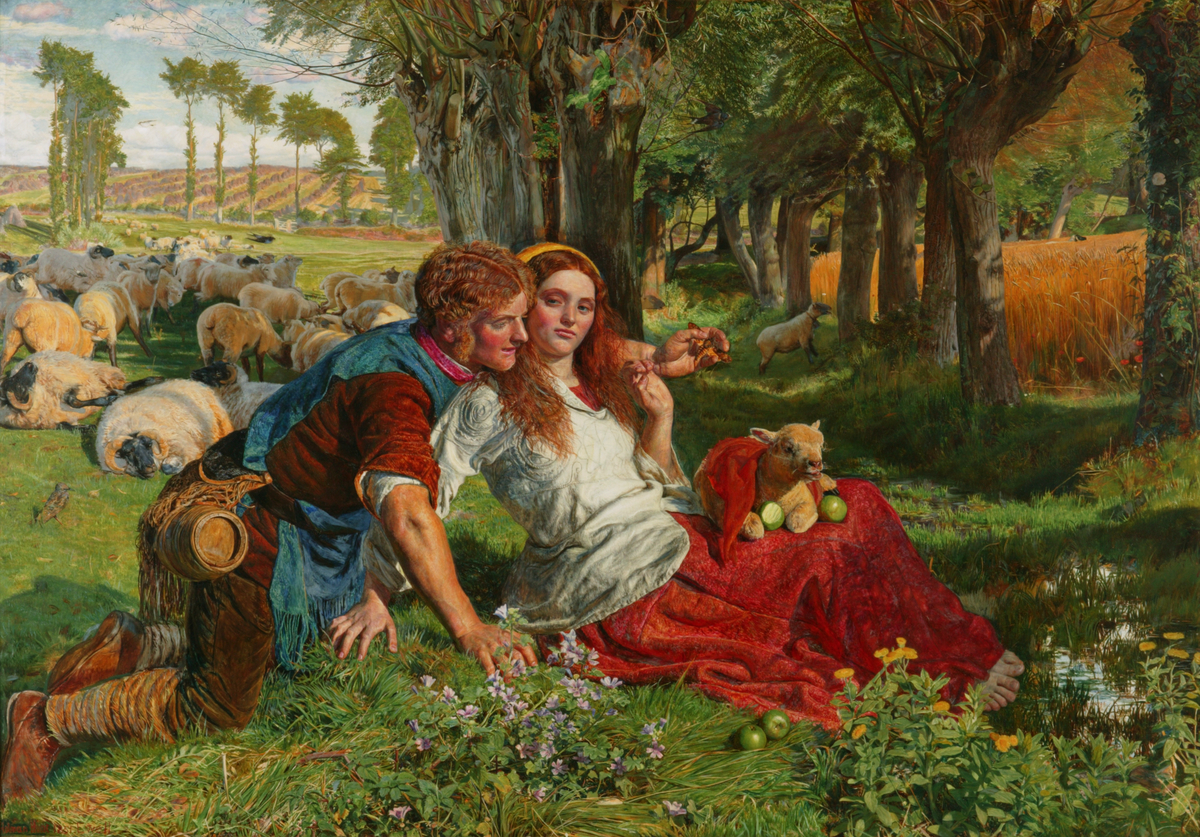 William Holman Hunt (1827-1910)
The painting, The Hireling Shepherd, by Hunt is replete with biblical imagery [Cf. John 10:1-18]. Hunt brought together Rossetti and Millais and in all likelihood was the artist most responsible for the formation of the Pre-Raphaelite Brotherhood.
But it is interesting to note several other things about the PRB. First, they named themselves for someone -- or, more accurately, for a time period prior to someone, namely, the artist Raphael. Why go to the bother of cryptically calling yourself by a time period that preceded an artist when you happen to be aspiring artists living in England?
Look at the dates of Raphael. He was born in 1483 and died in 1520. Notice anything? Not yet?
Okay, then let's look at two other dates that juxtapose interestingly. First, the birth year of a man who would change western Christendom for better or worse, Martin Luther: 1483. And now a date by which this firebrand German monk would have set fire to dry tinder with such tracts as his Epitome in which he declared "that the true Antichrist is sitting in the temple of God and is reigning in Rome -- that empurpled Babylon -- and that the Roman curia is the Synagogue of Satan" [Will Durant, The Reformation: A History of European Civilization from Wyclif to Calvin: 1300-1564, 351].
Secondly, many themes of the PRB came lovingly from plays by William Shakespeare, who as I have posted recently, is attaining a measurable reputation for being a "papist" in post Reformation England.
Thirdly, in their own lifetimes, the PRB artists were castigated for painting themes that narrowly skirted accusations of being pro-Catholic Church. I will share these in future posts.
But the most important piece of evidence that the PRB was not merely a romantic sigh for a lost Medievalism, I think, is the first point above. It was the Brotherhood's agreement to cloak their identity in a kind of counter-Protestant Reformation mentality, artistry, and loyalty. It was just sufficiently obscure and forthright that a curious investigator could easily connect the historical "dots" but most would not.
I would be interested in knowing if others -- and probably much more scholarly than I -- have traced these pieces of evidence. I will happily bow to former and better research if that so happens.
Meanwhile, I like to think I have discovered why I love the Pre-Raphaelite paintings so much.
To learn more about Raphael please link to Artsy’s Raphael page.
What IS the Wrath of God?
One of the most profoundly misunderstood concepts among Christ's followers is that known as God's wrath. Here to help us is our friend, mentor, and pal of the Three Massketeers, Gil Bailie.
The following comes from Gil's taped lecture entitled, "The Mystery of History." For more opportunities to hear Gil speak, either in person or on CD/tape, go to his website linked above.
The following comes from Gil's taped lecture entitled, "The Mystery of History." For more opportunities to hear Gil speak, either in person or on CD/tape, go to his website linked above.
What is “God’s wrath?” Does Jesus reveal a wrathful God? It’s a very central question. Clearly John [of Patmos] is talking about the wrath of God. And clearly the crucifixion and resurrection represent a judgment; a very solemn one with enormous consequences. But how are we to reckon with this notion of the wrath of God?
I will suggest to you the following, not based on my suppositions or my speculation, but based on what I think is in John’s Apocalypse. We don’t realize how profoundly John is reinterpreting the Old Testament images and symbolism that he is using to express his Christian faith. We don’t realize how in concert the Book of Revelation is with all the other New Testament texts. You see, this has to be in concert with I Corinthians 13; this has to be in concert with the Gospels that speak of the mercy of God and that show us God incarnate in the One Who was constantly forgiving and bidding his disciples to turn the other cheek and go the extra mile. John’s Apocalypse has to be in concert with that. And it is, I think, read correctly.
What then is the wrath of God? I would say that the wrath of God is forgiveness. The wrath of God is forgiveness. Sin is its own punishment. Dante knew that. Surely God knows it. All we have to do is look around. Sin is its own punishment. It doesn’t need a shove from God. In the natural course of its transformation from heady self-assertion into dreary despair and alienation. Sin is deprived of all its consolations, save one: the sinner can sulk in the spiteful knowledge that his misery is imposed by a harsh and vindictive God. And he can curse God for condemning him to the hellish conditions in which he finds himself.
But when God forgives through Christ on the cross, then the sinner either accepts forgiveness or he rejects it and is forced to inhabit a hell whose doors stand wide open. And to be tormented thereby by the realization that the torment itself can be blamed on no one but himself. That’s hell. That is the wrath of God made possible by the revelation of God’s infinite mercy and forgiveness that Jesus brings to us. The wrath of God is God eliminating the notion of a wrathful God, and thereby condemning those who refuse forgiveness and cling to their sinful rebellion to the hellish torment of realizing that with one heartfelt mea culpa it could all be otherwise.
Franciscan Monks that Rock
Monks That Rock help spread the Good News to many young who otherwise may be dancing to a different tune.
Wednesday, June 06, 2007
Saint Norbert —1080-1134.

June 6 - St. Norbert
Norbert became archbishop of Magdeburg in central Germany, a territory half pagan and half Christian. In this position he zealously and courageously continued his work for the Church until his death on June 6, 1134.
On the occasion of his ordination to the priesthood, Norbert said,
"O Priest! You are not yourself because you are God. You are not of yourself because you are the servant and minister of Christ. You are not your own because you are the spouse of the Church. You are not yourself because you are the mediator between God and man. You are not from yourself because you are nothing. What then are you? Nothing and everything. O Priest! Take care lest what was said to Christ on the cross be said to you: 'He saved others, himself he cannot save!'"
As most of Europe withers away in indifference to the Christian Word, we pray that Pope Benedict XVI is able to turn the tide in Germany. Read about a saint who, in a distant past, did so much in converting the hearts and souls of Germany.
From American Catholic:
A different world cannot be built by indifferent people. The same is true in regard to the Church. Sad to say, the so-called updating of the Church has not engendered the different Church which was so devoutly and hopefully envisioned by Vatican Council II. A principal reason for this failure was—and is—the indifference of vast numbers of nominal faithful, their indifference to ecclesiastical authority and essential doctrines of the faith. Unswerving loyalty to the Church and fervent devotion to the Eucharist, as practiced by Norbert, will continue immeasurably towards maintaining the people of God in accord with the heart of Christ.
The Great God Debate
Following up on Athos' Hitch post below, the debate between Christopher Hitchens and Mark D. Roberts on Hugh Hewitt's show can be read in transcription or listened to here at Townhall (if you scroll around a bit).
I have not had a chance to read or hear it, and so can give no impressions yet.
Correction: Transcripts are not actually up yet, but you can still listen.
I have not had a chance to read or hear it, and so can give no impressions yet.
Correction: Transcripts are not actually up yet, but you can still listen.
Subscribe to:
Posts (Atom)