So, what's a chimera? English and Welsh bishops say that chimeras are humans and deserve life and dignity.
Porthos recommended Kazuo Ishiguro's Never Let Me Go. It apparently has come to this ...
Tuesday, June 26, 2007


"It Grows In Silence"
How does a vocation grow? The Deacon’s Bench offers two magnificent videos on vocations to the priesthood produced by the National Conference of Catholic Bishops.
Monday, June 25, 2007
The Sign of the Cross +
 If you haven't watched it, Children of Men qualifies as the most fear-filled prophetic film of sacrificial meltdown you will see. Why bother to watch the whole phantasmagoria? For a simple reason: Theo. Theo (played by Clive Owen -- King Arthur, 2004) is not a finger-pointing accuser, but a hustler/cubicle flunky who becomes a Saint Joseph-like protector of the only child born (in the entire world!) in 17 years. It is he who threads this immigrant mother and child through the death-dealing special interests of this dystopic futuristic vision of England, with the help of political cartoonist, Jasper Palmer, a favorite character of mine, played by Michael Caine.
Too, here is an appreciative review/essay by John Murphy in Godspy.
Warning: 'R' rated gun violence. But if you watch, look for the Sign of the Cross:
Dreadful Numbers
While Aramis launched a comment to The Turning Tide – Youth Turn to the Catholic Church that was worthy of a post in itself, John Heard (“Dreadnought”) ferrets out the faulty logic and crumbling reasons for supporting the so-called entity, "gay marriage" (warning: some disturbing images). As a professed homosexual, Heard is at one and the same time in full obedience to the Magisterium and teachings of the Catholic Church.
Let us never flag in prayer, practicing the virtues (Cardinal and Theological), and observance of the Blessed Sacrament. Our warfare, like that of St.-Anne's-on-the Hill in C. S. Lewis's That Hideous Strength and Aly's in The Dionysus Mandate is against the powers and principalities of Satan.
Jesus on the Most Holy Cross did not see wolves crucifying Him, as our friend and mentor, Gil Bailie says. He saw lost sheep. Hate the sin, never the sinner(s). Deo gratias!
Let us never flag in prayer, practicing the virtues (Cardinal and Theological), and observance of the Blessed Sacrament. Our warfare, like that of St.-Anne's-on-the Hill in C. S. Lewis's That Hideous Strength and Aly's in The Dionysus Mandate is against the powers and principalities of Satan.
Jesus on the Most Holy Cross did not see wolves crucifying Him, as our friend and mentor, Gil Bailie says. He saw lost sheep. Hate the sin, never the sinner(s). Deo gratias!
The Turning Tide
Youth Turn to the Catholic Church
as the Solid Rock amidst the shifting sands of cultural chaos.
as the Solid Rock amidst the shifting sands of cultural chaos.
Sunday, June 24, 2007
The Tiny Crack
Using the image of Monsignor Ronald Knox, “Within the Revolted City,”* one sees clearly that our planet is still that dreadful place. Gangs roam and ravage, seeking to quell their fears by making others feel what they refuse to feel in themselves: cowardice, dread, anguish, despair. Unforgiveness is the O/S, blame is the coin of the realm, and violence the cathartic pay-off.
Atop this unholy polis, like a mocking regent, sits Lucifer in dulcet, preening self-aggrandizement. All appears under his malevolent sway and power. His sole fear is that somehow the tiny crack in his city’s wall – caused 2,000 years ago by the One who, then, really did strike fear into him -- that tiny crack may one day bring down his ruinous reign and all the world’s kingdoms that parody his own. But his forces seem greater, more powerful and deadly today than ever. The tiny crack no longer concerns him.
But that tiny crack has both allowed something into his city and into the heart of every citizen of it. No longer are humans consigned merely to the heroic, or romantic, or lyrical -- noble human qualities at one time -- but now there is the breeze of the providential. One sees it in the best literature, like Tolkien's Lord of the Rings, and hears it in Leonard Cohen's Anthem, for example (Golding tries in his The Dionysus Mandate, too). In these there is the ineffable conviction of unseen help, beyond satanic power, pistols, pomp, and policies. And beyond even the cessation of biological life itself (Gandalf, Lenny).
And this providential help is not impersonal or transpersonal. It is “more we ourselves than we are are ourselves.” There is no need to stand off from it, fearing its influence or intrusion. It is mother’s milk, father’s arms, spouse's steadfast love, children at the table -- comfort, joy, red meat, mead, wine, and Home all in One.
And this Personal has a human face and name. And Mother.
This is the Good News of that tiny crack. It has not only breeched Satan's city wall. Its fissure runs through every human heart, only asking for the chance to broaden, widen, and let in the light of life and breeze of the Holy Spirit.
One of the best spokesmen at work thematizing this providential hope is Gil Bailie. For many years, Bailie worked along literary lines, mixing in insights of Carl Jung's analytical psychology -- but this, again, only gave a shove to the most noble aspects of human nature (Tenemos). It could not go further than the impersonal help of the collective unconscious -- a questionable source of assistance, at best. Then came Gil's discovery of René Girard's mimetic theory. Like nothing else, Girard's work gave Bailie the lens through which to view the "revolted city" of Lucifer with clinically forensic eyes (The Florilegia Institute).
But now Bailie has turned his attentive work to the providential tiny crack (The Cornerstone Forum) with such projects as The Emmaus Road Initiative.
I, for one, laud Bailie's work and urge readers to support his work. It is time to lean more heavily on providence, cursing the darkness less and letting the light in more.
Ring the bells that still can ring.
Forget your perfect offering.
There is a crack in everything.
That's how the light gets in. -- Leonard Cohen, "Anthem"
*University Sermons [1963, 322]
Atop this unholy polis, like a mocking regent, sits Lucifer in dulcet, preening self-aggrandizement. All appears under his malevolent sway and power. His sole fear is that somehow the tiny crack in his city’s wall – caused 2,000 years ago by the One who, then, really did strike fear into him -- that tiny crack may one day bring down his ruinous reign and all the world’s kingdoms that parody his own. But his forces seem greater, more powerful and deadly today than ever. The tiny crack no longer concerns him.
But that tiny crack has both allowed something into his city and into the heart of every citizen of it. No longer are humans consigned merely to the heroic, or romantic, or lyrical -- noble human qualities at one time -- but now there is the breeze of the providential. One sees it in the best literature, like Tolkien's Lord of the Rings, and hears it in Leonard Cohen's Anthem, for example (Golding tries in his The Dionysus Mandate, too). In these there is the ineffable conviction of unseen help, beyond satanic power, pistols, pomp, and policies. And beyond even the cessation of biological life itself (Gandalf, Lenny).
And this providential help is not impersonal or transpersonal. It is “more we ourselves than we are are ourselves.” There is no need to stand off from it, fearing its influence or intrusion. It is mother’s milk, father’s arms, spouse's steadfast love, children at the table -- comfort, joy, red meat, mead, wine, and Home all in One.
And this Personal has a human face and name. And Mother.
This is the Good News of that tiny crack. It has not only breeched Satan's city wall. Its fissure runs through every human heart, only asking for the chance to broaden, widen, and let in the light of life and breeze of the Holy Spirit.
One of the best spokesmen at work thematizing this providential hope is Gil Bailie. For many years, Bailie worked along literary lines, mixing in insights of Carl Jung's analytical psychology -- but this, again, only gave a shove to the most noble aspects of human nature (Tenemos). It could not go further than the impersonal help of the collective unconscious -- a questionable source of assistance, at best. Then came Gil's discovery of René Girard's mimetic theory. Like nothing else, Girard's work gave Bailie the lens through which to view the "revolted city" of Lucifer with clinically forensic eyes (The Florilegia Institute).
But now Bailie has turned his attentive work to the providential tiny crack (The Cornerstone Forum) with such projects as The Emmaus Road Initiative.
I, for one, laud Bailie's work and urge readers to support his work. It is time to lean more heavily on providence, cursing the darkness less and letting the light in more.
Ring the bells that still can ring.
Forget your perfect offering.
There is a crack in everything.
That's how the light gets in. -- Leonard Cohen, "Anthem"
*University Sermons [1963, 322]
Catholics Ponder Muslim Coexistence
In beautiful Venice, Catholics gathered to discuss this timely and vital issue.
One Western leader who has made a point of listening to the concerns of the Christians of the Muslim world is Venice's Cardinal Angelo Scola, host of the two-day encounter at the 17th century Basilica di Santa Maria della Salute. Scola is rapidly becoming Catholicism's most influential voice — beyond the Pope himself — on matters related to the Muslim world. From Venice, which for centuries has served as a bridge betweeen civilizations, the Cardinal founded Oasis, a cultural and study center and twice-annual journal that gathers perspectives from Catholics in Muslim countries. The initiative is both as a way to safeguard the rights of Christian minorities, and to promote mutual understanding between the Church and Islam.
"We gain knowledge about the different forms of Islam by starting with what the Christians living in these various realities suggest to us," Scola said. In the past, many in the Vatican hierarchy believed it was too risky to raise the issues of religious liberty and violence in Islamic countries. "Sometimes we have been too timid," Scola said. "We can't stay quiet. We want the encounter. It is vital to distinguish fundamentalism not just from the so-called 'moderate' Muslims, which can be an ambiguous term, but from the masses in the Islamic world."
Read more …
Saturday, June 23, 2007
Nativity of St. John the Baptist - Abu Gosh
 Saint Anne with the Christ Child, the Virgin, and Saint John the Baptist
Hans Baldung Grien - 1511
On this Solemnity of the Nativity of Saint John the Baptist (the Church only celebrates three births on her liturgical calendar -- guess the other two), I want to make mention of an interesting place if you ever make your way to the Holy Land on pilgrimage. It is a place that (a) may be the historical site of Emmaus, (b) is the site of a magnificent Crusader church similar to that of St. Ann's Church in Jerusalem, and (c) bears the name, alternatively, of St. John the Baptist and the Church of the Resurrection, commemorating the birth of the former and the post-resurrection appearance of Our Lord at Emmaus of the latter. The frescoes in the nave were being restored when I visited in 2001. Also, a chamber music festival takes place there utilizing its magnificent acoustics each year.
This Crusader church at Abu Gosh, Israel also bears the dubious honor of being the setting for a climactic scene in The Dionysus Mandate. Here is a brief excerpt:
He backed Aly down the steps to the grotto holding her arm in one hand and the pistol in the other. Aly recognized the mistake Neesam was making in the darkness as he walked them closer and closer to the edge of the deep, spring-fed baptism pool. She did nothing to warn Neesam or slow their progress. They stepped off and splashed simultaneously into the baptismal’s shockingly cold waters.
Aly had a split second to gulp a deep breath before going under. She felt herself going down in the dark waters with her hands tightly bound in the small of her back. Neesam disappeared. She thought, He’s up and back to the surface already. I can’t swim and I can’t breathe. And I can’t get my hands free.
But Lucent Neesam, though a naturally gifted swimmer, at that moment found himself slowly yet inexorably moved under an ancient stone archway once stood upon by chaplains to the Crusaders. His head struck solid rock when he tried to surface making him wince. All right, son of a buggering b**ch, he told himself. Let’s get out of this infernal puddle. He twisted, sweeping a hand through the further reaches of the baptismal pool. His lungs burned, and he lurched in the direction, he thought, of the opening beyond the massive walls of the Crusader church ...
+ + +
May the good saint forgive any exploitation the author of The Dionysus Mandate may have perpetrated by using the church commemorating his birthplace. Did Neesam and/or Aly get out of the baptismal pool's dark and dangerous waters? Ah, well ...
Waterhouse - PRB
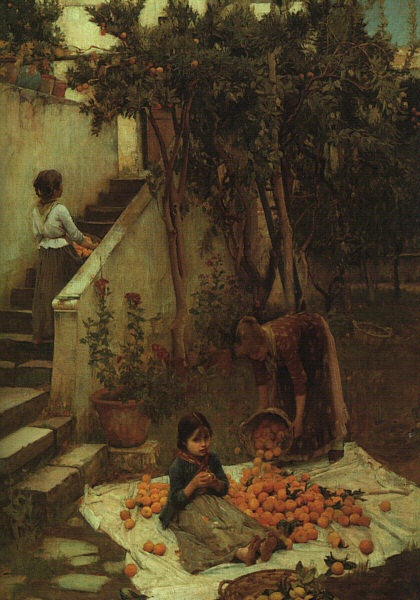 The Orange Gatherers - 1890 [Private Collection]
In 1874, at the age of twenty-five, Waterhouse submitted the classical allegory Sleep and His Half-Brother Death to the Royal Academy's Summer Exhibition. The painting was very well received and he exhibited at the RA almost every year afterwards until his death in 1917. In 1883 he married Esther Kenworthy, the daughter of an art schoolmaster from Ealing who had exhibited her own flower-paintings at the Royal Academy and elsewhere. They had two children, but both died in childhood.
In 1895 Waterhouse was elected to the status of full Academician. He taught at the St. John's Wood Art School, joined the St John's Wood Arts Club, and served on the Royal Academy Council.
One of Waterhouse's most famous paintings is The Lady of Shalott, a study of Elaine of Astolat, who dies of grief when Lancelot will not love her. He actually painted three different versions of this character, in 1888, 1896, and 1916.
Another of Waterhouse's favorite subjects was Ophelia; the most famous of his paintings of Ophelia depicts her just before her death, putting flowers in her hair as she sits on a tree branch leaning over a lake. Like The Lady of Shalott and other Waterhouse paintings, it deals with a woman dying in or near water. He also may have been inspired by paintings of Ophelia by Dante Gabriel Rossetti and Millais. He submitted his Ophelia painting of 1888 in order to receive his diploma from the Royal Academy. (He had originally wanted to submit a painting titled "A Mermaid", but it was not completed in time.) After this, the painting was lost until the 20th century, and is now displayed in the collection of Lord Lloyd-Webber. Waterhouse would paint Ophelia again in 1894 and 1909 or 1910, and planned another painting in the series, called "Ophelia in the Churchyard."
Waterhouse could not finish the series of Ophelia paintings because he was gravely ill with cancer by 1915. He died two years later, and his grave can be found at Kensal Green Cemetery in London. -- Wikipedia
Friday, June 22, 2007
Death & Politics
by Joseph Bottum
[snip] These topics of violence and death in the Bible play a major role in the writings of René Girard, and it is hardly possible to consider questions of death and the origin of culture without mentioning Girard’s fascinating work on the ancient mythology of sacrifice and scapegoats.
In a biographical interview he gave in 1995, Girard declared that all the themes he has developed over the last four decades were present in his mind even in the late 1950s as a “dense intuition,” a “block” to be penetrated little by little. His publications began to appear in the early 1960s with widely acclaimed expositions of the way triangular relations form among characters in novels, particularly Dostoevsky’s. He then moved to anthropology, holding that ancient cultures are based on sacrificial violence against a scapegoat.
The connection came with his increasing study of psychology and his argument that desire is “mimetic”—that we learn what it is we want by watching what others want. The simplest examples involve the innumerable ancient stories, from Egypt down to Rome, that speak of siblings, often twins, one of whom is destroyed in the course of founding a new city. Girard insists we read these myths as recording genuine human murders: In the mad swirl of mimetic violence, each revenge in turn revenged, the nascent city threatens to devour itself. But with the choice of a scapegoat to sacrifice, the cycle can be broken with an unconscious agreement to aim all the culture’s vengeance at a single target.
Some of Girard’s followers seem to envision a precultural state of primal violence, opening Girard’s thought to the complaint that what little we know of ancient history offers no evidence that cities were actually born in riot and mayhem. To interpret sacrificial myths, however, we need not posit an original fury. We need notice only that every ancient culture manifests in its myths a deep terror of the mimetic escalation of violence. In response to this threatened violence of all against all, the old foundational myths pose the solution of another violence: the violence of all against one, the violence in which a victim is selected as the source of the cultural breakdown and sacrificed. The sacrificial victim, Girard writes, “unwittingly conjures up a baleful, infectious force that his own death—or triumph—transforms into a guarantee of order and tranquility.”
Girard’s final turn, to explicit Christian theology, allowed him to unveil the solution: At the center of his thought lies the Cross, the Sacrifice that breaks the cycle of sacrifice, violence, and mimetic murder. For Girard, the problem of forming a culture—of preventing and containing the spiraling disaster of internecine murder and cultural collapse—is like a quadratic equation with two solutions: the negative one of sacrificial mythology and the positive one of nonviolence, made visible by biblical revelation. Christ’s sacrifice breaks open the scapegoat mechanism for all to see the murder that lies at its root.
Girard is surely right that modern political theory has systematically underestimated the social power of revenge: At the root of ancient culture, he notes, there was a burial society—although it usually had to commit murder in order to get the body to bury. Along the way, Girard grants real insight into both how the ancients used sacrifice and why Counter-Enlightenment thinkers embrace death as they strain for some new foundation. Through the old cultural mechanism of murder, violence really can drive out violence—Satan can drive out Satan, to use Girard’s expression—by aiming the escalating aggression of a culture at a single enemy and victim, a scapegoat for all that ails it.
The trouble is that Girard seems to lack much political theory—or, at least, much political theory short of Isaiah’s. “It shall come to pass in the last days” that “all nations shall flow unto” the holy city, but eschatology is a bad guide to ordinary politics. Indeed, in Girard’s reading of history, the Judeo-Christian revelation has increased or even created our modern political problems, for the scapegoat myth—the negative solution to the problem of culture—ceases to work particularly well once we understand how it works.
If the ancient mechanism has begun to fail, as Girard insists, replaced by a new mechanism that will work only in the End Time, then what help is there for us now? Girardianism pushes us to conclude that modern culture, in its essence, has become irretrievably thin and self-contradictory, while the modern state has grown fundamentally ungovernable. Surely the scapegoat mechanism proves too much: With Girard’s psychological explanation of mimetic rivalry for the success of death at forming community, we are left with murder and apocalyptic change as our only alternatives—the quadratic equation with only two solutions.
A more ordinary use of death seems necessary to get us by, enriching everyday life with temporal extension. We need, I suggest, a new theory of the cultural power of grief for the between-time in which we live. We need an intermediate—and properly political—understanding of the debt the living owe the dead.
Read the article/essay here.Thursday, June 21, 2007
They Really Were Out to Get Us...
Self-described ex-KGB operative and defector, Yuri Bezmenov, lays out in this interview the active propaganda measures which the KGB undertook to demoralize the US during the Cold War. NB: This is not a paranoid flag-waving post. Rather a warning in an age of disinformation. Don't get caught in themes; watch the anthropological structures. For more information read from: "Mimetic Theory & Rene Girard" in our sidebar.
Summer Thoughts
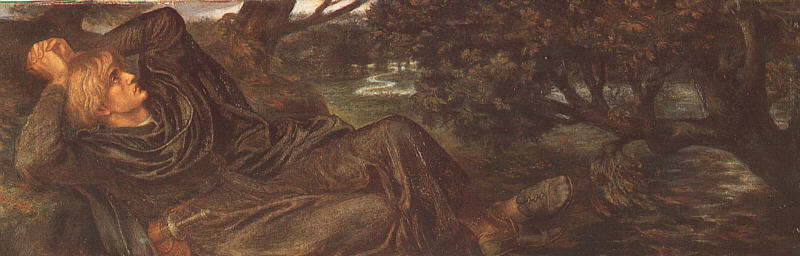 Predella - (1879) - Dante Gabriel Rossetti
It's a great concept, and I don't like to throw cold water on recollections of Bill Murray writhing in all his purgatorial splendor. So, consider this reflection not a squelching of Yousefzade's post, by any means, but instead a commentary on how mimetic theory sees Nietzsche's "eternal return."
In his choosing Dionysus over Christ, Nietzsche was rightly seeing the only alternatives, but he was choosing the way that Girard called "the primitive sacred."
The eternal return is the way that violence "makes gods" and establishes (at least) three elements necessary for culture formation: myth, ritual, and prohibition. After the founding violence during which a victim is arbitrarily chosen and cast out or murdered, myth develops, making the now unified people feel good about their actions of violence. Ritual too accrues vital importance, re-enacting the founding violence so as to "bind back" (religare) the people to what made them unified. This accounts for the universal presence of a sacrificial altar at the heart of every culture. And, finally, prohibitions keep people from falling into behaviors that threaten to destroy culture (murder, adultery, incest, etc.) before ressentiment can be siphoned off in the sanctioned, ritualized, cathartic events of sacrifice.
The "eternal return" takes place in Girard's understanding when the ritual no longer carries sufficient cathartic effect to cohere the culture. It spirals into a sacrificial event (the prologue called "sacrificial preparation") during which prohibitions, distinctions, and taboos are erased, and cultural "meltdown", as it were, occurs.
Disregarding the themes that bombard us in newspapers, internet news reports, blogs, and websites, many see western civilization in the throes, structurally, of just such a stage of the "eternal return."
Personally, I don't think Groundhog Day symbolizes Nietzsche's "eternal return" at all. But go rent it and enjoy -- the cool, snowy scenes may make summer more bearable!
Wednesday, June 20, 2007
Master Catechist - Pope B16 on St. Athanasius
 All too often we seem to blog away about choosing sides; like Christianity v. Islam or conservative v. liberal or atheist v. religious or corporate life v. farming (and on and on as we can't seem to define the "I" of each of us any other way except by the 'us v. them' scenario) and the sad reality is that very few of us in the pews this Sunday will have actually taken the time to study from any of the great catechists for the sole purpose of drawing ever nearer to God. I think that Amy Welborn has a great challenge for all of us, Catholic or otherwise, and that is to develop or get into a study using the soon to be available Apostles and her study guide coming out through OSV.
This is not to say that it isn't interesting to learn about the 'other side', however if called upon to defend the Church and The Word, just how much are you up on it to do that? It is one thing to know the 'other side' but it is another thing to have experienced the encounter of Christ and having your "I" expanded so to meet the 'other' and be on firm ground. Having just come from a Jeff Cavin and Tim Gray workshop on Acts of the Apostles (I'm that one toward the back right side next to the aisle) there is more and more options (meaning less and less excuses not) to get immersed in The Word. Are you up to doing that in a manner causing the least amount of scandal? When we model after the great catechists, who have drawn all their faith, hope, knowledge and love from the Living Word, rarely is one scandalized for the Truth sets one free. Read about St. Athanasius and St. Anthony and allow them to help you draw nearer to God.
From "ATHANASIUS: PASSIONATE THEOLOGIAN OF THE INCARNATE WORD" at Vatican Information Service reporting on Pope Benedict XVI's catechises this morning.
This saint's most famous work "is his treatise 'On the Incantation of the Word'," in which he affirms that the Word of God "was made man that we might be made God; and He manifested Himself by a body that we might receive the idea of the unseen Father; and He endured the insolence of men that we might inherit immortality."Here is a link to "Life of St. Anthony" by St. Athanasius that Pope Benedict XVI refers to in his catechises this morning.
Athanasius is also the author of meditations upon the Psalms and, above all, of one of the most popular works of ancient Christian literature, "the 'Life of St. Anthony,' the biography of St. Anthony Abbot which ... made a great contribution to the spread of monasticism in East and West."
The life of Athanasius, like that of St. Anthony, the Pope concluded, "shows us that 'those who draw near to God do not withdraw from men, but rather become truly close to them'."
Tip of the hat to Michael @ Annunciation
Prager's Alley & Don't-Get-It Atheists
 Dennis Prager confronted Christopher Hitchens with an hypothetical situation. Hitch cited Prager's question in his book, God Is Not Great: How Religion Poisons Everything, and even Richard Dawkins mentioned it. However, Prager now says Hitch mis-remembers the question, the context, and just about everything that he, Prager, was driving at. Decide for yourself -- Prager:
A question I pose to atheists and others who argue that religion is irrelevant to moral behavior has been cited by Christopher Hitchens in his national best-seller, "God Is Not Great: How Religion Poisons Everything." And Hitchens's citation has been widely quoted – from the New Yorker to the website of the Oxford evolutionist and best-selling atheist author Richard Dawkins.
Tuesday, June 19, 2007
A Must Read - On the Impact of Christianity
Fjordman (on a par with Mark Steyn, in my book) takes on enemies of Christianity, although admittedly not a Christian himself:
Keep reading …
Quite a few individuals among the anti-Western crowd hate Christianity passionately. You have to be an imbecile to believe that Christianity and Islam are “almost identical,” meaning “just as bad.” There’s a world of difference between the religious founders and their followers. Yes, it’s true that the Church has at times suppressed dissenters, including scientists. This is common knowledge. But to present Christianity as exclusively anti-science is factually wrong.
Dads - In Body and Truth
An area of occasional concern for the 3Ms is what fatherhood should look like for Christian men. Gerald Augustinus over at The Cafeteria Is Closed posted featuring an article from Slate entitled, ”Stretch Marks for Fathers.” Research is now showing that as their spouse's pregnancy develops, and even after birth, they too undergo some fairly significant physical changes. This is a hopeful development in underscoring the essential rôle of fathers today.
Both areas -- the new-found physiological changes in fathers' bodies and the abandoning of families by fathers -- are areas for profound prayer, accountability, and responsibility. Dads are not perfect. But nature can be profoundly changed, and even perfected, by the grace of God. (Neither of my sons would claim that of their father, I assure you.) And the place to begin is and ever will be the sacramental locus of God's grace, the Catholic Church.
Interest in how men's bodies prepare themselves for fatherhood only seems to matter to the extent it sheds light on mothers. Meanwhile, the ways in which dads screw up their kids is a thriving area of research.Meanwhile, in today's Washington Post, Eugene Robinson's op/ed piece, ”A Father’s Absence and a Son’s Message,” addresses the "dire" situation caused by absent fathers.
Both areas -- the new-found physiological changes in fathers' bodies and the abandoning of families by fathers -- are areas for profound prayer, accountability, and responsibility. Dads are not perfect. But nature can be profoundly changed, and even perfected, by the grace of God. (Neither of my sons would claim that of their father, I assure you.) And the place to begin is and ever will be the sacramental locus of God's grace, the Catholic Church.
Monday, June 18, 2007
Denouncing the Culture of Death
'The secretary of the organization Pro-Life Youth of Valencia (Spain), Juan Rivera, denounced the State and society for their “de facto protection of abortion,” saying, “Its hypocrisy to speak about human rights and at the same time pay no attention to those who walk down the street with their hands stained with blood.” '
This sounds like remarkable wisdom from one so young.
This sounds like remarkable wisdom from one so young.
Subscribe to:
Posts (Atom)