Monday, July 16, 2007

The Complicated Key vs. Dumbed-down Faith Alone

OCCASIONALLY, I am asked why the Catholic Church needs the Christian faith to be so confounded complex. It should be easy: just say (the magic words): "I accept Jesus Christ as my personal Lord and Savior," and be done with it.

Please recall that these same folk are fairly responsible adults. They balance their checkbooks. They fill out their tax forms. They carry out careers that place a great loads of responsibility on their very capable minds and shoulders. And yet, when it comes to something like eternal salvation, they suddenly have the notion that it all should be dumbed down to something a 3rd grader might do quite handily. Why is that?

John Henry Cardinal Newman, one of my British Catholic convert heroes, of whom I solicit prayers each day, once said, "To be deep in history is to cease to be a Protestant." Now, I am not certainly not "deep in history," but I am blessed with a vision and understanding that if the Church was indeed going to be able to carry out the work of Our Lord throughout all of history and, potentially, for all the world's peoples, it would have to look from the outside, perhaps, rather ungainly. Not axiomatically comprehensible in "sound bites" or in "Four Spiritual Laws." Not aerodynamic or given to iPhone user-friendly straight-out-of-the-box "I-get-it" ease for everyone Christ came to save.

I mean, look at the Bible, for goodness' sake. The story of God's working in history is flabbergastingly complex, enormous, and overwhelming. Why now do we think things should become all Tinker-toys and Morning Recess in the age of Christ's Church, particularly when we are facing three great foes, secular atheism, neo-paganism, and Jihadists?

It takes some humility to become a member of the Catholic Church; a willingness to say that everybody is not "equal" (that Politically Correct ghost-light goal), but the ground at the foot of the Cross is level and all persons standing there are equally in need of the grace of God for salvation. It also takes a realization that in our dark world and culture of death, we need unity, visibility, and organization with the complexity that entails. Therefore, G. K. Chesterton could write about the necessary complexity of a key and the Catholic Church this way:
"The shape of a key is in itself a rather fantastic shape. A savage who did not know it was a key would have the greatest difficulty in guessing what it could possibly be. And it is fantastic because it is in a sense arbitrary. A key is not a matter of abstractions; in that sense a key is not a matter of argument. It either fits the lock or it does not ...
"A key is necessarily a thing with a pattern, so this was one having in some ways a rather elaborate pattern. When people complain of the religion being so early complicated with theology and things of the kind, they forget that the world had not only got into a hole, but had got into a whole maze of holes and corners ... If the faith had faced the world only with the platitudes about peace and simplicity some moralists would confine it to, it would not have had the faintest effect on that luxurious and labyrinthine lunatic asylum ... There was undoubtedly much about the key that seemed complex; indeed there was only one thing about it that was simple. It opened the door."

Decaf - Handmotions in Heaven

On the lighter side...you will get a kick out of Bob Rice and Chris Padgett. Bob teaches at Franciscan University in Steubenville and Chris is the former lead singer of the contemporary gospel group “Scarecrow & Tinmen.”


tip to Jeff Cavins

Rivalry Unveiled -- Alma-Tadema

Unconscious Rivals (1893) - Sir Lawrence Alma-Tadema

René Girard writes, "Jealous and envy imply a third presence: object, subject, and a third person toward whom the jealousy or envy is directed. These two 'vices' are therefore triangular; however, we never recognize a model in the person who arouses jealousy because we always take a jealous person's attitude toward the problem of jealousy. Like all victims of internal mediation, the jealous person easily convinces himself that his desire is spontaneous, in other words, that it is deeply rooted in the object and the object alone. As a result he always maintains that his desire preceded the intervention of the mediator. He would have us see him as an intruder, a bore, a terzo incomodo who interrupts a delightful tête-à-tête. Jealousy is thus reduced to the irritation we all experience when one of our desires is accidentally thwarted. But true jealousy is infinitely more profound and complex; it always contains an element of fascination with the insolent rival ..." (My emphases)

This is why truest and dearest friends share nearly every thing in common; they "catch" desire from one another. Favorite sports teams, favorite fashions, favorite political leanings. However, as Alma-Tadema shows in the painting above, best friends can share nearly everything in common ... except someone they both desire. One can only imagine who it was who just passed under their admiring eyes!

Ultimately, and sadly, according to Robert Hamerton-Kelly, “(The rivalrous, resentful mind) is a mind enslaved. It desires not only to possess the other, but to consume or destroy. It wishes not only to imitate the other, nor merely to possess itself in the other, but to destroy the other as the place where the self is alien to the self.”

Father Lombardi - On Unity

"Widen Your Hearts!"
ROME, JULY 15, 2007 (Zenit.org).- Jesuit Father Federico Lombardi says Benedict XVI's "Summorum Pontificum" and the message accompanying it are a call to "enlarging the heart," reciprocal openness and reconciliation.

The Vatican spokesman commented on the July 7 papal document written "motu proprio" (on one's own initiative) during the most recent edition of the television program "Octava Dies."

Father Lombardi explained the Holy Father's hopes by referring to a phrase the latter used from St. Paul's Second Letter to the Corinthians: "'Our mouth is open to you, Corinthians, our heart is wide. You are not restricted by us, but you are restricted in your own affections. In return … widen your hearts also!'

"Benedict XVI makes his own these words of St. Paul in the culminating point of his accompanying letter to the recent [document issued] 'motu proprio' on the liturgy, to express in a more profound way the spirit that animates him. And he continues: 'Let us generously open our hearts and make room for everything that the faith itself allows.'"
Read further …

Saturday, July 14, 2007

The Age on René Girard

From a few years ago, Philip Hunt's excellent essay on Girard appeared in The Age. I was reminded of it as I read from The Letters of J. R. R. Tolkien, edited by Humphrey Carpenter and Christopher Tolkien. Hunt writes:
Girard's work shows that all human societies have mythologies. The most common is variously described as the victimage mechanism or scapegoating. Societies based on this mythology form when someone is accused as a scapegoat for the conflict that exists in society. Guilt is incidental.

Girard suggests that modern societies, too, are based on mythologies. The many symbols of nationalism - cheering the president, singing the anthem, waving the flag, and taboos and penalties against those who don't cheer, sing or wave loudly enough - all these are typical of mythologies in other societies.

The problem we have is that we do not think so.

When some wild Arab spokesman describes America as the "Great Satan" we know immediately that he is appealing to a myth. But when President Bush puts Iraq and North Korea on the "axis of evil" we react as if he is stating a fact. Are we incapable of seeing in ourselves that which we see in others?
Ouch. Tolkien also knew that if one uses the weapons of Mordor, one cannot expect to have a very "happy" ending.

A Catholic Vision for Farm and Town

From the National Catholic Reporter:
"It’s not well known that Catholics have been way ahead of Willie Nelson or Wendell Berry when it comes to a populist, environmental vision for rural America.

“ 'Environmental history intersects with American religious history in the National Catholic Rural Life Conference, with its distinctly Catholic-American environmental vision,' University of Notre Dame scholars Christopher Hamlin and John McGreevy wrote last year, adding that the conference has been completely missing from the environmental history and overlooked in the religious history.

"Consistently over its history, the conference has expressed and worked on behalf of a vision of religious, cultural, social, ethical and environmental values, all seen as part of one web of life.

"From inventing new kinds of Catholic rural communities during the Depression to countering the predations of the agri-industrial complex in recent years, the conference has served rural Catholics.

"Headquarters is a barn-red, two-story ranch house on the outskirts of Des Moines about a mile from where Interstates 35 and 80 intersect to form a crossroads of the nation.

"Its location in the upper Midwest is no accident, as it was born into and much influenced by the German-Catholic heritage of that area, which included a strong agrarian vision. Input from figures like liturgical reformer Benedictine Fr. Virgil Michel shaped the conference in its early years.

"Easily one of the most remarkable conference figures was Msgr. Luigi Ligutti, director during the 1950s, who was nicknamed the pope’s county agent.' ”

Read further …

The Gift of Self - Tape 3

Desire - Compulsive Preoccupation With the Other

Girard says,

“Desire is what happens to human relationships when there is no longer any resolution through the victim.”

"There can be no ritualistic or victimary resolution to the modern crisis. The crisis can be stabilized at different levels according to the individual’s concern, but it always lacks the resources of catharsis and expulsion.”
Click here to read my transcript of the beginning of tape 3 (a review of tape 1 & 2) in Gil Bailie's series, The Gift of Self.

The Meaning of Coredemptrix


tip to Catholic Video of the Day

In the words of the late Mother Teresa of Calcutta, “Of course Mary is the Co-redemptrix — she gave Jesus his body, and his body is what saved us.”

These are no lightweight issues - link here.

#7 - “Suffering is Redemptive” and the “Culture of Death”

A solemn definition of Mary Co-redemptrix would be a Christian proclamation to the world that “suffering is redemptive.” The Christian example of the Co-redemptrix manifests to the world that to accept the providentially permitted crosses of our human existence is not a valueless waste to be avoided at all costs, including intrinsic evils such as euthanasia and abortion. But rather that the patient endurance of all human hardships are of supernatural value when united with the sufferings of Jesus Christ, a participation in the distribution of the redemptive graces of Calvary, both for ourselves and for others (cf. Col. 1:24).

Even the example of Mary’s “yes” to unborn life, in circumstances which could foster undue judgement and ridicule from people surrounding her, is an example of a co-redemptive “yes” that all people should say in response to the event of unborn life, regardless the circumstance.

John Paul II describes the present “Culture of Death” as a “cultural climate which fails to perceive any meaning or value in suffering, but rather considers suffering to be the epitome of evil, to be eliminated at all cost. This is especially the case in the absence of a religious outlook which could help provide a positive under­standing of the mystery of suffering.” [79]

The concrete example of Mary Co-redemptrix offers to the Church and the world the positive Christian message that “suffering is redemptive” in all possible circumstances, from Christian persecution, to terminal cancer, to “unwanted” pregnancy, to the ordinary crosses of daily life.

Chick on Dr. Mark Miravalle to see more.


Looking at this from a Girardian perspective we may say that this brings into question the whole ontology issue of where one abides. If one abides in the One True God - the God that Mary found herself standing before at Golgotha - then they abide in Real Transcendence. At this grounding is where one can have a true and honest understanding of suffering that reaches beyond to the faith, hope and love of Christ for sustenance. It is here one dies to the flesh, the negative imitation of desire (compulsive pre-occupation of the other) and is reborn in Christ.

If one however has no real grounding, only blowing from one false transcendent noise-maker to the next, one lives in a constant state of negative desire (a compulsive pre-occupation with the other).

I close asking Mary to extend her YES for enabling God's Will to be done in me.

The Prayer of Mary
From the Catechism of the Catholic Church, Simplified

Mary's Cooperative Prayer (2617)
At the Annunciation, Mary's prayer cooperated in Christ's conception. At Pentecost Mary's prayer cooperated in forming the Church, Christ's Body. God found in Mary the acceptance he had always wanted. "Let it be done to me according to your Word" (Lk 1:38).

Her Prayer of Intercession (2618)
Mary's prayer of intercession was revealed at a wedding feast. This prefigured the wedding banquet of the Lamb, when Jesus gave his body and blood for his bride, the Church. At the foot of the cross, Mary became the "mother of all the living" (Gen 3:20).

Her Maternal Prayer (2619)
Mary's Magnificat is a song of the Mother of God and of the Church. It is a song of Zion and of the new People of God; a song "of the poor" who hope in the fulfillment of God's promises.

Friday, July 13, 2007

What Theists Can

In the op/ed section of the Washington Post, a skeptical Michael Gerson nearly hits the nail on the head thematically (if not anthropologically) in his piece, What Atheists Can't Answer.
British author G.K. Chesterton argued that every act of blasphemy is a kind of tribute to God, because it is based on belief. "If anyone doubts this," he wrote, "let him sit down seriously and try to think blasphemous thoughts about Thor."

By the evidence of the New York Times bestseller list, God has recently been bathed in such tributes. An irreverent trinity -- Christopher Hitchens, Sam Harris and Richard Dawkins -- has sold a lot of books accusing theism of fostering hatred, repressing sexuality and mutilating children (Hitchens doesn't approve of male circumcision). Every miracle is a fraud. Every mystic is a madman. And this atheism is presented as a war of liberation against centuries of spiritual tyranny.
What Gerson sees as the problem is the lack of a foundation for morality in atheism, not a necessity to prove of God's existence, which holds no interest for him.
So the dilemma is this: How do we choose between good and bad instincts? Theism, for several millennia, has given one answer: We should cultivate the better angels of our nature because the God we love and respect requires it. While many of us fall tragically short, the ideal remains.

Atheism provides no answer to this dilemma. It cannot reply: "Obey your evolutionary instincts" because those instincts are conflicted. "Respect your brain chemistry" or "follow your mental wiring" don't seem very compelling either. It would be perfectly rational for someone to respond: "To hell with my wiring and your socialization, I'm going to do whatever I please." C.S. Lewis put the argument this way: "When all that says 'it is good' has been debunked, what says 'I want' remains."
Perhaps this is why the Holy Father emphasizes the tectonic plate division does not run between the monotheisms of Judeo-Christianity and Islam (though it will take a great deal of goodwill, charity, and infused grace for all of us to see eye-to-eye). Rather, it runs between the vacuous secularist-atheist neo-paganism that is still growing like a cancer and persons who take seriously the God Who Is.

A Change of Heart?

A bizarre story from today's Washington Post begins thus:
A grand feast of marinated steaks and jumbo shrimp was winding down, and a group of friends was sitting on the back patio of a Capitol Hill home, sipping red wine. Suddenly, a hooded man slid in through an open gate and put the barrel of a handgun to the head of a 14-year-old guest.

"Give me your money, or I'll start shooting," he demanded, according to D.C. police and witness accounts.

The five other guests, including the girls' parents, froze -- and then one spoke.

"We were just finishing dinner," Cristina "Cha Cha" Rowan, 43, blurted out. "Why don't you have a glass of wine with us?"

The intruder took a sip of their Chateau Malescot St-Exupéry and said, "Damn, that's good wine."

The girl's father, Michael Rabdau, 51, who described the harrowing evening in an interview, told the intruder, described as being in his 20s, to take the whole glass. Rowan offered him the bottle. The would-be robber, his hood now down, took another sip and had a bite of Camembert cheese that was on the table.

Then he tucked the gun into the pocket of his nylon sweatpants.

"I think I may have come to the wrong house," he said, looking around the patio of the home in the 1300 block of Constitution Avenue NE.

"I'm sorry," he told the group. "Can I get a hug?"
Keep reading ...

Did the suggestion, "Why don't you have a glass of wine with us?" make all the difference? From the viewpoint of mimetic theory, yes. The previously invisible person, famished for he-knew-not-what suddenly had every eye fixed on him, and in the invitation, "Why don't you have a glass of wine with us?" he was given a rushing-in of ontological substantiation, belonging, and entrée.

Was it true change of heart? I'd keep the security system on ...

Thursday, July 12, 2007

Bad Hare Day

There has to be a parable in this, and
Maybe Jimmy Carter and Monty Python have a point ...

Journey Home

Very affecting testimony from a former UK Gangster on this week's The Journey Home. It might be up as archived video up for four or five days.

1) Go to the EWTN site,
2) pull down the Multimedia menu to Archived RealVideo,
3) select The Journey Home on the secondary menu that opens up on the right.

Touching Heaven and Hell

A man, Matthew Dovel, tells ABC News that he has seen Heaven and hell; both visions transformed his life. The former he saw as a boy when involved in a pool accident. The latter gave him grace to go "cold turkey" from a $1,000-per week drug habit and found a suicide prevention non-profit. Science can't get further than amino acids, electrical impulses, and similes (natch).

But a film that is funny as hell (sorry), with astounding images, and one or two extremely right-on theological insights (like the Hebrew meaning of 'Chabod' - "glory") is Constantine, starring Keanu Reeves and Rachel Weisz. This clip-vision of hell aligns pretty well with what Dovel experienced:

Missouri Puts It to Planned Parenthood

Is Missouri becoming the American Poland? And I mean that as a supreme compliment!
[Tip: J. Akin]

Wednesday, July 11, 2007

That Catholic Show #6 - You Are a Priest Forever

The Gift of Self -- Excerpt from tape series by Gil Bailie

As I revisit the tape series, The Gift of Self: Reflections on the Meaning of Christian Discipleship by Gil Bailie I will try to leave fresh notes here on our blog.

Conclusion to tape 1

"There is no unique subject: no personality without otherness; no consciousness turned in upon itself; no real being without intersubjectivity; no real knowledge nor ontological density without mystery. And no man without God."
- Henri de Lubac

Gil concludes the first session with the following:
"Either he is right or we moderns are right. The money is on the board and the dice are rolling… We moderns, by and large, have put all our faith in something other than what he (de Lubac) says. The gamble is whether or not some kind of selfhood that knows nothing of what de Lubac is talking about can retain its independence and its sanity and its civility as it moves further and further away from the biblical tradition that de Lubac is articulating."

"...note with interest: '…no real knowledge ... without mystery.' This takes us back to the Enlightenment project which was to achieve real knowledge by mere acts of rational or empirical analysis. We must take our hats off (to the Enlightenment) for it has produced a mountain of insights and information – but as Eliot says, 'Where is wisdom we have lost in knowledge? Where is the knowledge we have lost in information?' "

"Again, de Lubac says that it (information) looses its status as knowledge if it does not defer religiously to something greater than itself."

St Benedict's Blessing - Fruitfulness of the Spirit and Author of Heaven

Blessing to all and especially ... "to those whom he was arming against the cruelty of the world and the violence of the devil: 'Be of good cheer, I have overcome the world.'" (from quote below)


I, Aramis, believe that when we write or read other commentaries on the culture today about concerns over religionists terrorizing the world we must always re-member who (or what) we ourselves are birthing (see previous post, God in a World of Violence). Are we birthing ressentiment by way of getting caught up in bad imitation of the other and therefore fanning fire with fire or are we birthing Him? From the Meditation of the Day in the Magnificat today: "And of course this is the victory that overcomes the world, our faith, but only if it is not tepid or timorous but confident, a faith unfeigned, a hope unshaken. Not only is the world overcome by it but heaven is won." It is our faith gifted to us by Our Lord that overcomes the world as we go out and share it with those close as well to those who are foreign to us - both are our sisters and brothers.


The Reign of God at Hand

Saint Benedict’s blessing is in the fruitfulness of the Spirit and the Author of heaven, who speaks through the Prophets: “I will be as the dew.” Of him also it is said: “Your dew is the dew of light.” And certainly in Christ is the blessing of the Father, for the Father proclaimed of him: “Blessed be everyone who blesses you.” In very truth therefore the man who trust in the Lord is blessed in the Lord because whoever puts his trust in the Lord inserts himself into him. The tree drinks in the sap of life and the waters of fertility from wherever its roots have penetrated. And surely he has sent out his roots to the waters who – I use the words of our master, Benedict – “has put his hope in God’ and from the very Source of All Good drinks in the waters of life full of blessings and grace.

Through this loving and devoted confidence sins are forgiven, healing obtained for bodily ills and more especially for ills of the soul, dangers averted, fears despised, the world overcome; all things are possible to the one who believes, there is no doubt about it. To those in sins, Christ says: “Take heart, my son; your sins are forgiven you;” to those to whom he gives health of body or soul: “According to your faith be it done to you,” and: “Your faith has made you well”; to those terrified and in danger of shipwreck: “Have faith in God,” and: “Why are you afraid, O men of little faith?” to those whom he was arming against the cruelty of the world and the violence of the devil: “Be of good cheer, I have overcome the world.”

And of course this is the victory that overcomes the world, our faith, but only if it is not tepid or timorous but confident, a faith unfeigned, a hope unshaken. Not only is the world overcome by it but heaven is won.

Blessed Guerric of Igny (+ 1157) was an abbot and a close friend of Saint Bernard.
tip from Doctors of the Catholic Church and the Magnificat

In Adoration of the FEAST OF ST. BENEDICT July 11th from a Franciscan


On this his feast day, let us take heed and bend our ear to the heart of Christ as Saint Benedict prescribes.

From the Prologue of Saint Benedict's Rule:

"Let us then rise at length, since the Scripture arouseth us, saying: "It is now the hour for us to rise from sleep" (Rom 13:11); and having opened our eyes to the deifying light, let us hear with awestruck ears what the divine voice, crying out daily, doth admonish us, saying: "Today, if you shall hear his voice, harden not your hearts" (Ps 94[95]:8). And again: "He that hath ears to hear let him hear what the Spirit saith to the churches" (Rev 2:7). And what doth He say? -- "Come, children, hearken unto me, I will teach you the fear of the Lord" (Ps 33[34]:12). "Run whilst you have the light of life, that the darkness of death overtake you not" (Jn 12:35)."

Franciscans have a deep love and appreciation for Benedict. After Francis' conversion and rebuilding of the little church at San Damiano he went on to the little church of St. Mary of the Angles at the Portiuncula that belonged to Benedictine monks of Subasio. As Francis began to develop a following of brothers they needed a place to stay and worship in. Soon the abbot of the Benedictine monastery gave them in perpetuity their beloved Portiuncula chapel and the ground on which it stood. Francis would accept only the use of the property. The spirit of holy poverty must govern their order, if they were to be disciples of Him who had not where to lay His head. In token of this arrangement, the friars sent to the Benedictines every year as rent a basket of fish caught in a neighboring river. In return, the monks gave the friars a barrel of oil. This annual exchange of gifts still goes on between the Benedictines of St. Peter's in Assisi and the Franciscans of the Portiuncula. On the ground around the chapel the friars quickly built themselves some huts of wood and clay, enclosing them by a hedge. This was the first Franciscan monastery.

This portrait of St. Francis is located in Subiaco, Italy, in a Benedictine Monastery called "Sacro Speco". It is believed to be the true portrait of St. Francis, painted when he was still alive, because of the inscription, which is: Fr. Francesco (not St. Francis), and because there is no halo around St. Francis head. Also, St. Francis does not have the stigmata, so the date of this painting should be before 1224, when he received this precious gift. The Sacro Speco is a shrine, built in the site of the hermitage of St. Benedict, who spent three years in a cave in solitude, on the mountains of Umbria. It is built into the side of a spectacular cliff, and comprises two churches, the upper and the lower one, richly ornate by frescoes. The portrait of St. Francis stands in a lateral room named St. Gregory Chapel.


Sowing Seeds of Faith


A beautiful necessity is the work of the laity in catechizing. Sherry Weddell writes ”In Praise of Catechists.”

Tuesday, July 10, 2007

Monday, July 09, 2007

God in a World of Violence

Your most excellent post Good News Ath and the question, "But won't any religion do?" made me think of my notes from when I led a class on the book Franciscan Prayer by Sr Ilia Delio concerning the God question – pg 55 - 62.

If you are not birthing Christ who or what are you likely to birth?

From: God in a World of Violence by Sr. Diana Culbertson

Overview – Session 1
The Romans had a household god known as Janus. This god was always pictured with two faces – one looking back, one looking forward. He was the god of the past and of beginnings. The doors of the temple of Janus were open at times of war, closed at times of peace. Other versions of this god suggested that he was a god of mercy and of justice. The Persians had two gods: a god of light (Ahura Mazda) and a god of darkness (Ahriman). These two gods accounted for the good and evil in the world. Curiously, many religious believers tend to divide the one God into two: a God who rewards, a God who punishes; a God who curses and a God who blesses. But does the God in whom we believe have two faces? What kind of God did Jesus reveal to us? Was this Abba, this Father of Jesus, just like the God in whom the Jewish people already believed? How was this God different from the God that we project, that we imagine, that we sometimes fear?

Overview – Session 6
The death of Jesus as the innocent victim of human violence, and his being raised to life through the power of the Holy Spirit, reveals the face of God. In God there is nothing but infinite life and love. God has given us his Son who suffered hatred and rejection, who chose to pour out his life so that we could know him and know the infinite love and forgiveness of his Father. Jesus has identified himself with all victims of human violence and all who suffer. Our response to the astonishing love of God for us is to see Jesus in the hungry and the poor, the imprisoned and the weak – all the outcasts of the world. Only the message of the Gospel can heal the world of violence. Only the Holy Spirit can defend us from the evil that threatens to destroy the world that God created out of love.


Sr. Culbertson, an Akron Dominican Sister, is Professor of English and Comparative Literature and Director of Religious Studies at Kent State University in Kent, Ohio and past President of the Colloquium on Violence and Religion. God in a World of Violence - ISBN: 1-56077-710-9 Grade Level: Adult 64 pages

The Mission of Christ's Disciples -- John Paul II


Let us not forget...the Gospel readings 7/8/07 - Luke 10:1-12, 17-20

The Mission of Christ’s Disciples

For the disciple of Christ the duty to evangelize is an obligation of love. “The love of Christ impels us” (2 Cor 5:14), declares the Apostles Paul, recalling all that the Son of God did for us in his redeeming sacrifice: “One man has died for all… that those who live may live no longer for themselves, but for him who died and was raised for their sake’ (2 Cor 5:14-15)…

To be true disciples of the Lord believers must bear witness to their faith, and “witnesses testify not only with words, but also with their lives.” We must keep in mind the words of Jesus: “Not everyone who says to me, ‘Lord, Lord!’ shall enter the kingdom of heaven, but he who does the will of my Father who is in heaven” (Mt 7:21). Openness to the Father’s will supposes a total self-giving, including even the gift of one’s life: “The greatest witness is martyrdom” … The basic task for which Jesus sends out his disciples is the proclamation of the Good News, that is, evangelization (cf. Mk 16: 15-18). Consequently, “to evangelize is a grace and vocation proper to the Church, her most profound identity.”

Urgent needs mean that the mission of evangelization today calls for a new program which can be defined overall as a “new evangelization.” I urgently desire to encourage all the members of God’s People, particularly those living in America, to take up this project and to cooperate in carrying it out. In accepting this mission, everyone should keep in mind that the vital core of the new evangelization must be a clear and unequivocal proclamation of the person of Jesus Christ, that is, the preaching of his name, his teaching, his life, his promises and the kingdom which he has gained for us by his Paschal Mystery.

Pope John Paul II


From the Magnificat 7/8/07 - tip to Doctors of the Church and Catholic Video of the Day

400th Post - In Honor of Brother Porthos

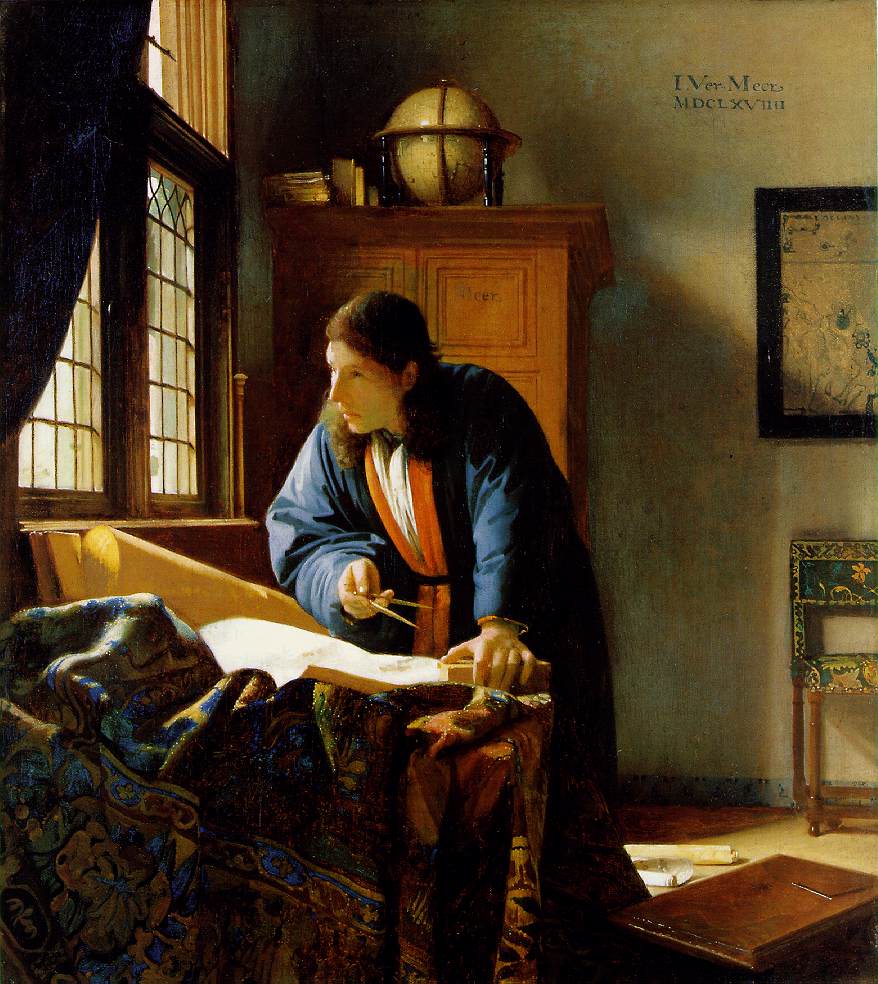
The Geographer - Jan Vermeer
c. 1668-69; Oil on canvas, 52 x 45.5 cm; Stadelsches Kunstinstitut, Frankfurt am Main

In The Geographer, Vermeer presents another individual in an interior. This male figure, though, is endowed with intense energy in comparison to the contemplative women of other compositions. The flow of light from left to right activates the canvas. The flow is accentuated compositionally by the massing of objects on the left. The light spills forcefully into the open area on the right, casting a powerful series of diagonal shadows. Vermeer adjusted his initial depiction of the figure to provide a more active stance. Detailed study of the canvas reveals that the geographer originally looked down at the table, with his dividers also pointed down. Adjusting the composition to align the man's face and the dividers with the flow of light gave further energy to the movement across the canvas. The folds of the robe also serve to activate the figure, with their dynamic, almost abstract depiction in their sunlit portion.

The painting accurately renders the cartographic objects that express the theme: the sea chart, globe, dividers, square and a cross-staff that was used to measure the elevation angle of the sun and stars. It is probable that Vermeer's sophisticated presentation of these instruments was informed by his association with famed scientist Anthony Van Leeuwenhoek. Although no documents exist linking the two, they were both born in Delft in the same year. A contemporary portrait of Leeuwenhoek closely resembles the figure in Vermeer's geographer, and it is very possible that Leewenhoek served as the model.

Another Vermeer work, The Astronomer, is commonly considered a pendant to The Geographer. In it, the same model is depicted, this time among the instruments of astronomical study. Both paintings dramatically convey the excitement of scholarly inquiry and discovery. Considering these works as pendants offers an allegorical interpretation: the astronomer, student of the heavens, searches for spiritual guidance; the geographer, student of the earth, charts the proper course for temporal life. -- Web Museum

Rowling, Tolkien, & Fjordman

From the Global Politician:
Superman, Harry Potter and the War Against Jihad
Fjordman - 7/9/2007

I have commented that there is an undercurrent of anti-Western self-loathing permeating parts of our popular culture and our news media. There is. But there are also some other trends worth studying.

I watched the movie Superman Returns recently. I knew it had received some criticism in advance. Rather than Superman’s traditional motto “truth, justice and the American way,” his mission had now been transformed to “truth, justice and all that stuff" by scribes Michael Dougherty and Dan Harris. “The world has changed. The world is a different place,” Harris said. “The truth is he’s an alien. He was sent from another planet. He has landed on the planet Earth, and he is here for everybody. He’s an international superhero.” “We were always hesitant to include the term ‘American way’ because the meaning of that today is somewhat uncertain,” Dougherty explained.

Some commentators complained that Superman had adopted too much of the “metrosexual” trend and had been reduced from the Man of Steel to the Flying Girlie-Man. I think they were being too hard on Superman. Sure, he probably wears more mascara than his great love Lois Lane, but he still fights the bad guys and kicks their a**es.

Read further …

Sunday, July 08, 2007

Good News

The first bishop of the United States was Archbishop John Carroll (+1815). He wrote:
"...we are all but one body in Christ, and that which strengthens and gives vigor to this mystical body is the common edification mutually given and received, and resulting from the outward functions of religion, which make the greater impression, as we are naturally more encouraged to imitate what we see. But if, on the other hand, this outward worship begins to be neglected, all languishes with it: the idea of religion itself begins to fade away in our minds; impiety avails itself of this neglect and introduces not only a disgust, but even a contempt of all public and every private worship."
What the modern, superficial, and naive secularist who finds himself or herself in this state of "contempt" for the public or private worship as members of the body of Christ, the Church, does not realize is that if one will not have the revealed religion, or faith, that Archbishop Carroll admonishes us to observe, then the only alternative is, as Nietzsche taught us, is Dionysian religion. And what, pray tell is that? Gil Bailie informs us in his tape series on The Gospel of John:
At the Dionysian ritual, the point at which the distinction between male and female, between pleasure and pain, between sex and violence are swept away is the point at which the ritual is about to settle down to its sacrificial business ... [4b]
(For a more detailed examination of the primitive sacred, I suggest chapter one, "The Victimage Mechanism as the Basis of Religion," in Girard's Things Hidden Since the Foundation of the World.) The point is, we may choose to practice (in every since of that word) the Christian faith, or we will fall into the ancient practices of the Dionysian, regardless of the myriad ways we "gussy up" and rationalize it. Probably the most foolish, naive, and self-congratulatory notion today is the myth of the autonomous self. "I Did It Myyyyy Wayyyyy" is the single silliest idea to pass through the human mind, and one that all traditional societies would see as dangerous as the plague. Such a self simply does not exist. Mimetic studies have had to invent an illumining word to help us better understand subjectivity and personhood; namely, "interdividuality". The only choice we have to avoid psychological promiscuity (of which sexual promiscuity is only one symptom) and becoming another modern who has fallen into the Dionysian is to choose to follow Christ through His Church.

"But won't any religion do?" the question may be asked. The shadow of mortality may begin to haunt a person after a close encounter with injury, illness, or death itself, after all. It's quite a marketplace out there, with every imaginable religionist hawking his or her wares. "Why Christianity, for goodness' sake? Why not something more cool? Hip?"

Let's take just one example: Islam. The word itself means "submission". To whom, or what? Like that of all religions, the question goes back to the image of God of this particular religion. In the case of Islam, God, Allah, is a Taskmaster, harsh Judge and Master. Humans are mere slaves, either obedient and faithful or unfaithful, but slaves -- all -- nonetheless. Submit to this Dictator deity, or else... Well, if that is what God is really like, wanting global war, then I'll take hell and the sooner the better.

But if the Bible is correct, and by the way, if the Catholic Church that produced the Bible is correct, then God is love -- a love that is the source and ground of our very being; a love that is steadfast and unconditional; a love that will not abandon us, but is willing to allow us the free will to walk away from this love that is our grounding and selfhood. The Christian faith goes so far as to say that this love became one-with-us, the "Word made flesh" [Jn 1,14] in Jesus Christ the Lord. He lived among us, taught and healed, was crucified, died, was buried, and rose from death in glory and vindication. He established his Church on earth to continue his mission and ministry, feed us grace through his Sacraments, and to reassure us that he will be with us always "the close of the age" [Matt 28,20].

The secularist believes there is no God; no heaven; no hell. So eat, drink, be merry, for tomorrow we will be worm food. He will predictably end up pagan and acting (tho' never admitting) in ways that show that he is worshiping pagan gods and goddesses in "primitive forms of bonding" (Bailie). You can call that good news if you want. I don't.

The Muslim talks about a deity who wants faithful, obedient slaves. You can call that good news if you want. I don't.

Perhaps G. K. Chesterton said well what constitutes good news to mortals:
"...So far as a man may be proud of a religion rooted in humility, I am very proud of my religion; I am especially proud of those parts of it that are most commonly called superstition. I am proud of being fettered by antiquated dogmas and enslaved by dead creeds (as my journalistic friends repeat with so much pertinacity), for I know very well that it is the heretical creeds that are dead, and that it is only the reasonable dogma that lives long enough to be called antiquated."

Saturday, July 07, 2007

Is Timing Everything? What about "Summorum Pontificum"?

I have only known the Mass in the vernacular, and I LOVE IT. With that said though, I go to a Latin Mass every first Saturday of the month (today) and usually find that I want everything to slow WAY down so I can take all the mystery of it in. I do believe there may be important aspects about releasing the Summorum Pontificum document now:

1) as Athos brought up in a comment to a previous post, there will be a bonding of sorts for all Catholics everywhere (including past and future). As the Church continues to be under attack this binding back of Catholics to Our Source of Sustenance will prove to be vitual;

2) it will stimulate a deepening and strengthening of the meaning of sacrifice - as sacrifice is at the heart of the Mass. Girardians will see the significance of this and I believe that this is crucial as we own up to - God wants mercy (as in self-sacrifice) and not the usual projecting of our violence onto another (or falling back into pagan violence that Athos posted here). Pope Benedict XVI continues to shatter the hall-of-mirrors of relativism as he points the way to peace masterfully using Truth to explain the differences in sacrifice; and

3) it centers or re-focuses our sights on the Real Transcendence. Again another point of significance for a Girardian - our only way to break free of the inevitability of mimetic doubling and rivalry was having a model "without sin" - a Transcendent Other. As we all know that we are so into living and believing without MYSTERY, going on for now generations, as we have raised ourselves up in educational environments and 'self-sustaining' worldviews that dispensed with mystery all together. The Latin Mass brings MYSTERY back with full regalia.

Thanks be to God. AMEN.

Pope Benedict XVI's Motu Proprio, Summorum Pontificum (in English)

A tip of the hat to Michael Joseph at Vox Nova.

The USCCB has an unofficial translation of Pope Benedict XVI's Motu Proprio, Summorum Pontificum, and the accompanying explanatory letter to bishops, as well as a Q&A section on the Motu Proprio. You can read all three here.

When all the world seems gripped by hate, bombings and terrorists I can't help but feel that the timing of this treasure and gift of the Catholic Church is just right. During this chaotic time when we could simply 'run' through this blessing, taking it for granted, we have this gift of an opening up, if you will, the significance of what the traditional Mass means to the believers.
To celebrate this day, below is a Traditional Latin Mass filmed on Easter Sunday in 1941 at Our Lady of Sorrows church in Chicago. The film presents the ceremonies of the Missa Solemnis or Solemn High Mass in full detail with narration by then-Mgr. Fulton J. Sheen. Celebrated by Rev. J. R. Keane of the Order of Servites (hence the white habits and cowls), the ceremonies are accompanied by a full polyphonic choir, orchestra, and fifty Gregorian Chanters.


Trady posted this film on You Tube and had the following comments.
The attention to detail in the ceremonies is impressive. Notice, for example, how the servers and ministers always take great care to move in order. Notice too that the servers are all almost identical in height. The Ordinary of the Mass, composed by Rev. Edwin V. Hoover, while pleasant in places, is very much a reflection of its time. The Proper on the other hand is timeless and sung admirably by a healthy throng of Seminarians from Mundelein, Illinois.

Unfortunately due to size restrictions at Youtube around 20 mins have been cut from the original, ... In addition to the cuts I have added new captions and edited the opening credits which had deteriorated in the original. Other than this the film remains largely unchanged. Apologies for the error in the captions for the two parts of the Mass (software). The first part is of couse the Mass of the Catechumens, the second is the Mass of the Faithful.
Another tip of the hat to Catholic Video of the Day for the video.

Friday, July 06, 2007

Pagan Violence - Pure and Simple

David Quinn, like Mark Steyn, has a thing or two to say about Ken Livingstone, the mayor of London, in the wake of the two near-bombings in his fair city and one semi-successful bombing in Scotland.

What I want to suggest, however, goes beyond the predictable hand-wringing and dissembling of journalists and talking-heads. The first place you should go to is to the wisdom of 3 Mass'keteers' friend and mentor, Gil Bailie, who reports on his remarks stated at the COV/R Amsterdam Conference. Here you will begin to see how honest, consistent confrontation with the template proffered by Islam and its prophet can be carried out by a (lay and unofficial) spokesman of the Christian faith, in general, and the Catholic Church, in particular.

But, for the record, let it be stated that from my understanding of the mimetic theory of René Girard, the acts of violence carried out by any human beings in the name of whatever deity they chose to foist their acts of terror upon are, by definition and structurally, sacrificial and at-one with the primitive sacred, regardless of what they themselves call them or however they seek to justify them. Such violence is pagan, a product of Original Sin, and is satanic, purely and simply.

This might surprise representatives of a certain major world religion whose numbers hover around a billion (like that of Catholicism) who feel a compulsion to murder innocent men, women, and children whom they deem to be infidel, while (a) a majority of fellow co-religionists seem to view their more violent brothers and sisters as better representatives of "true" religion than themselves and therefore (b) are likely to cover for these violent extremists if necessary.

The Gospel of Jesus Christ vouchsafed by the Magisterium of the Catholic Church and couched in the deposit of faith found in Scripture and Tradition is the clearest renunciation of such sacred violence. Do people who call themselves "Christian" carry out similar pagan violence? Yes, and they should know better and their guilt is far, far greater for falling back into paganism. And yet, how many of us drive past abortion clinics and do not bat an eye at the genocide and silent screams going on there?

If this sounds shrill, it is not intended to. Rather, it is proposing that we do not fall into a doubling rivalry that will whisk many, many followers of Jesus Christ into the swirling vortex of the primitive sacred realm of Satan. Let us follow Mr. Bailie's example (above) and confront in honesty, charity, and reality in Jesus' Name. The consequences of not doing so are too great to ignore. Secularist naïveté will only continue to create a vacuum that the primitive sacred will gladly fill.

Fulton Sheen on Freedom

Note well what the Archbishop says about freedom to draw a triangle, as long as it has 3 sides. If one chooses to be magnanimous and give a square 5 sides, it is no longer a square ... So, when it a marriage not a marriage, regardless of what a merely human legislature or judiciary defines a marriage to be?

Originally, there was a nifty You Tube clip of Archbishop Sheen on freedom, but ... someone in his infinite wisdom decided to make that "no longer available." Fortunately for us, my brother-in-arms Aramis went and found a transcript of the great man Fulton Sheen that speaks to the matter at hand: freedom. Thanks to Aramis, you can read said transcript here.

Your Lying Cries

Research is showing that babies aren't as innocent as they seem. I ask my Middle School students if they think infants are also stained by Original Sin. Almost all the girls say, "No". I'm glad science finally "has my back" (as the kids say) on this. After all, any parent knows that babies are the most selfish creatures on earth. The whole world revolves around both ends of a baby, and don't they let you know it!

Thursday, July 05, 2007

Faith and Fatherhood

Family researcher, Loren Marks, and co-author of Why Fathers Count, is interviewed.

Another book that looks good (when the book budget is back in line...) is Father – The Family Protector, by James Stenson.

Dante’s Divine Comedy and Independence Day

Anthony Esolen

“The vision of Dante reveals, on the one hand, the continuity between Christian faith in God and the search developed by reason and by the world of religions; on the other, a novelty appears that surpasses all human research: the novelty of a love that moved God to take on a human face, even to take on flesh and blood, the entire human being.” (Pope Benedict XVI)

Dante and Virgil are climbing the steep base of Purgatory Mountain, not sure of the way, when they notice what in that realm is a rarity: a “spirit all alone,” says Virgil, “alone and looking at us quietly” (Purg. 6.58-59). He seems impassive, this spirit, aloof, yet possessed of great nobility. Dante’s description captures the man in a few magnificent strokes:

O soul of Lombardy,
how proud and full of dignity you stood,
deliberate in each movement of the eye
And honorably so. No word he said
but watched us as we neared him, as a lion
at rest will watch and never turn his head.
(61-66)

Homeland

But man is not meant to live alone. Man, says Aristotle, the philosopher whom Dante revered as “the master of all those who know” (Inferno 4.131), can only attain his perfection, the pursuit of moral and intellectual virtue, in the context of a city. Naturally, Aristotle was thinking of Greek republics such as Athens and Sparta, but his wisdom was not lost on Thomas Aquinas, who saw much to be praised in the natural goods that man pursues in the city, while acknowledging that the Christian must look in hope for a good that no city here on earth can provide.

That is why Dante sets his readers up for a surprise. For this soul who seems solitary is most devoted to his homeland and his people. When Virgil asks him the way, he does not pass the time with personal introductions or idle questions about the journey, but speaks immediately from his heart, making

no response
But to inquire about our native land
and who we were in life; and the sweet guide
began with “Mantua,” when that desert shade
Rose up from where he’d stood so firm in place –
“We share one country, you of Mantua!
I am Sordello!” – and the two embraced.
(70-75)

With that outburst of love and patriotism Dante calls the dramatic scene to a halt, suspending the action for a seventy-five-line invective against the Italy of his day, and against his own Florence in particular, whence he was unjustly exiled on pain of death in 1302, and where he would never return. His exclamation after the embrace above is a stern rebuke to all of us who despise patriotism as quaint or illusory:

Ah Italy, you slave, you inn of grief,
you ship without a pilot in the storm,
no lady of the shire, you house for whores,
That noble spirit felt a love so warm
just from the sweet sound of his country’s name,
he ran to greet his townsman even there,
While now in you those still alive all pitch
battle, and gnaw each other, and so near
as those divided by a wall and ditch! (76-84)

Patriotism and worship

Americans still celebrate their Independence Day, with fireworks and barbecues and ballgames; but seldom, I think, with proud faces lifted high, with filial devotion, and even a tear of gratitude. We are perhaps too rich for that, and wealth will ever blur the memory of benefits past. Dante was himself a fierce patriot, one who loved Florence so well that he burned to see her made just. But why should his sacred poem be preoccupied with Florence? What does patriotism have to do with the Christian life?

A great deal more than we wish to admit. No altar, no community: without the common bond of worship, men do not form a city or a nation, and this is as true of America as it was of ancient Athens. No man will lend his heart to a low tax rate or to a system of national roads. But speak to him of liberty, and his eyes grow bright; tell him that that honor was granted to him by his Maker, and he will lay down his life, if need be, to ensure that the honor be respected, for himself and his children, for all generations. So it is that the state can attain its perfection only by recognizing a divinity beyond it; if its dome is not the vault of stars above, it must collapse.

But it is also true that our villages and towns and countries are provided by God as foreshadowings of the world to come. When Aquinas talks about the heavens above us, he uses the Latin caelum or caeli; so too when he discusses heaven as an object of metaphysical reflection. But when he talks about the life of the blessed saints in heaven, it is never caelum but patriathe homeland, the land of one’s fathers. If we are poor lovers of our homeland here, how shall we be prepared for dwelling, as Dante puts it, “where Christ is Roman, in that Rome above” (Purg. 32.102)? There we will find a kingdom, a city, peopled with saints who honored their fathers and mothers here on earth, and who honored the earthly nation that too is father and mother, that directs our hearts to the land of glory. For Aristotle was right: man is the sort of creature who shall attain his perfection only in a city. But the name of that city is not Athens, nor Florence. It is the new Jerusalem.

Anthony Esolen is a professor of English at Providence College, and a contributing editor of Touchstone Magazine. He has recently translated Dante’s Divine Comedy (Random House).
From Magnificat, July 2007.

"Africans to Bono: For God's Sake, Please stop!"

Via Pajamas Media again.


Actually a fairly measured and balanced piece.

WYD - Sydney / Guy Sebastian and Paulini

Tip to Peter @ Cum Grano Salis

Catholic Social Teaching, Economics, and

The Common Good

From a superb essay in the Boston Review by Lew Daly:

The common good commands objective change in the balance of economic power. It is not a unifying force but one that divides right from wrong by a unifying standard. It is a faith with poor friends and wealthy enemies. To deny responsibility for the common good, asking “Am I my brother’s keeper?,” is the same thing as murder, the Bible teaches. In medieval Christianity, “ordering what is personal to what is common” is the beginning of justice, and the tyrant, simply, is one who destroys the common good for private gain. For Roosevelt, it was necessary to wage a “struggle for the liberty of the community rather than the liberty of the individual.” Martin Luther King Jr. described a “single garment of destiny,” by which “injustice anywhere is a threat to justice everywhere.” Freedom came not from autonomy or anarchy but from one’s membership and birthright in the “beloved community.”

Within the last 30 years, the struggle between the common good and competing principles of property right and economic efficiency was enjoined again, by a resurgent ruling class. While they cannot succeed in returning to the good old days of laissez-faire constitutionalism, they have succeeded in stalling and, in some respects, rolling back the legislative progress secured in the 1930s.

Catholic teaching recognized the evil that arose from releasing individuals from the moral law. In the background to the New Deal, its whole thrust was to replenish that moral law in binding force against destructive economic power. Father Ryan inscribed this in our public history when he dedicated the new building of the Department of Labor in 1935, beseeching public authorities to fulfill their solemn obligation to the common good, so that God’s justice will “dominate and permeate all the relations of industry and labor.” In King’s “Letter from Birmingham Jail,” the moral evil of segregation aborted the same natural law. It was aborted again as the spirit of Lochner was reborn in the Reagan-Bush era. Ryan and King and the millions they helped had little doubt of what was at stake. Has abandoning their faith profited justice in the decades since?

Wednesday, July 04, 2007

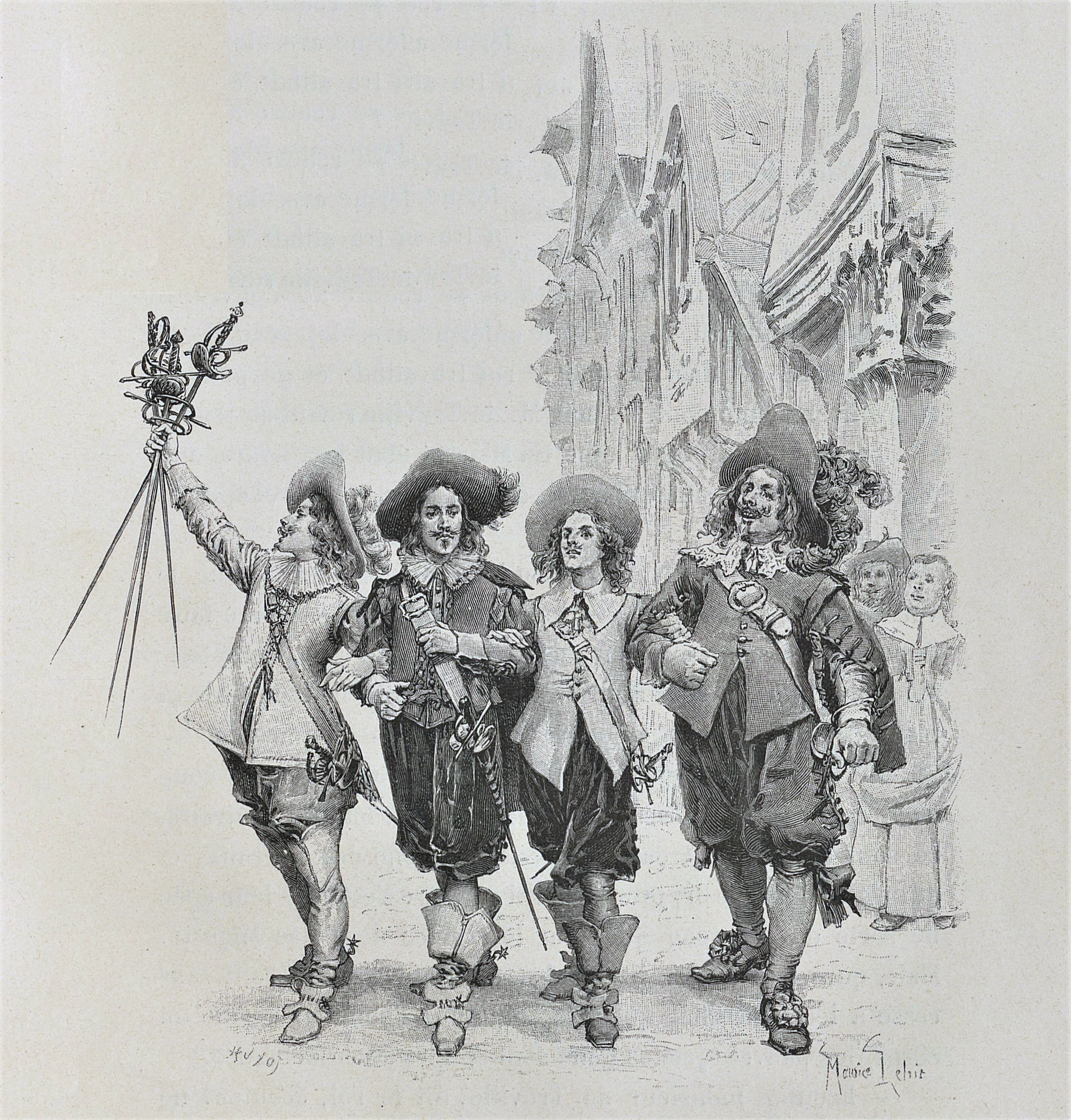
3 Mus(Mass')keteers (& d'Artagnan)

Image by Maurice Leloir, 1894

The Complete People's History

At Pajamas Media.


Blogger analysis & commentary: I read it all the way through! Honest!

Happy 4th!

Stark Realities - Peace Possible

From the article in Instaurare – The Chistendom College Update (July 2007):
Benedictine priest and Professor of Anthropology at St. Vincent's College Reverend Mark Gruber, OSB, delivered a talk entitled Islam Among the Nations at Christiandom College on Monday, April 2, before a crowded auditorium.

"Honest, self-respecting dialogue is what we need in communicating with the Muslim nations," Gruber said. "When the religion of Islam proposes a way of life, it does not mean the same thing that Christianity or Judaism mean. Islam proposes a nation -- a state -- a constitution -- when it proposes a way of life."

According to his vast research on the matter of Islam and its followers, Gruber believes that Muslims cannot be citizens of another nation, for they belong to the nation of Islam. The Muslims who try to spiritualize the teachings of the Koran are a very small minority, less than 1%. The message of the Koran is realized in an earthly state.

Gruber received a Masters in Anthropology and a PhD in Anthropological Sciences from the State University of New York. His anthropological studies in the religion of the Middle East have helped establish him as a nationally circulated spokesman regarding the culture of Islam. He has authored Journey Back to Eden: My Life and Times Among the Desert Fathers.

"The mainstream media likes to paint a picture that Islam is peaceful and that it is just extremists who hold this point of view," he continued. "But that simply is not true. While I was working on my Doctoral Dissertation, I spent a year in Egypt and other Muslim countries. During that time I got to see first-hand what the Muslim children were learning. And it was pretty enlightening! Parents would teach their children songs about killing the infidel -- songs about death and destruction. Cars, with loud speakers attached, would drive through the streets repeating the message, 'Let their women be raped, their men be killed, and their children enslaved.'"

"To be able to accurately judge a religion, we have to pay attention most importantly to what it teaches its children, not to what it says to the outside world," Gruber said. "No progress will be made unless we speak to each other with self-respect and honesty. There is hope for peace, but we must face the facts and use common sense."

Okkayy

Flying Humanoids ...?

Taxonomy of Gender Confusion

Gay No More
From Dawn Eden by way of the Curt Jester, a noted leader and former editor in chief of Young Gay America, Michael Glatze relates in his own words the way that a relationship with God -- a kind and forgiving God at that -- started him on the path away from homosexuality. Glatze:
Poland, a country all-too familiar with the destruction of its people by outside influences, is bravely attempting to stop the European Union from indoctrinating its children with homosexual propaganda. In response, the European Union has called the prime minister of Poland "repulsive."

I was repulsive for quite some time; I am still dealing with all of my guilt.

As a leader in the "gay rights" movement, I was given the opportunity to address the public many times. If I could take back some of the things I said, I would. Now I know that homosexuality is lust and pornography wrapped into one. I'll never let anybody try to convince me otherwise, no matter how slick their tongues or how sad their story. I have seen it. I know the truth.

God gave us truth for a reason. It exists so we could be ourselves. It exists so we could share that perfect self with the world, to make the perfect world. These are not fanciful schemes or strange ideals – these are the Truth.

Healing from the sins of the world will not happen in an instant; but, it will happen – if we don't pridefully block it. God wins in the end, in case you didn't know.

Tuesday, July 03, 2007

"Silver Ships" and Mayan Apocalypse

Similar to the UFO phenomenon that Aramis posted about in Look, Up in the Sky... Happy 60th Anniversary, the New York Times Sunday Magazine ran a story called, "The Final Days – Is the New Age Apocalypse Coming Round at Last?"

The tipping point apparently is based on the Mayan calendar which ceases in 2012. Well, it doesn't cease cease. Rather, "the Maya conceived of history not as the linear passage of time but as a series of cycles -- they called them 'world age cycles' -- that would repeat over and over."

A guru of the 2012 doomsday prediction is José Argüelles, with his Foundation for the Law of Time. Argüelles states, "The post-2012 world will be a world of universal telepathy." He has moved to New Zealand to prepare for the transition, and recently has been calling himself Valum Votan, Closer of the Cycle (this is in the New York Times!). "There will be a lot fewer of us, with simple lifestyles, solar technology, garden culture, and lots of telepathic communication." As for those who have not evolved spiritually, well, Argüelles predicts that they will be taken away in "silver ships."

Argüelles and others in the article are called "the Gnostics of our time," by Prof. Anthony Aveni, archeoastronomer and professor at Colgate University.

Now, what are we to make of all this? Why this quirky interest in what feels similar to concentrating on "when the moon is in the seventh house, and Jupiter aligned with Mars..." interest in the dawning of "The Age of Aquarius?"

Robert Hamerton-Kelly has noted that when the sacrificial cult at the heart of every (fallen and sinful) human culture begins to lose its momentum and gravitational pull, capable of keeping that culture coherent psychologically and socially, two things notoriously take place regarding the kind of victims on that culture's altar of sacrifice (didn't you know it still takes place? Really?). (1) Either the victims must become more prestigious, or (2) the number of victims increases: regicide or genocide.

Looking at the 60's, one remembers who was assassinated: John F. Kennedy (president), Martin Luther King, Jr. (prophetic, charismatic leader for vast numbers of Americans), Robert F. Kennedy (presidential candidate). So far, Hamerton-Kelly makes a point. But what of his other notion, genocide? Between 1965 and 1980, murder rates doubled, while rates for aggravated assaults skyrocketed by 165 percent in the same time period. And, the unseen, voiceless victims of abortion go unheard and unprotected by law to this moment. (One might add, the soldiers and civilians killed on the exported altar in Iraq, structurally speaking.)

Loopy apocalypticism aside, in my opinion, we are in a gravely serious cultural time that René Girard calls the "sacrificial preparation." His mimetic theory is an asset of great import to the Church in diagnosing the sin of the world. And, again in my opinion, for those who do not wish to cave to quirky end-of-the-world nuttiness on the one hand, or give a free hand to atheistic social science drivel on the other, mimetic theory helps us understand cultural melodrama and sacrificial events in ways that, at the very least, thematize the sin at work around us and our loved ones. More to come on this ... Oh! Did I mention that the Maya practiced human sacrifice? You probably knew that.

The Target of the Terrorists - London

Via Gerald Augustinus' ”The Cafeteria Is Closed”, Christopher Hitchens points out a disturbing fact about the non-bombings in London.

Monday, July 02, 2007

Link to Get Dawn Eden's Talk at Chesterton Conference


Here is just a little post from the Chesterton Blog site on Dawn Eden's talk at their conference last month.

To get a copy of her most excellent talk, I highly recommend it, you can order online here.

We are anxiously awaiting news about Dawn's first day at her new job as Cardinal Newman Society’s first Director of its new Love and Responsibility Program. For more information about the Love and Responsibility Program link here.

We are wishing you the very best and we know you will do a great job.
By the way, the suave and debonair gent sitting next to Dawn is our very own Athos. Nice smile there Ath.

The Crisis of Distinctions

I just read Porthos' suggested article, then I listened to this (click on the second song, "I Was Just Flipped Off by a Silver-Haired Old Lady with a 'Honk If You Love Jesus' Sticker on the Bumper of Her Car"). I ... I just don't know (pulling at hair). The cognitive dissonance is just too much to bear. Christians sin? Aarrrggghhh! [HT: Mark Shea]

The Culture Wars Are Dead. Long Live the Culture Wars.

??

Well, I dunno. Make of it what you will . . .

Look, Up in the Sky... Happy 60th Anniversary

July 2nd, 1947 -- the phenomenon of "flying saucers" got its big push when something crashed in the desert near the military base in Roswell NM. We are still tracking those strange incidents 60 years later.

Read here

We know that there is more to this life and so we keep searching, mainly in the wrong places...

This part about the test dummies struck a nerve in me as I was born in Roswell during these dummy sitings...

These tests ran from 1954 to 1959 in New Mexico, and the U.S. government suggested that sightings of these dummies might have been the root of stories about humanoid aliens, with people mistaking the dates after so many years, and erroneously linking what they'd seen with the 1947 story of a UFO crash.
But we got to ask ourselves...


So what is it about UFOs that continues to excite our imaginations? To some people, the subject has become almost a religion and perhaps that gets to the heart of it. Those who study the subject are on a quest not just for the truth, but for meaning. It's a search for the answer to one of the most fundamental questions we can ask - are we alone?

Dangerous Dads of Boys

Recently, I purchased a copy of Hal Iggulden's Dangerous Book for Boys for my 10-year old. It has plans for tree houses, knot-tying, and even a section on grammar. Iggulden has a great essay in the Washington Post entitled, ”In Praise of Skinned Knees and Grubby Faces." And, from The Weekly Standard, Boys Will Be...
...pleased by this garden of earthly delights
.

I am fortunate to come from an era and place similar to that of Iggulden, and to share the experience of having a father, like his, who could fix nearly anything, pinched pennies and lived within a family budget (a la The Great Depression), and could make a toaster shine and last for decades. In his retirement village apartment, he still has a workbench in a back room, replete with an iron vice/anvil (!). At 87, he is my compleat man.

What prompted this post, however, was something that the Musical Monk said in a comment on Aramis' review of Evan Almighty. "After the flood, all the colors came out -- Sir Bono," says he. Hmmm, colors came out ... Colors came out. Aha! -- Calvin's Dad! thinks I.

Dads can -- and should be seens, perhaps, by sons -- as "dangerous" too. Caveat -- Not in a sacrificial, abusive, fearful way. Nope. Rather, dangerous as in knowing a few things, because the "Old Man" or "Gaffer" (as Sam Gamgee calls his father) has been around the block a few times. He's been through the School of Hard Knocks. He is a survivor.

And we see perhaps the greatest exemplar of the art of fatherhood in Calvin's Dad. Not perfect (see illustration above), but capable of helping Calvin not to be too "cocky" and to see the wonders of existence. In the linked conversations with Calvin, note especially When the world was still black and white. You go, Dangerous Dads ...

Sunday, July 01, 2007

Prayers, Please

A long-time sister-friend from my Protestant pastoring days, Kathi, has felt the pull that Chesterton describes (below) upon a person by the Catholic Church. She has recently accepted a full-time office position at a Catholic Church. Please keep her and her family in prayer as she discerns God's call and will for her. Thanks!

Chesterton: “...Truth is a magnet, with the powers of attraction and repulsion ... The moment men cease to pull against [the Catholic Church] they feel a tug towards it. The moment they cease to shout it down they begin to listen to it with pleasure. The moment they try to be fair to it they begin to be fond of it. But when that affection has passed a certain point it begins to take on the tragic and menacing grandeur of a great love affair ... When he has entered the Church, he finds that the Church is much larger inside than it is outside.”

Day - by - Day from the Magnificat

Thanks to Doctors of the Catholic Church

Putting Our Hand to the Plow

For the man of the world, life is but a space to be got over as slowly as possible, by the pleasantest road; but the Christian does not regard it in such a light. He knows that every man is the vicar or Jesus Christ, to labor by the sacrifice of himself for the redemption of humanity; and that in the plan of this great work each has a place, marked out eternally, which he is fee to accept or refuse.

He knows that if he voluntarily deserts this place which Providence offers to him in the ranks of useful beings, it well be transferred to a better than he, and that he him himself will be abandoned to his own guidance in the wide and short way of egotism. These thoughts occupy the Christian to whom his predestination is not yet revealed; and, convinced that the surest way to ascertain it is to desire to accomplish it, whatever it may be, he keeps himself ever ready to accept the appointments of God’s will.

He despises none of the functions necessary for the Christian republic, because in all may be found three things on which depends their real value – the will of God which imposes them, the good which results from their faithful exercise, and the devotedness of heart of which they are confided. He even believes firmly that the less honored are not the less high, and that the crown of the saints never comes more directly from heaven than upon a poor man’s head, grown gray in the accepted humiliation of a laborious calling. Little does it matter to him, then, where God may appoint his place; it suffices for him to know that its is his will.
- Father Jean-Baptiste Henri Lacordaire ( + 1861) was a great Dominican preacher who refounded the Order of Preachers in France after the French Revolution.


He (the Christian) knows that every man is the vicar of Jesus Christ. WOW! From the CCC, "vicar" means one who stands in for or acts for another. I love that and a different way of saying - we are to be Christ for one another.

Evan Almighty - The Meaning of the Flood


"...lot of people didn't get the point of the story. They think it is about God's wrath and anger...they love it when God gets angry... "

"...sounds like an opportunity. If someone prays for patience, do you think that God gives them patience or does He give them the opportunity to be patient? If one prays for courage does God give them courage or the opportunity to be courageous? If someone prays for the family to be closer do you think God actually wants them to have warm fuzzy feelings or does He give them opportunities to love each other?" -- Al Mighty

This scene didn't make any the trailers yet I thought it was perfect to play here in our blog.

Two Thumbs Up. Going in, I had a good feeling about this movie yet at the same time I had braced myself for disappointment. We were NOT disappointed as we walked out of the theater with smiles and, and well, joy. Great family movie. Morgan Freeman is great in the role of God.