Monday, June 18, 2007

Pope Benedict XVI in Assisi - 800th Anniversary of the Conversion of St. Francis

Benedict XVI delivers a great message to 25,ooo youth gathered in Assisi yesterday.

Pope to youth: be, like Francis, in love with Christ and history’s protagonists

Dear young people, you have reminded me of some of the pressing issues for youth today, of your difficulties in building a future for yourselves and above all of your strained efforts to discover the truth. In the account of Christ’s passion we find Pilates question: “What is the truth?” (Jn 18,38). It is a question which resounds widely throughout modern day culture. The Gospel indicates Christ as the truth: God’s truth and man’s truth. We risk spending our entire lives deafened by the chaos of empty voices, we risk losing his voice among the din, the only voice which counts because it is the only voice which saves. We content ourselves with fragments of the truth, we allow ourselves to be seduced by truths that are only such in appearance. Is it really a wonder, then, that we find ourselves surrounded by a world of contradictions, which, despite the many marvellous things, so often deludes us with its banal expressions, its injustices, and its violence? Without God, the world looses its basis and its direction. Do not be afraid my dear friends, to imitate Francis above all in the ability to turn to yourselves. He knew how to make room for silence within himself, to listen to God’s Word. Step by step he allowed himself to be taken by the hand and guided by God towards a full encounter with Christ, to the point of making it the precious treasure and light of his life. Link to the article.

To read a second of Benedict XVI's message; On Peace, a Call From Assisi link here. And for more photos of what Assisi looked like on June 17, 2007 link here.

Girard, Gans & Imitation in Children

Athos and I touched on GA lightly and briefly in the comment boxes. Not directly related, but there is an interesting and informative article by Richard van Oort in the new issue ofAnthropoetics.

Antioch Closes

The small, liberal arts college famed for establishing policy governing methodology of sexual activity ("May I unbutton your blouse?" "May I touch your br**st?") is closing. Sad, are we?
Antioch College became a rump where the most illiberal trends in education became entrenched. Since it is always easier to impose a conformist ethos on a small group than a large one, as the student body dwindled, free expression and freedom of thought were crushed under the weight of ultraliberal orthodoxy. By the 1990s the breadth of challenging ideas a student might encounter at Antioch had narrowed, and the college became a place not for education, but for indoctrination. Everyone was on the same page, a little to the left of The Nation in worldview.
And so, R.I.P. Antioch College. Nah.

Sunday, June 17, 2007

Solitary Refinement

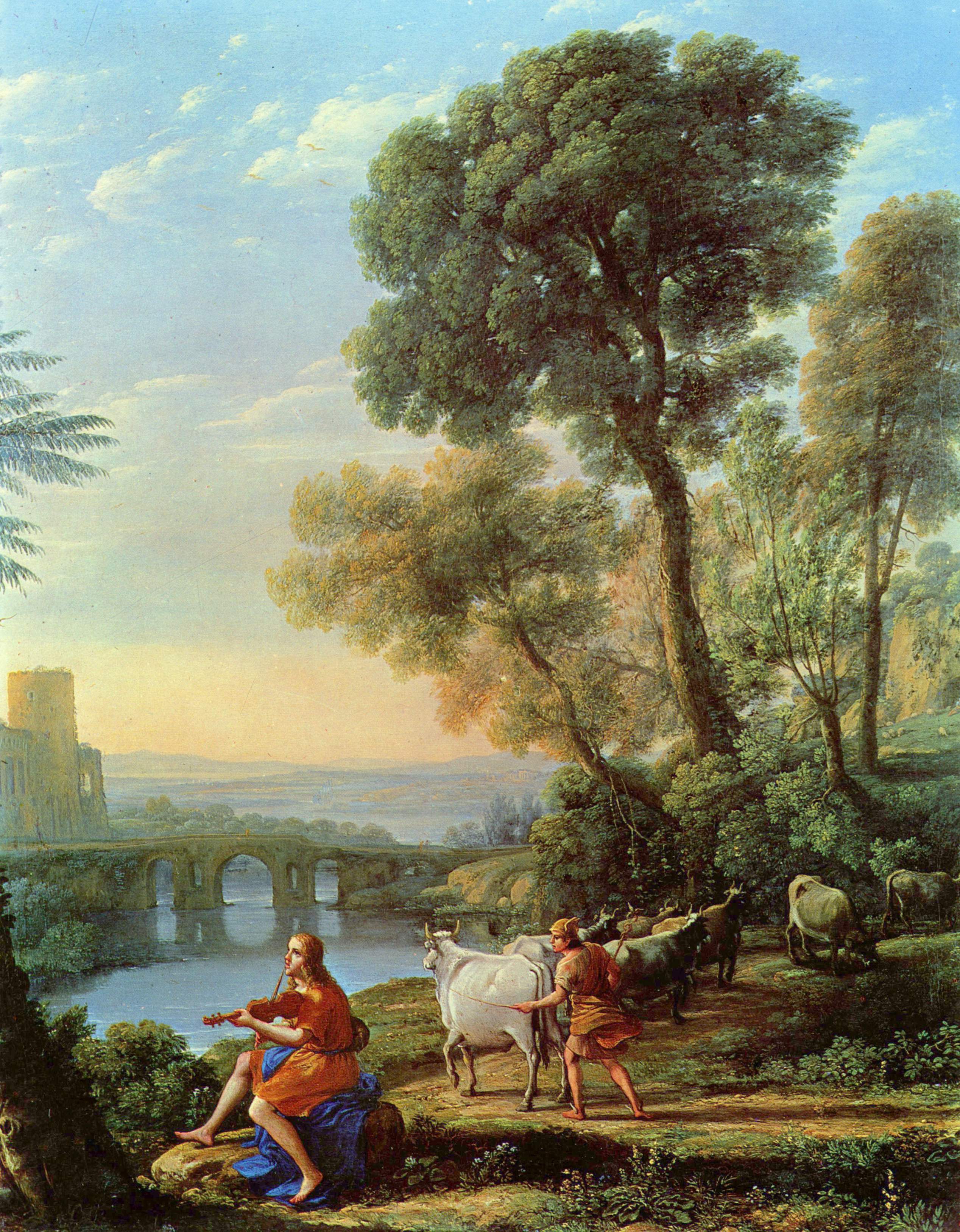
Landscape with Apollo and Mercury (1645) - Claude Lorrain
Leave your Blackberry behind: local retreats offer a serene reprieve from the workaday grind in today’s Washington Post.

The Bane of Western Man

But, Hey - At Least I'm First! Aren't I the Winner?

Fjordman once again stuns with insights about Western Man. Analyzing the cause, say, of 9/11, he observes that,
The Canadian writer Naomi Klein believes that the terror attacks of September 11th 2001 were caused by Western racism. On the contrary, they were triggered by excessive anti-racism. If you believe the story of Michael Tuoheya, a former U.S. Airways ticket agent, he checked in terrorist leader Muhammad Atta for a flight that day. According to Tuoheya, “I said to myself, ‘If this guy doesn’t look like an Arab terrorist, then nothing does.’ Then I gave myself a mental slap, because in this day and age, it’s not nice to say things like this.” Atta joined three other hijackers and crashed into one of the World Trade Center’s towers in New York City.

Modern Westerners are increasingly unwilling to risk our lives for anything, but we are willing to die for anti-discrimination any day. Anti-racism is the new God, an angry God requiring your unquestioned submission and if necessary death — a bit like Allah, incidentally.
Regarding Western Man's compulsion to be "first" at any and everything:
The Western man was the first to create parliamentary democracy, the first to reach the North and the South Pole and the first to travel to the Moon. He always likes to go where no man has gone before him. The sad thing is that there is now so little unchartered territory, so few boundaries left to breach. What to do? Well, embracing organized national suicide is something no man has ever done before, presumably for very good reasons. The Western Man smells an opportunity to once again lead mankind into unchartered territory, and boldly seizes it. He may not be sensible, but at least he’s first, and to the Western Man, that is what matters above all else.
Fjordman's analysis is not informed by Girard's mimetic theory, yet it is clear that he sees what Girard points to as a key element of a sacrificial preparation; namely, the breaking down of distinctions, of mores, of prohibitions that lead a society even further into the abyss of cultural chaos:
It is possible to view the history of the West as one of freeing oneself from the constraints of the past, and of granting equality to ever-expanding circles of people, starting with universal suffrage for men, later for women, then equality for all ethnic, religious and sexual subgroups and eventually even for non-citizens and enemies. The West has led the world in innovation for centuries. Yet perhaps this disposition, which has been the Western Man’s greatest strength, can also be his curse. Perhaps he sometimes breaks down restraints that are needed, and insists on equality where no equality naturally exists. His self-image has been to question tradition on every level, to always move forward. The Western Man has freed himself from the restraints of his traditions, his religion, his culture and the memories of his past. More recently, he has also rid himself off his sex, his skin color, his very physical being. He is, in essence, nothing, and is thus constrained by nothing. The Western Man is thus free at least.
Fjordman is right, from a non-Christian point of view. So let us end by clearing the air with some much needed tonic hope from a master of the 20th century who also greatly loved all things of the broad, clear expanses of the north, J. R. R. Tolkien.
In a letter to son Michael he said,
This is a fallen world ... The world has been 'going to the bad' all down the ages. The various social forms shift, and each new mode has its special dangers; but the 'hard spirit of concupiescence' has walked down every street, and sat leering in every house, since Adam fell ... I put before you the one great thing to love on earth: the Blessed Sacrament ..... There you will find romance, glory, honour, fidelity, and the true way of all your loves upon earth, and more than that: Death: by the divine paradox, that which ends life, and demands the surrender of all, and yet by the taste (or foretaste) of which alone can what you seek in your earthly relationships (love, faithfulness, joy) be maintained, or take on that complexion of reality, of eternal endurance, which every man's heart desires. [6-8 March 1941]

Woody Allen Interviews Billy Graham

In honor of the passing of Ruth Graham. These clips (H/T Instapundit several months ago) from a more civil era!

Part 1


Part 2

Saturday, June 16, 2007

GKC - Truer Today than When He Said It

G. K. Chesterton connects the dots concerning Sex, Life, and Property.

Dreadnought Redux

John Heard - aka Dreadnought - is, as Porthos repeatedly tells us, one of the most forthright crusaders for the Church's teachings on human sexuality. In a post on an article from Commonweal here (warning: some disturbing "eye candy"), he decries the succumbing of so many who want to subvert the Church's teachings to mere human predilections and whims (read: Gnostic desires and disordered passions):
(This is nothing except) a telling example of what Catholicism would look like if it were a bastard religion that worshipped a new god known (or more likely unknown) most often via personal experience. In short, it is the same Christianity-lite and near neo-Pagansim we've been fed by sixties-era liberals for decades.
This from a self-avowed homosexual ("gay conservative") who deems John Paul II the Great's Theology of the Body the "summa" of the 21st century. You go, Dreadnought.

Friday, June 15, 2007

"Girl on a Rock" (+ Truth & Goodness)

Maxfield Parrish - (1870 - 1966)

And, while you are looking at beauty, read Father Cantalamessa's homily on Conversion and the Pearl of Great Price.

Crisis of Distinctions

Over at Vox Nova, Katerina Marie posted news about the Hamas/Fatah fighting happening in Gaza. The comments contain the usual "news analysis" one comes to expect from the respective liberal / conservative arenas: it's the Bush/Cheney Regime's fault; no, it's the UN's ... Sigh.

None of this addresses the problem at the "tectonic level," if you will. For this, one must turn to the unique revelatory witness of the canonical New Testament for the deepest anthropological underpinnings of human culture, human interactions, human violence. And, in the service of the Magisterium of the Church, no one has explicated the ramifications of biblical understanding in anthropological terms better than René Girard. If you don't know a thing about Girard or are convinced that your mentor/interpreter of human life is much better than Girard, c'est la vie.

This blog is not an apologetic, but a forum for "Squaring the Circle of Our Rad Trad Catholic Girardian Conserberalism." So, in the words of Father Goose, if you don't happen to like (us), pass (us) by.

Hamas and Fatah, structurally, are rivals. To the observer, one would have a difficult time discerning many differences in them. Both lay claim to leadership via authority from the people and, more importantly, from Allah. Both see Israel an abomination to Islam. Both strive to observe Shariah, with subtle and slight differences that are hardly noticeable. And that is the issue: a crisis of distinctions. That which causes conflict is not difference but similarity. As Girard notes:
Sometimes the cause is internal -- political disturbances, for example, or religious conflicts. Fortunately, we do not have to determine the actual cause. No matter what circumstances trigger great collective persecutions, the experience of those who live through them is the same. The strongest impression is without question an extreme loss of social order evidenced by the disappearance of the rules and "differences" that define cultural divisions. Descriptions of these events are all alike ... We should not be surprised since all the sources speak endlessly of the absence of difference, the lack of cultural differentiation, and the confusion that results. For example the Portuguese monk Fco de Santa Maria writes in 1697:

As soon as this violent and tempestuous spark is lit in a kingdom or a republic, magistrates are bewildered, people are terrified, the government is thrown into disarray. Laws are no longer obeyed; business comes to a halt; families lose coherence ... Those who were burying others yesterday are themselves buried today ... No pity is shown to friends since every sign of pity is dangerous.
What terrifies the onlooker is that one worries with a not-insignificant fear that what is happening in Gaza (or Sarajevo not so many years ago) may happen in Paris, in Madrid, in New York, or Dearborn before long. What happens when ad-hoc "priests" (aka "street youth") light very dry tinder near me? Thus, Girard lays open the anxieties of the post-modern western person who is beginning to realize with Girard that the inchoate fall-back religion of the human race is not a sweeping, Rousseau-esque "Co-Exist" naïveté of so many New Age bumper-stickers, nor is it the Golden Rule (that is a hard-fought value as every Christian parent knows).

Rather, the natural and fallen human religion is bloodthirsty, violent, and sacrificial -- other, not self-. The anthropology of the Bible knows this. The deposit of the faith safeguarded and dilegently taught by Mother Church knows this. Modern westerners have forgotten or rejected this, and those not under the influence of Christ's teaching never knew this.

The "crisis of distinctions" in Girard's stunningly accurate analysis is the world we now live in. How we shall address this crisis when it draws near to us is the task given us to perform.

Wednesday, June 13, 2007

Walker Percy @ Notre Dame

Whacked - Lives 18 Months

This reads like something I vaguely remember from the Desert Fathers. Or was it Washington Irving?

[HT: Shea]

I once was lost, but now am found - Feast Day of St. Anthony of Padua


These words from John Newton seem to reflect a devotion similar to what many might pray to St. Anthony. We know Anthony as the saint to pray for lost items, yet he was gifted in many areas of life. It was by chance that Anthony was asked to preach for the friars at an ordination and it was then that they discovered one of his great gifts, that of preaching the Good News. Francis soon wrote to Anthony:
I Brother Francis send wishes of health to Brother Anthony, my bishop. It pleases me that you teach sacred theology to the brothers, as long as in the words of the Rule you "do not extinguish the Spirit of prayer and devotion" with study of this kind.
“(N)ot to extinguish the Spirit of prayer and devotion with study”…within this admonishment comes the view that in everything we teach we present it fully in the Spirit of prayer and devotion. Boy, how we have lost that in our schools, universities and, I am afraid, in many of our families. Let us lift up our prayers to St. Anthony today asking for help to see and speak everything through the Spirit of prayer and devotion.

Guys check out the basilica of St. Anthony. Click here to see more on St. Anthony

Why Shop @ a Farmers' Market

Narnia in the Meantime

A visitor @ Mark Shea's blog lifted up an apparent Catholic Narnia Fan Website (not that one needs be Catholic to love the land of us Puddleglum types).

Village Atheists

There are several prominent authors presently promulgating books regarding what they consider to be the idiocy of believing in God. Since it is a time-honored practice to consider one's opponent as a valuable voice in the low tavern of life, the Three Massketeers choose not to dismiss their wrong-headed opinions out of hand, much the way Professor Ransom considered MacPhee an invaluable member of the group gathered at St.-Anne's-on-the-Hill in Lewis's That Hideous Strength. (Yes, yes, modeled on Lewis's tutor who taught him syllogistic thinking: "I have no opinions!")

As resources, Michael Liccione suggests the follow ways for ”Dealing with Dawkins.”

[Tip: Amy Welborn]

Tuesday, June 12, 2007

The Other Musical Monk


It was inevitable. I mean, somebody had to do this . . .

Saint Eulalia + PRB

St. Eulalia - John William Waterhouse [1885] - The Tate Gallery, London

This painting earned Waterhouse, member of the Pre-Raphaelite Brotherhood, his election as an Associate of the Royal Academy. Waterhouse avoids manipulation by depicting the vulnerability of the dead saint, life "going on," and the ostensible power of the state in a now-peaceful moment after her martyrdom.

Prudentius says that the body of St. Eulalia was shrouded by a miraculous fall of snow when lying exposed in the forum after her martyrdom.

"A Spanish martyr in the persecution of Diocletian (12 February, 304), patron of the cathedral and city of Barcelona, also of sailors. The Acts of her life and martyrdom were copied early in the twelfth century, and with elegant conciseness, by the learned ecclesiastic Renallus Grammaticus (Bol. acad. hist., Madrid, 1902, XLI, 253-255). Their chief historical source is a Latin hymn of the middle of the seventh century by Quiricus, Bishop of Barcelona, friend and correspondent of St. Ildephonsus of Toledo and of Tajo, Bishop of Saragossa. This hymn, identical with that of Prudentius (Peridstephanon, III) for the feast of St. Eulalia of Merida (10 December, 304), was preserved in the Visigothic Church and has reached us through the Mozarabic Liturgy.

"There is no reason to doubt the existence of two distinct saints of this name, despite the over-hasty and hypercritical doubts of some. The aforesaid Quiricus of Barcelona and Oroncius of Merida were present at the tenth council of Toledo (656). The latter had already founded (651) a convent of nuns close by the basilica of the celebrated martyr of his episcopal city, had written a rule for its guidance, and given it for abbess the noble lady Eugenia. Quiricus now did as much for the basilica and sepulchre of the martyr of Barcelona, close to whom he wished to be buried, as we read in the last lines of the hymn. The inscriptions on many Visigothic altars show that they contained relics of St. Eulalia; except in the context, however, they do not distinguish between the martyr of Barcelona and the one of Merida. On an altar in the village of Morera, Province of Badajoz, we find enumerated consecutively Sts. Fructuosus and Augurius (Tarragona), St. Eulalia (Barcelona), St. Baudillius (Nimes, and St. Paulus (Narbonne). The Visigothic archeology of Eastern Spain has been hitherto poor in hagiological remains; nevertheless, a trans-Pyrenean inscription found at Montady near Béziers mentions a basilica dedicated to the martyrs Sts. Vincentius, Iñes, and Eulalia (of Barcelona). Until 23 November, 874, the body of the Barcelona bartyr reposed outside the walls of the city in the church of Santa Maria del Mar. On that date both the body and the tomb were transferred to his cathedral by Bishop Frodoinus. In memory of this act hehe set up an inscription yet preserved in the Muséo Provincial of Barcelona (no. 864); see also volume XX of Florez, "España Sagrada", for a reproduction of the same. Not long before this the martyr, St. Eulogius, having occasion to defend the martyrs of Cordova for their spontaneous confession of the Christian Faith before the Muslim magistrates, quoted the example of St. Eulalia of Barcelona, and referred to the ancients Acts of her martyrdom. Her distinct personality is also confirmed by the existence of an ancient church and monastery in Cordova that bear the name of the Barcelona martyr; this important evidence is borne out by the Mozarabic calendars examined by the learned Dom Ferotin." -- New Advent

Her Feast Day is February 12.

Monday, June 11, 2007

Fearsome, Faithful Living + Part 2

Athos' post Fearsome, Faithful Living + stirred in me a response that turned into something more than a mere comment - so I decided to post it here.

Dear Ath, beware that you and Monk do not fall into some kind of model/rival scandal. Pondering this post left me thinking about 3 great remarks from 3 great teachers:

1) Gil Bailie's comment from The Truth of the Cross tape, "The Gospel is like the Supreme Court. Let’s say that you are going to do something that is going to cost you many millions of dollars; however you are a little anxious that it is somehow against the law, or it might be unconstitutional. You go to the Supreme Court and say that we are going to do this and it is very expensive, is that unconstitutional? The Supreme Court will tell you that they cannot tell you because we cannot give advisory opinions. So they say, go spend your millions and if someone sues you, come back in and then we will tell you. The Gospel is the same way. It answers no idle questions. It answers no questions that are asked for merely curiosity sake. But it does answer questions that arise with urgency, and new questions always arise. When we are moved due to historical situations, because of existential situations, go to the Gospel and ask it, ask the Christ Gospel, to answer our needs, it will answer us, but we will have to come to it with that kind of need." and

2A) Model-Rival. Strictly speaking, if a model is a person in our immediate life setting (parent, authority figure, peer), then he or she is always potentially a rival. Likewise, a rival in this same immediate setting is always basically a model, although this may not be apparent to the subject. The model-rival is associated with an object of desire which the subject wants to obtain, but the important thing is not as much the object as the defeat of the model-rival. Continually putting oneself in situations of rivalry may be exhilarating if one is winning, but losing may lead to extreme depression. The situation becomes a crisis if the person is entrapped in a model-obstacle relationship.

2B) Model-Obstacle. The model-obstacle is someone or something over whom the subject cannot win, or in some cases it would be accurate to say that the subject will not allow himself to defeat the model/obstacle, for to achieve that would be to lose the model. All sorts of self-defeating behavior, including addictions (so well described in Dostoyevsky's writings), stem from this predicament. From the standpoint of the mimetic theory, it can only be understood in terms of the mimetic, interdividual character of human existence. The person in this predicament could be described as stumbling over or being blocked by the skandalon. The skandalon of the Gospels is a an obstacle or stumblingblock (the older meaning of "scandal" in English and French, from the Latin and Greek). The skandalon is associated with Satan. This is seen particularly, e.g., in the Gospel of Matthew. Jesus has spoken of his suffering, death, and resurrection, and Peter rebukes him for saying he will suffer and die. Jesus in turn rebukes Peter: "Get behind me, Satan! You are a skandalon to me... " (Matt. 16:23). That is, "you are a scandal, an obstacle, a hindrance to me." Here Satan, usually named as the personification of the mimetic model-obstacle, is "deconstructed" or "demythologized" in that Jesus uses the name to express the mimetic rivalry that obsesses Peter. Peter wants to identify himself with a worldly winner and in anger he begins telling his master what he can and cannot do. Something quite similar is reported concerning James and John, who ask to be Jesus's chief lieutenants when he comes into his glory (Mark 10:35-45; Matt. 20:20-28).
The preceding is taken from "The Girard Reader," edited by James G. Williams.

and 3) being a follower of the Franciscan way; once Brother Leo asked Francis what perfect joy is? Francis related that if, they, when wet, cold, and muddy, knocked on a convent door, and the porter refused to let them in but drove them away like a couple of thieves, beating them with clubs until they nearly died, "and if we endure all this so patiently, and think of the sufferings of Christ, the All-praised One, and of how much we ought to suffer for the sake of our love of him - O Brother Leo, mark thou, that in this is perfect joy."

Question: Prior to the Protestant rebellion would such wonderings (such as what constitutes legitimate "security" that you and Monk tossed around) have even entered the minds of anyone?

Sunday, June 10, 2007

Fearsome, Faithful Living +

From today's New York Times, what you need to know about what the Koran teaches regarding killing another human being, entitled Permission – The Guidebook for Taking a Life.

In a post, below, Monk from The Wacky Wannabee Musical Monk and I discussed what constitutes legitimate "security". It's only normal if one is exercising any concern for oneself and one's loved ones that we try to size up potential areas of danger ahead, and avoid them (walking in Central Park or on the Washington Mall in deserted, shadowy places sans visible people, etc.). But in reality, it is nearly impossible to take into account all such contingencies.

In C. S. Lewis's second book of his Space Trilogy, Ransom is on Perelandra (Venus, in the Massketeers' Guide to the Galaxy). Lewis tells how his hero made his way through the treacherous caverns of Perelandra: at one moment taking what would appear (if watched by an observer) overmuch caution, at another extreme risks, because he himself could not see but was climbing by feel alone.

In my opinion (in the same way that Saint Paul will occasionally step aside in the Epistles and say, "Now this is my opinion -- Paul" when not proclaiming the Gospel) -- this is Athos speaking now -- we must do three things in the face of such realistic threats:

(1) Not succumb to hate. We must pray for our enemies, as Our Lord commands [Mtt 5,44], and never willingly give in to "righteous" anger. Love [caritas, agape] is a decision. Like top-spin in ping-pong, it takes all the side-spin of evil off the ball served to us. Through God's grace, we choose not to return evil for evil. I will suggest a method for such prayer in the first comment (below).
(2) Exercise legitimate defense. The Catechism of the Catholic Church is clear: "Love toward oneself remains a fundamental principle of morality ..." (Remember, "Love your neighbor as yourself?") and "The defense of the common good requires that an unjust aggressor be rendered unable to cause harm." (Nos. 2264, 2265) This is posited on justice as Saint Thomas Aquinas understood it: to give what is due to God and to our neighbor; namely, what is right for the common good. This is perfectly in keeping with honoring and loving our aggressive "enemy" -- one wants to keep the enemy from carrying out unjust evil and violence, even if the enemy is accidentally injured or even killed in so doing (No. 2264).
(3) And, perhaps the most important point, do not provoke a potential enemy into aggressive and sinful behavior. This is scandal, and constitutes grave sin. Again, the Catechism:
Scandal is an attitude or behavior which leads another to do evil. The person who gives scandal becomes his neighbor's tempter. He damages virtue and integrity; he may even draw his brother into spiritual death. Scandal is a grave offense if by deed or omission another is deliberately led into a grave offense. (No. 2284) "Temptations to sin are sure to come; but woe to him by whom they come!" (Lk 17,1 in No. 2287).
So, as difficult as these days are, Our Lord gives us a viable path through them to Heaven by His grace: in seven wonderful words, prudence, justice, fortitude, temperance (the Cardinal Virtues), faith, hope, and love (the Theological virtues).

And keep your eyes on Jesus! As the old Gospel chorus said: Turn your eyes upon Jesus, Look full in His wonderful face. And the things of earth will grow strangely dim, In the light of His glory and grace. +